Question 14: koala bears in "if-then" form
Rewrite in "if-then" form: Koala bears eat only eucalyptus leaves.
- Find what is being claimed. The sentence restricts what a koala eats; it says nothing about who else might eat eucalyptus.
- So one correct form is: If an animal is a koala bear, then it eats only eucalyptus leaves. Another: If a koala bear is eating something, then it is a eucalyptus leaf.
- Now test a tempting wrong answer: "If an animal eats eucalyptus leaves, it is a koala bear." The original sentence was true, and this is false; possums eat them too. A translation that changes a true sentence into a false one is wrong.
- Use the same check on 15 to 20. Each sentence has one honest "if-then" reading, and the word doing the hiding ("whenever," "in case of," "no") is different every time.
Questions 31 to 33: the Yankees diagram
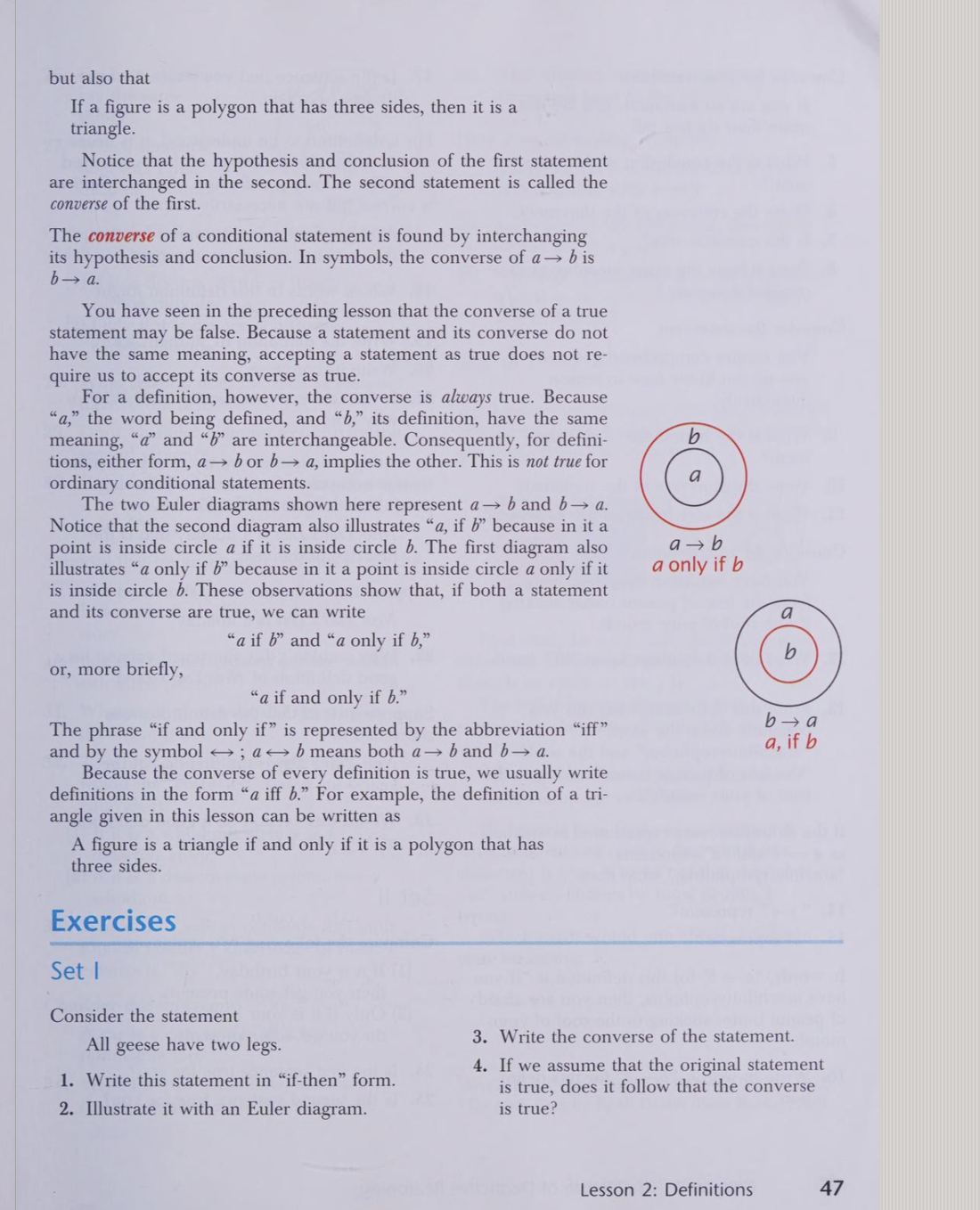
Draw an Euler diagram for "All players for the Yankees make a lot of money." Which of the four statements (a) to (d) does it illustrate, and which are true?
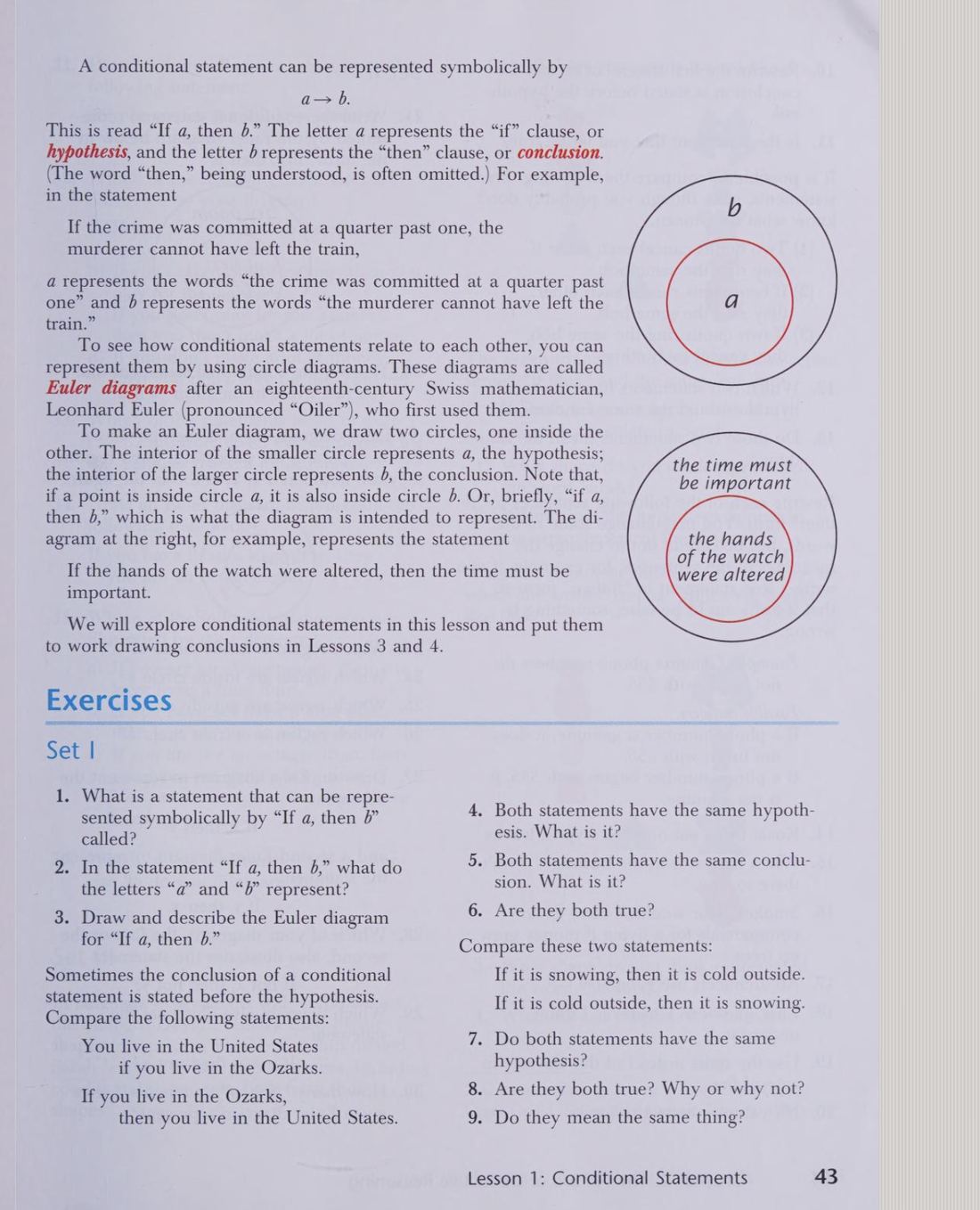
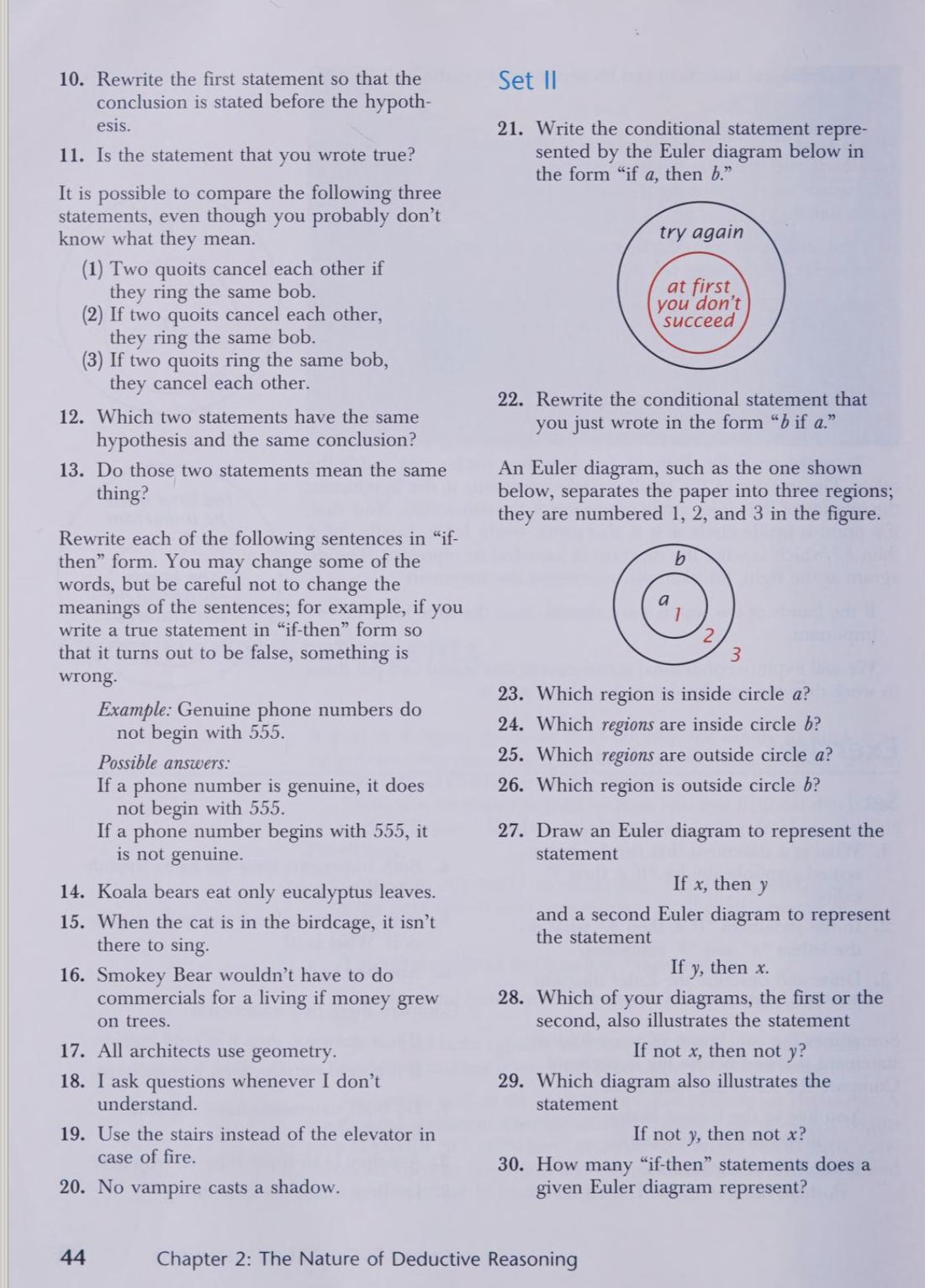
- "All Yankees make a lot of money" is "If you play for the Yankees, you make a lot of money." Hypothesis inside: draw the Yankees circle inside the money-makers circle.
- Test each statement by placing a point. (a) A point in the Yankees circle is in the money circle. Illustrated, and true.
- (b) says money implies Yankees. In your diagram there is room for a point inside money but outside Yankees (a movie star, say), so the diagram does not illustrate it, and it is false.
- (c) says not-Yankees implies not-money. The same movie-star point defeats it: outside the small circle, inside the big one. False.
- (d) says if you don't make a lot of money, you don't play for the Yankees. A point outside the big circle is automatically outside the small one. Illustrated by the same diagram, and true. So (a) and (d) travel together, and that pairing returns on page 47.
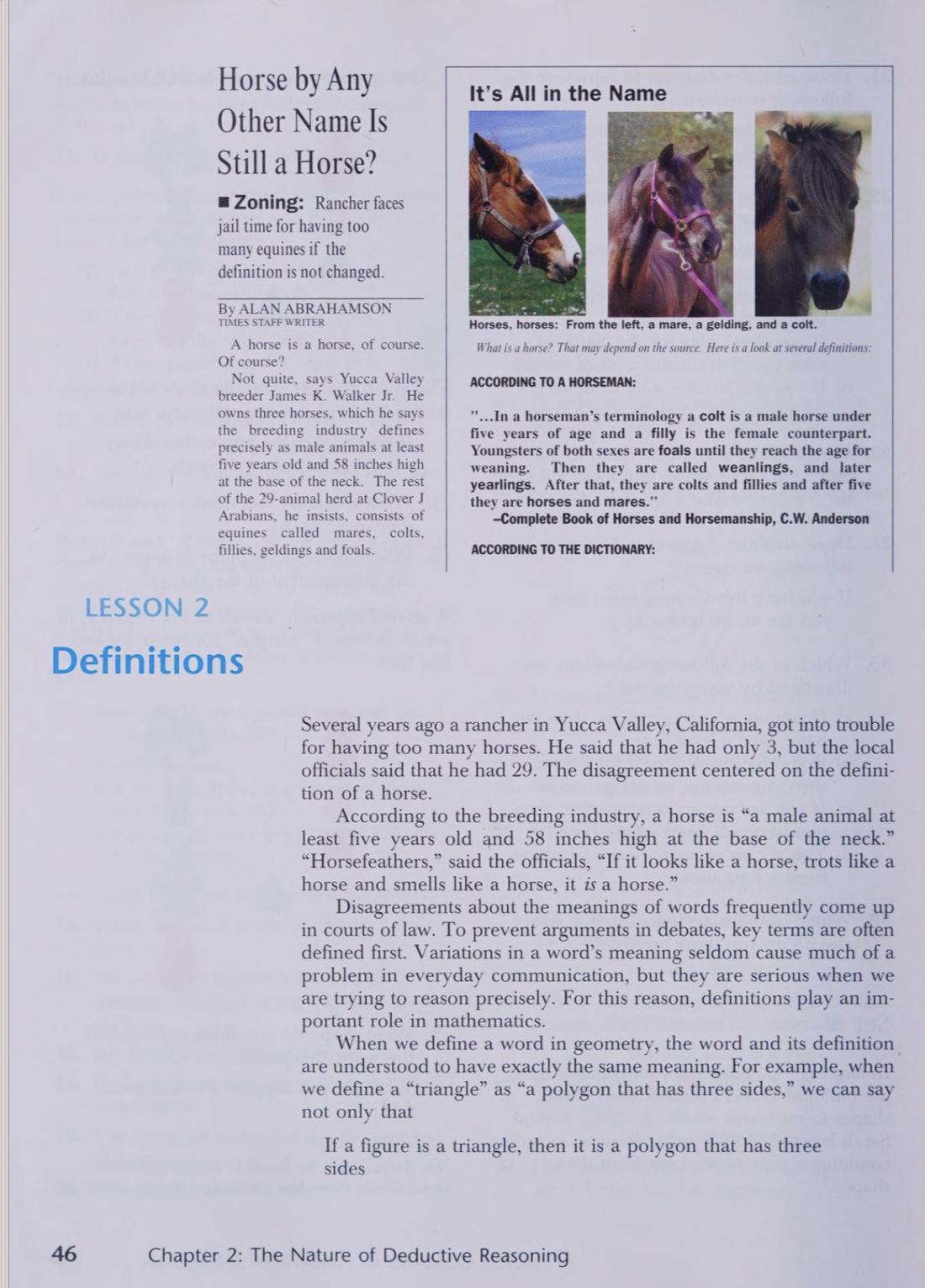
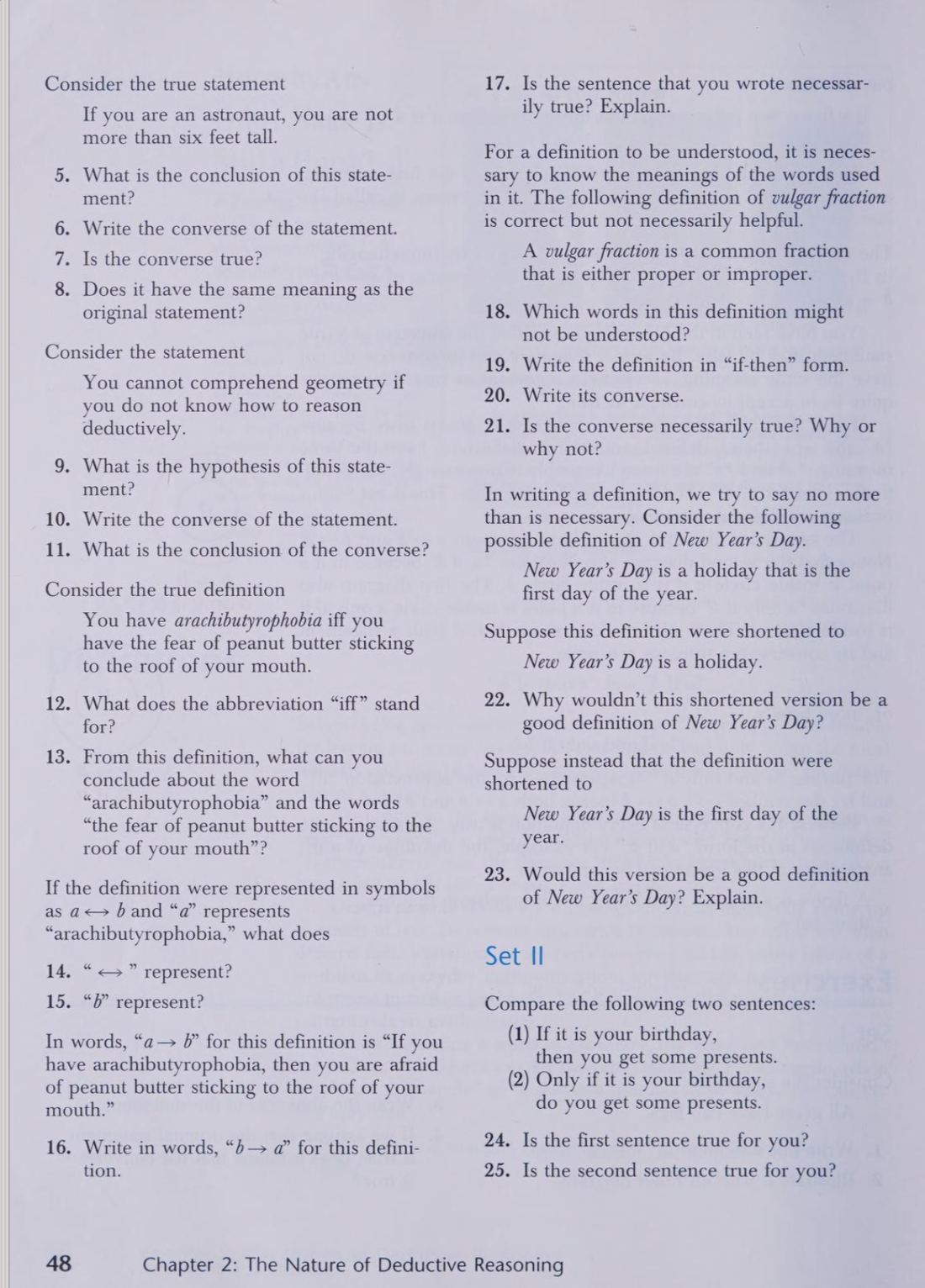
Questions 5 to 8: the astronaut's converse
Consider the true statement "If you are an astronaut, you are not more than six feet tall." What is its conclusion? Write the converse. Is the converse true? Does it mean the same thing?
- Split at the comma. Hypothesis: you are an astronaut. Conclusion: you are not more than six feet tall.
- Converse: swap them. "If you are not more than six feet tall, you are an astronaut."
- Is it true? Find one counterexample: any short person who has never flown. The converse is false.
- So a true statement and a false converse live in the same pair of clauses, which answers question 8: they cannot mean the same thing. Height limits keep people out of the astronaut corps; they do not put people in it.
- Carry the same three moves (split, swap, hunt a counterexample) into questions 9 to 11, where the sentence hides its hypothesis in the middle.
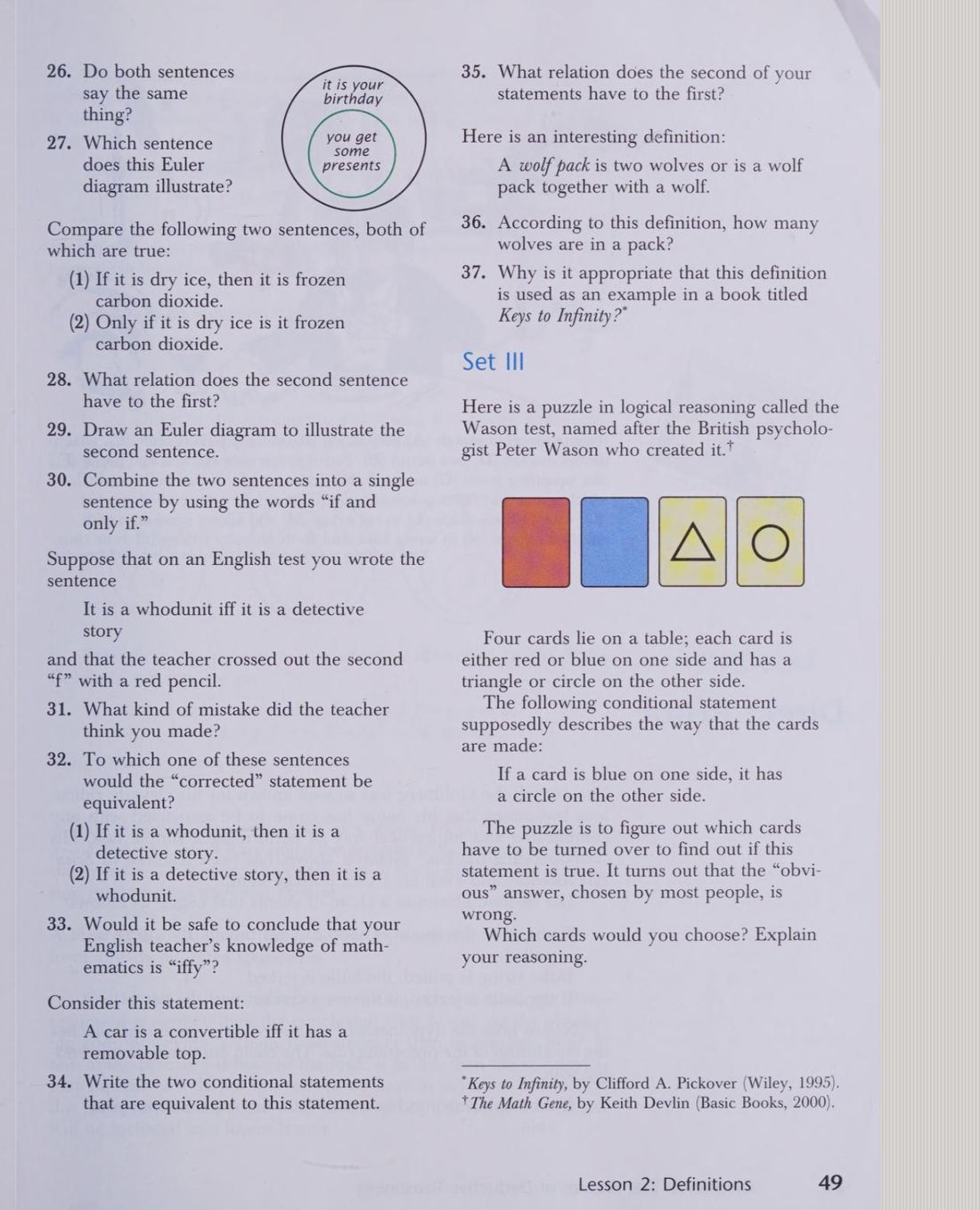
Set III: the Wason test
Cards show red, blue, a triangle, and a circle. Claim: if a card is blue on one side, it has a circle on the other. Which cards must you turn over to test the claim?
- Ask of each card: could its hidden side break the rule? The rule is broken only by a card that is blue on one side without a circle on the other.
- The blue card: its hidden side could be a triangle. Must turn.
- The triangle card: its hidden side could be blue, and a blue-triangle card breaks the rule. Must turn.
- The red card cannot break the rule no matter what is behind it; the rule says nothing about red. Leave it.
- The circle card is the trap. Whatever color is behind it, blue or red, the rule survives; the rule never claimed only blue cards get circles. Turning it is checking the converse, page 47's exact error. Answer: the blue card and the triangle card.
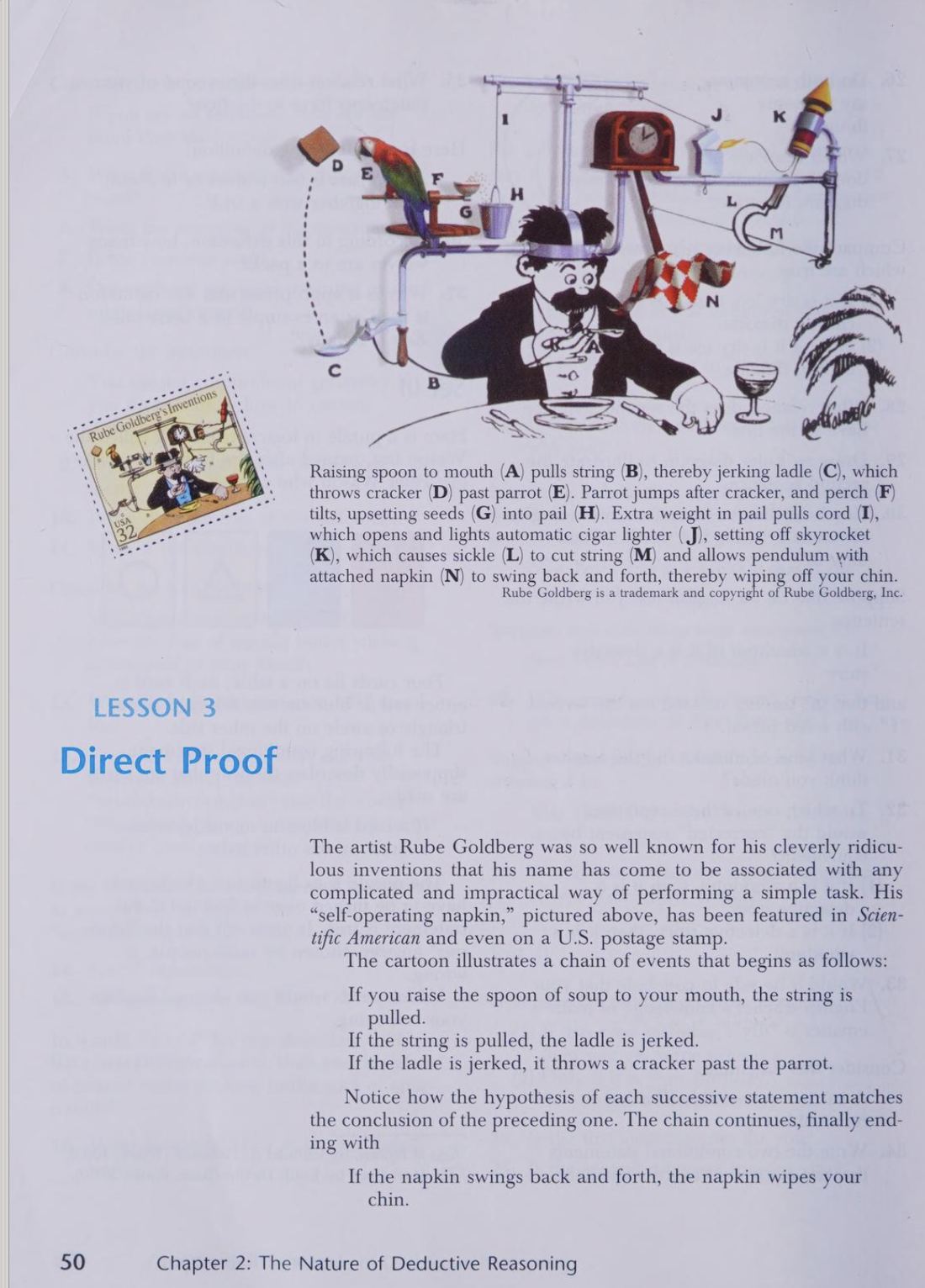
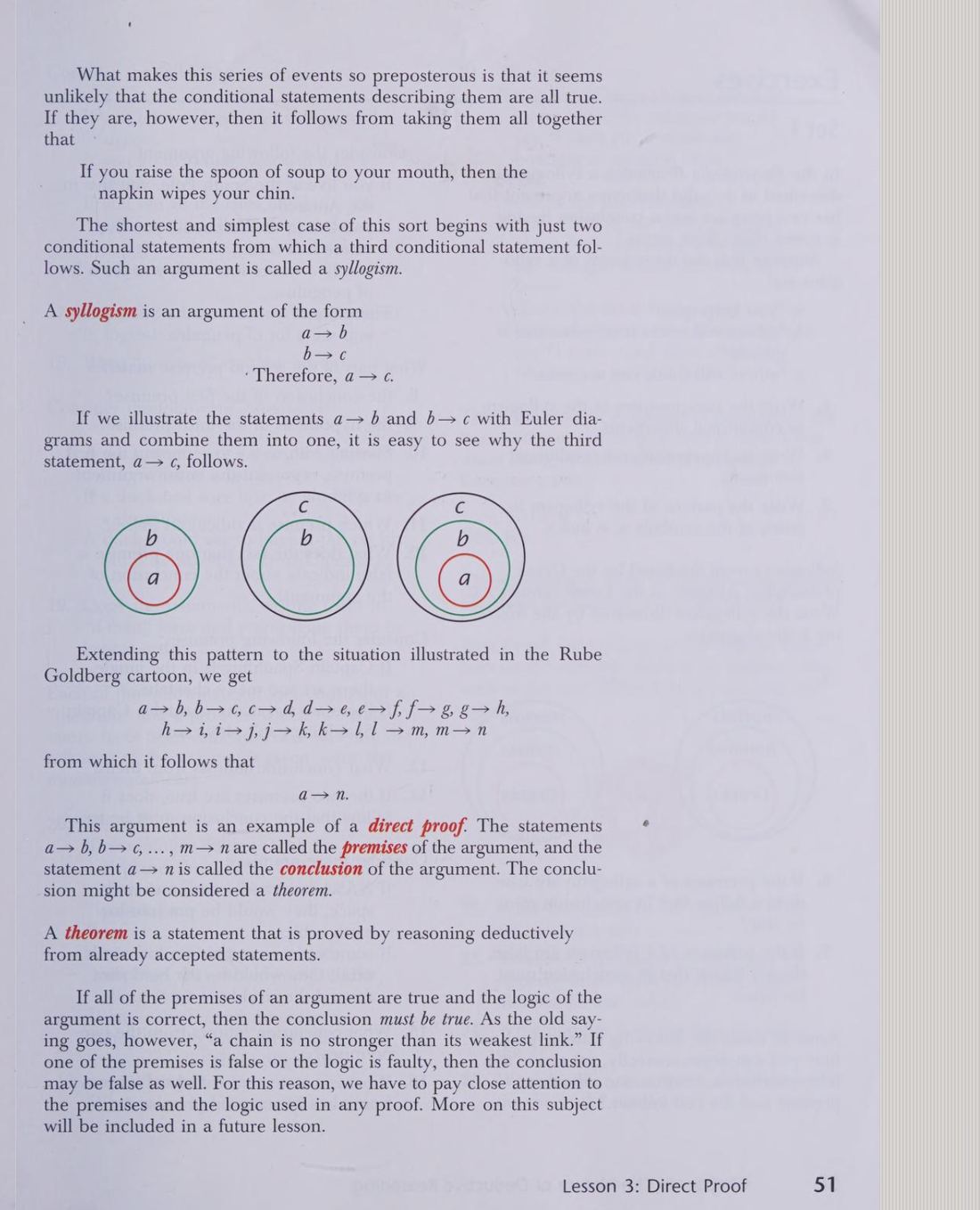
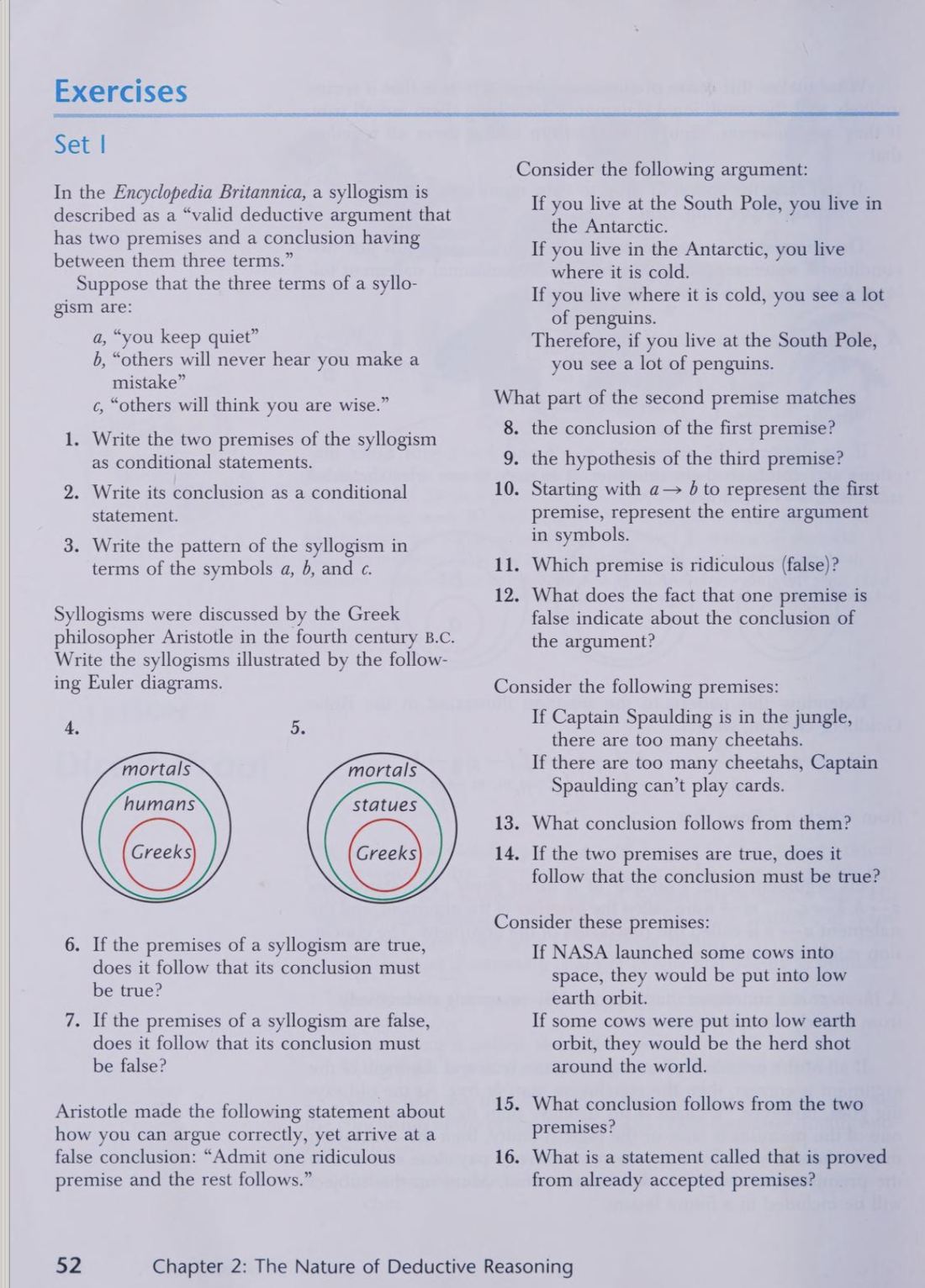
Questions 8 to 12: the penguin chain
South Pole → Antarctic → cold → penguins; therefore, if you live at the South Pole, you see a lot of penguins. Trace the links, write it in symbols, and find the false premise.
- Question 8: the second premise opens with "If you live in the Antarctic," which is the first premise's conclusion. Question 9: it closes with "where it is cold," the third premise's hypothesis. The links interlock exactly as on page 50.
- Question 10: let a be South Pole, b Antarctic, c cold, d penguins. The argument is a → b, b → c, c → d, therefore a → d.
- Question 11: hunt the false link. Cold does not summon penguins; Alaska is cold and has none (penguins live south of the equator). The third premise is the ridiculous one.
- Question 12: one false premise means the argument no longer guarantees its conclusion. It does not mean the conclusion is false; the South Pole does, in fact, have penguins. An unproved statement and a false statement are different things, and that distinction is worth a sentence in your answer.
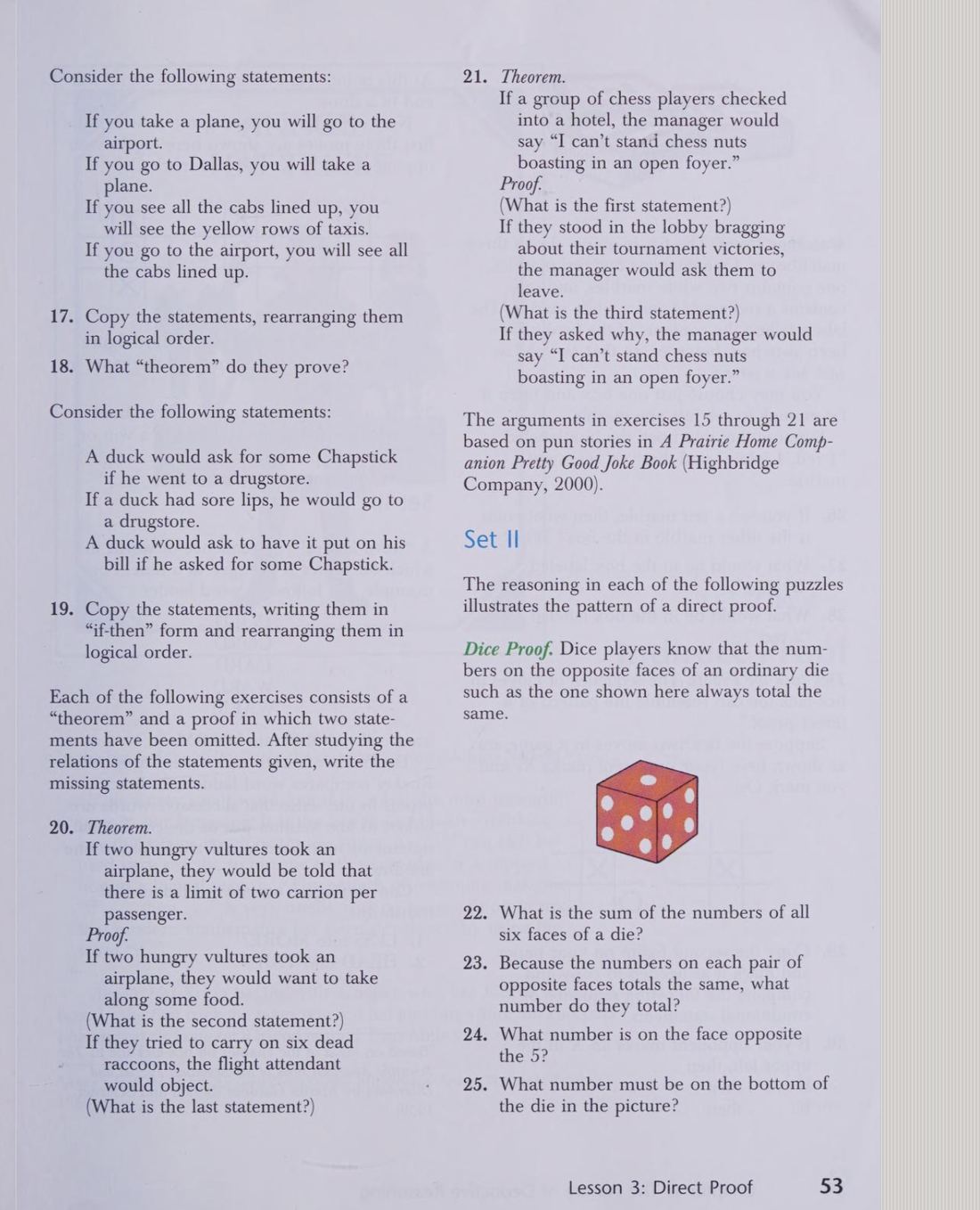
Questions 17 and 18: untangling the taxi chain
Rearrange into logical order: If you take a plane, you will go to the airport. If you go to Dallas, you will take a plane. If you see all the cabs lined up, you will see the yellow rows of taxis. If you go to the airport, you will see all the cabs lined up. What theorem do they prove?
- Find the starting link: the hypothesis that appears in no other statement's conclusion. Nothing concludes "you go to Dallas," so "If you go to Dallas, you will take a plane" starts the chain.
- Now follow conclusions to hypotheses: Dallas → plane, plane → airport, airport → cabs lined up, cabs → yellow rows of taxis.
- Check every seam: each "then" clause is the next "if" clause, word for word. One seam that fails to match means the order is wrong.
- The theorem (question 18) jumps from first hypothesis to last conclusion: If you go to Dallas, you will see the yellow rows of taxis. Say it out loud to collect the pun, then use the same find-the-loose-end trick on the duck in question 19.
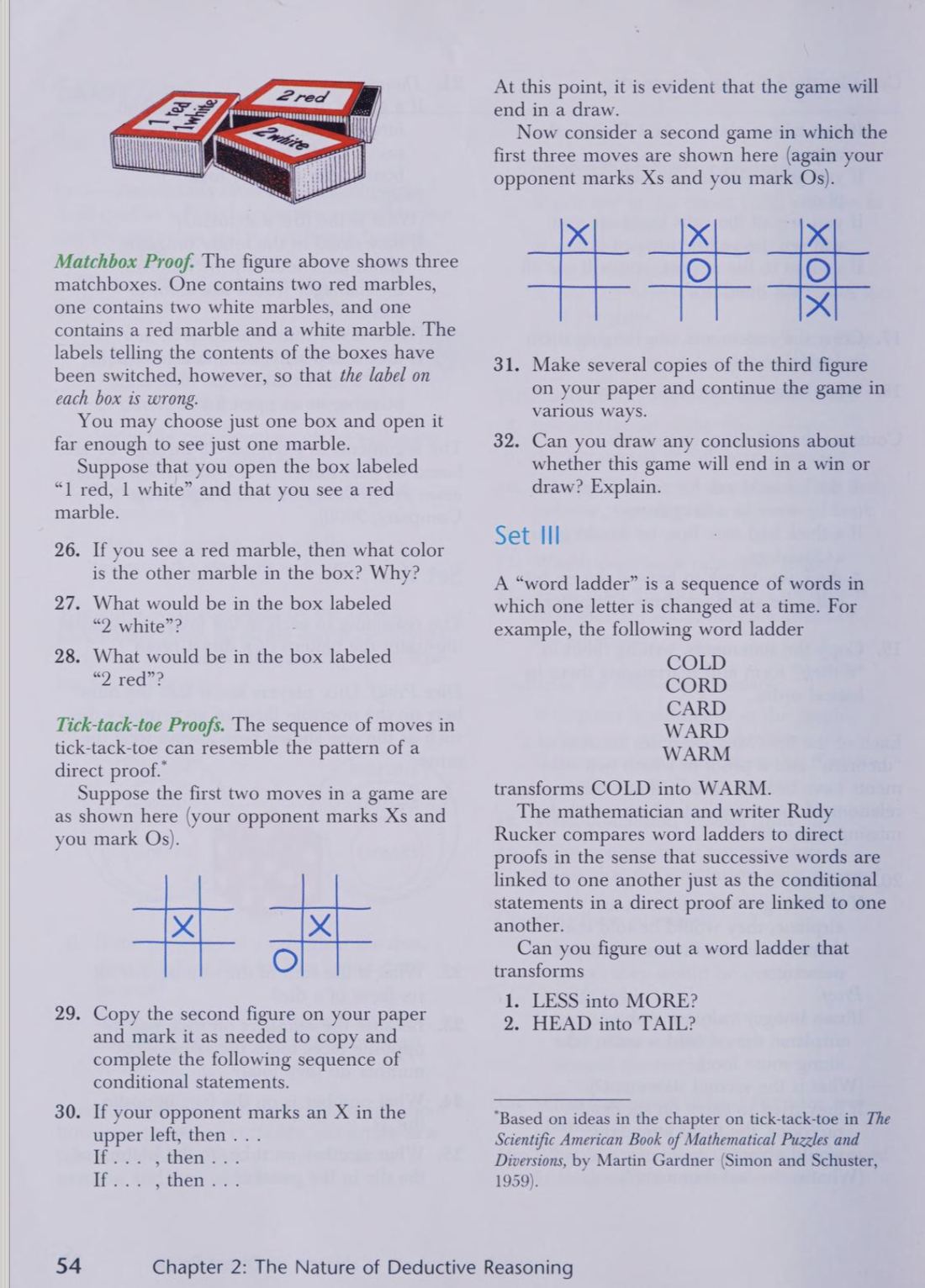
Questions 26 to 28: the matchboxes
Boxes labeled "2 red," "2 white," and "1 red, 1 white," and every label is wrong. You open the box labeled "1 red, 1 white" and see a red marble. What is in each box?
- Start from the box you opened. Its label is wrong, so it is not the mixed box; it holds 2 red or 2 white. You saw red, so it is the 2 red box. That answers question 26: the other marble is red.
- Question 27: the box labeled "2 white" cannot hold 2 white (wrong label) and cannot hold 2 red (you are holding that box). Only 1 red, 1 white remains.
- Question 28: the box labeled "2 red" gets the last option, 2 white. Notice it also checks out on its own: its label is wrong, as promised.
- Now count what you used: one observed marble, plus the premise "every label is wrong," applied three times. Cover the premise and the whole structure collapses; that is what page 51 meant about weak links.
Questions 6 to 8: the Canton jail
The town resolved to: (A) build a new jail, (B) build it out of the materials of the old jail, and (C) use the old jail until the new jail is finished. Which pairs conflict?
- Test pairs one at a time, hunting for a collision, exactly as an indirect proof hunts one. A and B: build a new jail from the old one's materials. Do the demolition first, then build. No conflict.
- B and C: the new jail is built of the old jail's materials, so the old jail must come down before the new one goes up; but C keeps prisoners in the old jail until the new one is finished. The old jail must be demolished and standing at the same time. Contradiction.
- A and C: build a new jail, use the old one meanwhile. Perfectly ordinary. No conflict.
- Self-check: only the pair that forces one object to be in two states at once conflicts. That "must be both, cannot be both" feeling is precisely what you are paid to notice in questions 11 to 21.
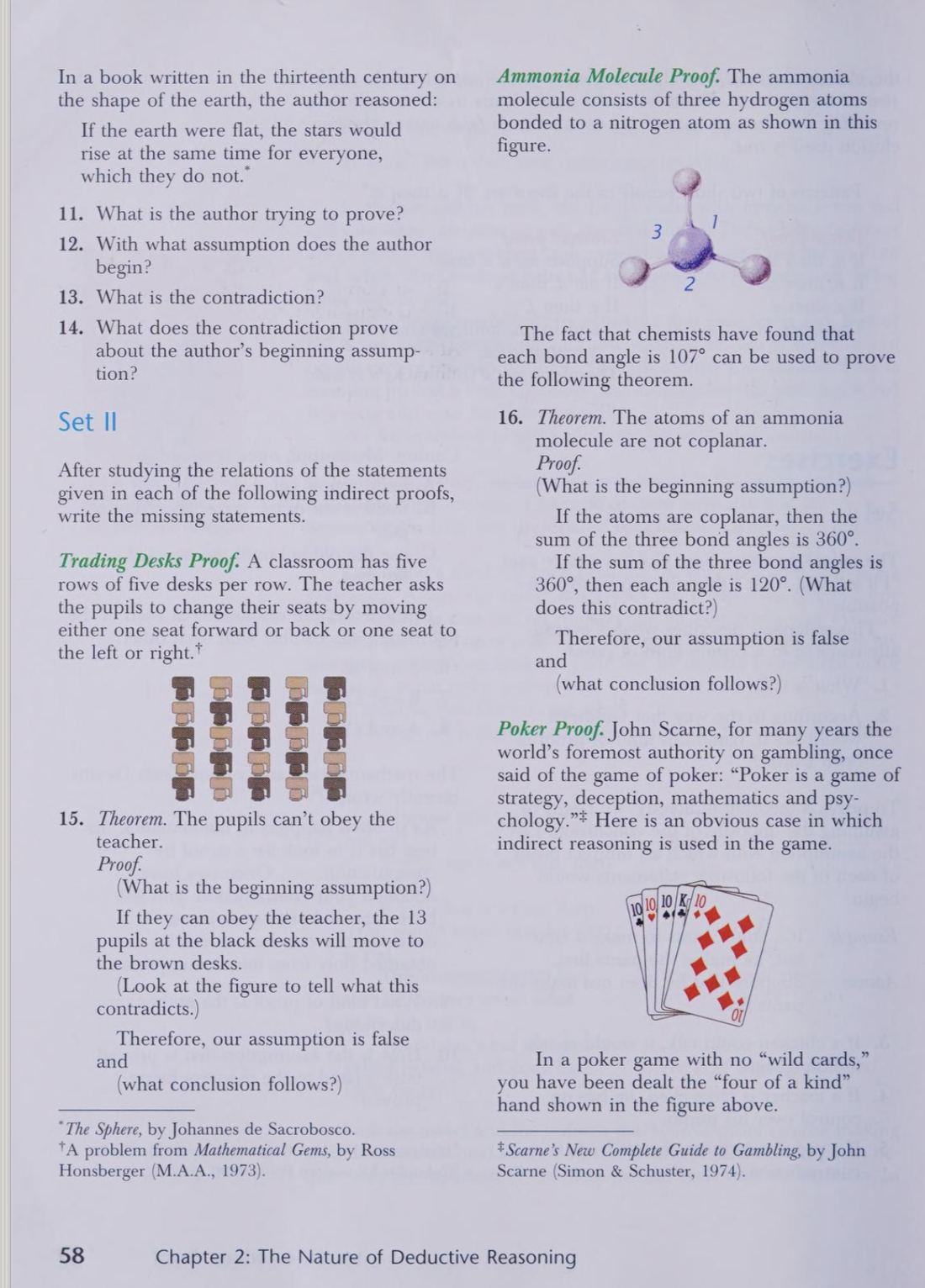
Question 15: the trading desks
Five rows of five desks. Every pupil must move exactly one desk forward, back, left, or right. Theorem: the pupils can't obey the teacher. Fill in the missing proof lines.
- Beginning assumption, the opposite of the theorem: suppose the pupils can obey the teacher.
- Color the 25 desks like a checkerboard, as the book's figure does: 13 of one color, 12 of the other. Every legal move (one step in any of the four directions) moves a pupil to a desk of the opposite color.
- Then the 13 pupils on the 13 dark desks all need light desks, and there are only 12 light desks. Two pupils would have to share, which contradicts one pupil per desk.
- Therefore the assumption is false: the pupils can't obey the teacher, which is the theorem.
- Check the skeleton against page 56's margin notes: assumption, chain, contradiction, conclusion, in that order. The ammonia and poker proofs below want the identical four beats.
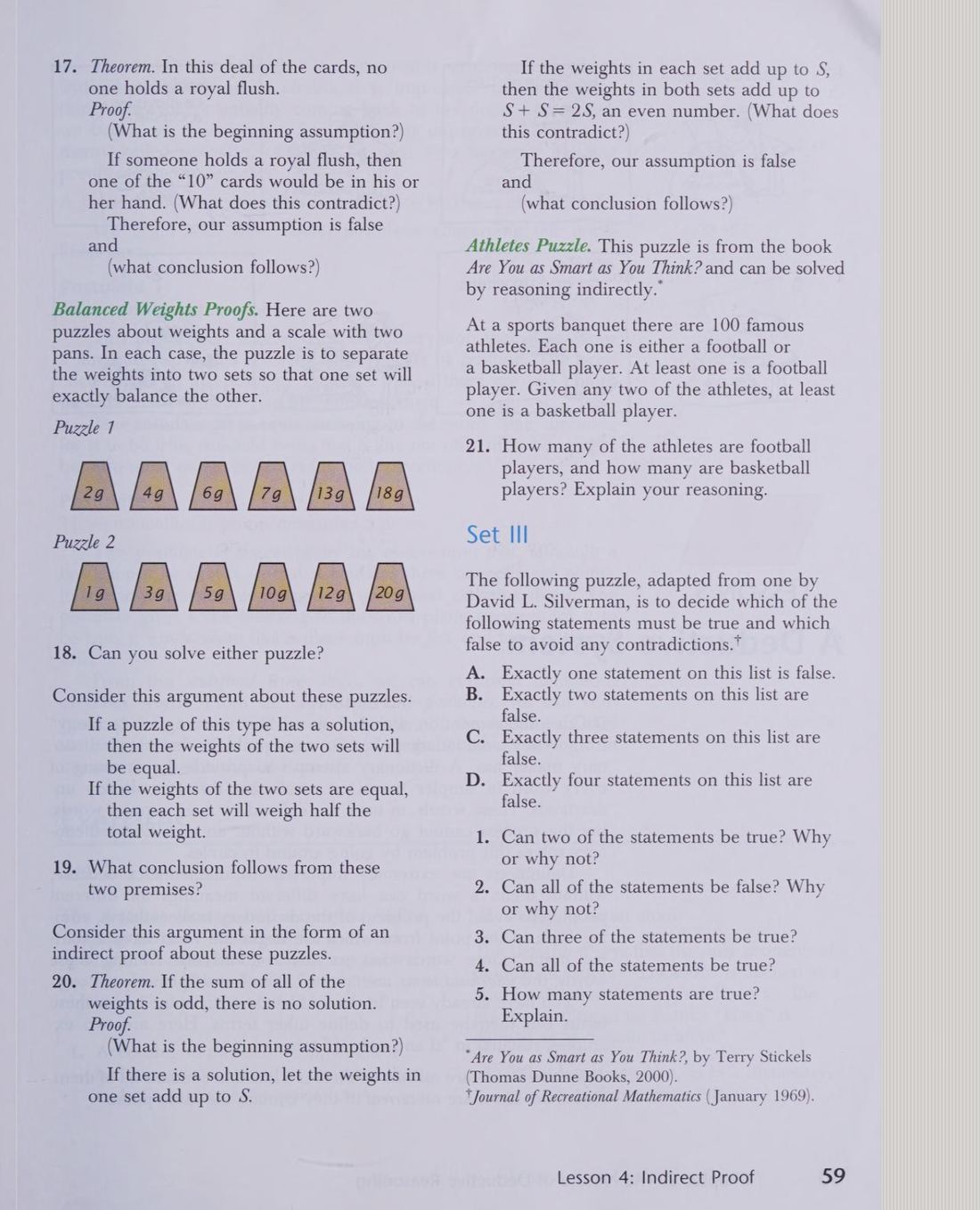
Question 21: the athletes puzzle
100 athletes; each is a football or a basketball player. At least one is a football player. Given any two of the athletes, at least one is a basketball player. How many of each?
- Suppose the opposite of what the answer will turn out to be: suppose there are two or more football players.
- Then pick two of them as your "any two of the athletes." Neither one is a basketball player.
- That contradicts the given fact that any two athletes include at least one basketball player. So the assumption is false: there are fewer than two football players.
- The other given fact says there is at least one. Fewer than two and at least one leaves exactly one: 1 football player and 99 basketball players.
- Check it forward: with only one football player, any pair of athletes contains at most one, so the other is always a basketball player. Both given facts hold, and the squeeze between "at least" and "at most" did all the work.