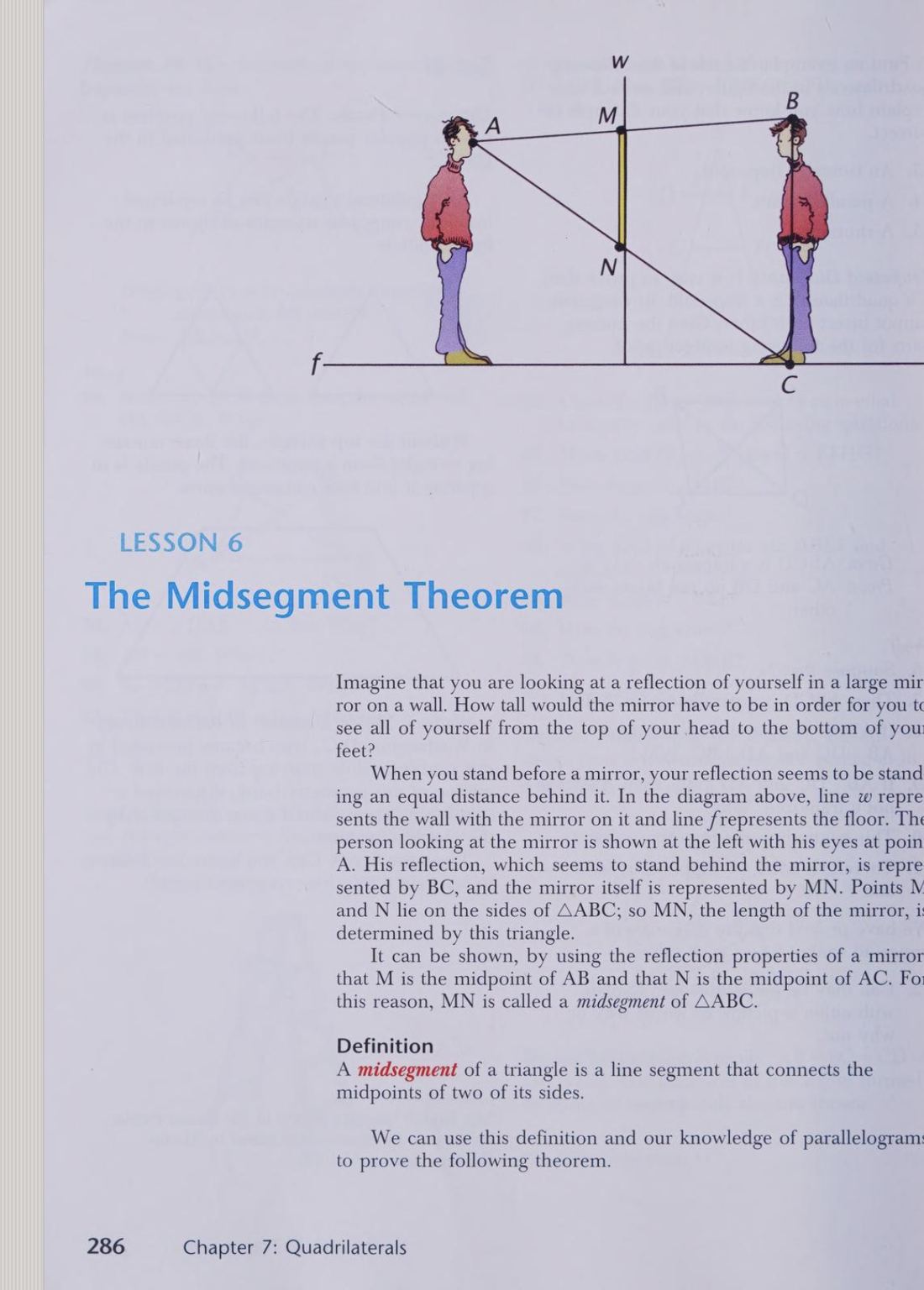
Questions 6 to 15: the midpoint parallelogram, proved
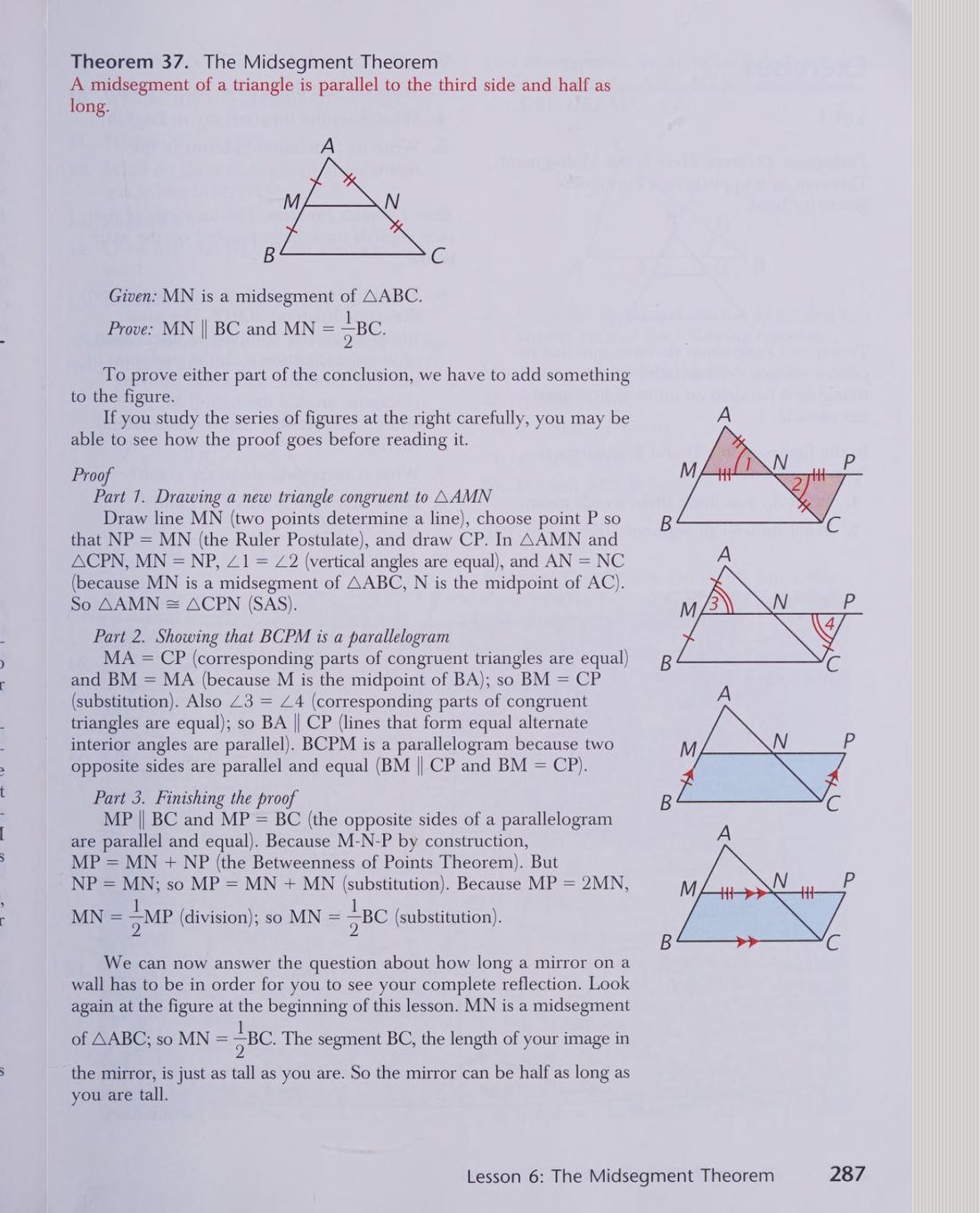
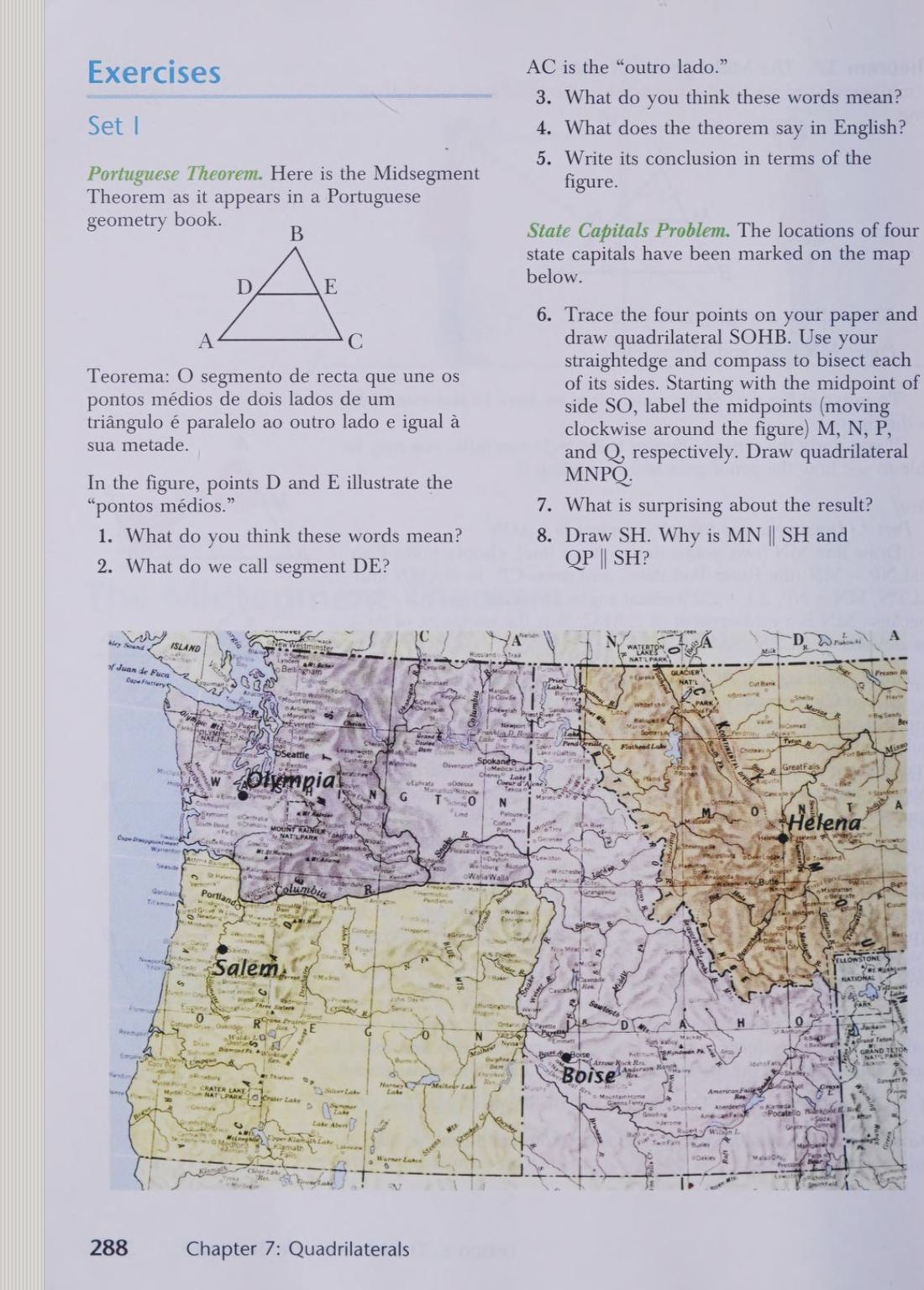
MNPQ joins the midpoints of quadrilateral SOHB's sides in order. Prove MNPQ is a parallelogram, and say what is true of MP and NQ.
- Question 8: draw diagonal SH. In triangle SOH, segment MN joins two midpoints: a midsegment, so MN ∥ SH. In triangle SBH, segment QP is a midsegment too: QP ∥ SH.
- Question 9: two segments parallel to SH are parallel to each other (Theorem 18).
- Questions 10 and 11: the same theorem's other half: MN = SH/2 and QP = SH/2, so MN = QP.
- Questions 12 and 13: one pair of opposite sides both parallel and equal is Theorem 29's certificate: MNPQ is a parallelogram, whatever crooked quadrilateral the capitals make.
- Questions 14 and 15: MP and NQ are the new parallelogram's diagonals, so they bisect each other (Theorem 26). Four state capitals, one hidden parallelogram, and its center is the balancing point of the four cities: the Varignon parallelogram, as mathematicians call it, now yours with proof.
Questions 16 to 21: perimeter equals diagonal sum
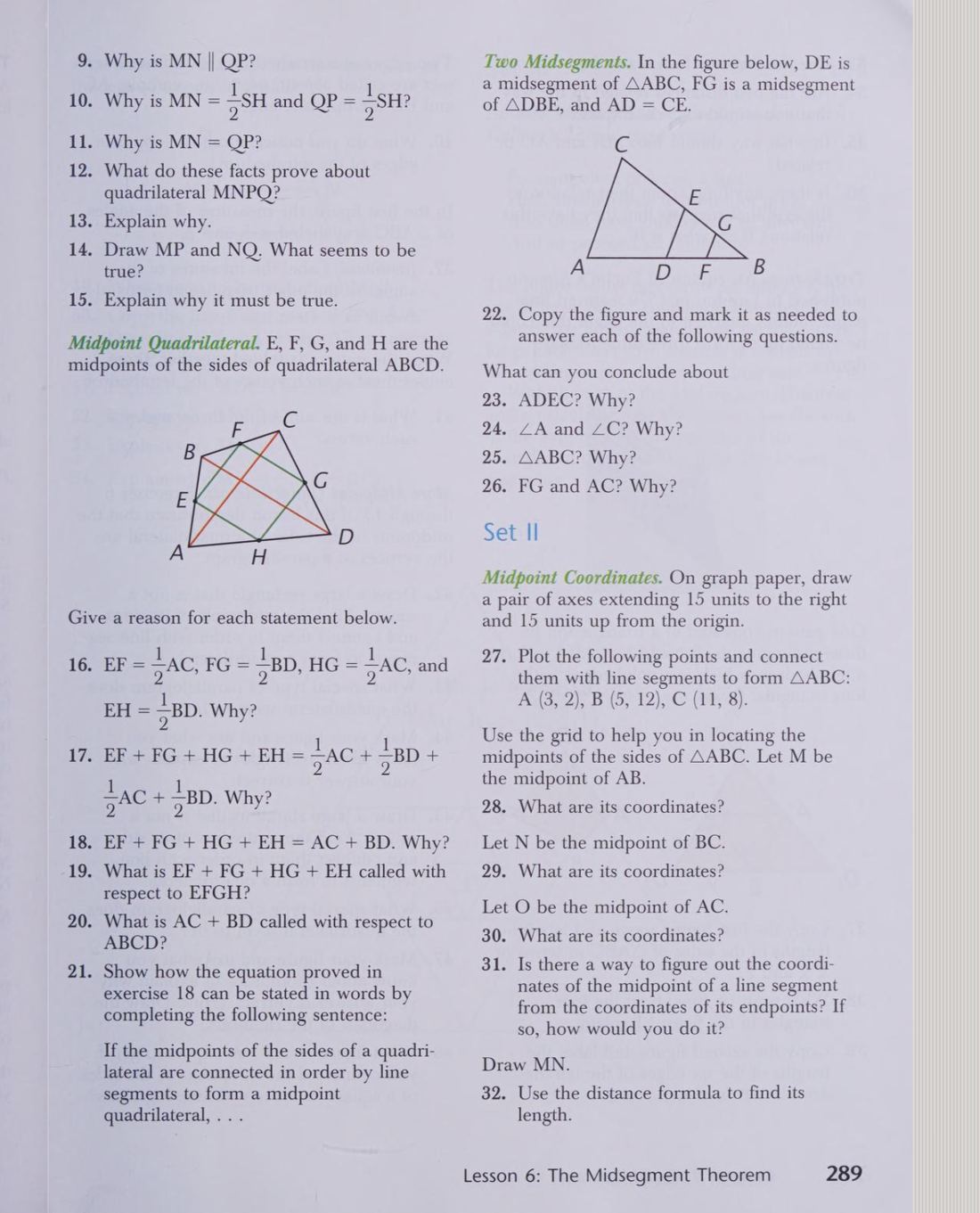
E, F, G, H are the midpoints of quadrilateral ABCD's sides. Prove EF + FG + GH + HE = AC + BD.
- Question 16: each side of EFGH is a midsegment of a triangle cut off by a diagonal: EF = AC/2 and HG = AC/2 (triangles on diagonal AC), FG = BD/2 and EH = BD/2 (triangles on BD). One theorem, four applications.
- Question 17: add all four equations (the addition property).
- Question 18: collect halves: two halves of AC and two of BD make EF + FG + HG + EH = AC + BD.
- Questions 19 and 20: the left side is the perimeter of the midpoint quadrilateral; the right side is the sum of the diagonals of the original.
- Question 21's sentence: if the midpoints of a quadrilateral's sides are joined in order, the resulting quadrilateral's perimeter equals the sum of the original's diagonals. On page 38 you measured 29 centimeters twice and wondered; today it is arithmetic. That eighteen-session round trip is what a deductive system feels like when it lands.
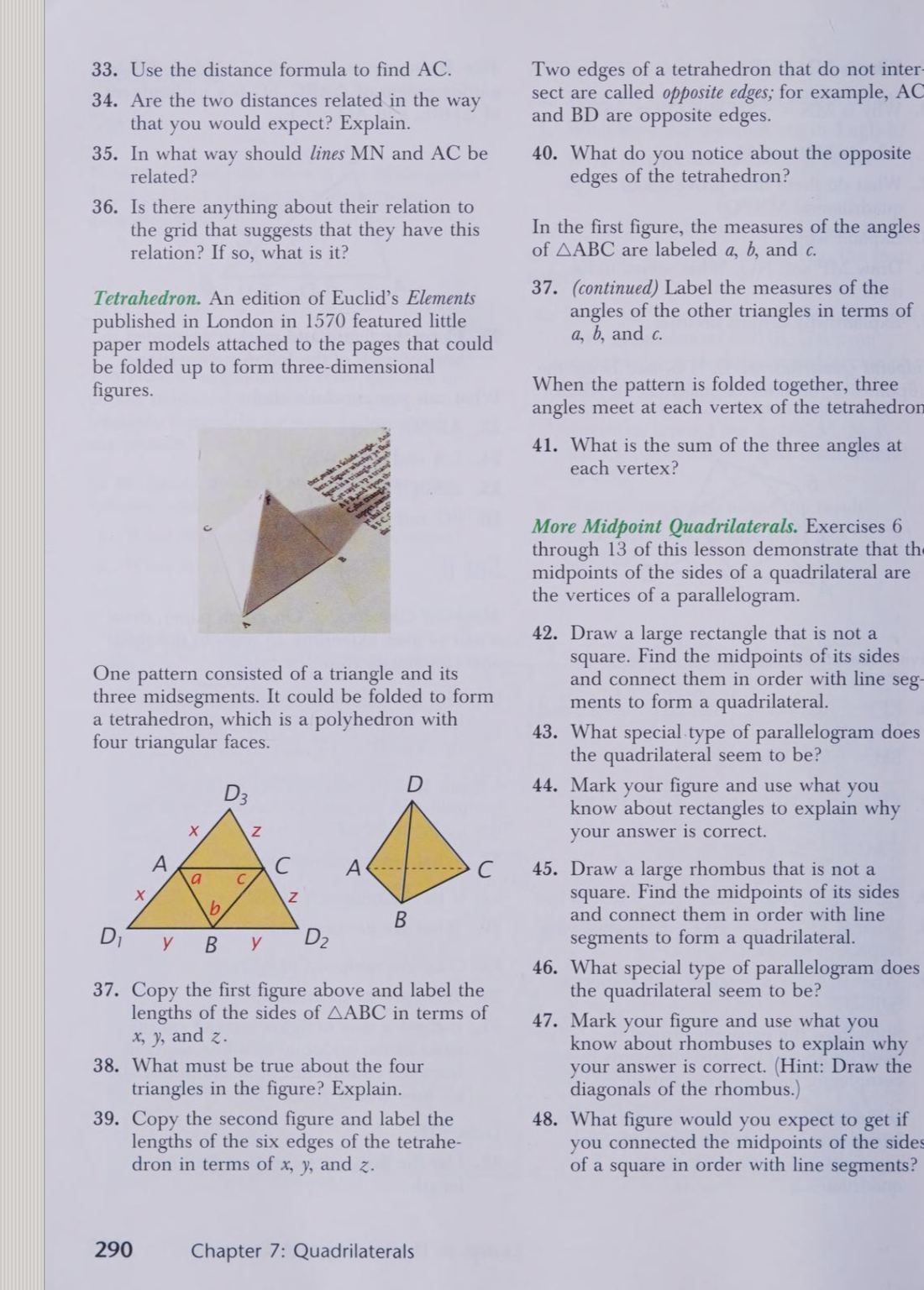
Questions 42 to 48: the midpoint swap
Join the midpoints of a rectangle's sides in order: what appears? Do the same for a rhombus, then predict the square.
- Questions 42 to 44: from a rectangle you get a rhombus. Why: the midpoint quadrilateral's sides are half-diagonals of the original (the Varignon argument), and a rectangle's diagonals are equal (Theorem 33), so all four new sides are equal: a rhombus.
- Questions 45 to 47: from a rhombus you get a rectangle. Why: the new sides run parallel to the original's diagonals, and a rhombus's diagonals are perpendicular (Theorem 34), so adjacent new sides meet at right angles: a rectangle.
- Equal diagonals give equal sides; perpendicular diagonals give right angles. Each family's diagonal heirloom becomes the other family's defining trait, one generation down.
- Question 48: a square has both heirlooms, so its midpoint child inherits both: a smaller square, turned 45°, half the area. Iterate in your head and squares spiral inward forever, which is exactly the infinite figure waiting on the next page.
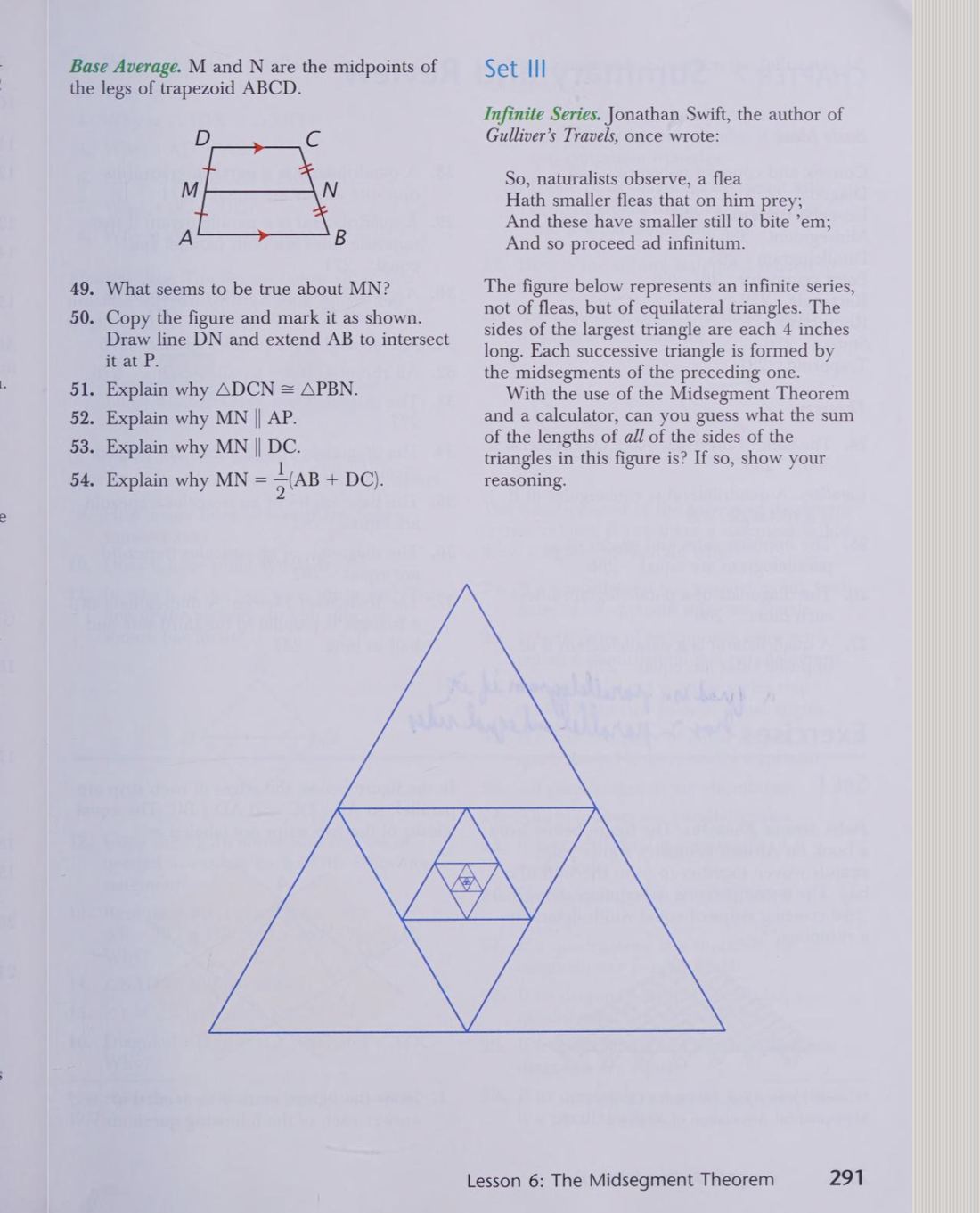
Set III: summing the flea triangles
An equilateral triangle of side 4 contains its midsegment triangle, which contains its own, ad infinitum. What is the total length of all sides of all triangles?
- Perimeters first: the outer triangle's is 12. Each midsegment is half its parent side (Theorem 37), so each generation's perimeter halves: 12, 6, 3, 1.5, ...
- The total is 12 + 6 + 3 + 1.5 + ..., and your calculator shows the partial sums marching: 18, 21, 22.5, 23.25, 23.625, closing in on something.
- See the limit without the calculator: each term is half the previous, so whatever remains to add is exactly equal to the last term added. The sum chases 24 and never passes it: total 24 inches.
- The slick argument: let S = 12 + 6 + 3 + ...; then S/2 = 6 + 3 + 1.5 + ... = S − 12, so S = 24. Algebra swallows infinitely many terms in one bite.
- Infinitely many triangles, two feet of ink. Swift's fleas converge, and this little sum is your first taste of the infinite series that power all of calculus. The Midsegment Theorem supplied the halving; geometry priced the infinite.
Questions 2 to 8: two strips make a rhombus
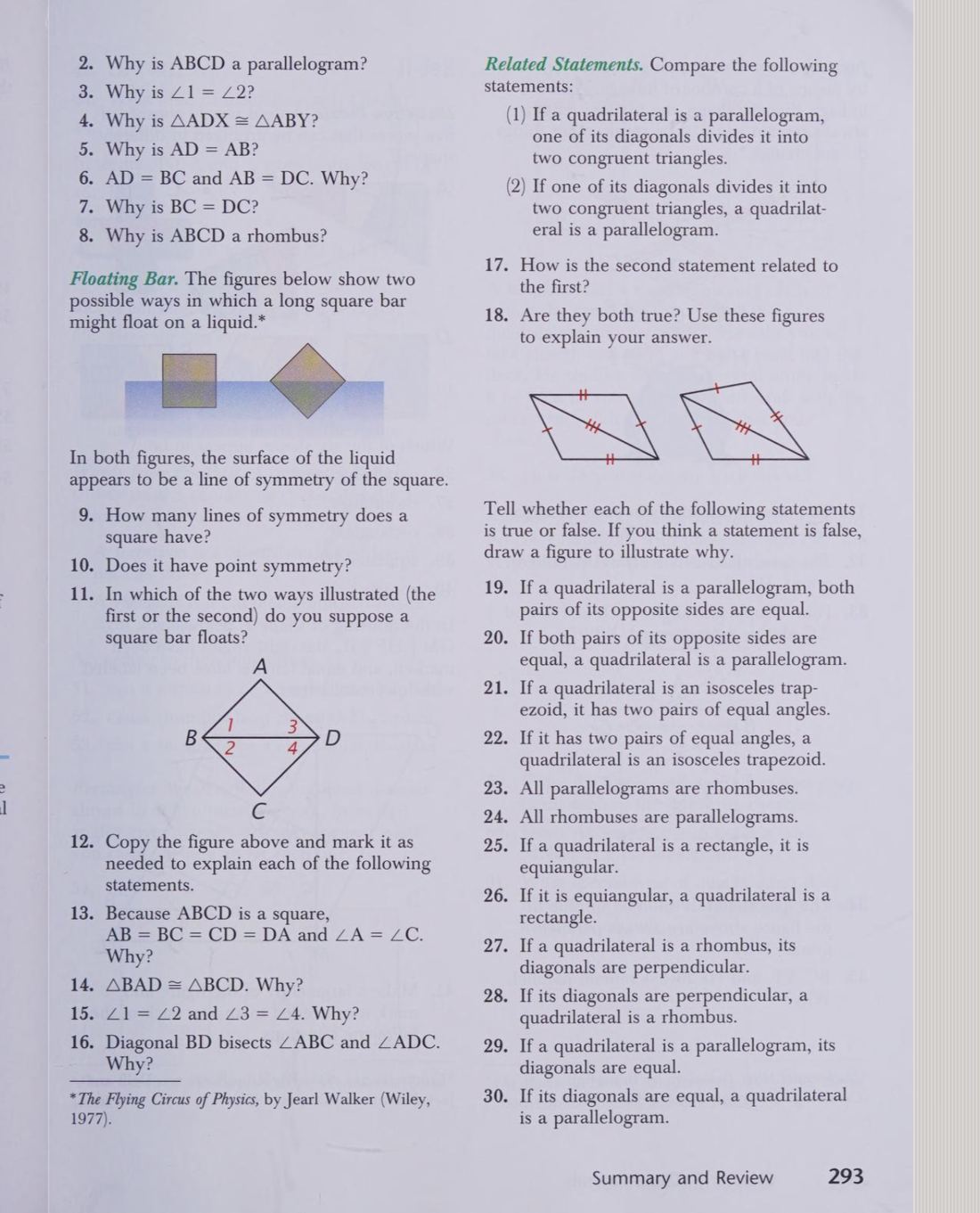
Two woven strips of equal width w cross: their edges are parallel (AB ∥ DC, AD ∥ BC). Prove the overlap ABCD is a rhombus.
- Question 2: both pairs of opposite sides are parallel (the strips' edges), so ABCD is a parallelogram by definition.
- Question 3: the strip widths are the perpendicular distances AX and AY from A to the far edges, both equal to w, with right angles marked at X and Y. The angles ∠1 and ∠2 at D and B are equal because both are angles of the parallelogram's congruent halves.
- Questions 4 and 5: right triangles ADX and ABY have equal legs (AX = AY = w) and equal angles (∠1 = ∠2), so AAS gives △ADX ≅ △ABY, and AD = AB as corresponding hypotenuses.
- Questions 6 and 7: Theorem 25 supplies AD = BC and AB = DC; substitution spreads AD = AB to all four: BC = DC too.
- Question 8: four equal sides is the definition: a rhombus. The weaver's rule ("equal widths make a rhombus") is Theorem 25 plus one AAS, executed in palm fiber. Change the widths and you get a mere parallelogram; the equality is load-bearing.
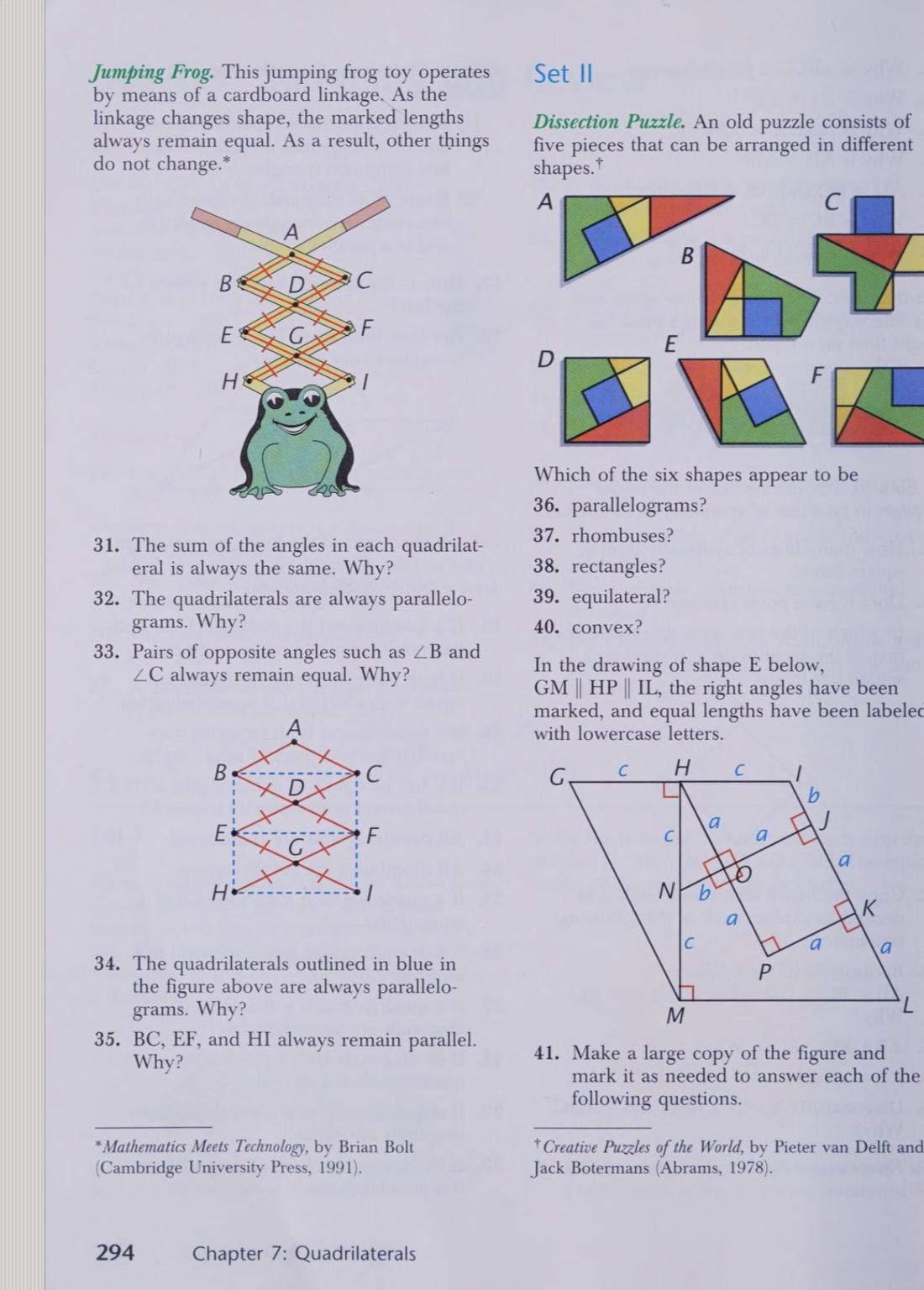
Questions 31 to 35: the frog's linkage
The cardboard scissor linkage keeps its marked rod lengths equal as it flexes. Why is each quadrilateral's angle sum constant, why are they always parallelograms, and why do BC, EF, HI stay parallel?
- Question 31: the angle sum of any quadrilateral is 360° (Theorem 24) at every flex; the sum never budges even as each angle does.
- Question 32: each cell keeps both pairs of opposite sides equal (cardboard does not stretch), so Theorem 27 certifies a parallelogram at every position, exactly as with page 272's pop-up tab.
- Question 33: opposite angles of a parallelogram are equal (Theorem 25), so ∠B = ∠C survives every jump.
- Questions 34 and 35: the blue outlined quadrilaterals have opposite sides built from equal rod-pairs: parallelograms again by Theorem 27, and their opposite sides BC, EF, HI are parallel in chains (Theorem 18 splicing cell to cell).
- So the frog's feet stay parallel to its shoulders through the whole leap: Theorems 18, 24, 25, and 27 riding one piece of cardboard. Toys are theorems with springs.
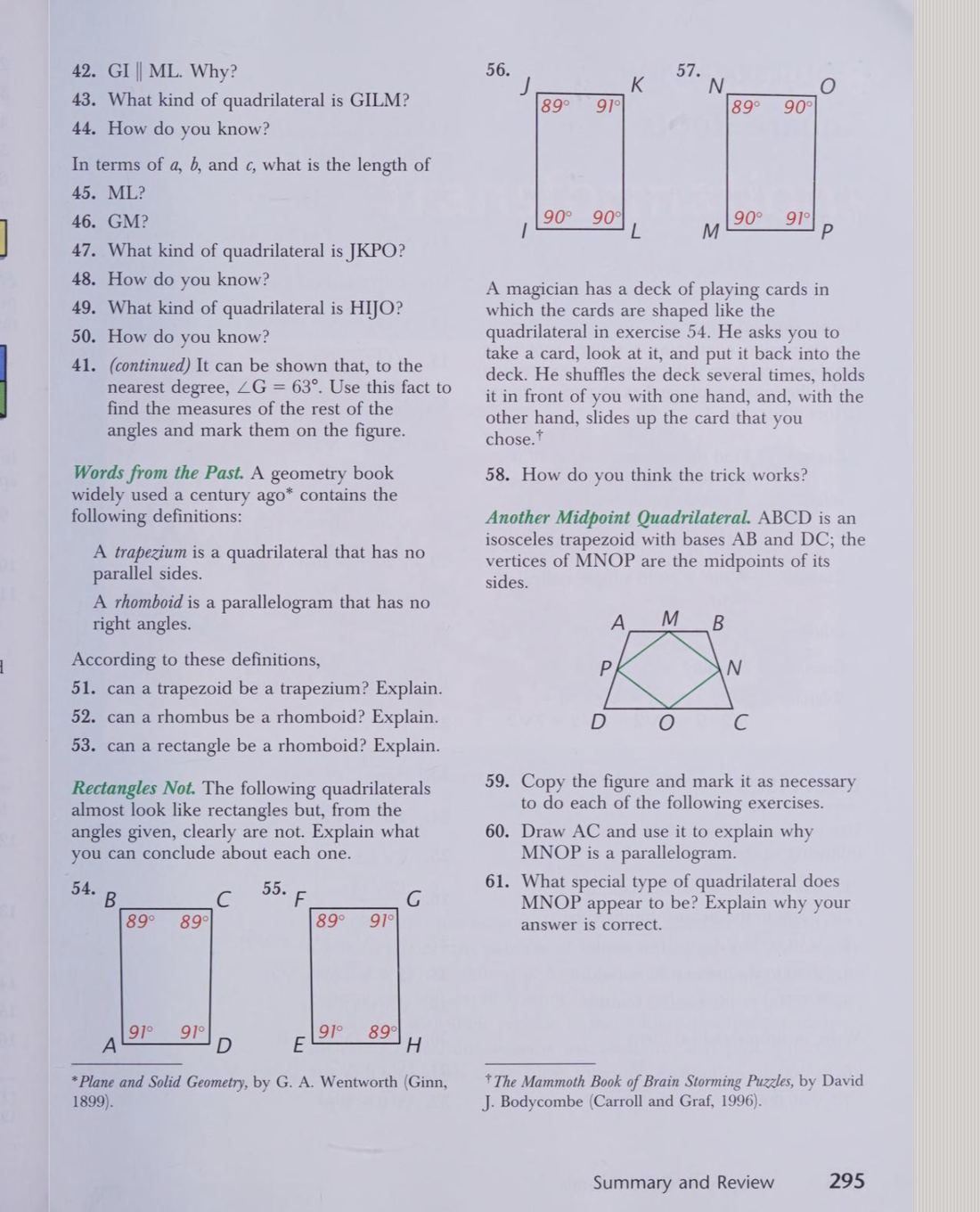
Questions 54 to 58: almost-rectangles and a card trick
Four quadrilaterals carry angles of 89, 90, and 91 degrees in different arrangements. Classify each, then explain the magician's tapered deck.
- Question 54 (89, 89 on top; 91, 91 below): down each side, 89 + 91 = 180, so the same-side interior angles make the top and bottom edges parallel, and the equal base-angle pairs make it an isosceles trapezoid.
- Question 55 (89, 91 / 91, 89): opposite angles equal: Theorem 28 says parallelogram, leaning one degree from rectanglehood.
- Questions 56 and 57: (89, 91, 90, 90) has exactly one parallel pair: a plain trapezoid; (89, 90, 90, 91) arranged so no pair of co-interior angles sums to 180: no parallel sides at all, the old books' trapezium.
- Question 58, the trick: every card is a subtle isosceles trapezoid, and the deck is stacked with all tapers aligned. Before you return your card, the magician quietly turns the deck end for end, so your card goes back tapering the wrong way: its wide end sits among narrow ends. A thumb sliding along the edge finds the protruding card by touch.
- One degree of angle is invisible to the eye and unmistakable to the thumb. The whole chapter's moral in a card trick: tiny angle facts are real, and instruments (even thumbs) beat impressions.
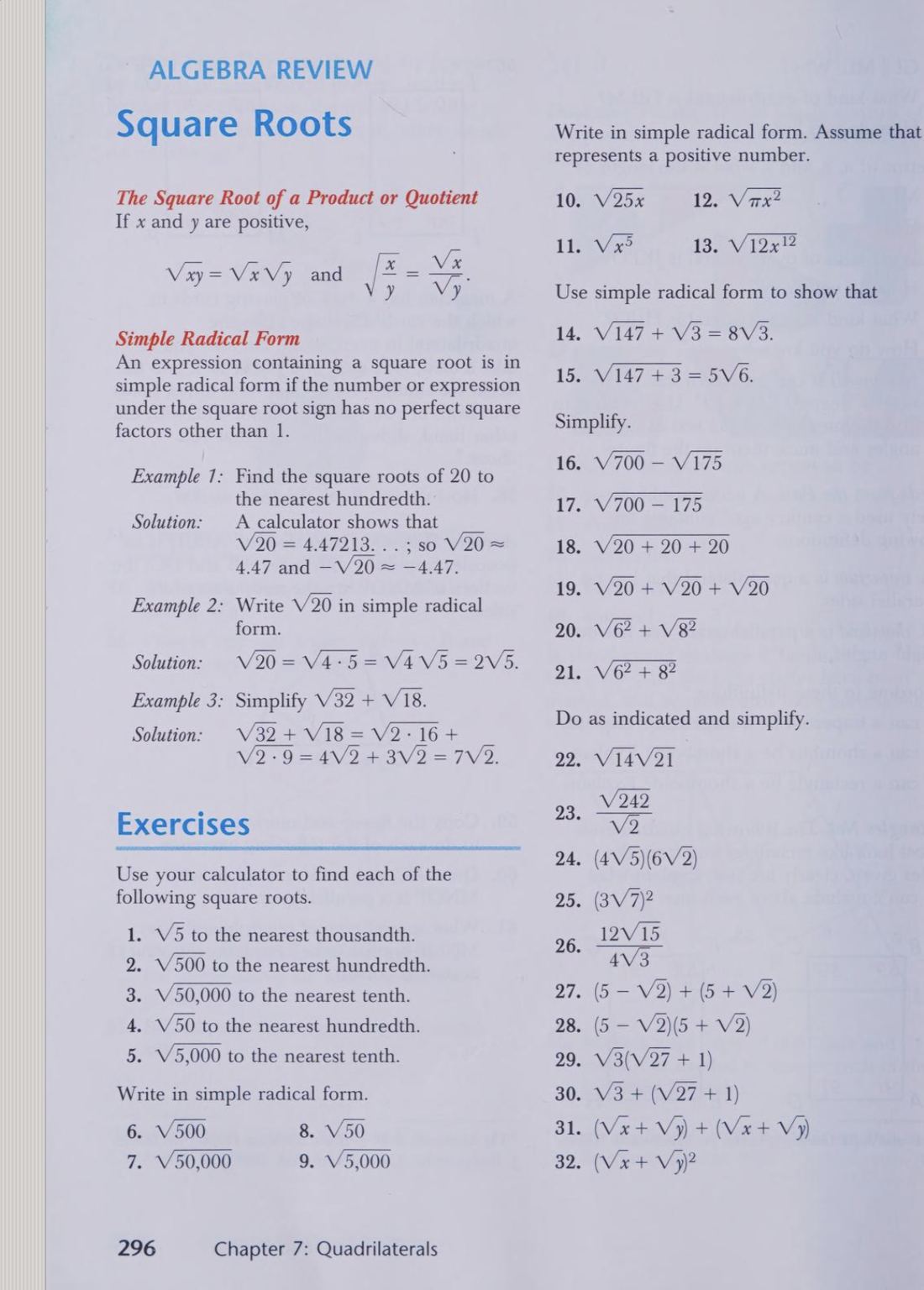
Questions 20 and 21: the root of a sum is not the sum of roots
Simplify √(6²) + √(8²), and then √(6² + 8²).
- Question 20: each root undoes its square: √36 + √64 = 6 + 8 = 14.
- Question 21: add first: 36 + 64 = 100, and √100 = 10.
- Fourteen versus ten. The root symbol distributes over products (the page's boxed rule) and flatly refuses to distribute over sums; these two exercises are the proof by example.
- And the numbers were not chosen idly: 6, 8, 10 is the doubled 3-4-5, so question 21 is a right triangle's hypotenuse and question 20 is the two legs walked separately. The gap between 14 and 10 is the triangle inequality's detour tax, priced in radicals.
- Carry the moral into every Pythagorean computation ahead: square, add, then root, never root-and-add. The chapter's last trap is the next chapter's daily arithmetic.