Questions 1 to 4: the pop-up tab
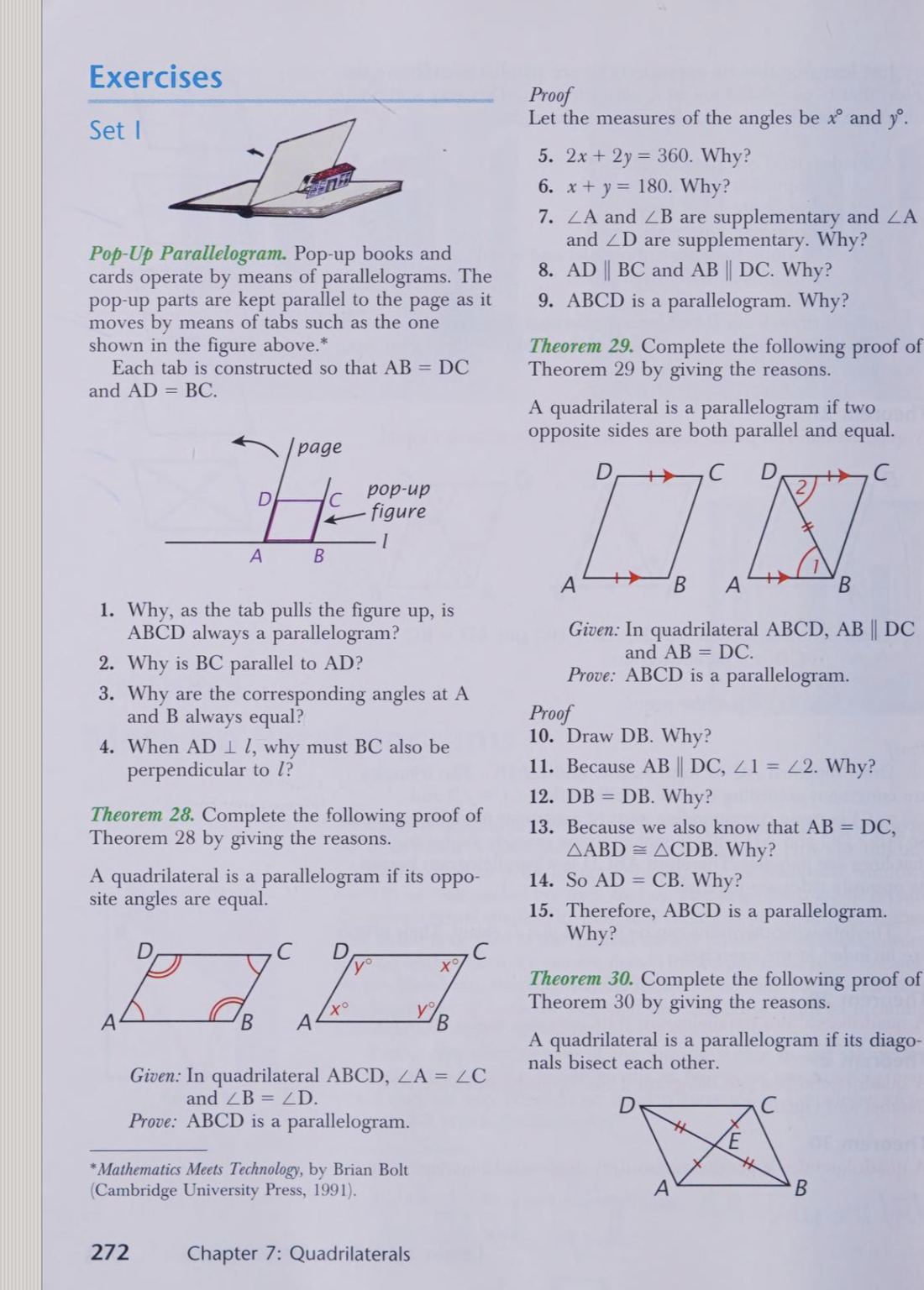
The tab is built so AB = DC and AD = BC. Why is ABCD always a parallelogram, why is BC ∥ AD, why are the corresponding angles at A and B equal, and why does AD ⊥ l force BC ⊥ l?
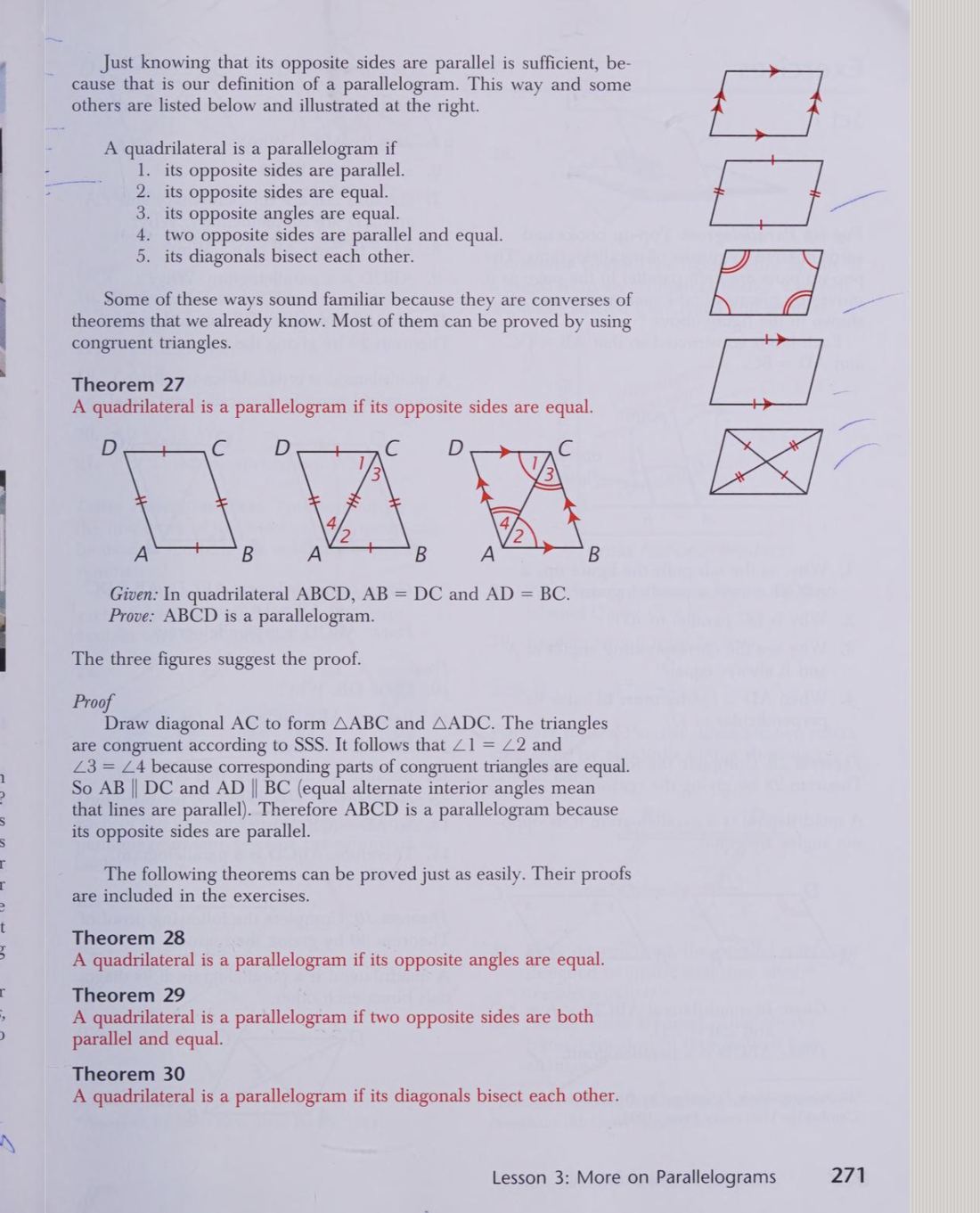
- Question 1: both pairs of opposite sides are equal by construction, so Theorem 27 certifies ABCD a parallelogram at every position of the page. The certificate never expires because the lengths never change.
- Question 2: parallelogram means opposite sides parallel (the definition cashing out): BC ∥ AD.
- Question 3: with BC ∥ AD cut by the page line l, the angles at A and B are corresponding angles, equal by Theorem 19.
- Question 4: AD ⊥ l plus BC ∥ AD makes BC ⊥ l too: a line perpendicular to one of two parallels is perpendicular to the other. The pop-up figure therefore stands square to the page exactly when the page lies flat, which is the whole design.
Questions 16 to 21: bisecting diagonals suffice
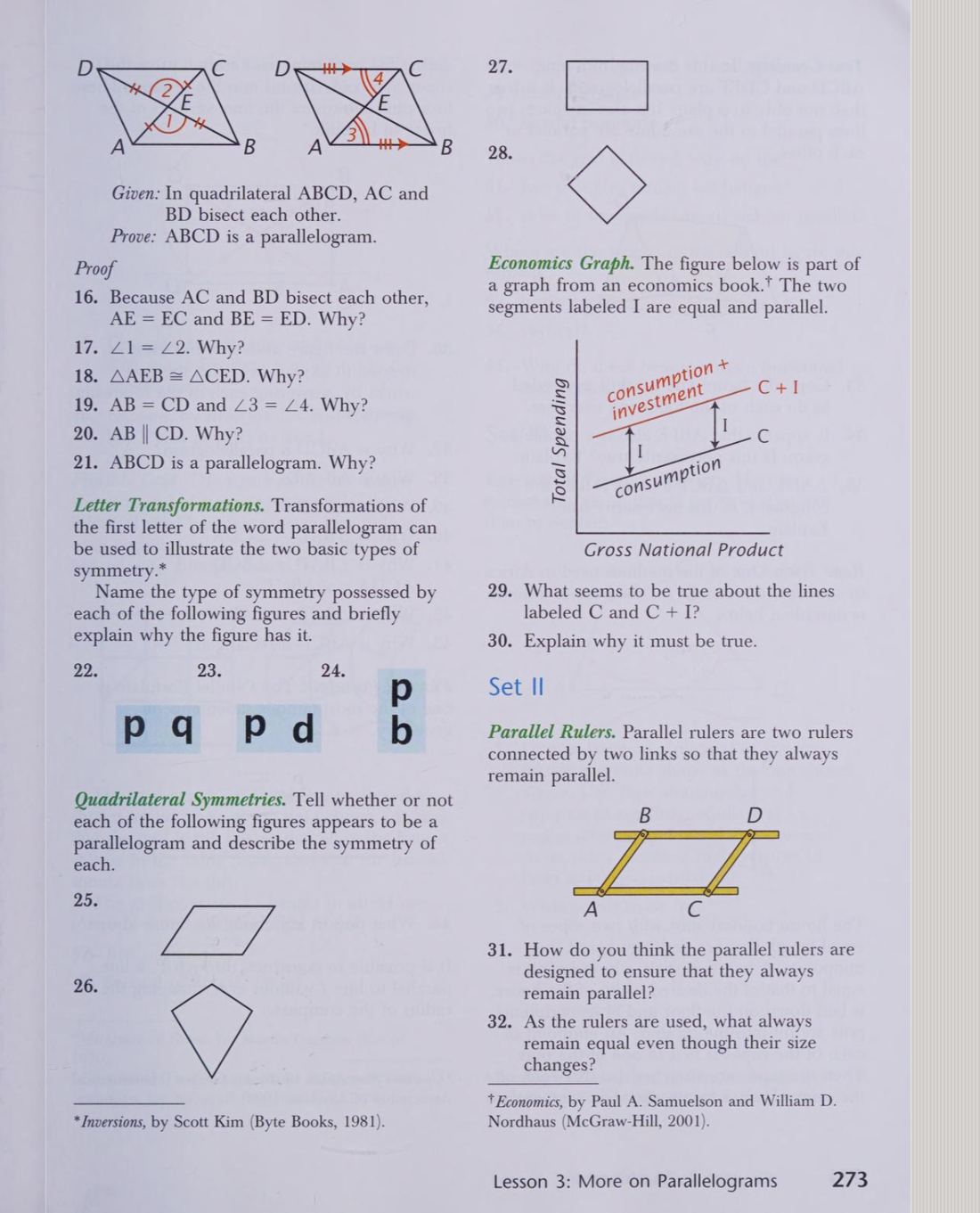
In quadrilateral ABCD the diagonals AC and BD bisect each other at E. Prove ABCD is a parallelogram.
- Question 16: bisecting each other means AE = EC and BE = ED, the definition of bisect applied to both diagonals.
- Question 17: ∠1 = ∠2 at E: vertical angles are equal.
- Question 18: SAS assembles △AEB ≅ △CED around the crossing.
- Question 19: corresponding parts: AB = CD and ∠3 = ∠4.
- Questions 20 and 21: the equal alternate interior angles make AB ∥ CD, and one pair of opposite sides both equal and parallel is Theorem 29's test: ABCD is a parallelogram. Note the economy: half the diagonals' information proved everything, and the other half (the △AED pair) would have done the same job.
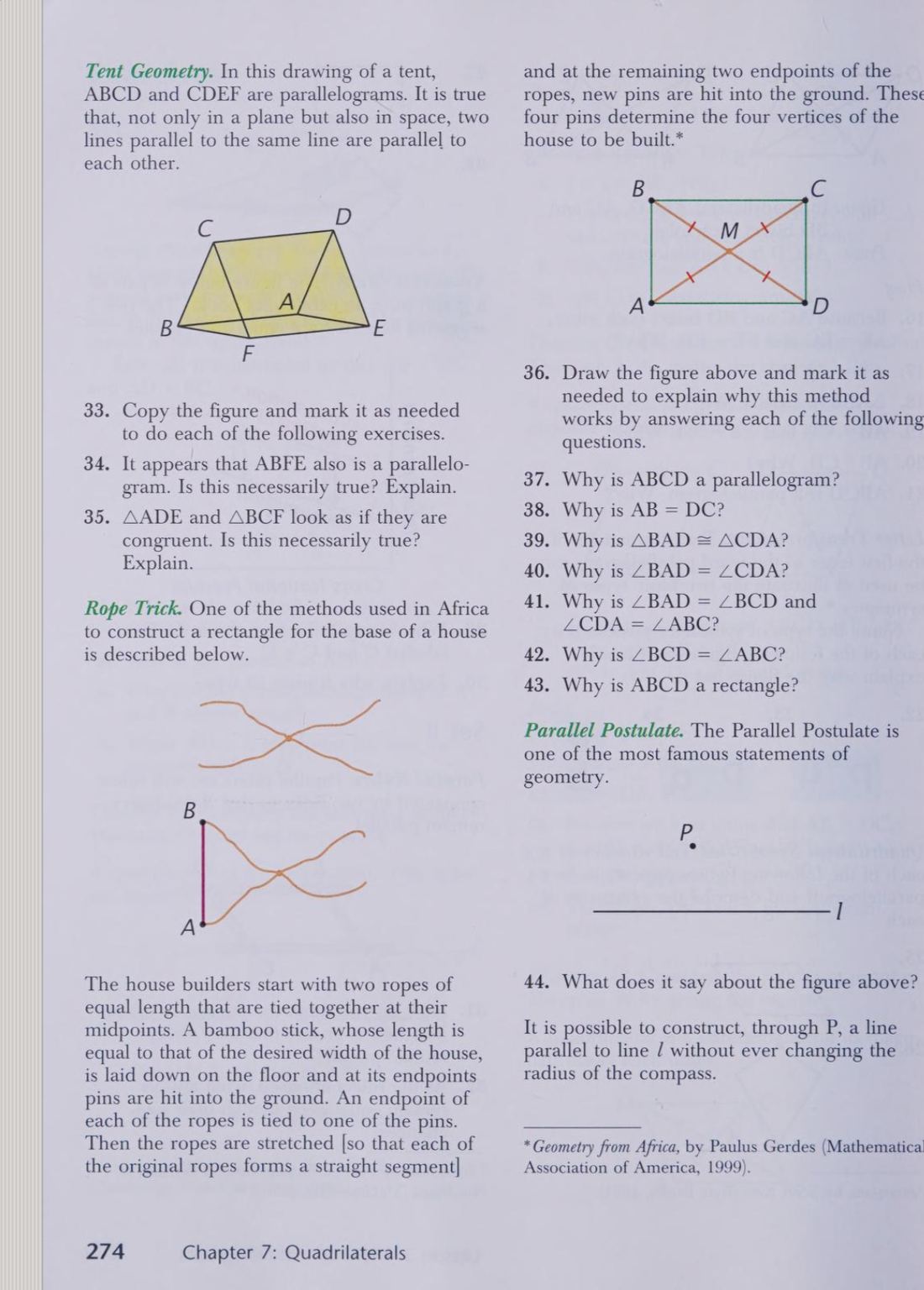
Questions 36 to 43: the rope-built rectangle
Two equal ropes are tied together at their midpoints M; their four endpoints, stretched straight, are pinned at A, B, C, D. Why is ABCD a rectangle?
- Question 37: each rope is a straight diagonal through M, and M is the midpoint of both: the diagonals bisect each other, so ABCD is a parallelogram by Theorem 30.
- Question 38: AB = DC, opposite sides of that parallelogram (Theorem 25).
- Question 39: the ropes are equal, so the diagonals are equal: AC = BD. Now △BAD and △CDA share side AD, have AB = DC from step 2, and have BD = CA: congruent by SSS.
- Questions 40 to 42: corresponding parts give ∠BAD = ∠CDA; Theorem 25 pairs each with its opposite, so all four angles are equal.
- Question 43: an equiangular quadrilateral is a rectangle (the corollary to Theorem 24). Two ropes, one knot, four pins: equal bisecting diagonals are a complete rectangle kit, and the page 279 carpenter will run the same test in reverse.
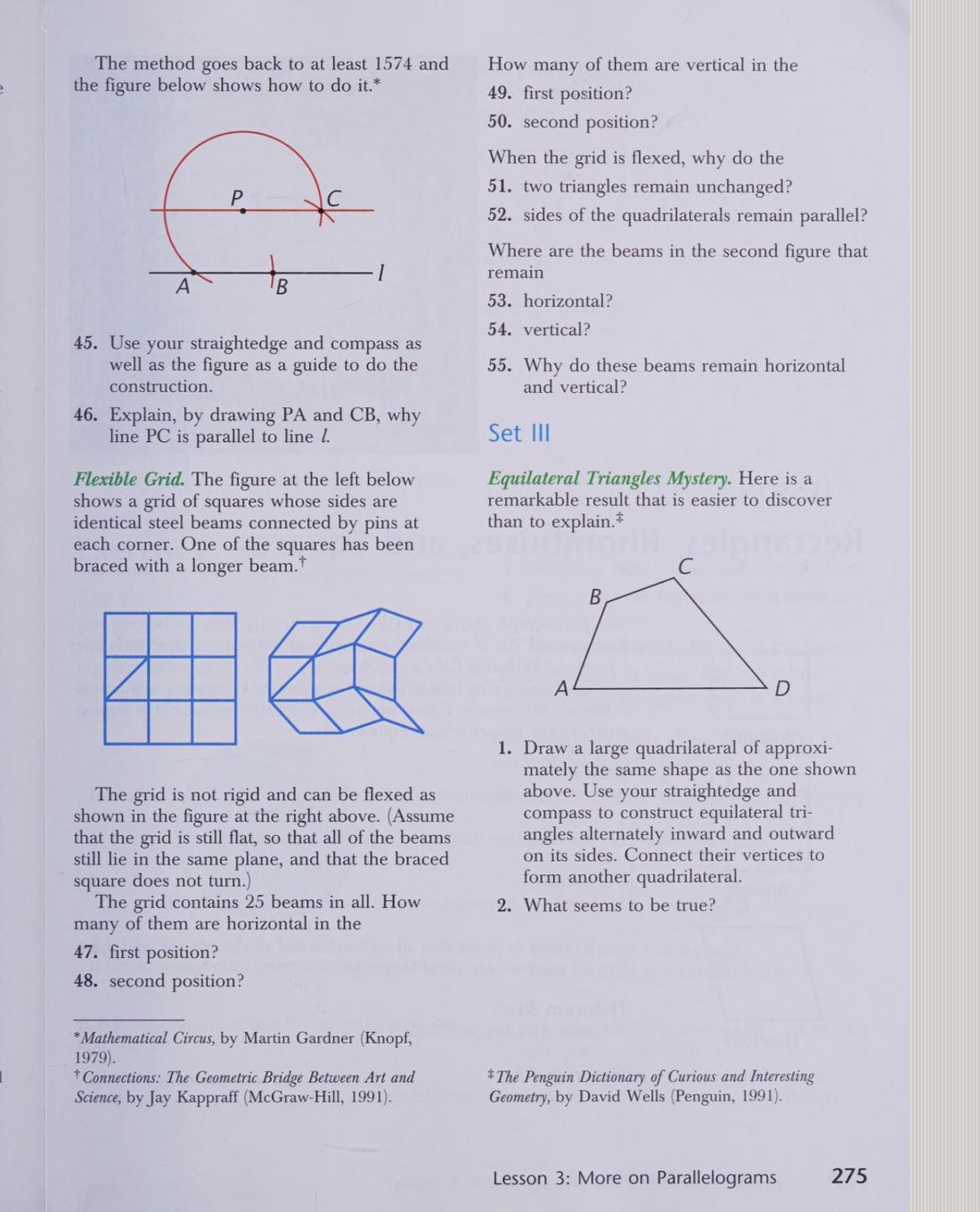
Questions 47 to 55: flexing the grid
A 5-by-5-beam grid of hinged squares has one braced square. Flexed flat, what stays horizontal, vertical, and why?
- Questions 47 to 50: count your figure by orientation: of the 25 beams, the horizontal rows and vertical columns split the total in the first position, and in the flexed position only a handful of each survive. Exact counts come from your own drawing; the point is which beams keep their bearing.
- Question 51: the braced square is two triangles, and triangles are rigid (SSS, the page 163 lesson): brace and frame cannot change shape.
- Question 52: every cell keeps all four sides equal in length (steel does not stretch), so each stays a parallelogram by Theorem 27 even as its angles shear: opposite sides remain parallel at every flex.
- Questions 53 to 55: parallelism chains (Theorem 18) from the braced square outward along its own row and column: beams parallel to the braced square's sides stay horizontal and vertical; every other beam is free to lean. One brace disciplines exactly the beams that share its directions.
- The grid is the chapter in steel: equal sides make parallelograms, parallelograms flex, triangles refuse, and parallelism is contagious along chains.
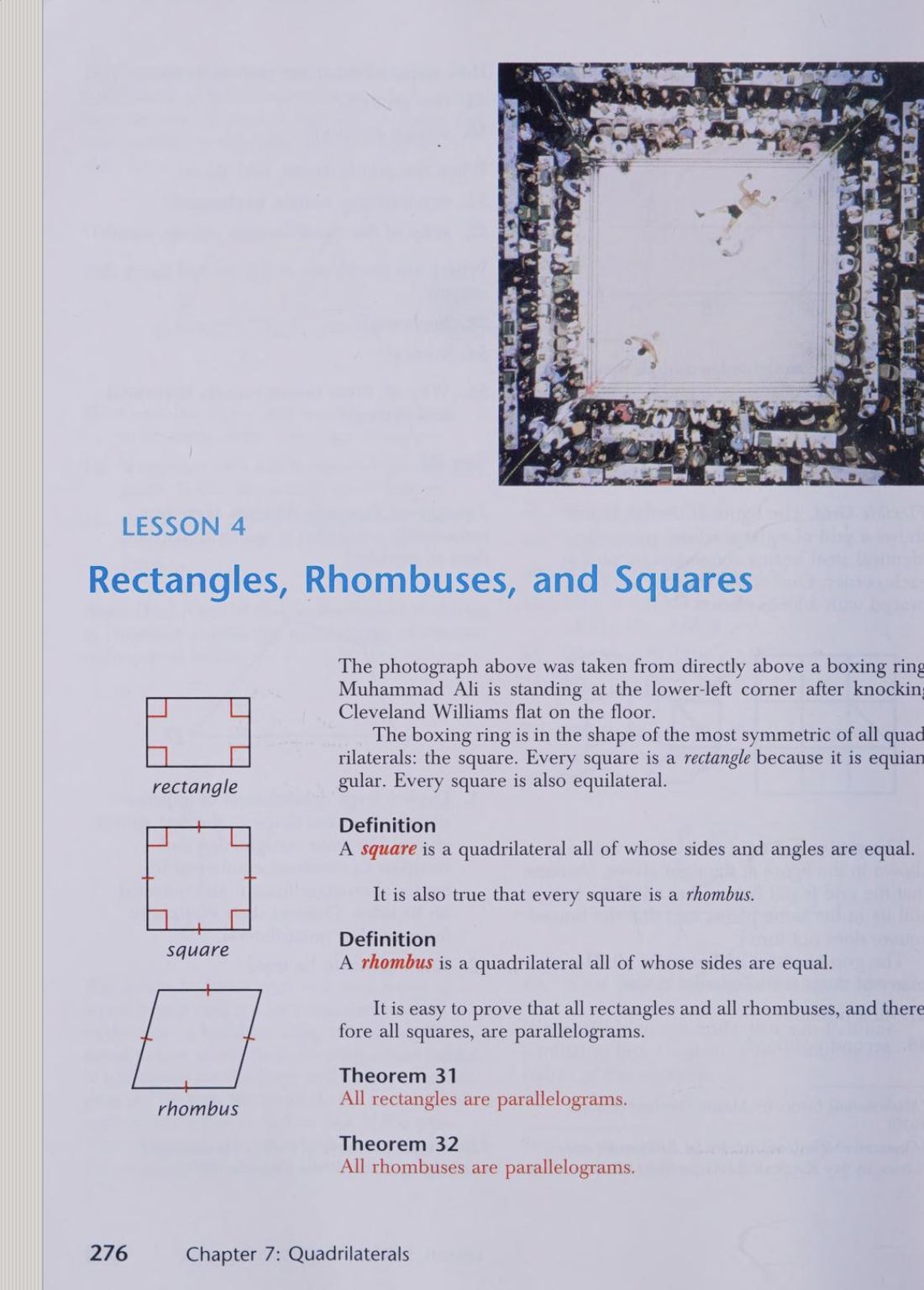
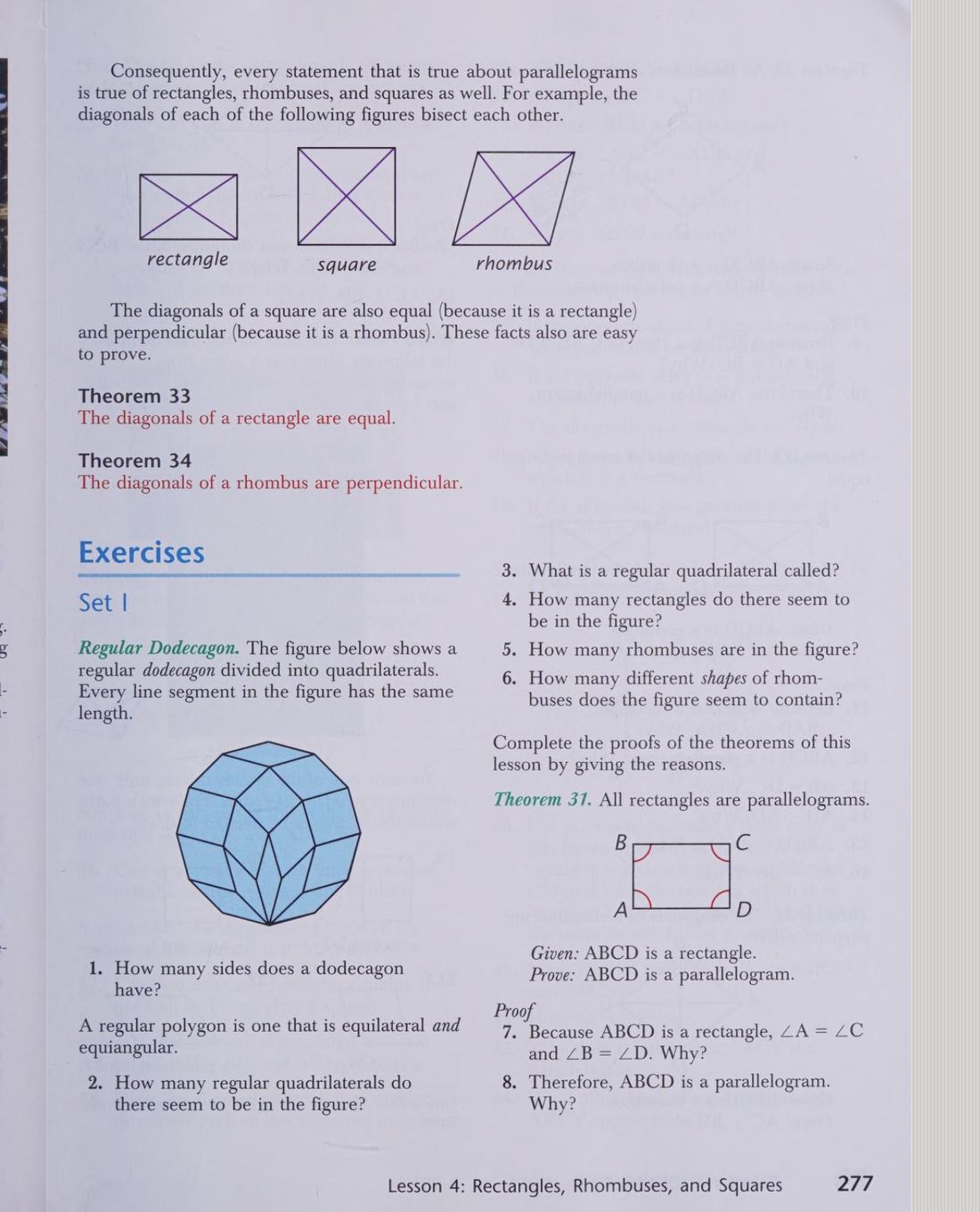
Questions 7 to 18: four proofs, one tour
Prove: all rectangles and all rhombuses are parallelograms; a rectangle's diagonals are equal; a rhombus's are perpendicular.
- Theorem 31 (questions 7 and 8): a rectangle's four right angles are equal, so opposite angles are certainly equal, and Theorem 28's test fires: parallelogram.
- Theorem 32 (9 and 10): a rhombus's four equal sides make opposite sides equal: Theorem 27's test: parallelogram.
- Theorem 33 (11 to 16): in rectangle ABCD, ∠BAD = ∠CDA (right angles), AB = DC (a parallelogram now, so Theorem 25), AD shared: SAS gives △BAD ≅ △CDA, and the diagonals AC and BD match as corresponding parts.
- Theorem 34 (17 and 18): in rhombus ABCD, B and D are each equidistant from A and C (all sides equal), so line BD is the perpendicular bisector of AC by Theorem 16, the chapter 6 two-equidistant-points theorem: AC ⊥ BD.
- Notice the sourcing: two tests from this chapter, one SAS, and one loan from chapter 6. The family tree is built from the whole book's lumber, which is what a deductive system is for.
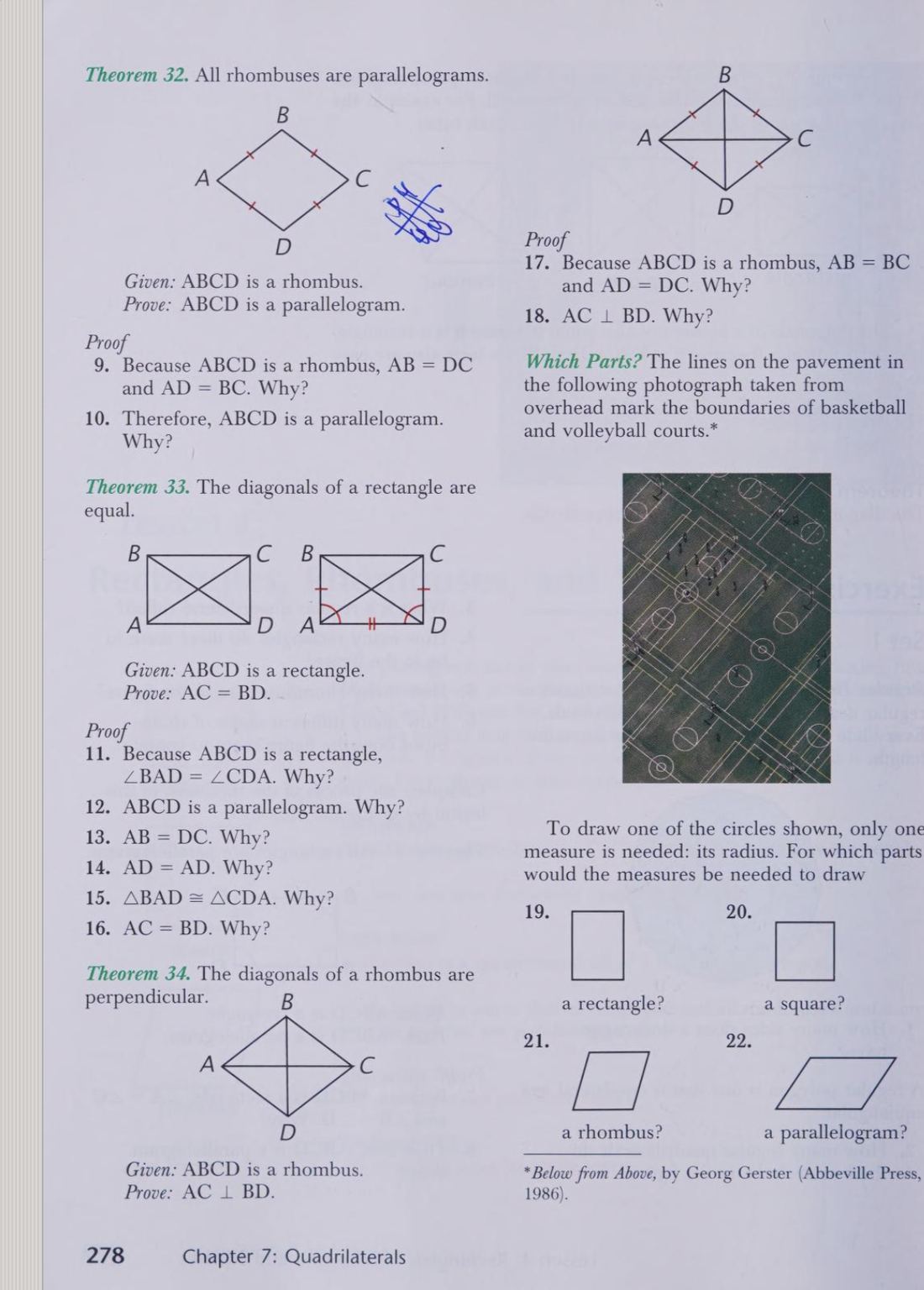
Questions 19 to 22: how many measures?
A circle needs one measure (its radius). How many do you need to draw a given rectangle, square, rhombus, parallelogram?
- Question 20 first, the floor: a square needs one measure, the side. Its angles are fixed at 90 by definition; nothing else is free.
- Question 19: a rectangle needs two, length and width. The angles come free, the sides do not.
- Question 21: a rhombus needs two as well, but a different two: the side (all four at once) and one angle, since a rhombus can lean.
- Question 22: a parallelogram needs three: two adjacent sides and the included angle. (SAS is exactly why three suffice: the triangle they determine fixes the rest by Theorem 25.)
- Read the ladder 1, 2, 2, 3 as symmetry made numerical: every added freedom is a constraint the shape's definition declined to impose. Engineers call these degrees of freedom, and you just counted them with a protractor's worth of theory.
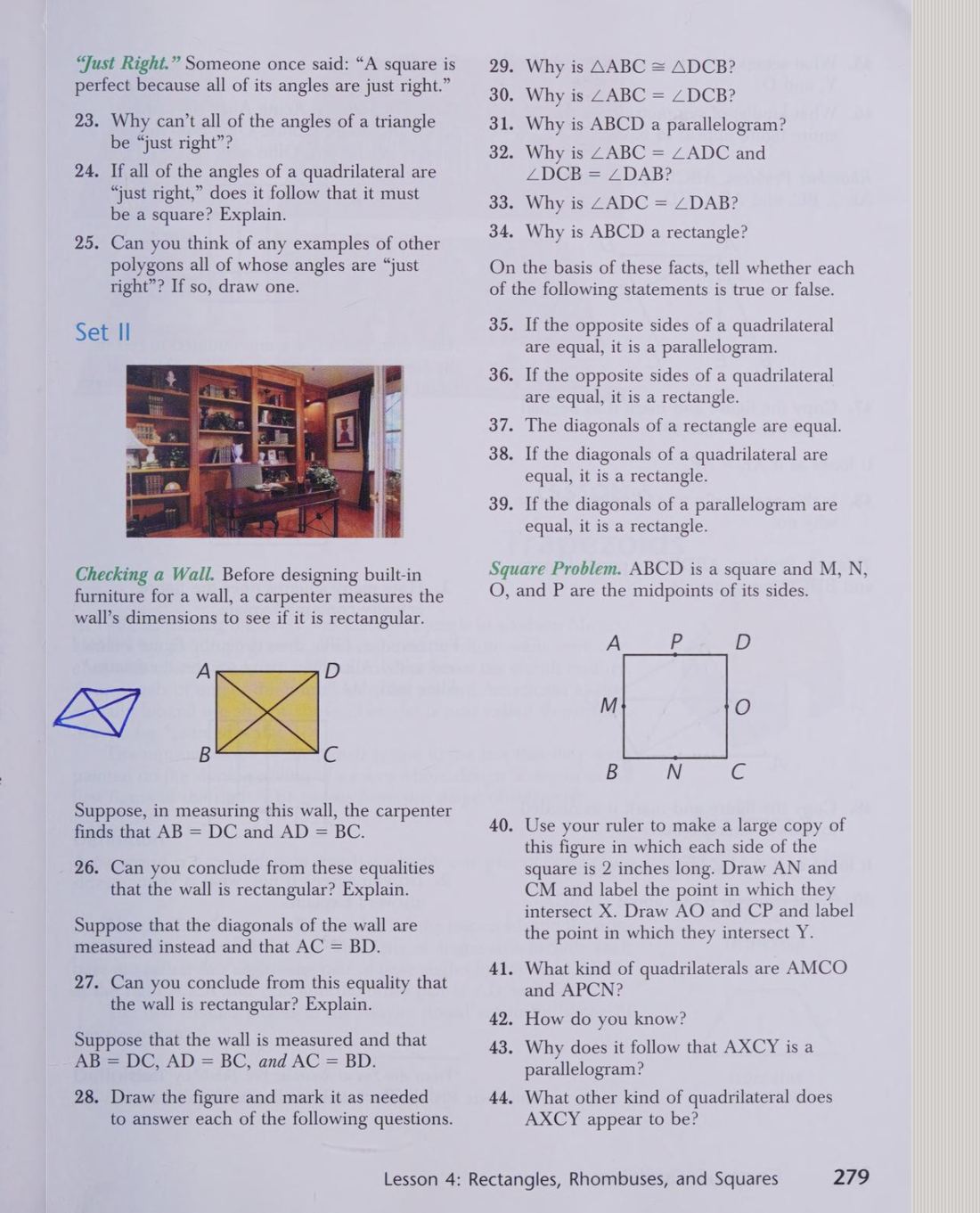
Questions 26 to 39: certifying the carpenter's wall
Measuring a wall: equal opposite sides alone, equal diagonals alone, or both: which combination proves it rectangular?
- Question 26: AB = DC and AD = BC certify only a parallelogram (Theorem 27); a leaning parallelogram passes the same tape-measure test. Not enough.
- Question 27: AC = BD alone is worse: an isosceles trapezoid has equal diagonals too (Theorem 36, two pages ahead). Not enough.
- Questions 28 to 34, both together: SSS on the diagonal triangles gives ∠ABC = ∠DCB; the parallelogram makes opposite angles equal; so all four angles are equal, and the equiangular corollary stamps it a rectangle.
- Questions 35 to 39, the true-false harvest: equal opposite sides make a parallelogram (true), a rectangle (false); a rectangle's diagonals are equal (true); equal diagonals make a rectangle (false); equal diagonals in a parallelogram make a rectangle (true, the carpenter's actual theorem).
- So the professional protocol is two tapes: opposite sides, then diagonals. If both pairs pass, the wall is square-cornered, no protractor on site. Theorem 30's rope-builders and this carpenter are using the same mathematics from opposite ends.
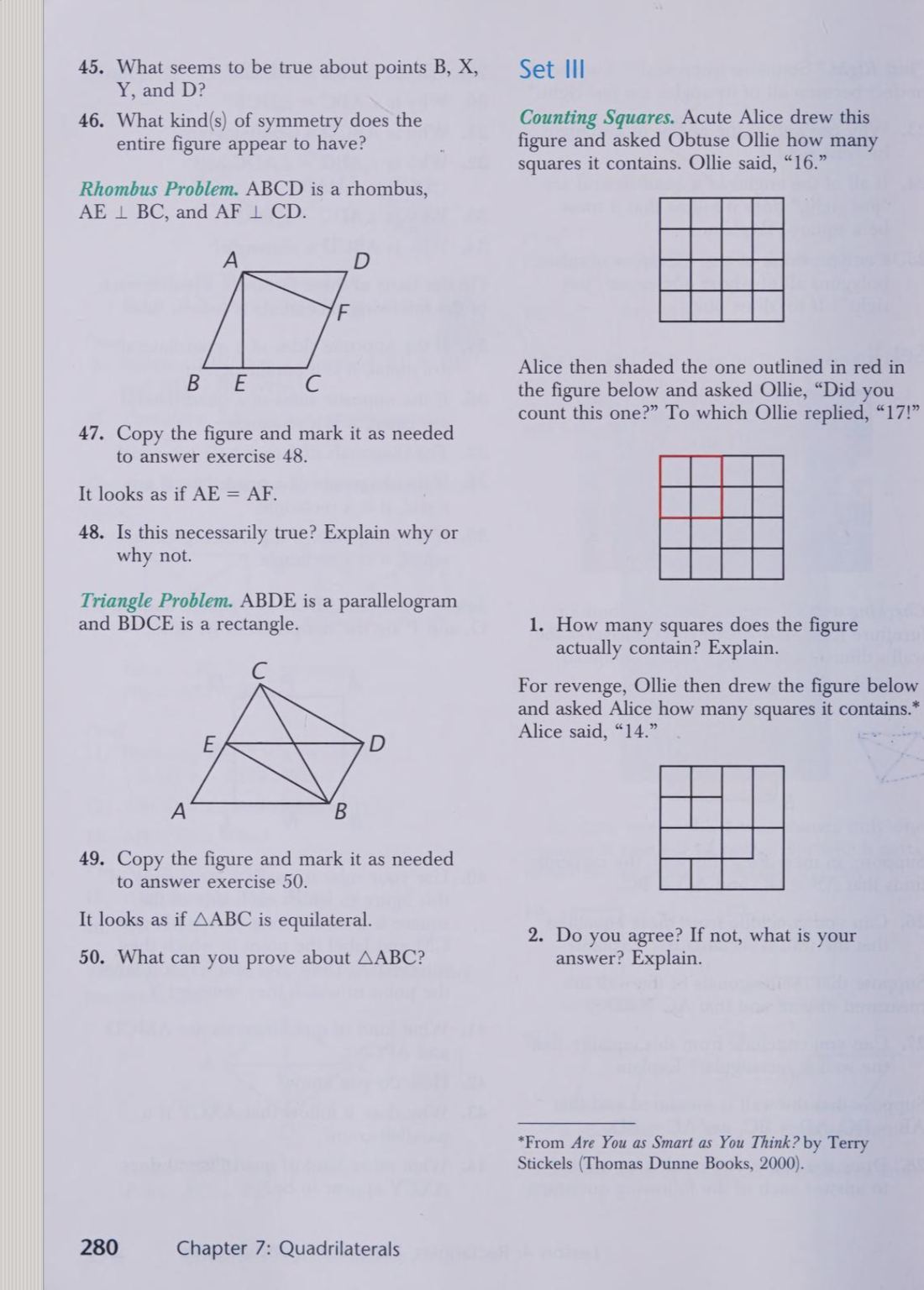
Questions 47 to 50: two quick proofs
47 and 48: in rhombus ABCD with AE ⊥ BC and AF ⊥ CD, is AE = AF necessarily? 49 and 50: ABDE is a parallelogram and BDCE a rectangle; what can you prove about △ABC?
- Rhombus first: mark AB = AD (rhombus sides) and ∠B = ∠D (opposite angles of the parallelogram it is, Theorem 25).
- With the right angles at E and F, AAS gives △ABE ≅ △ADF, and corresponding parts deliver AE = AF: yes, necessarily. A rhombus stands equally tall over both pairs of sides.
- Triangle problem: in parallelogram ABDE, the opposite sides AB and DE are equal (Theorem 25).
- In rectangle BDCE, the segments BC and DE are the two diagonals, and a rectangle's diagonals are equal (Theorem 33): BC = DE. Chain the equalities: AB = DE = BC, so AB = BC.
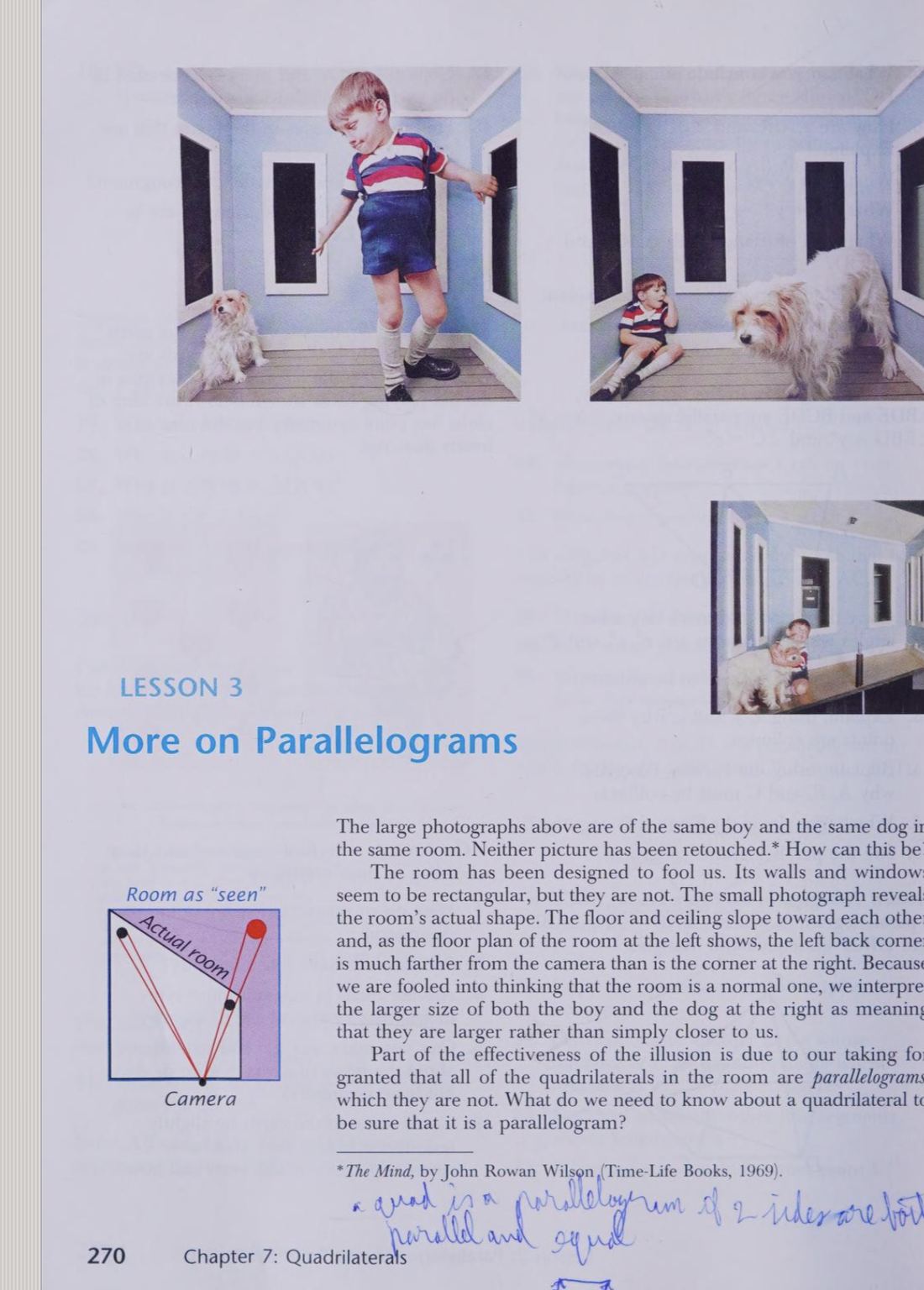
- So question 50's answer: you can prove △ABC is isosceles, and no more. Equilateral is how the figure happens to be drawn, not what the givens force; a taller rectangle keeps every given and stretches AC. "What can you prove" and "what does it look like" are different questions, the Ames room's lesson one more time.
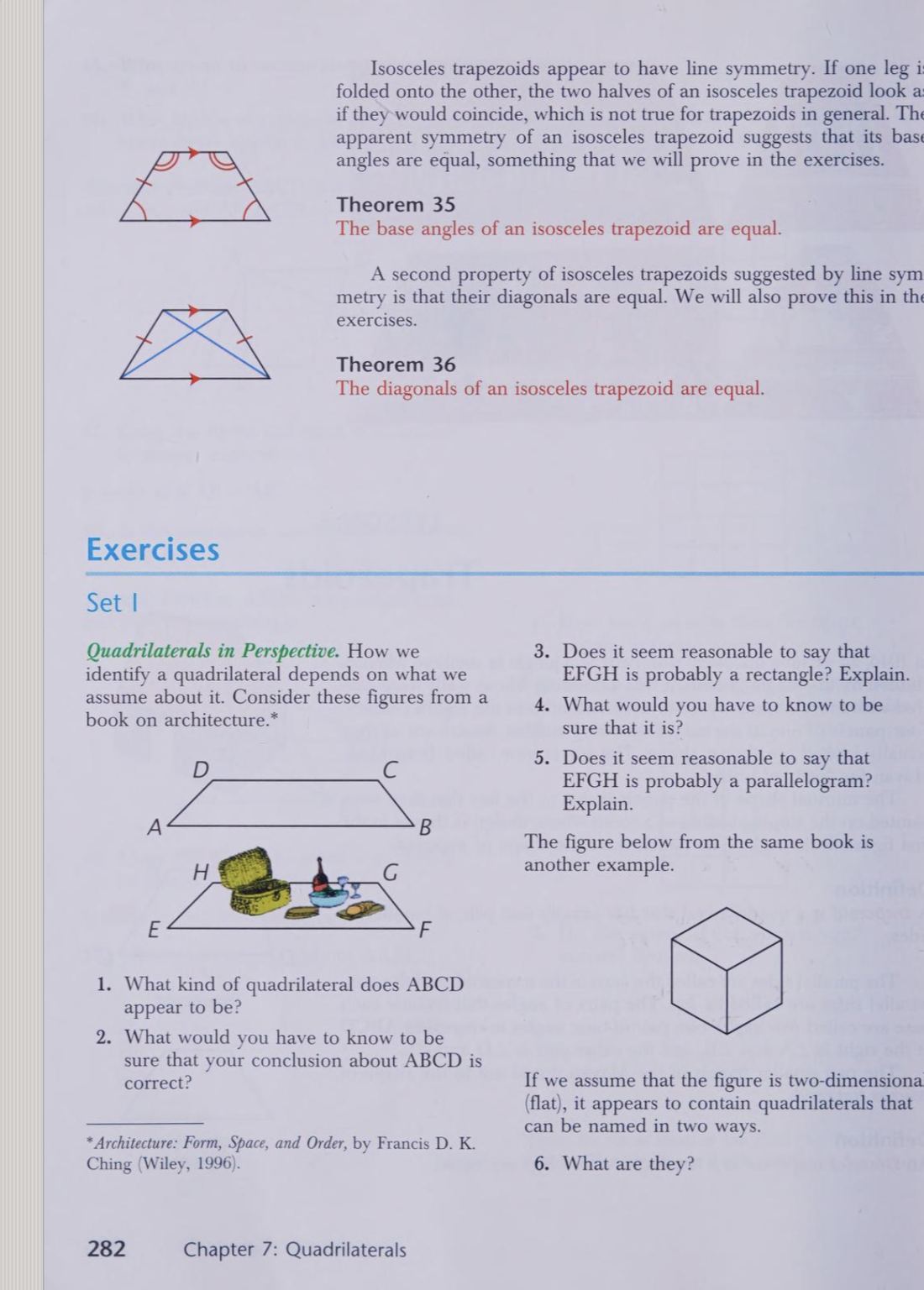
Questions 1 to 7: what you see versus what you know
A drawn tabletop ABCD and picnic cloth EFGH: what do they appear to be, and what would certainty cost? The cube drawing: name its quadrilaterals flat and solid.
- Questions 1 and 2: ABCD appears to be a trapezoid (one pair of sides drawn parallel). Certainty needs exactly the definition: that DC ∥ AB and that the other pair is not parallel. Two facts, neither readable from ink alone.
- Questions 3 to 5: EFGH is probably drawn as a perspective rectangle, but as drawn it is a trapezoid shape; to be sure of "rectangle" you would need four right angles, and even "parallelogram" needs both parallelisms. Reasonable and certain are different currencies.
- Questions 6 and 7: the cube figure, read flat, holds quadrilaterals nameable two ways: rhombi and parallelograms (equal sides drawn, opposite sides parallel).
- Read solid, the same faces earn four names: parallelogram, rhombus, rectangle, square, because a cube's faces are squares and squares carry the whole family tree. One drawing, two ontologies, four names; assumptions are load-bearing.
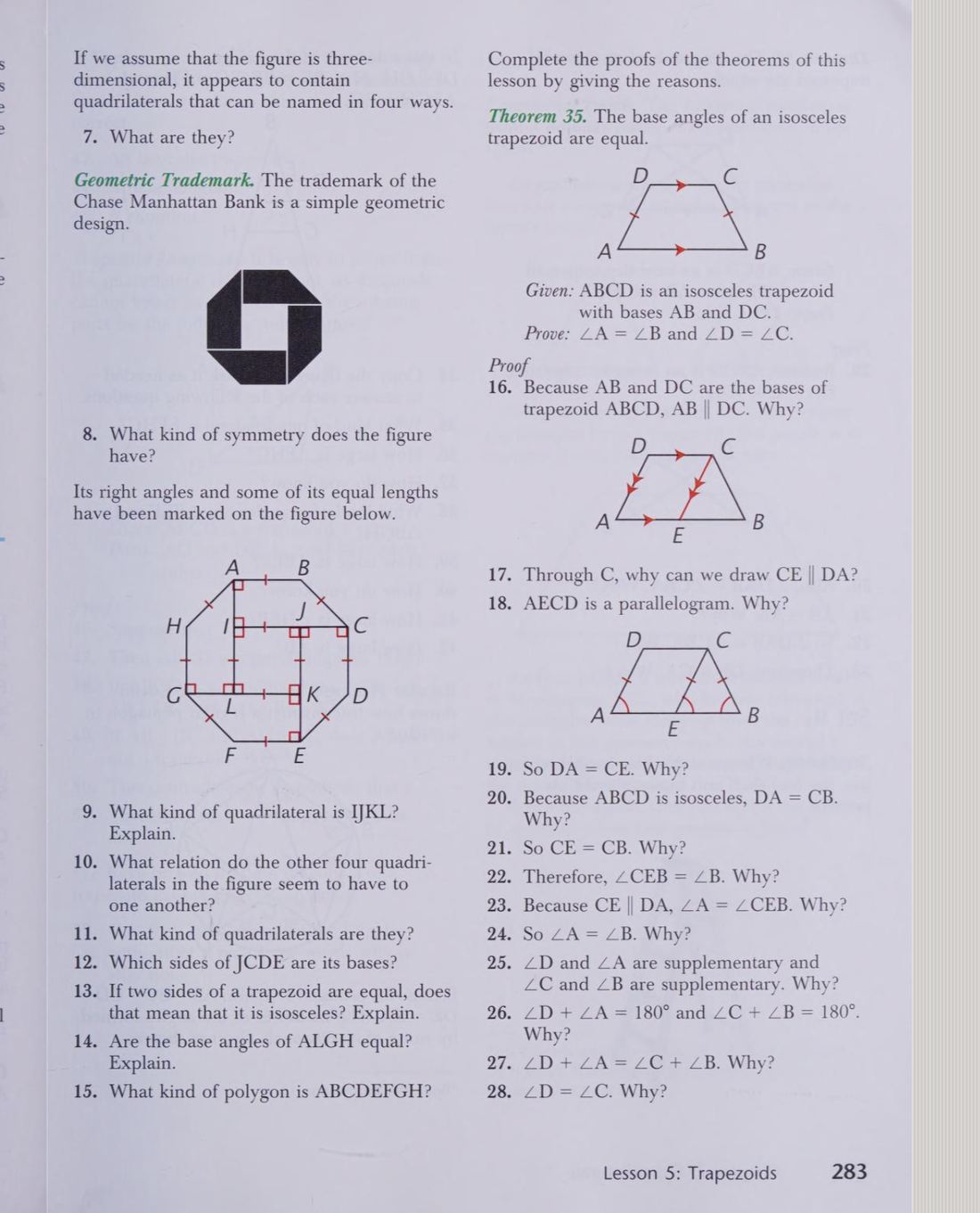
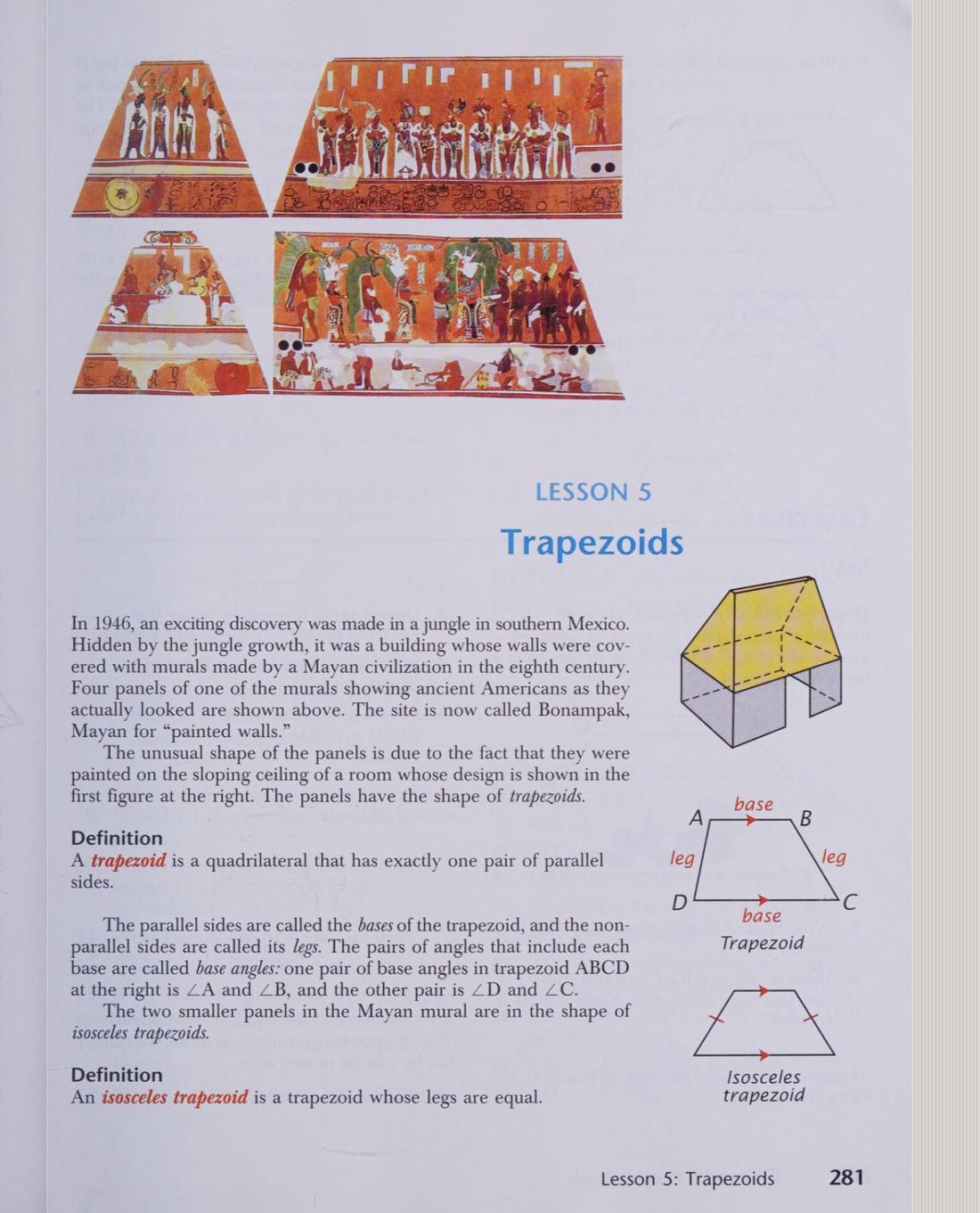
Questions 16 to 28: base angles of an isosceles trapezoid
ABCD is an isosceles trapezoid with bases AB and DC. Prove ∠A = ∠B and ∠D = ∠C.
- Questions 16 to 18: AB ∥ DC (bases are the parallel pair), and through C the Parallel Postulate permits CE ∥ DA; with both pairs parallel, AECD is a parallelogram.
- Questions 19 to 21: DA = CE (opposite sides of that parallelogram) and DA = CB (isosceles legs), so CE = CB by substitution: triangle CEB is isosceles.
- Question 22: its base angles are equal: ∠CEB = ∠B (Theorem 9, the old bridge of asses).
- Questions 23 and 24: CE ∥ DA makes ∠A = ∠CEB (corresponding angles), and substitution chains ∠A = ∠B: the first pair of base angles.
- Questions 25 to 28: same-side interior angles make ∠D supplementary to ∠A and ∠C to ∠B; equal angles have equal supplements, so ∠D = ∠C. The translated leg converted a trapezoid theorem into an isosceles-triangle theorem, a trick worth stealing for the rest of the course.
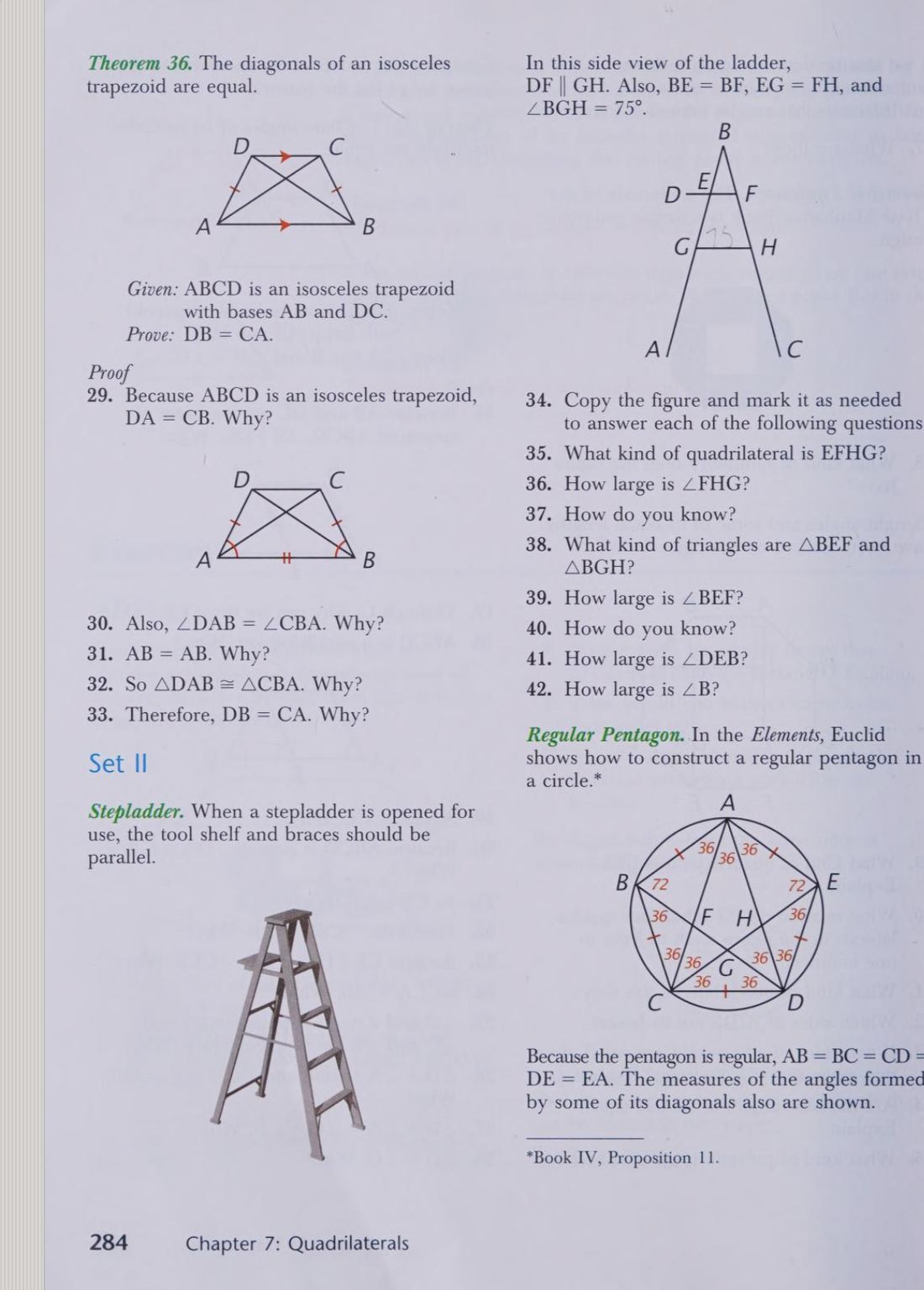
Questions 34 to 42: the stepladder
DF ∥ GH, BE = BF, EG = FH, and ∠BGH = 75°. Classify EFHG, find ∠FHG, classify the triangles, and find ∠BEF, ∠DEB, and ∠B.
- Question 35: the shelf EFHG has its top EF on line DF, so EF ∥ GH by the given, and its legs EG = FH are equal: an isosceles trapezoid.
- Questions 36 and 37: Theorem 35 makes its base angles equal: ∠FHG = ∠EGH = 75°.
- Question 38: BE = BF makes △BEF isosceles, and △BGH likewise (its base angles both 75).
- Questions 39 to 41: with EF ∥ GH, corresponding angles give ∠BEF = ∠BGH = 75°, and the linear pair at E gives ∠DEB = 105°.
- Question 42: the angle sum in △BGH (or BEF): ∠B = 180 − 75 − 75 = 30°. A ladder's safe spread, certified by one trapezoid theorem and two isosceles triangles; carry a protractor to the hardware store or carry this page.
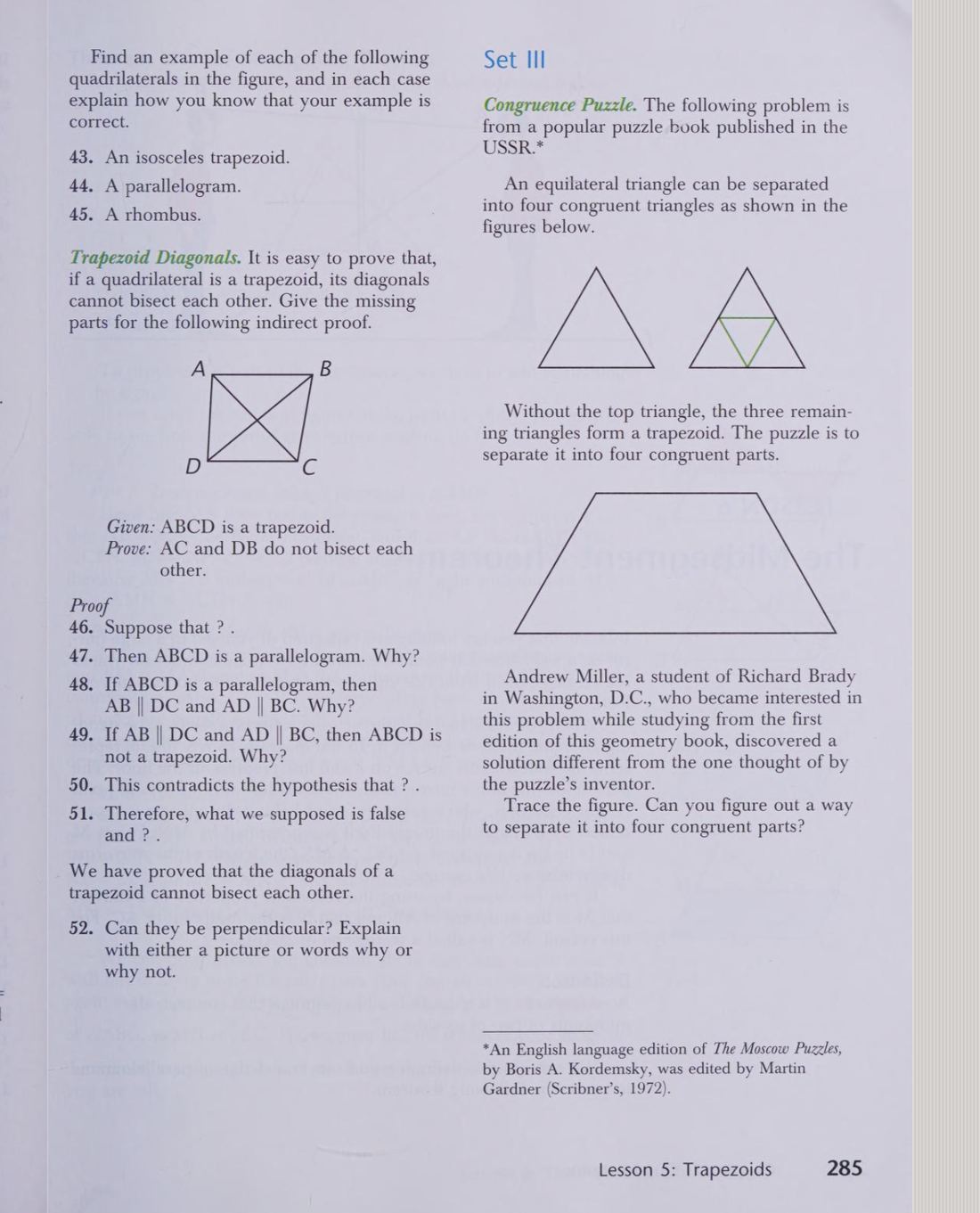
Questions 46 to 51: diagonals that refuse to bisect
ABCD is a trapezoid. Prove its diagonals AC and DB cannot bisect each other.
- Question 46: suppose they do bisect each other; the indirect door opens with the opposite of the claim.
- Question 47: bisecting diagonals is Theorem 30's test: ABCD would be a parallelogram.
- Question 48: a parallelogram has AB ∥ DC and AD ∥ BC, the definition.
- Questions 49 and 50: two parallel pairs contradict the trapezoid's "exactly one pair"; ABCD would not be a trapezoid, against the given.
- Question 51: the supposition dies: a trapezoid's diagonals never bisect each other. The families are disjoint by theorem, not by taste, and the five parallelogram tests from page 271 now double as trapezoid detectors: fail them all and exactly-one parallelism is still alive.