Questions 1 to 5: proving the 360
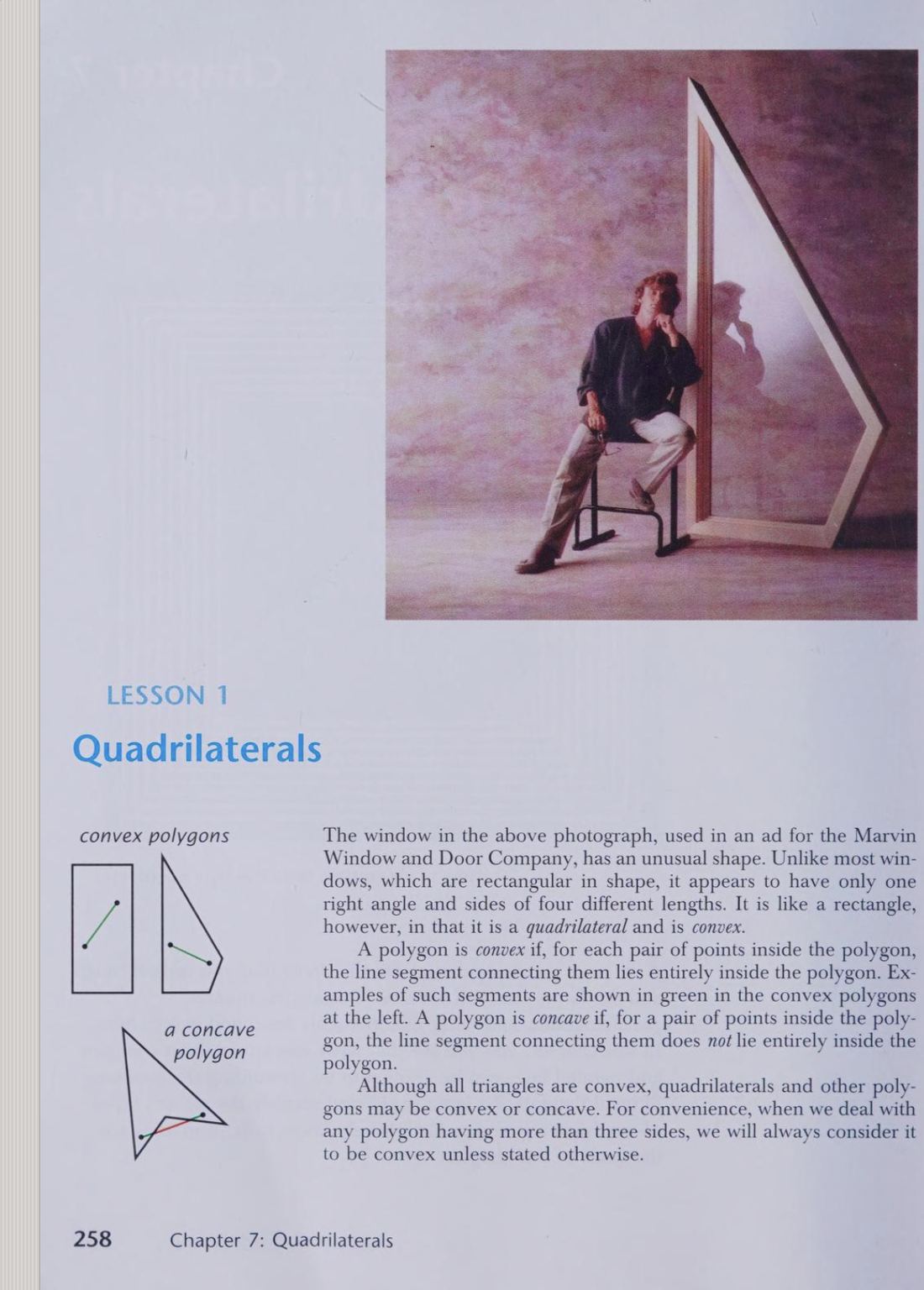
ABCD is a quadrilateral. Prove ∠A + ∠B + ∠C + ∠D = 360°, giving each reason.
- Question 1: draw diagonal BD; two points determine a line. One segment, two triangles.
- Question 2: each triangle's angles total 180 (the Angle Sum Theorem, twice): ∠A + ∠1 + ∠4 = 180 and ∠2 + ∠3 + ∠C = 180.
- Question 3: add the equations: the six pieces total 360 (addition property).
- Question 4: ∠1 + ∠2 = ∠ABC and ∠3 + ∠4 = ∠CDA, the Betweenness of Rays Theorem reassembling the split corners.
- Question 5: substitute the sums back in: ∠A + ∠ABC + ∠C + ∠CDA = 360°. One diagonal, two 180s, and the quadrilateral's budget is fixed forever, the number your kite figures and SAT problems have been spending since page 160.
Questions 26 and 27: the SAT quadrilateral
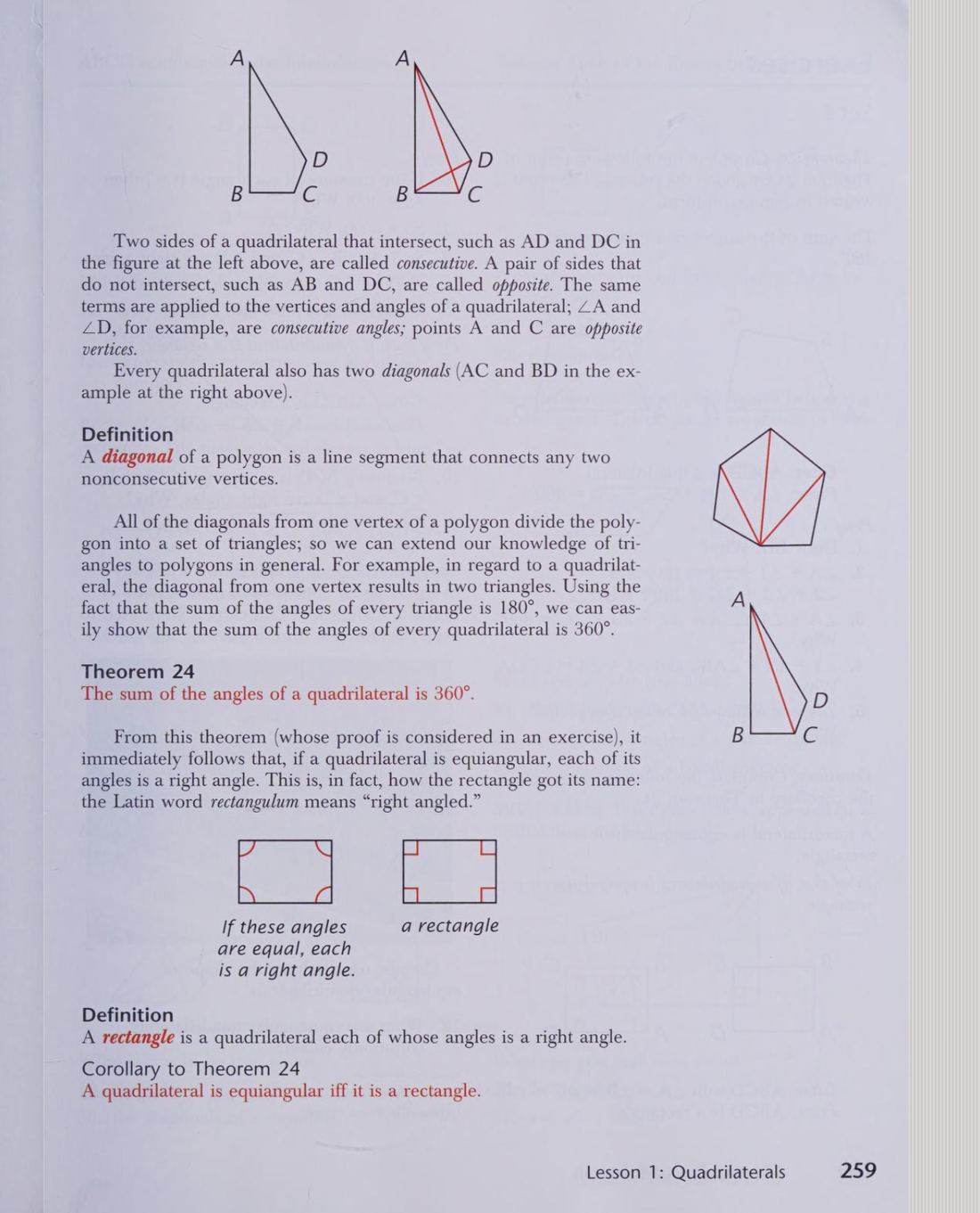
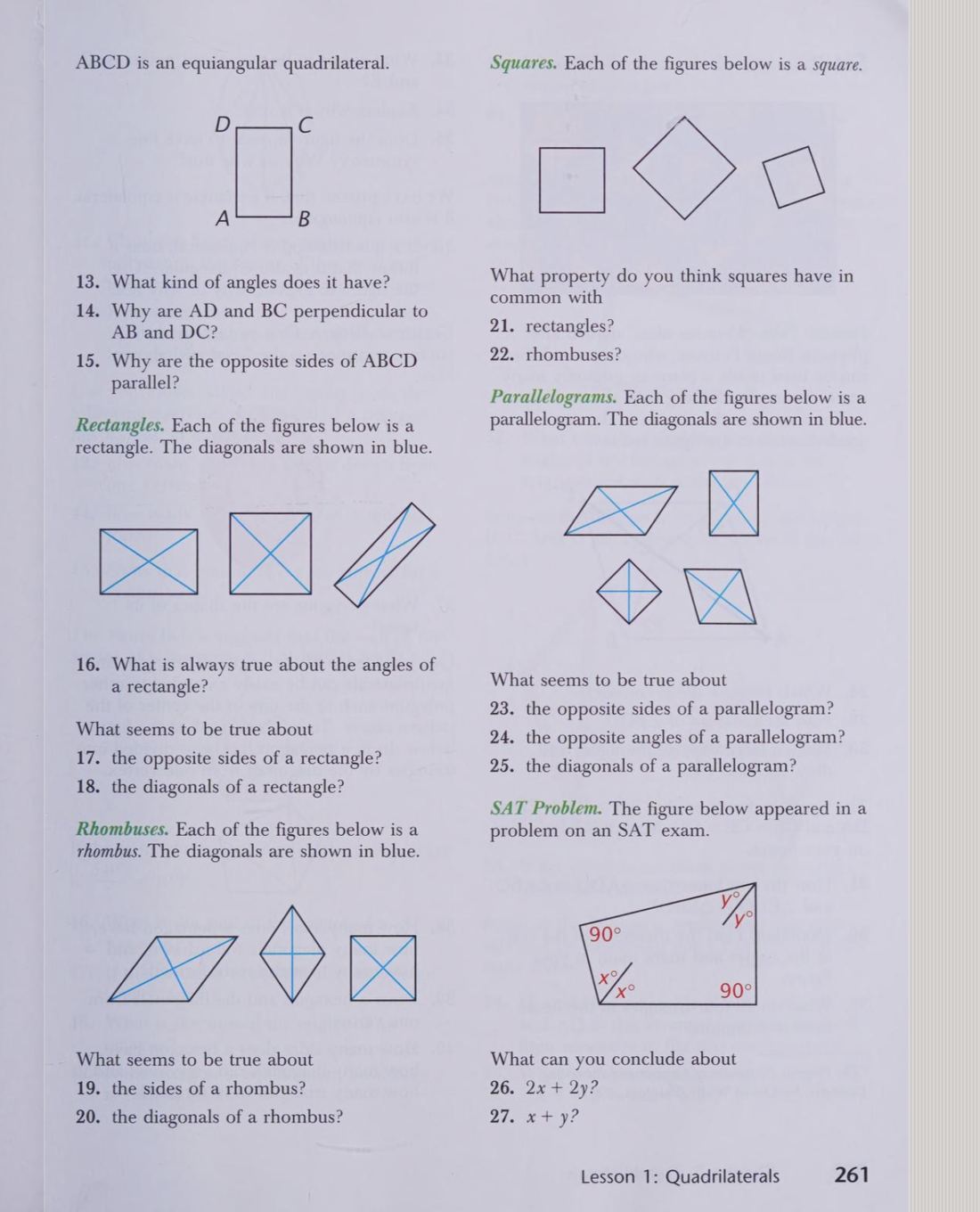
A quadrilateral has two right angles, and its other two angles measure 2x° and 2y° (each marked as two equal halves x, x and y, y). What can you conclude about 2x + 2y and about x + y?
- Theorem 24 taxes every quadrilateral 360°: 90 + 90 + 2x + 2y = 360.
- Question 26: subtract the two right angles: 2x + 2y = 180.
- Question 27: divide by 2: x + y = 90; the half-angles are complementary.
- Note what the figure was hinting with its bisected corners: the two bisecting rays would meet at a right angle, page 121's linear-pair-bisector fact in quadrilateral form. The SAT wanted two subtractions; the geometry offers a bonus theorem to anyone who keeps looking.
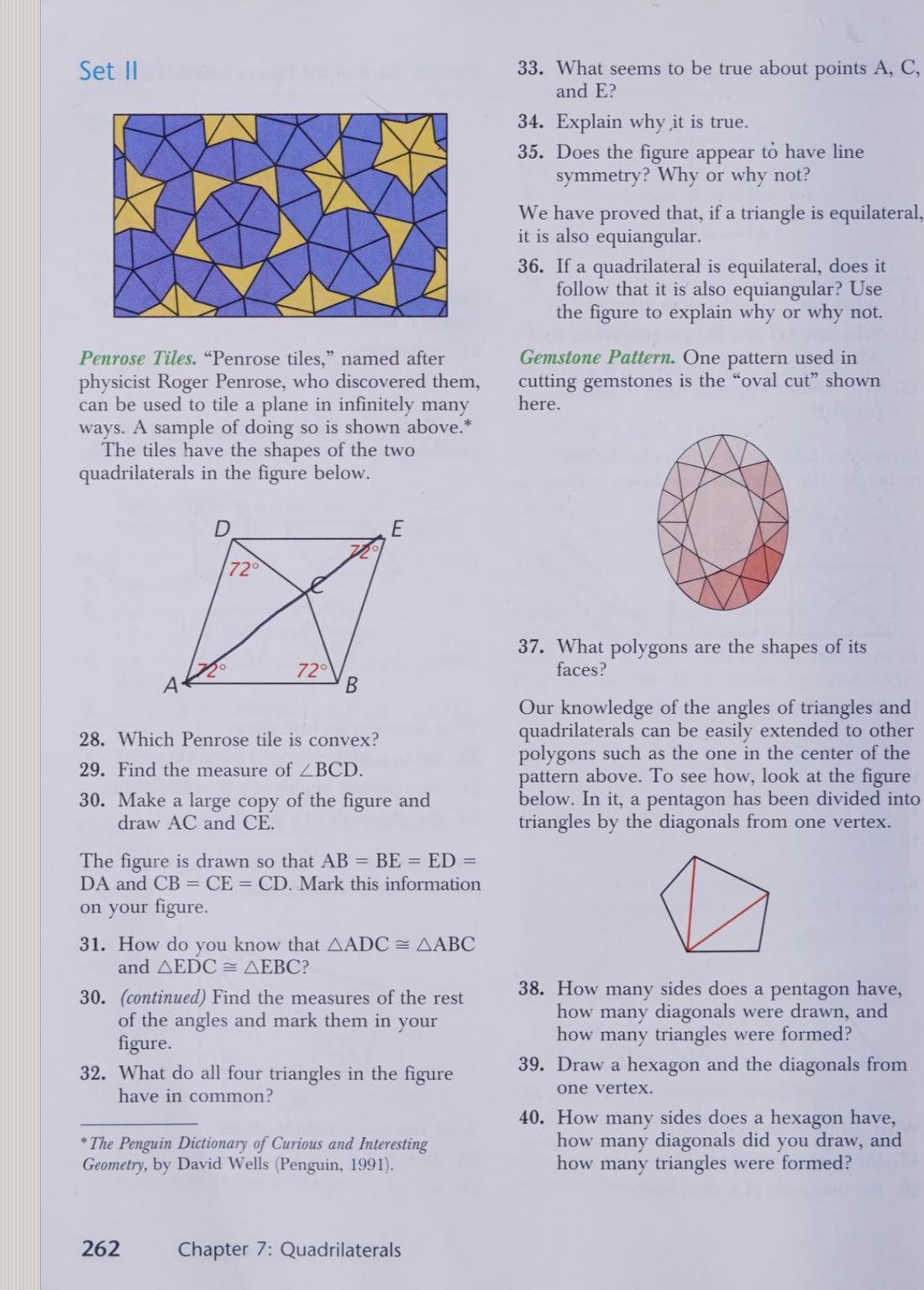
Questions 28 to 35: inside the Penrose kite
In the figure, AB = BE = ED = DA and CB = CE = CD, with 72° angles marked at A (twice), D, and E. Which tile is convex, what is ∠BCD, and why are A, C, E collinear?
- Question 28: of the two tiles, the kite is convex; the dart's pushed-in corner fails the page 258 segment test (an interior segment can escape through the notch).
- Question 29: apply Theorem 24 to the quadrilateral holding the three 72s: ∠BCD = 360 − 72 − 72 − 72 = 144°.
- Question 31: with AB = BE = ED = DA and CB = CE = CD, SSS certifies △ADC ≅ △ABC and △EDC ≅ △EBC; the diagonals split the tiles into matched pairs.
- Questions 32 to 34: all four triangles are isosceles, and chasing their base angles fills in every corner. At C the angles on one side of the line through A and E total exactly 180, so A, C, E are collinear, the straight-angle test from page 168.
- Question 35: the figure folds over line AE (or ACE): line symmetry, with the matched SSS pairs as the two halves. Aperiodic tiling, built from isosceles triangles and one collinearity; five-fold angles hiding in four-sided tiles.
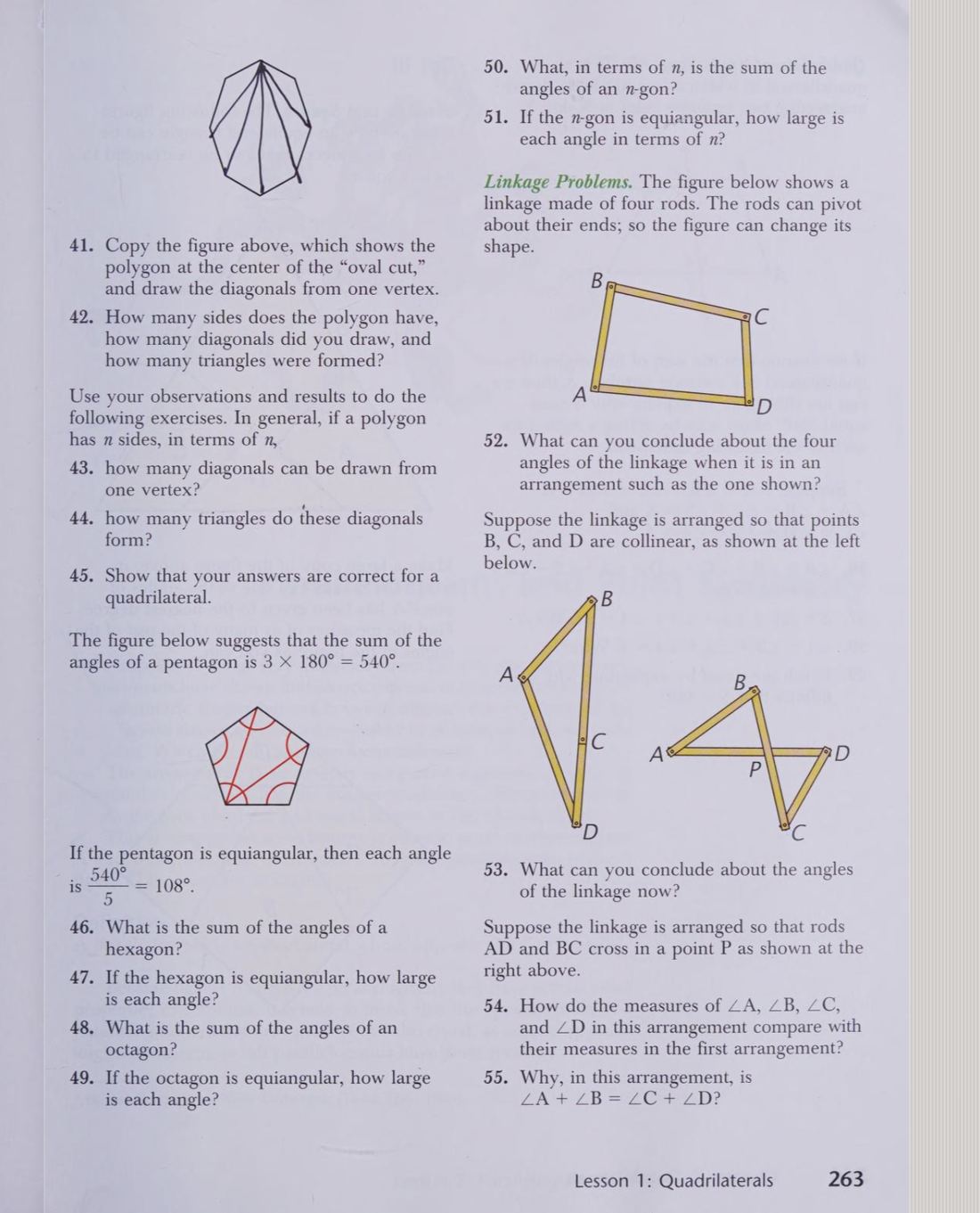
Questions 43 to 51: the n-gon formulas
From the pentagon, hexagon, and oval-cut drawings: how many diagonals from one vertex, how many triangles, what angle sum, and what does each angle of an equiangular n-gon measure?
- Question 43: from one vertex you cannot draw diagonals to itself or its two neighbors: n − 3 diagonals. (Check: pentagon 2, hexagon 3, as your drawings show.)
- Question 44: those diagonals fan the polygon into n − 2 triangles, one more than the diagonal count.
- Question 45, the audit: a quadrilateral gives 4 − 3 = 1 diagonal and 4 − 2 = 2 triangles, exactly page 260's proof.
- Questions 46 to 50: each triangle contributes 180, so the angle sum is (n − 2)180: hexagon 720, octagon 1080, n-gon in general. Equiangular shares equally: hexagon 120°, octagon 135° (the stop sign's corner), and in general (n − 2)180/n.
- Watch the formula's two limits: n = 3 returns the sacred 180, and huge n pushes each angle toward 180 as the polygon rounds toward a circle. One diagonal fan, and every polygon's angle budget is published in advance.
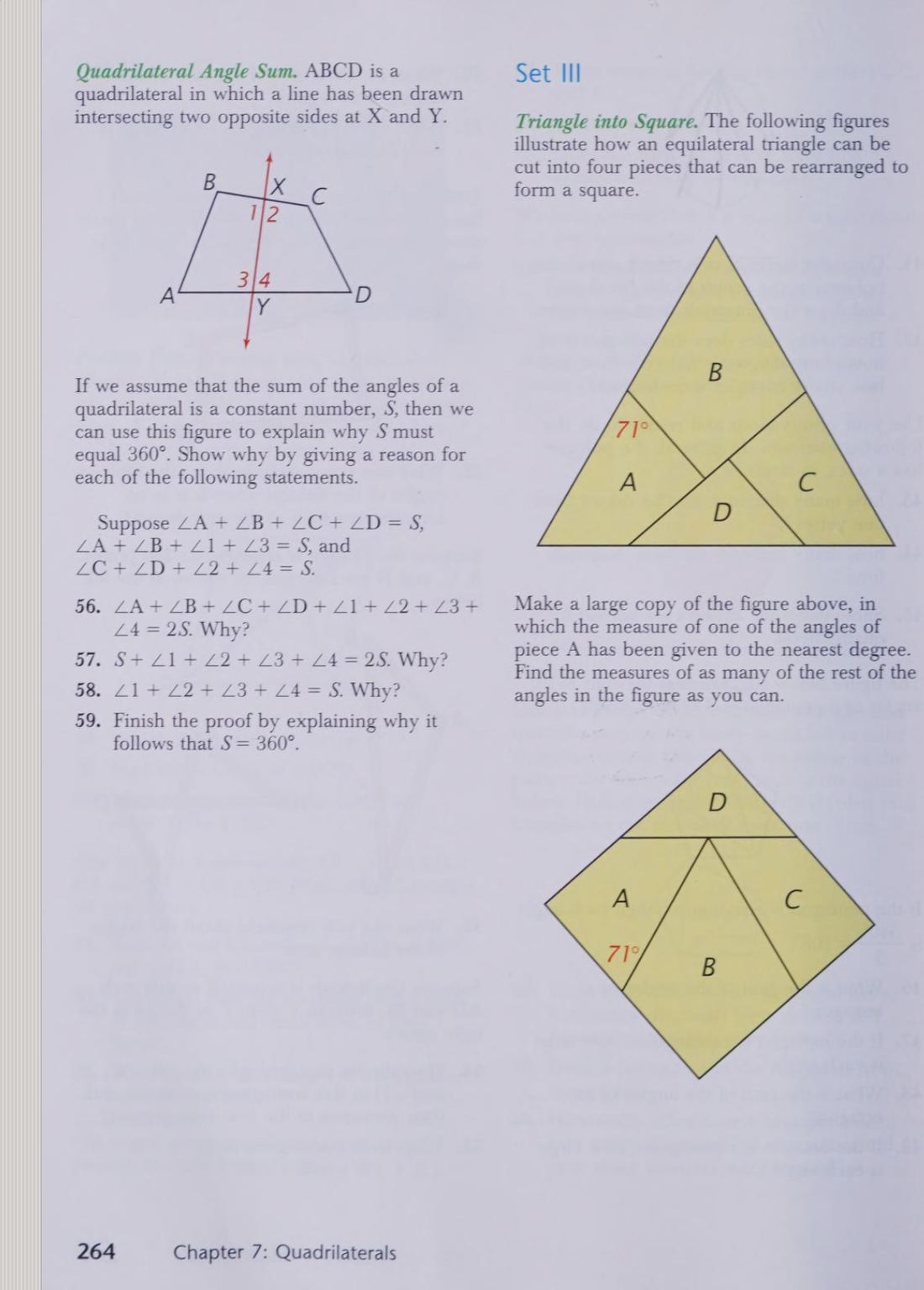
Questions 56 to 59: the sum that fixes itself
Suppose every quadrilateral's angles total the same number S. A line through X on BC and Y on AD splits ABCD into two quadrilaterals. Derive S = 360.
- Write the three assumed equations: the whole quadrilateral gives ∠A + ∠B + ∠C + ∠D = S, and each half quadrilateral gives S too, with the four new angles 1 through 4 at X and Y included.
- Question 56: add the two halves' equations: every original angle appears once, plus all four new angles: total 2S (addition).
- Question 57: substitute S for the original four angles' sum: S + ∠1 + ∠2 + ∠3 + ∠4 = 2S.
- Question 58: subtract S: the four new angles alone total S.
- Question 59: but those four angles are two linear pairs along the cutting line at X and at Y: 180 + 180 = 360. So S = 360, forced by consistency alone. The same style of argument, "if a constant exists, it can only be this," runs deep in mathematics, and this is a perfect first specimen.
Questions 10 to 15: the diagonals bisect each other
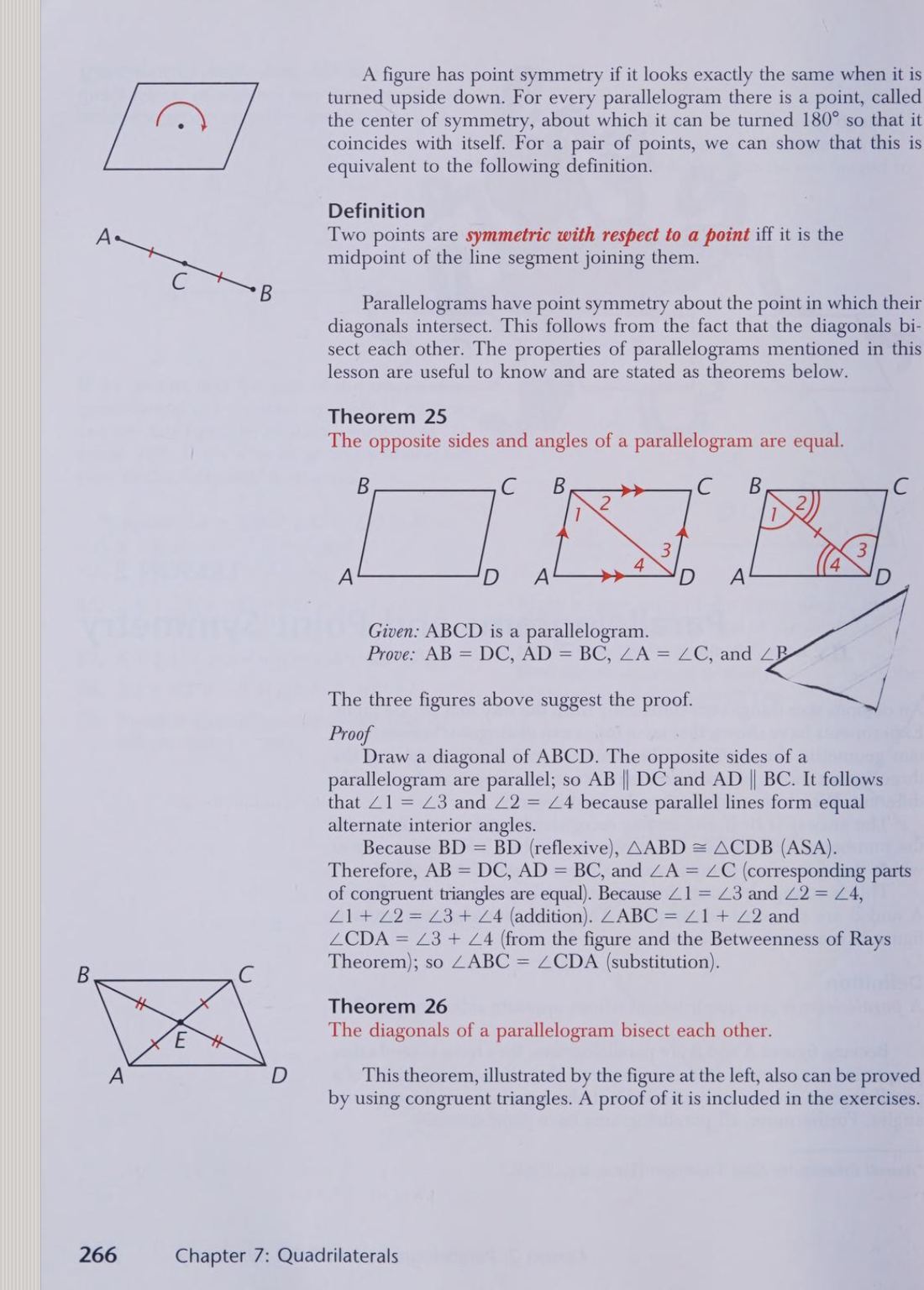
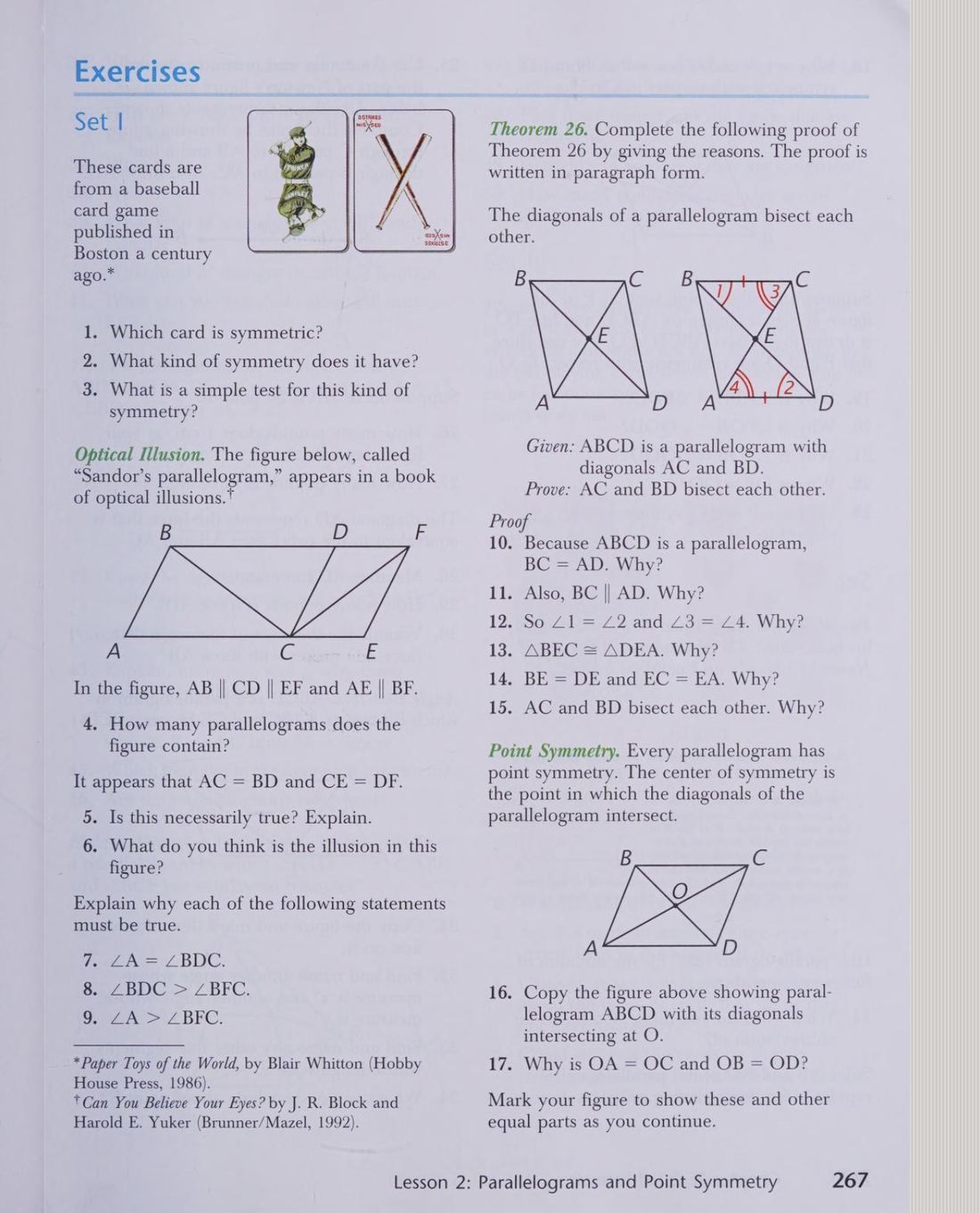
ABCD is a parallelogram with diagonals AC and BD meeting at E. Supply the reasons that they bisect each other.
- Question 10: BC = AD, opposite sides of a parallelogram are equal (Theorem 25, fresh from the previous page).
- Question 11: BC ∥ AD, the definition of a parallelogram itself.
- Question 12: the parallel sides make two pairs of alternate interior angles across the diagonals: ∠1 = ∠2 and ∠3 = ∠4 (Theorem 19's first corollary).
- Question 13: △BEC ≅ △DEA by ASA: two angle pairs flanking the equal sides BC and AD.
- Questions 14 and 15: corresponding parts give BE = DE and EC = EA, and equal halves is what bisecting means. E is the midpoint of both diagonals at once: the parallelogram's center of symmetry, certified. Every point-symmetry claim on the next page stands on this proof.
Questions 24 to 30: Newton's parallelogram of forces
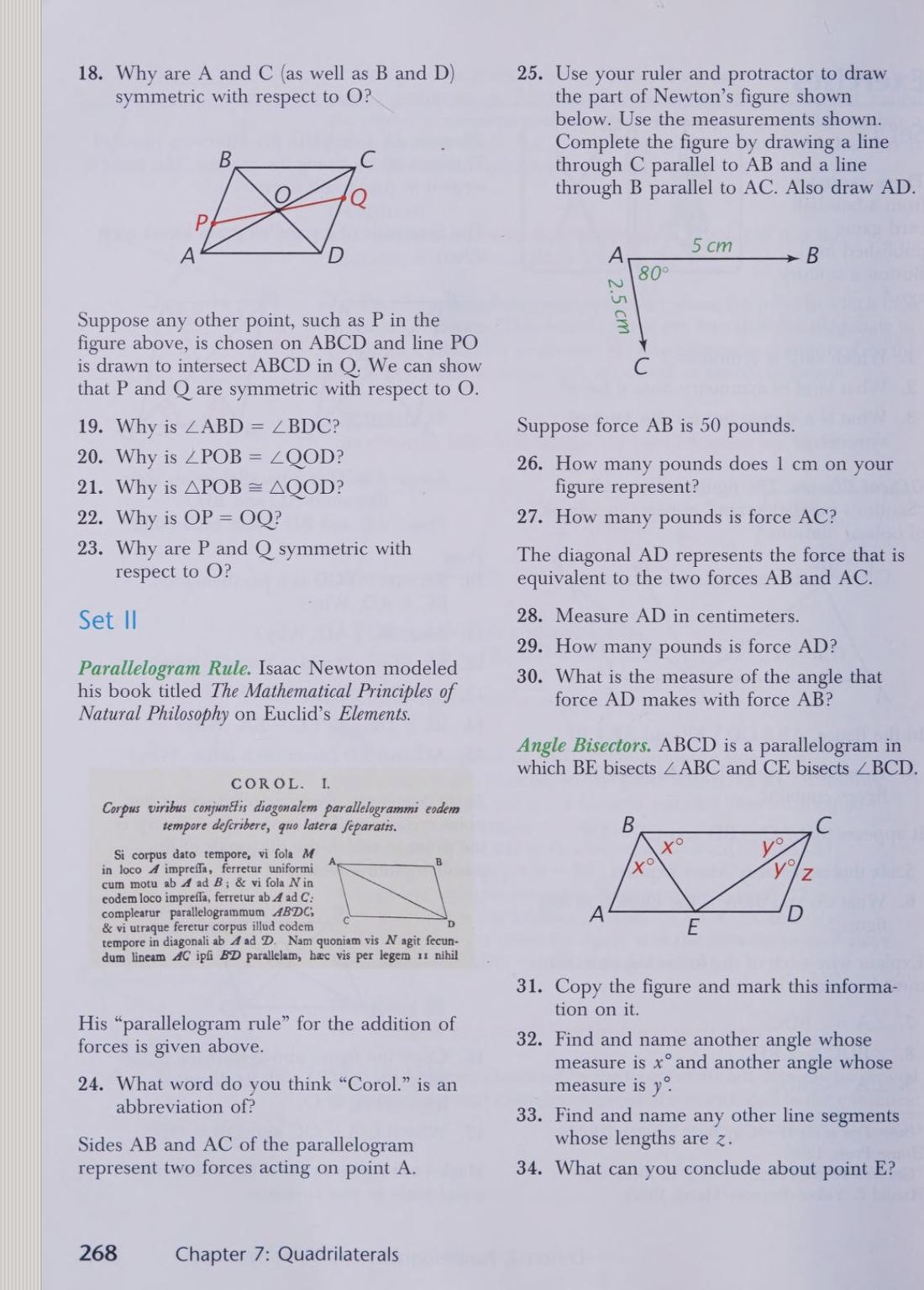
Draw AB = 5 cm and AC = 2.5 cm with an 80° angle at A; complete the parallelogram and draw diagonal AD. If force AB is 50 pounds, read off the rest.
- Question 24: "Corol." abbreviates corollary, and this one is to Newton's laws of motion: forces add along the parallelogram's diagonal. Even his book design copied Euclid.
- Construct with page 225's parallel construction: through C parallel to AB, through B parallel to AC, D at the crossing.
- Questions 26 and 27: 5 cm stands for 50 pounds, so 1 cm is 10 pounds, and force AC = 2.5 × 10 = 25 pounds.
- Questions 28 and 29: measure the diagonal: AD comes out near 5.9 cm, so the combined force is about 59 pounds. Notice it is less than 50 + 25; forces at an angle partly cancel, which the parallelogram displays and arithmetic alone would hide.
- Question 30: the protractor reads roughly 24° between AD and AB: the combined force leans toward the stronger component. Your compass just did vector addition, three centuries before that name existed.
Questions 47 to 50: the hidden equilateral
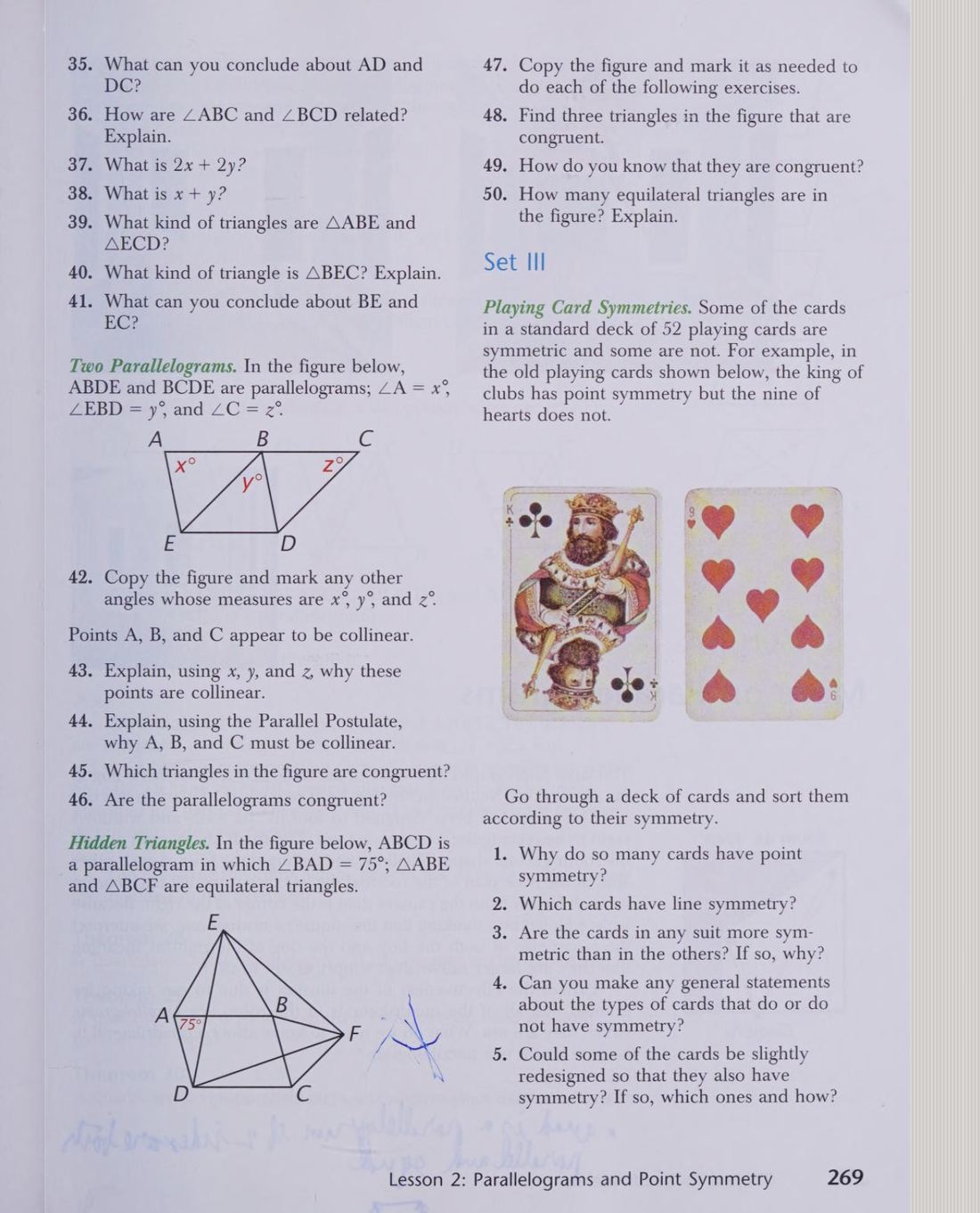
ABCD is a parallelogram with ∠BAD = 75°; equilateral triangles ABE and BCF are built on two of its sides. Find three congruent triangles and count the equilaterals.
- Mark what the figure gives: AE = AB = BE and BF = BC = CF (equilateral sides), plus AB = DC and AD = BC (Theorem 25).
- Chase the angles at each equilateral's corner. The parallelogram gives ∠ABC = 105° (supplement of 75). Then ∠EAD = 60 + 75 = 135°, ∠EBF = 360 − 60 − 60 − 105 = 135°, and ∠FCD = 60 + 75 = 135°: three matching 135s.
- Questions 48 and 49: △EAD, △EBF, and △FCD match by SAS: each holds one equilateral-triangle side, one parallelogram side, and a 135° between them (EA with AD, EB with BF, FC with CD).
- Corresponding parts make ED = EF = FD: triangle DEF is equilateral.
- Question 50's count: three equilateral triangles: the two you built and the one that appeared. This is a cousin of Napoleon's theorem, and it works from any parallelogram angle, 75° being merely the book's choice. Symmetry manufactured, not assumed.