Questions 11 to 18: at least, no more than, exactly
"Exactly one" means at least one and no more than one. Which phrases fit each statement about midpoints, bisectors, intersections, and perpendiculars?
- Question 11 sets the logic: "at least one flea" needs only a find; "no more than one" needs an argument about every flea. The two halves of "exactly" have different prices, existence usually cheap, uniqueness usually dear.
- Questions 12 and 13: a segment has exactly one midpoint, an angle exactly one bisecting ray, both by the corollaries of pages 99 and 100. Both halves proved.
- Questions 14 to 16: a triangle contains no more than one right angle (two would break the angle sum... more carefully here, page 193's two-angles-under-180 theorem), and might contain none: "no more than." Two lines intersect in no more than one point (page 64's theorem); they may not intersect at all. Perpendicularity needs only "at least" one right angle, since one forces the other three.
- Questions 17 and 18: perpendiculars through a point, on the line or off it: exactly one, both proved on page 226.
- Now say the punchline: for parallels through an external point, "at least one" was Construction 7, and "no more than one" is precisely what cannot be proved and had to be postulated. The whole lesson lives in the gap between those two phrases.
Questions 25 to 28: where do they meet?
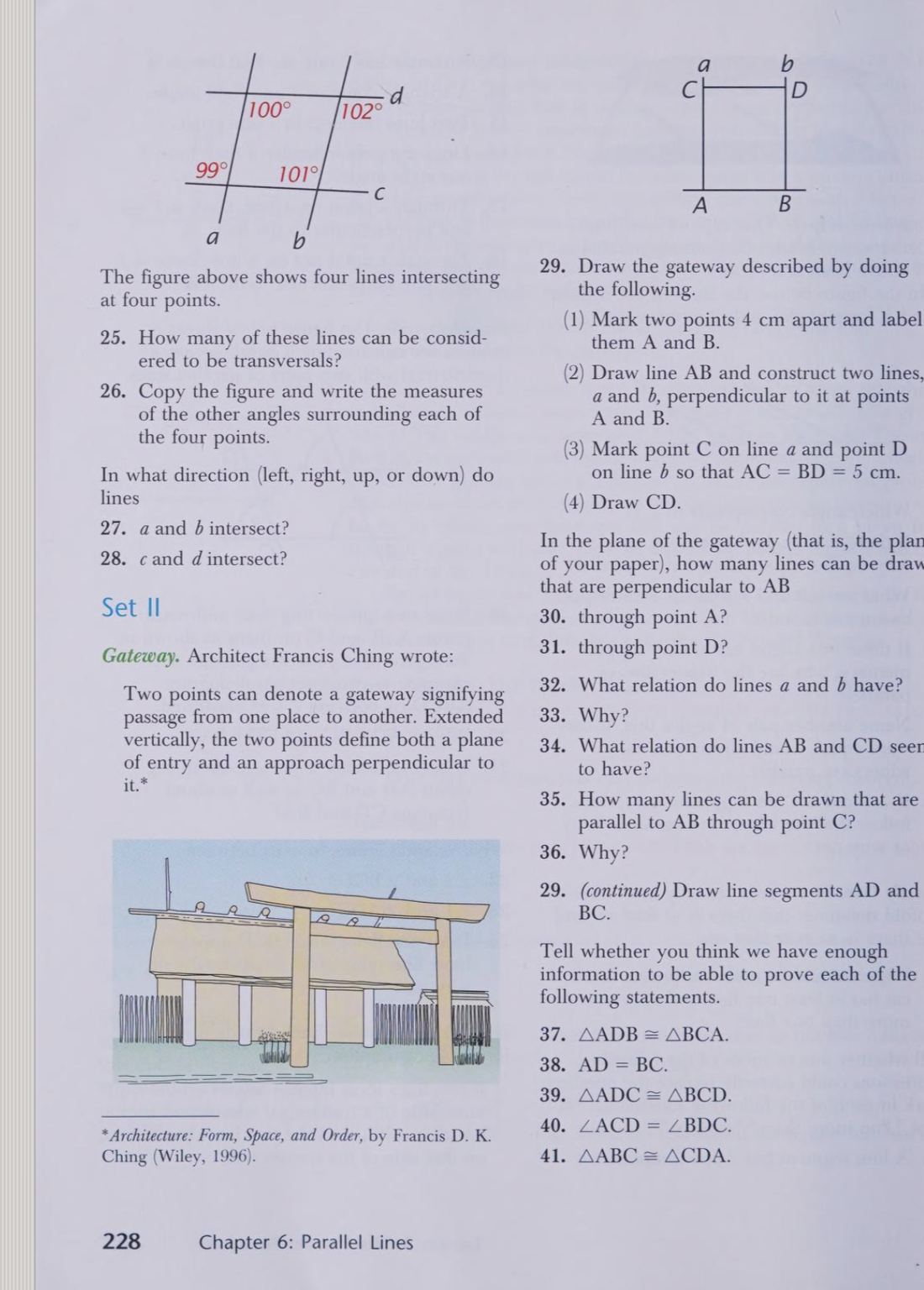
Four lines cross at four points; the marked angles are 100° and 102° at the top crossings, 99° and 101° at the bottom. Which lines are transversals, and in which directions do a and b, then c and d, intersect?
- Question 25: every one of the four lines crosses two others in different points, so all four qualify as transversals; the word names a role, not a species.
- Question 26: fill each crossing with its linear pairs and vertical angles: beside 100° live 80s, beside 102° live 78s, and so on around all four points.
- Question 27: read a and b against transversal c: the same-side interior angles are 100° and 99°, summing 199. Euclid's assumption says nothing there, but the other side's pair sum 80 + 81 = 161 < 180, so a and b meet on that side: to the left.
- Question 28: c and d against transversal b: interior angles 102 and 101 sum over 180, so the meeting is on the opposite side, where 78 + 79 = 157: they intersect downward.
- Notice what you just used: Euclid's Fifth in the raw. It reads clumsier than our Parallel Postulate but it is equivalent, and it does something ours keeps quiet about: it points to where the intersection lies. Two phrasings, one assumption; page 226's history in one exercise.
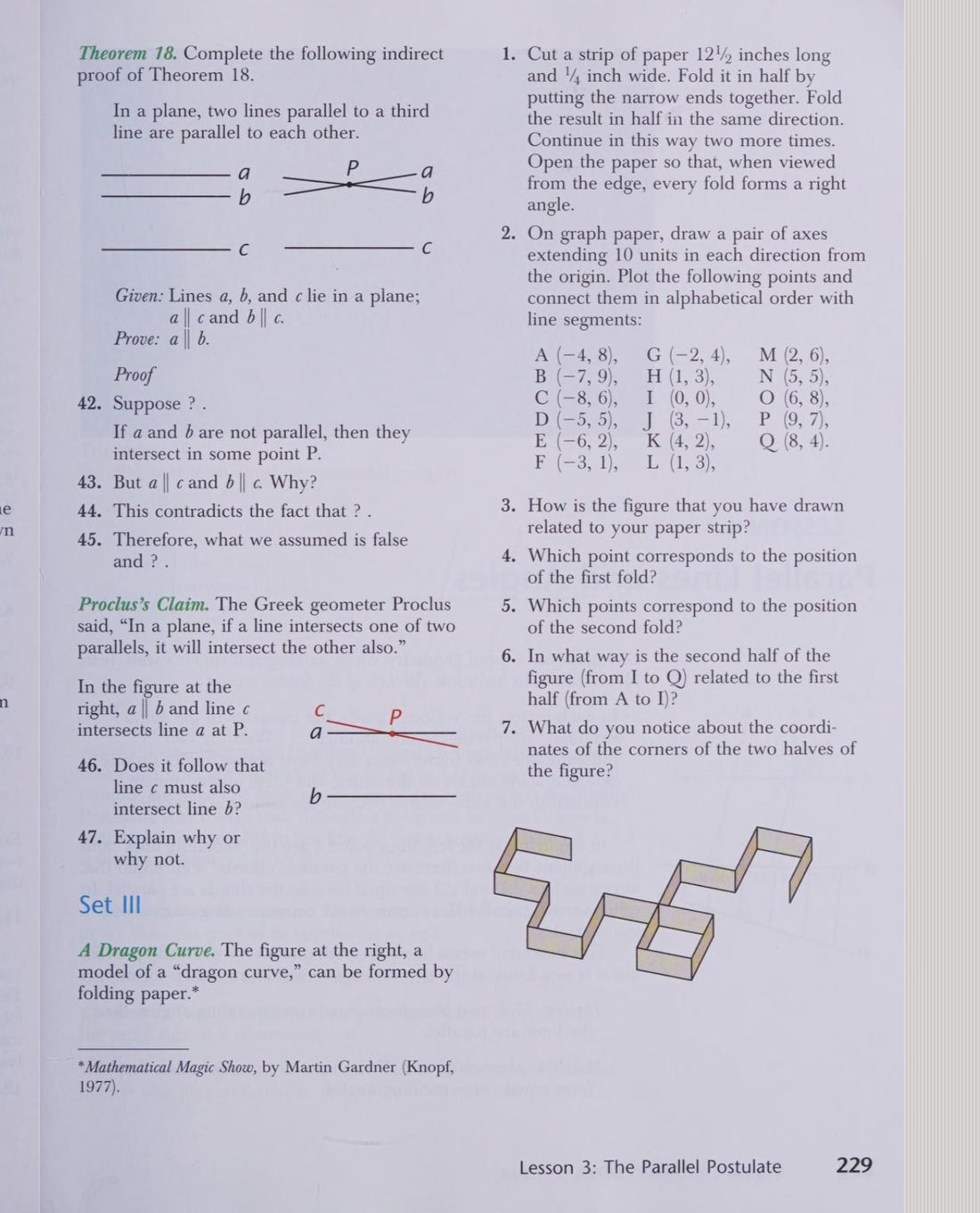
Questions 42 to 45: proving Theorem 18
In a plane, a ∥ c and b ∥ c. Prove a ∥ b indirectly.
- Question 42: suppose a and b are not parallel. Lying in one plane, they must then intersect; call the point P.
- Question 43: a ∥ c and b ∥ c hold by the given, unbothered by our supposition.
- Question 44: but now two different lines through P are both parallel to c, and the Parallel Postulate says through a point not on a line there is exactly one such line. Contradiction.
- Question 45: the assumption dies: a ∥ b.
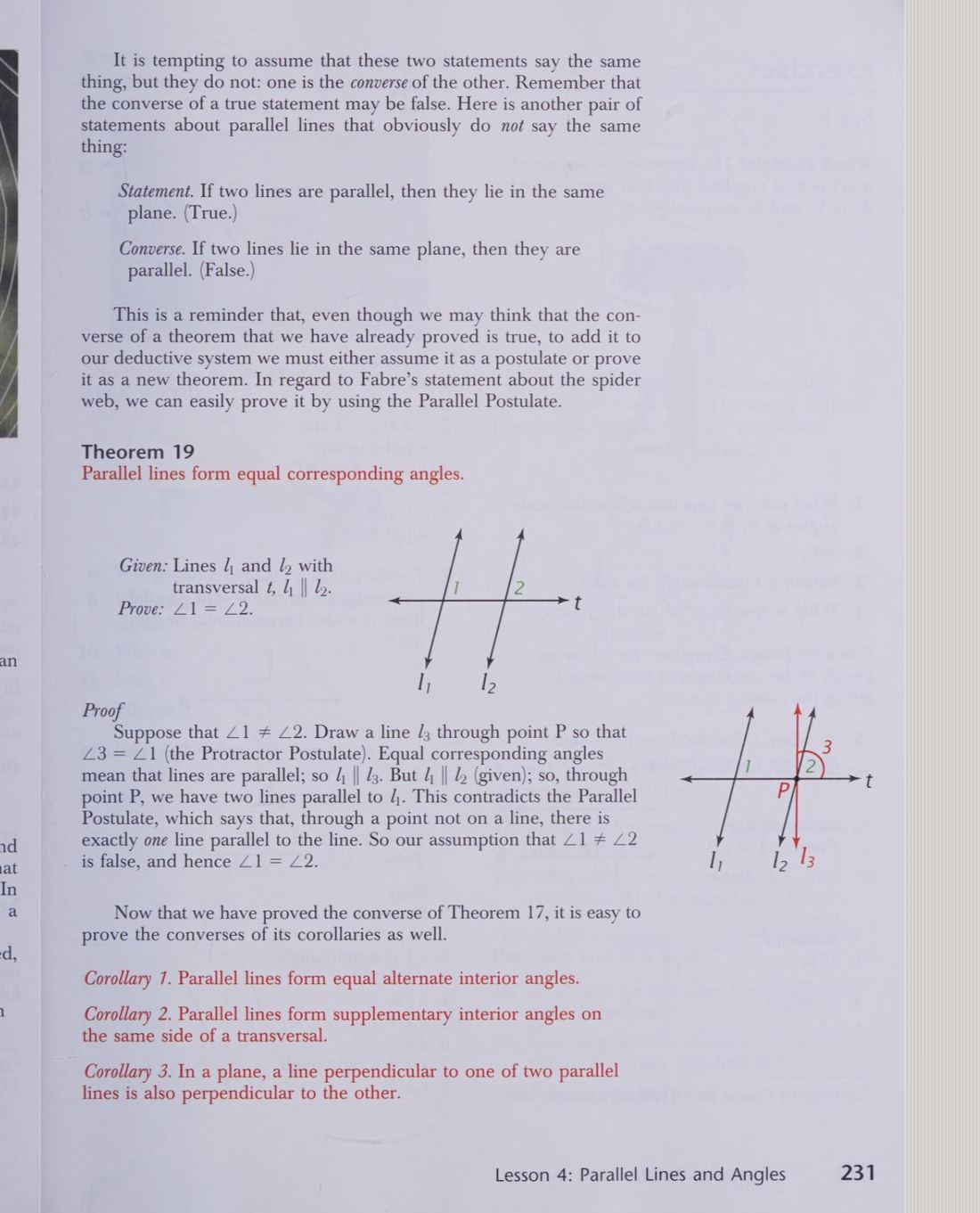
- File the proof's shape: the Parallel Postulate almost always enters proofs exactly this way, as the wall an extra parallel crashes into. Theorem 19 on page 231 uses the same collision, and spotting "two parallels through one point" as an absurdity is the skill both proofs train.
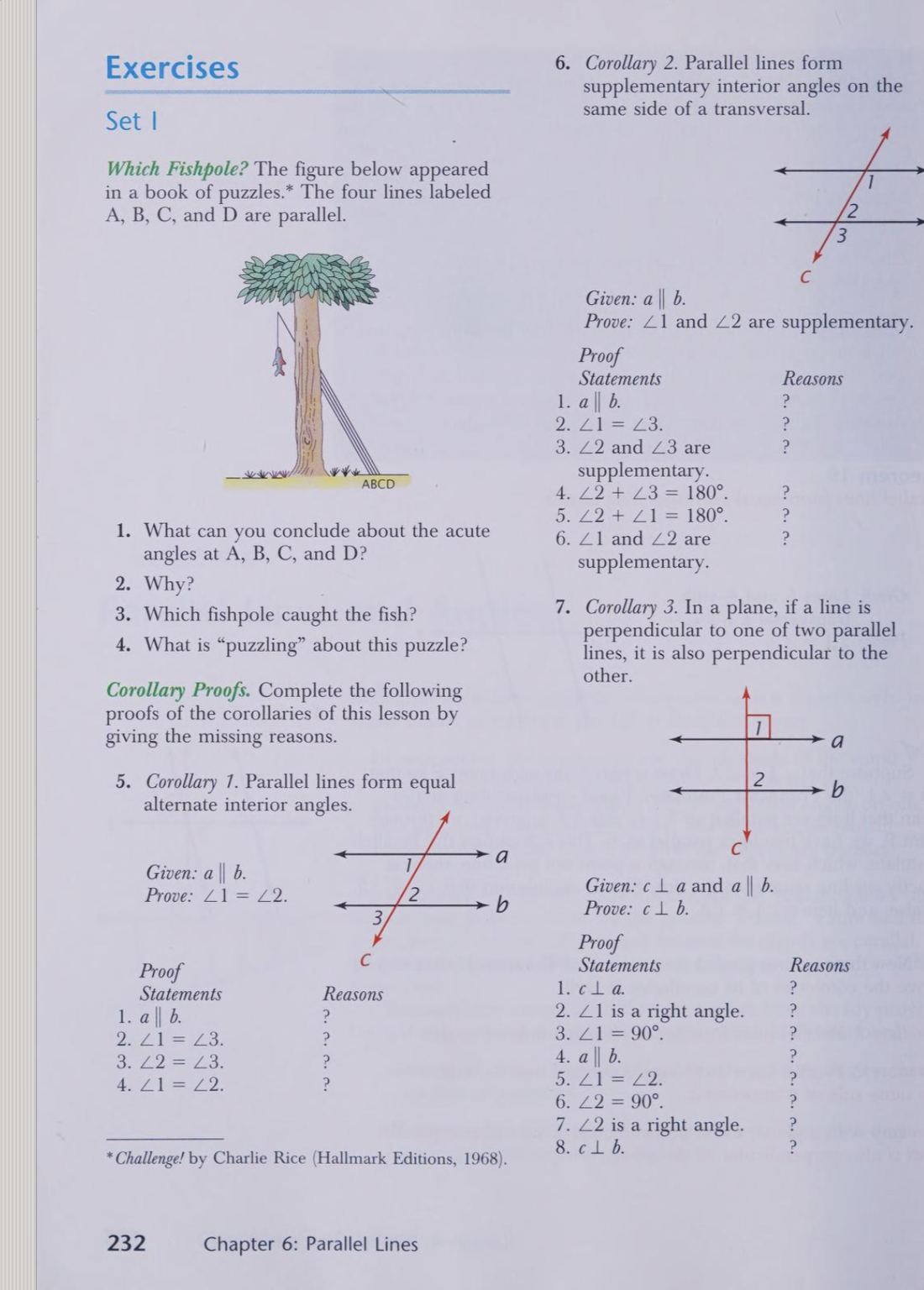
Questions 5 to 7: the three converse corollaries
Supply the reasons: parallel lines form equal alternate interior angles; supplementary same-side interior angles; and a line perpendicular to one of two parallels is perpendicular to the other.
- Question 5: a ∥ b (given); ∠1 = ∠3 (parallel lines form equal corresponding angles, Theorem 19); ∠2 = ∠3 (vertical angles are equal); ∠1 = ∠2 (substitution). The same vertical-angle pivot as page 221, run in reverse.
- Question 6: a ∥ b (given); ∠1 = ∠3 (Theorem 19); ∠2 and ∠3 are supplementary (linear pair); ∠2 + ∠3 = 180; substitute ∠1 for ∠3: ∠2 + ∠1 = 180; so supplementary (definition).
- Question 7: c ⊥ a gives a right ∠1 of 90 (definition of perpendicular, then of right angle); a ∥ b gives ∠1 = ∠2 (Theorem 19); so ∠2 = 90, a right angle, and c ⊥ b (definitions in reverse).
- Self-check by symmetry: page 221's three proofs each ended "equal corresponding angles mean lines are parallel"; these three each begin "parallel lines form equal corresponding angles." Six proofs, one hinge, both swings.
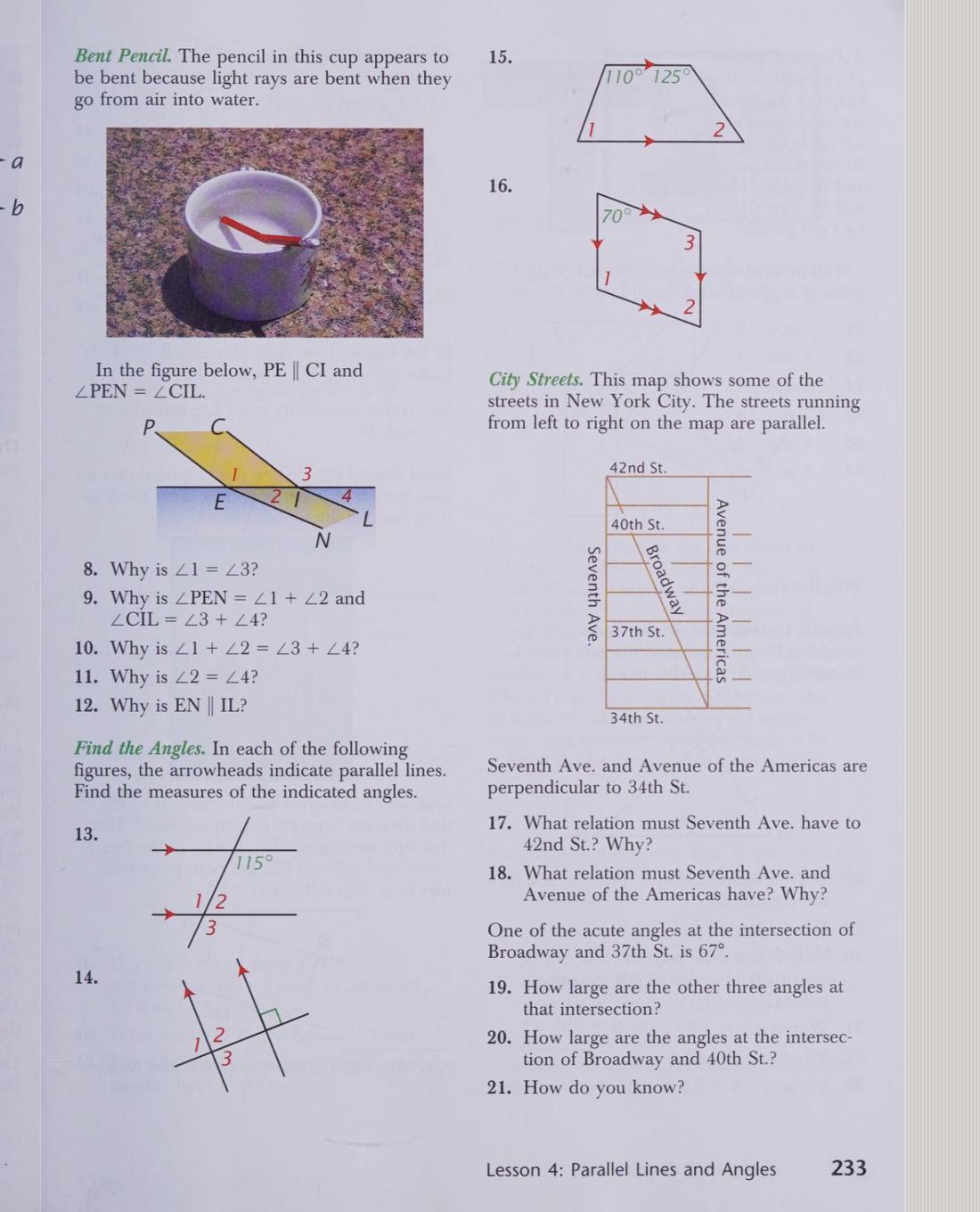
Questions 17 to 21: the New York grid
The east-west streets are parallel. Seventh Ave. and Avenue of the Americas are both perpendicular to 34th St. Broadway crosses 37th St. at 67°. Work out the relations and the Broadway angles.
- Question 17: Seventh Ave. ⊥ 34th St., and 42nd St. ∥ 34th St., so Seventh Ave. ⊥ 42nd St. by this lesson's Corollary 3: perpendicular to one parallel, perpendicular to all.
- Question 18: Seventh and Americas are two lines perpendicular to the same 34th St.: parallel to each other, by page 220's Corollary 3 (the other direction's version).
- Question 19: at Broadway and 37th, one acute angle is 67°; the crossing's other three are its supplement and their verticals: 113, 67, 113.
- Questions 20 and 21: 40th St. is parallel to 37th, and Broadway is one transversal across both, so Theorem 19 copies the whole crossing: 67, 113, 67, 113 again, without a protractor ever visiting 40th.
- That copying is why diagonal avenues make the same famous angle at every numbered street, and why Times Square's bowtie repeats uptown at Herald Square: one theorem, laid down in asphalt, block after block.
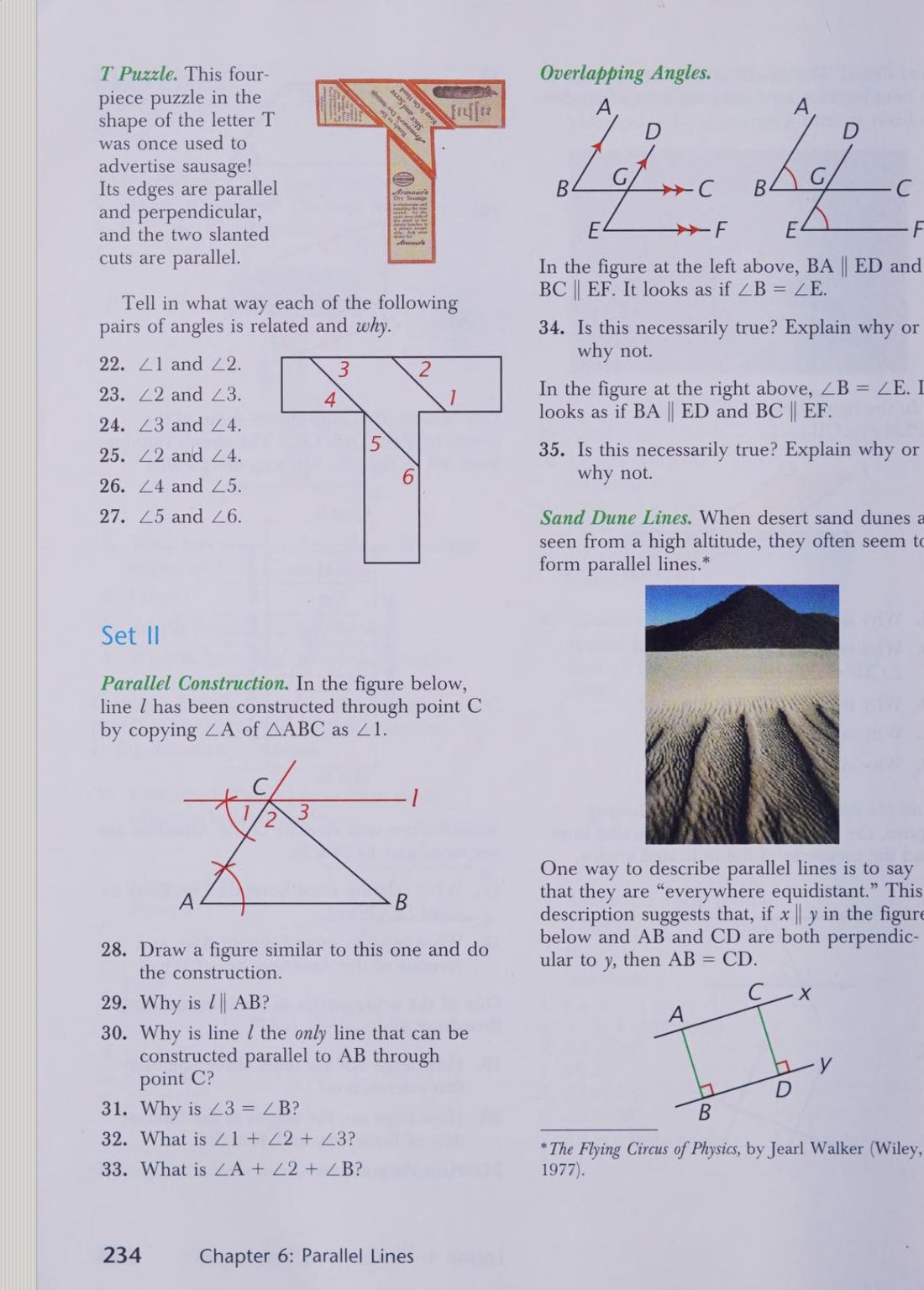
Questions 28 to 33: a straight angle foretells a theorem
Line l is constructed through C by copying ∠A as ∠1. Why is l ∥ AB, why is it unique, why is ∠3 = ∠B, and what are the two sums?
- Question 29: ∠1 was built equal to ∠A, and they are alternate interior angles across transversal AC: l ∥ AB by Corollary 1 of Theorem 17.
- Question 30: the Parallel Postulate: through C there is exactly one parallel to AB, and l is it. Every other line through C crosses AB somewhere.
- Question 31: ∠3 and ∠B are alternate interior angles across transversal BC, and now that l ∥ AB is established, Theorem 19's Corollary 1 makes them equal.
- Question 32: ∠1, ∠2, ∠3 fill the straight angle along l at C: their sum is 180°.
- Question 33: substitute ∠A for ∠1 and ∠B for ∠3: ∠A + ∠2 + ∠B = 180°, and ∠2 is just ∠C of the triangle. You have discovered, by construction, that a triangle's angles sum to a straight angle. Two pages from now this becomes Theorem 20, proved with exactly the line you just drew.
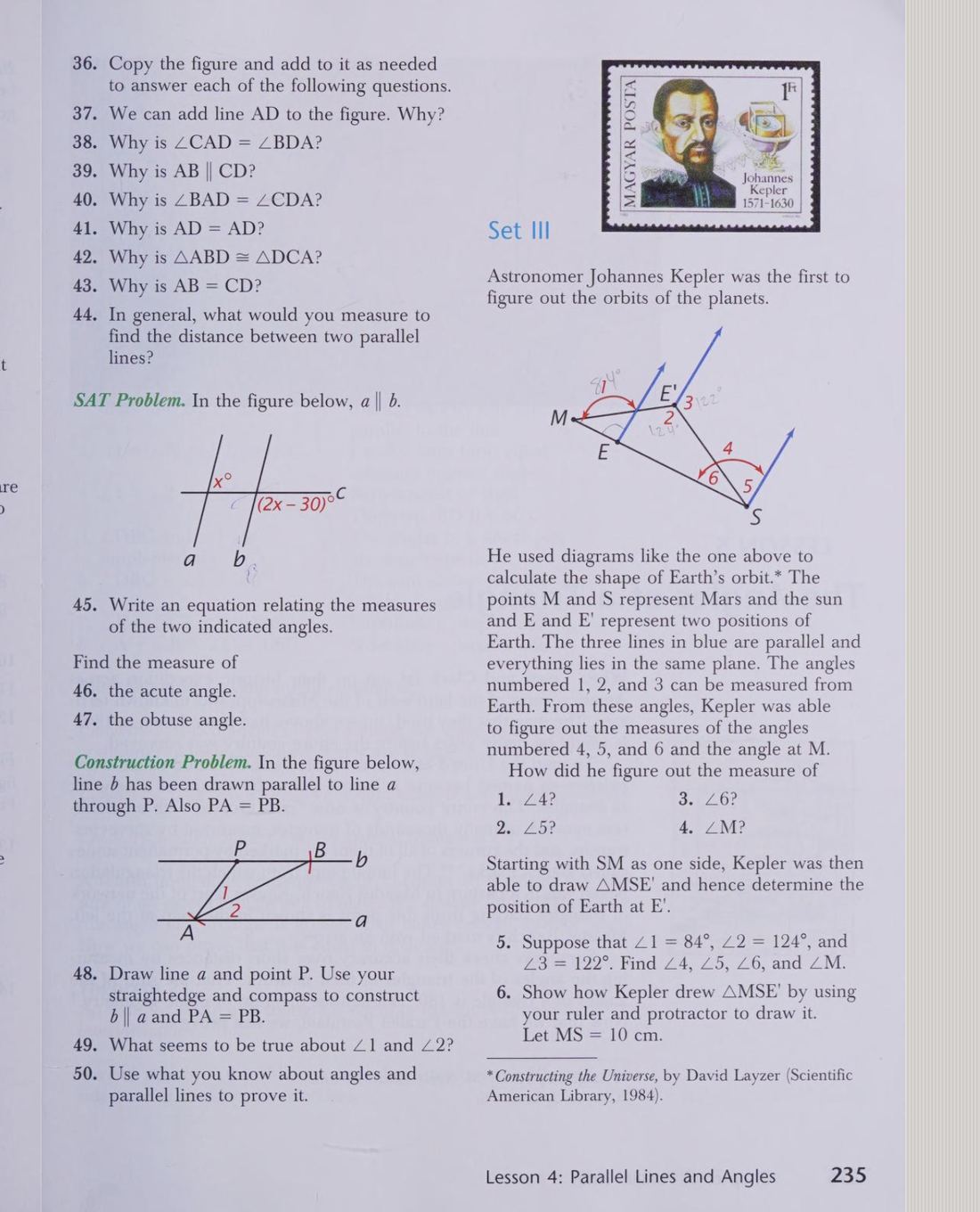
Questions 36 to 44: everywhere equidistant
x ∥ y, with AB and CD both perpendicular to y. Prove AB = CD, and say what "the distance between parallel lines" means.
- Questions 37 to 39: draw AD (two points determine a line). ∠CAD = ∠BDA as alternate interior angles across AD between the parallels x and y; and AB ∥ CD by Corollary 3's partner: both are perpendicular to y.
- Question 40: with AB ∥ CD, the same transversal AD gives ∠BAD = ∠CDA, alternate interior angles again.
- Questions 41 and 42: AD = AD, and ASA assembles △ABD ≅ △DCA: two angle pairs around the shared side.
- Question 43: corresponding parts: AB = CD. The two perpendicular "rungs" are equal wherever they stand.
- Question 44: so "the distance between parallels" is well-defined: measure along any perpendicular, and every choice agrees. That is what the sand dunes, the wiper blades, and the lined paper under your homework have been silently asserting all chapter.
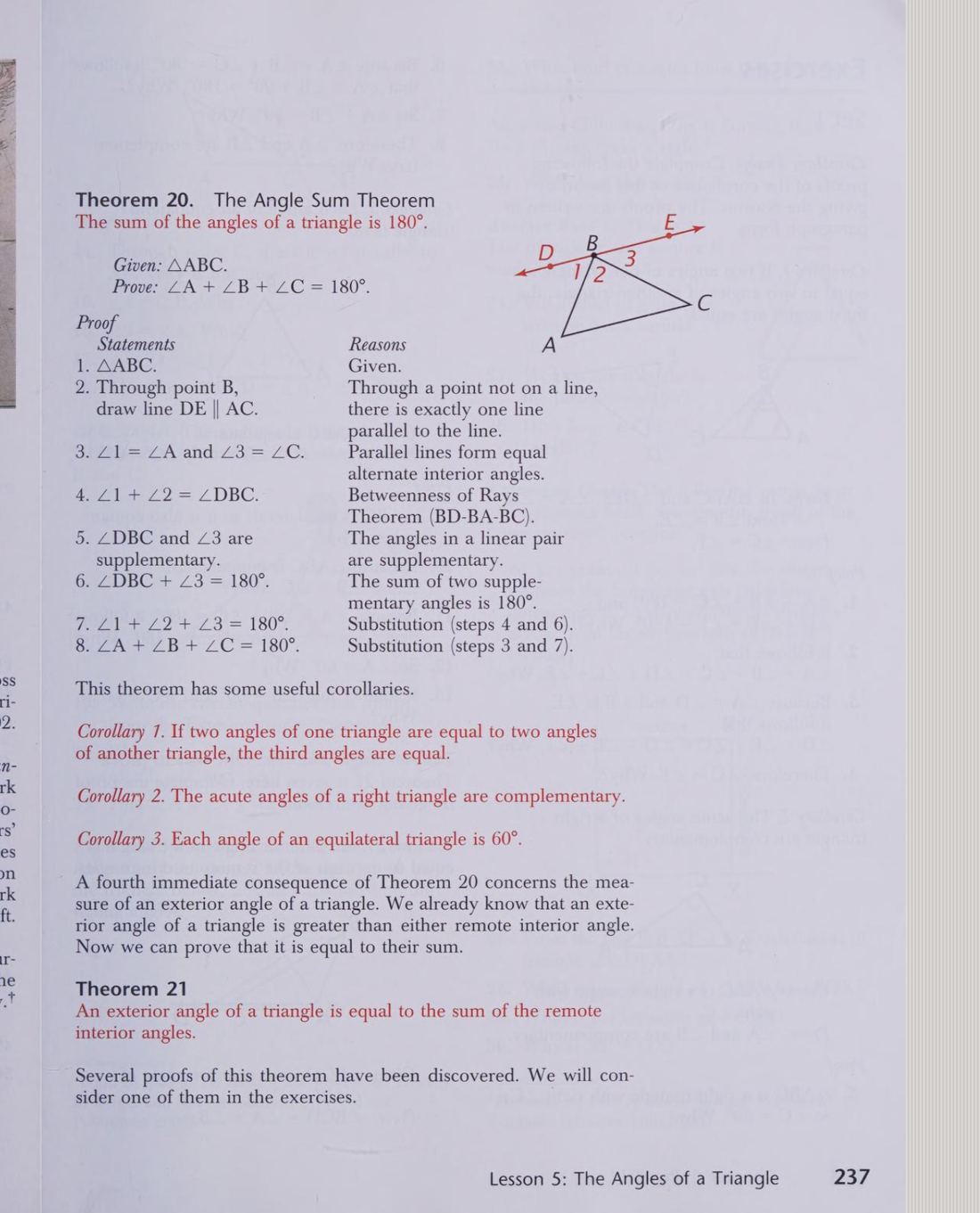
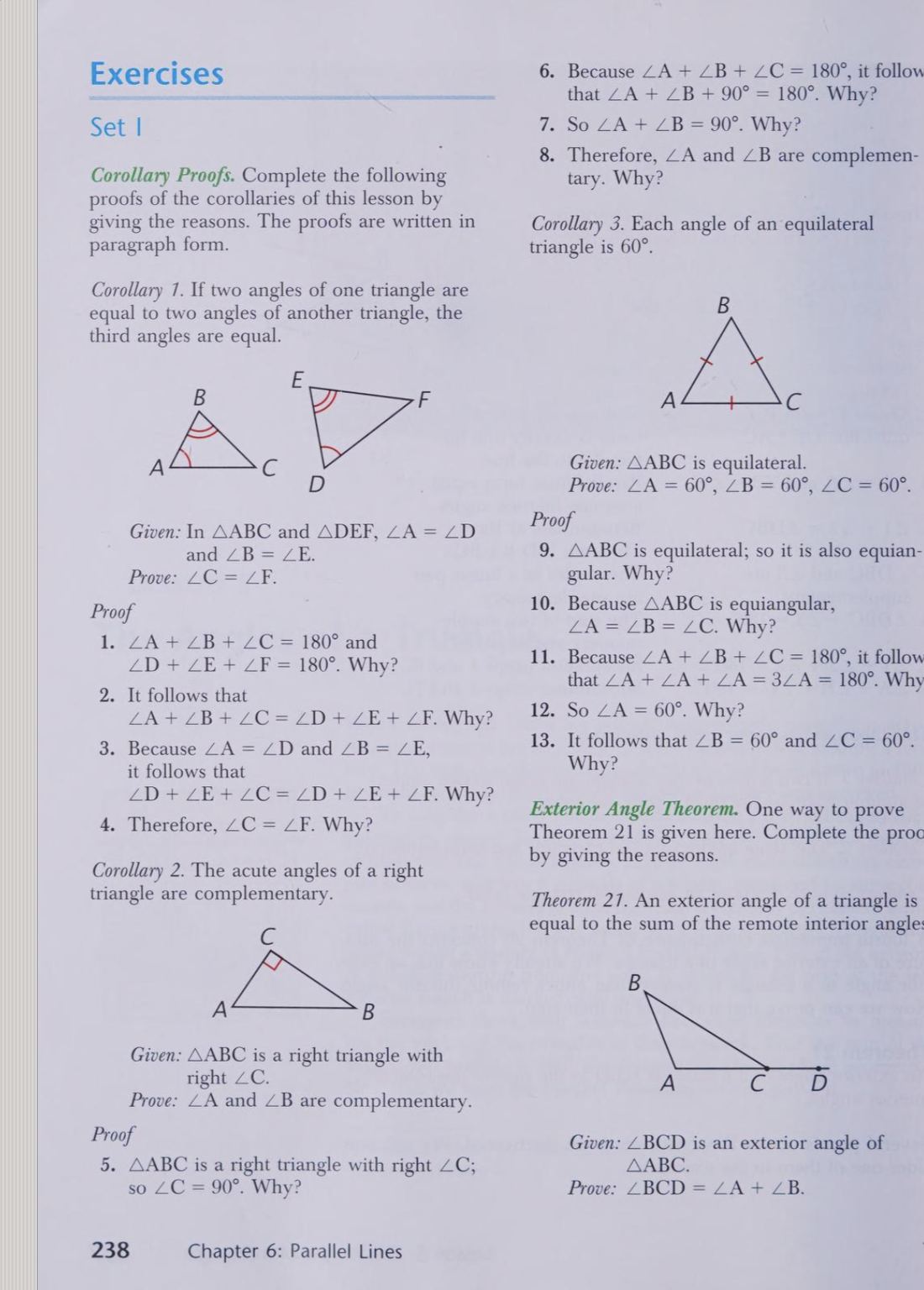
Questions 1 to 13: the three corollaries' reasons
Justify each step of the three paragraph proofs.
- Corollary 1 (questions 1 to 4): both triangles' sums are 180 (Theorem 20); set the sums equal (substitution); replace ∠D and ∠E by ∠A and ∠B (substitution of the given equalities); subtract the shared pair: ∠C = ∠F (subtraction). Matching two angles rents you the third for free.
- Corollary 2 (questions 5 to 8): the right angle is 90 by definition; substitute into the angle sum; subtract 90; and "sum is 90" is the definition of complementary (page 105).
- Corollary 3 (questions 9 to 13): equilateral forces equiangular (page 159's corollary); equiangular names the three angles equal; substitution turns the sum into 3∠A = 180; division gives 60; substitution hands the same 60 to B and C.
- Tally the machinery: one theorem, plus the properties of equality from page 79 doing every stitch. The corollaries are Theorem 20 wearing three different work shirts, and citing them by name from now on saves three lines each time.
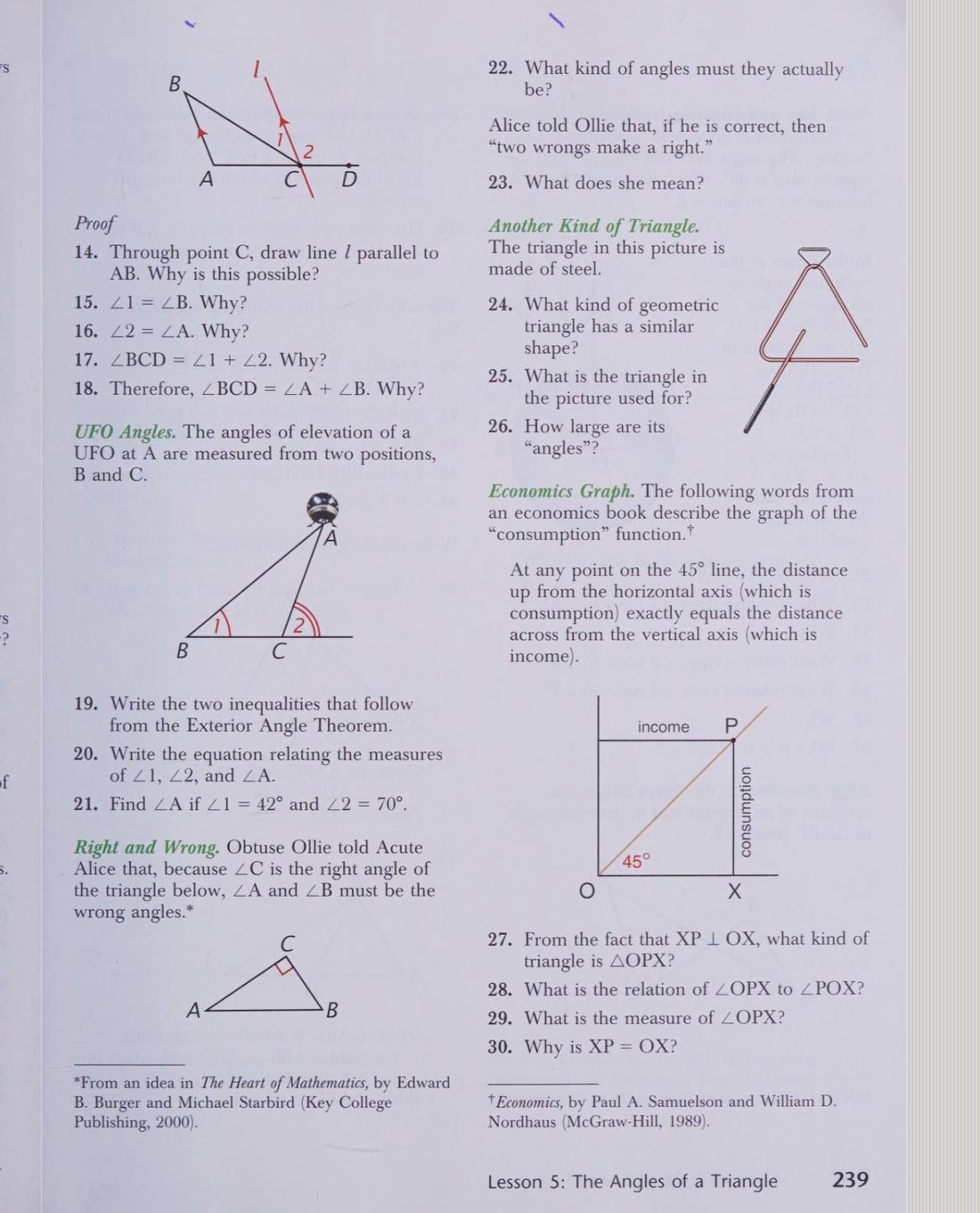
Questions 14 to 21: Theorem 21, then the UFO
Complete the proof that an exterior angle equals the sum of the remote interior angles, then find ∠A for the UFO when ∠1 = 42° and ∠2 = 70°.
- Questions 14 to 16: through C draw l ∥ AB (the Parallel Postulate permits exactly this); then ∠1 = ∠B and ∠2 = ∠A, alternate interior and corresponding angles formed by the parallels.
- Question 17: ∠BCD = ∠1 + ∠2 by the Betweenness of Rays Theorem; the drawn parallel splits the exterior angle.
- Question 18: substitute: ∠BCD = ∠A + ∠B. Equality achieved where chapter 5 could only prove greater-than; Theorem 12 retires with honors.
- Questions 19 and 20: for the UFO, the old inequalities (∠2 > ∠1, ∠2 > ∠A) sharpen to the equation ∠2 = ∠1 + ∠A.
- Question 21: ∠A = 70 − 42 = 28°. Two sextant readings from the ground now hand over the angle at the saucer, and with the baseline distance, ASA pins its altitude: page 190's promise, kept with three theorems' interest.
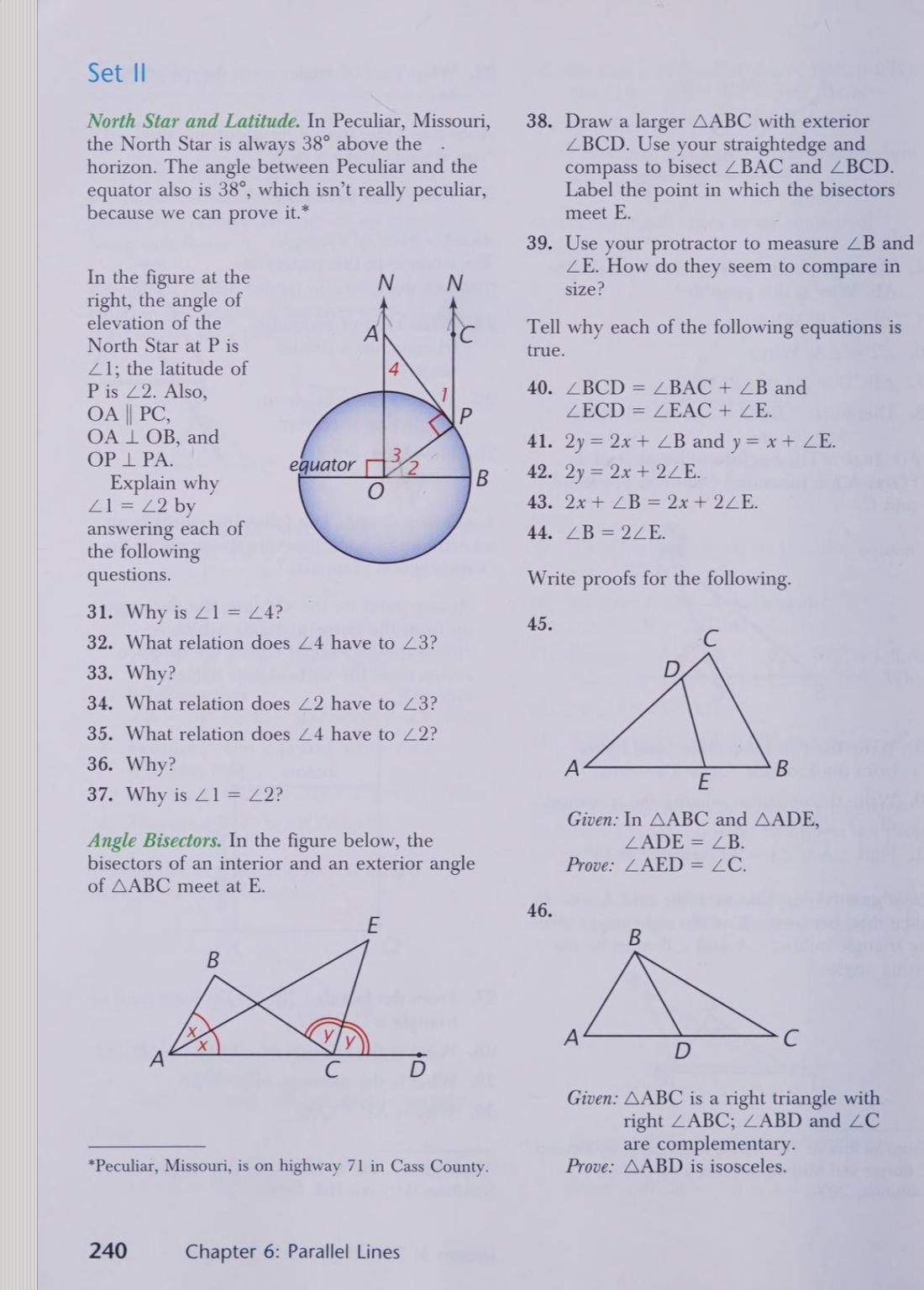
Questions 31 to 37: why latitude equals the star's height
∠1 is the North Star's elevation at P; ∠2 is P's latitude. Given OA ∥ PC (both aim at the effectively infinite star), OA ⊥ OB, and OP ⊥ PA, prove ∠1 = ∠2.
- Question 31: OA ∥ PC with transversal OP makes ∠1 = ∠4, alternate interior angles. The star is far enough that its rays arrive parallel; that is the only physics in the proof.
- Questions 32 and 33: OA ⊥ OB makes the angle at O a right angle, so ∠4 and ∠3 are complementary; they share it.
- Questions 34 to 36: OP ⊥ PA makes the angle at P right, so ∠2 and ∠3 are complementary too. Complements of the same angle are equal (Theorem 3, page 106): ∠4 = ∠2.
- Question 37: substitute through step 1: ∠1 = ∠4 = ∠2. The star's height is the latitude, exactly.
- Feel the reach: a sailor with a sextant reads ∠1, and this little proof converts it to a coordinate on the globe. Eratosthenes measured the earth with a shadow on page 15; Polaris hands you your address on it, by the same geometry of parallel sunbeams and starbeams.
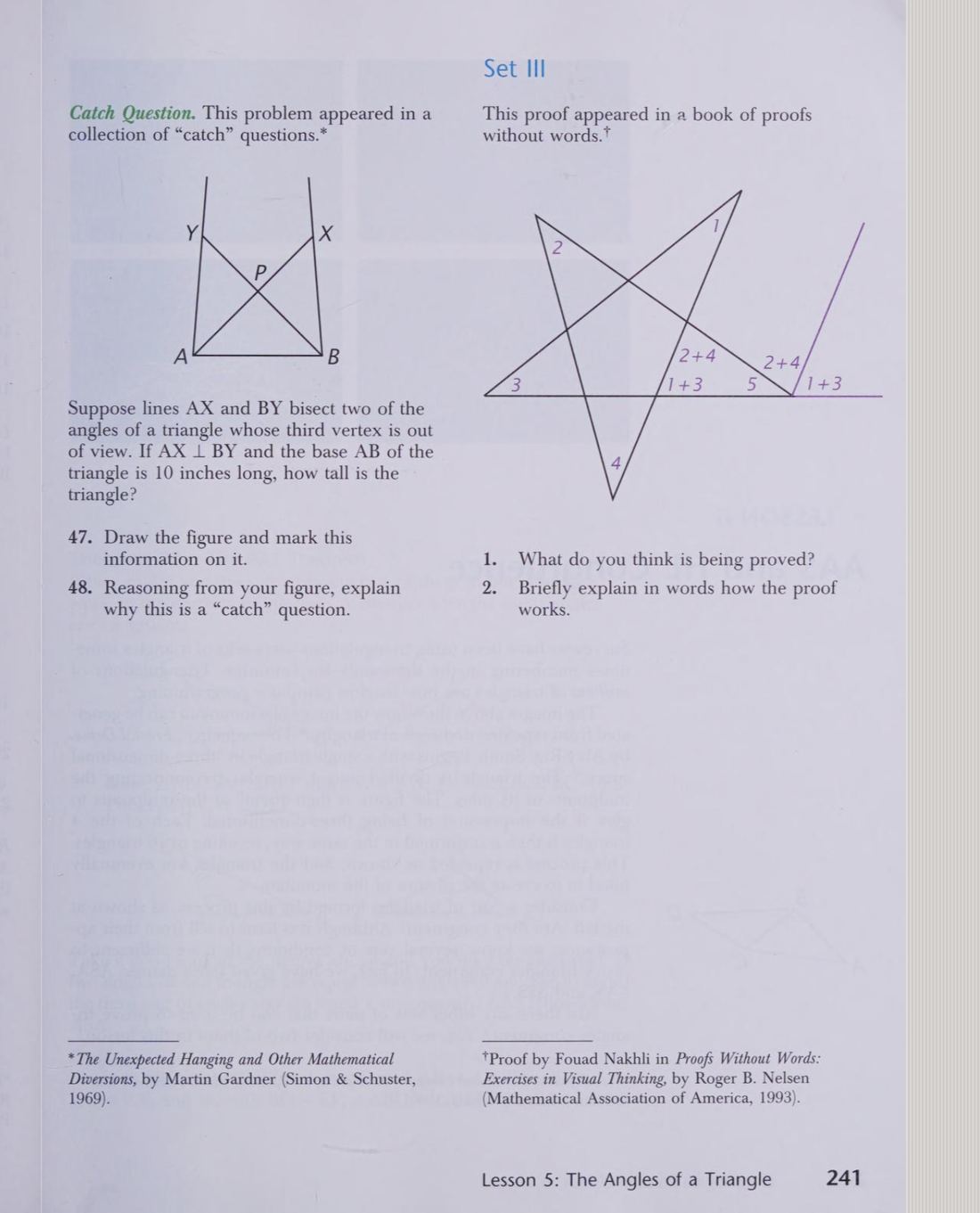
Set III: the five-pointed star's silent proof
The diagram labels the star's point angles 1 through 5, then marks "2 + 4" and "1 + 3" collapsing toward one corner. What is being proved, and how does it work?
- Question 1: the claim is that the five point angles of a five-pointed star total 180°.
- Question 2, the mechanism: each little marked step is Theorem 21. In one outer triangle, the exterior angle at its base equals the sum of two remote star points: angles 2 and 4 combine into the single angle marked 2 + 4.
- A second application combines angles 1 and 3 the same way, one triangle over: the marked 1 + 3.
- Now all five point angles sit inside one small triangle as (2 + 4), (1 + 3), and 5, and Theorem 20 reads that triangle's total: 180°. Done, wordlessly.
- Draw any lopsided star and check with a protractor: the five points still share 180. Then admire the economy: two exterior angles and one angle sum, no measurement, every star ever drawn. A proof without words still has reasons; you just supplied them.