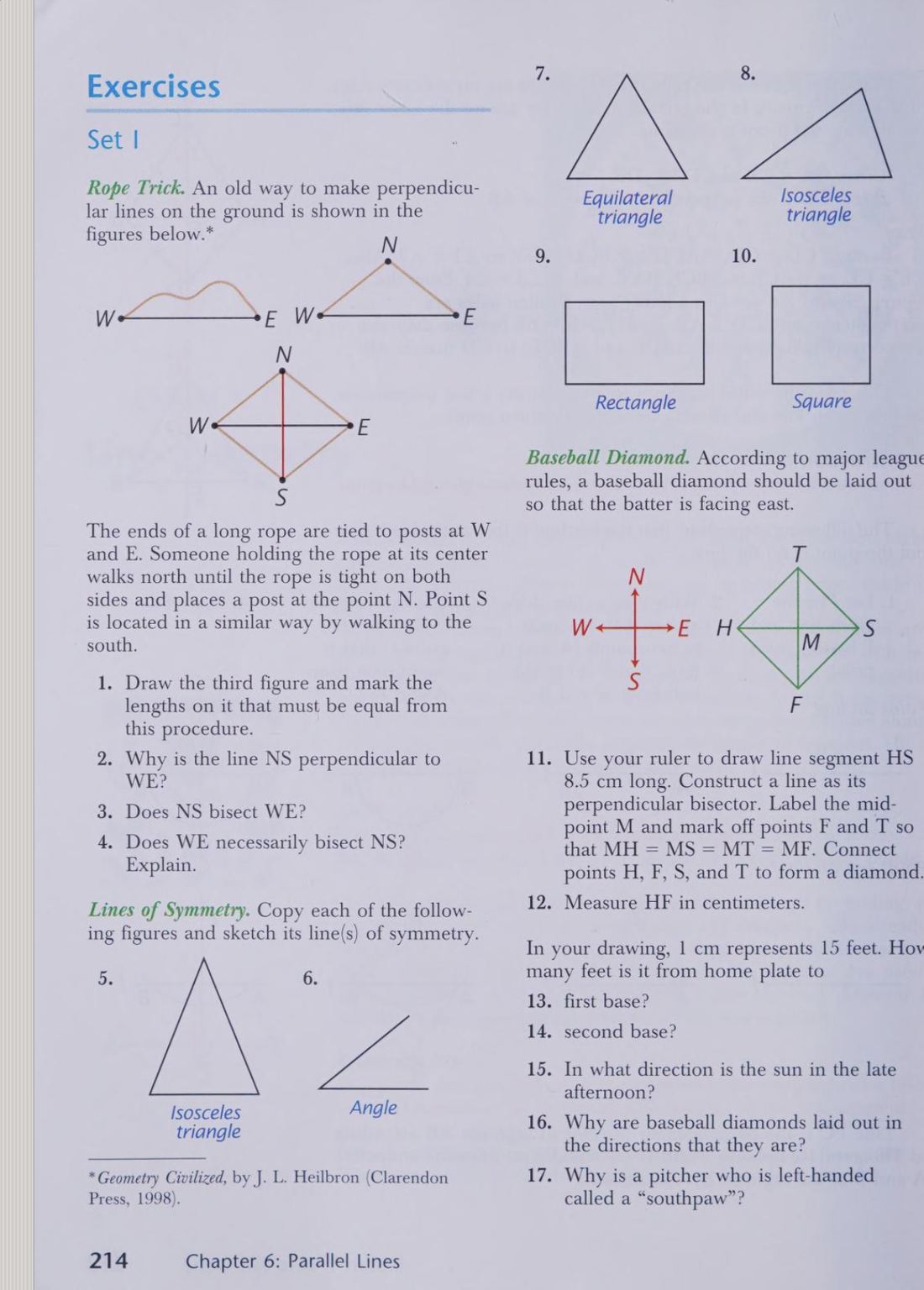
Questions 11 to 17: laying out the diamond
Draw HS = 8.5 cm, construct its perpendicular bisector, mark M and then F and T with MH = MS = MT = MF, and connect H, F, S, T. One centimeter is 15 feet. Read off the distances and answer the sun questions.
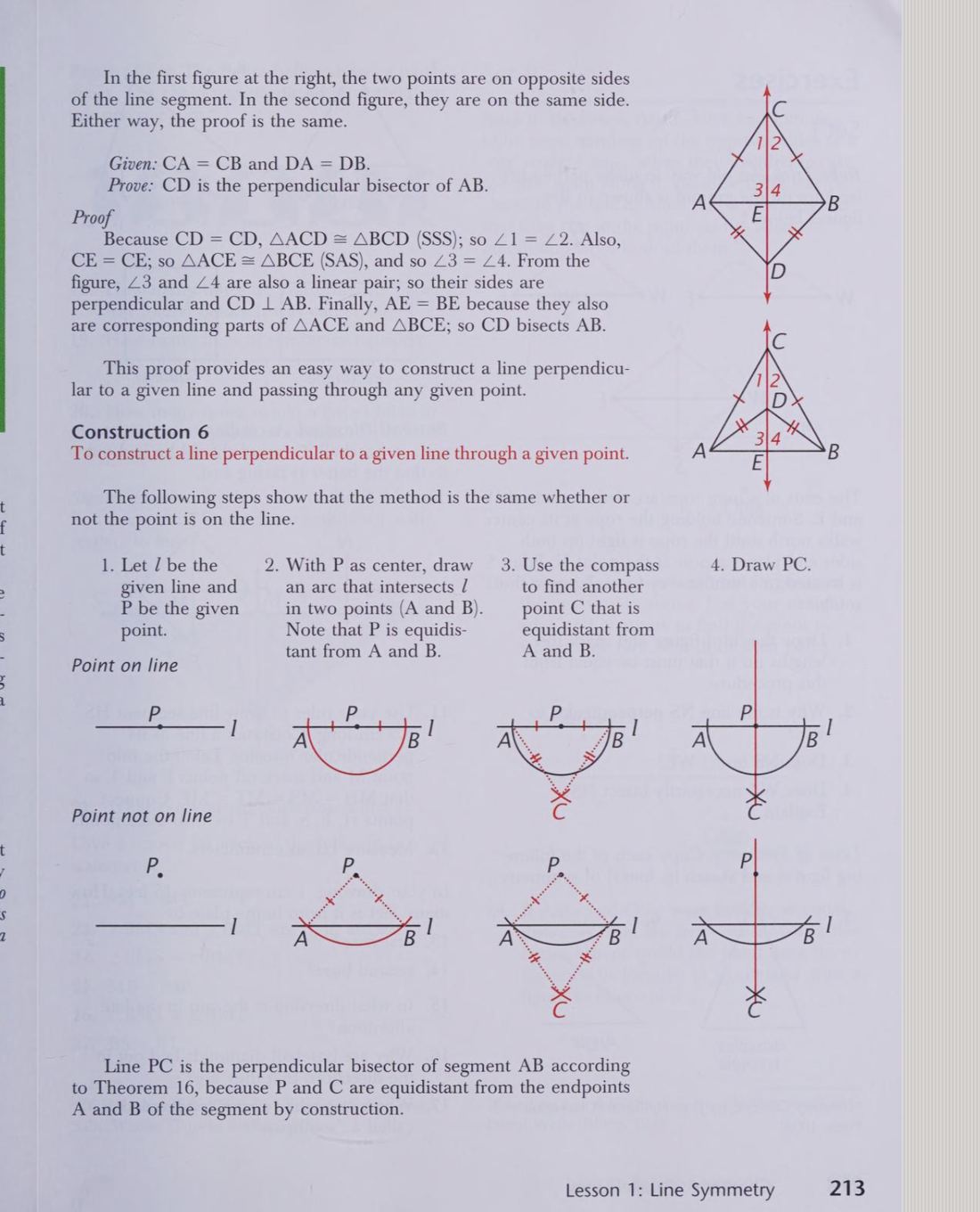
- Question 11: the construction is pages 212 and 213 verbatim: arcs from H and S locate two equidistant points, their line is the perpendicular bisector, and M is the crossing. Equal compass steps from M place F and T.
- Question 12: the four corners sit at equal distances from M on perpendicular lines, so HFST is a square, and HF should measure close to 6.0 cm (8.5 divided by √2).
- Questions 13 and 14: convert: home to first is 6.0 × 15 = 90 feet, the real rule-book number, and home to second is the full diagonal, 8.5 × 15 ≈ 128 feet.
- Questions 15 and 16: the batter faces east by rule, so the late-afternoon sun, in the west, sits behind the batter rather than in the batter's eyes. The rule is applied geometry plus astronomy.
- Question 17: with the batter facing east, the pitcher faces west, and a left-handed pitcher's throwing arm hangs on the south side: a southpaw. Vocabulary by compass direction, and your construction just explained a hundred years of sports slang.
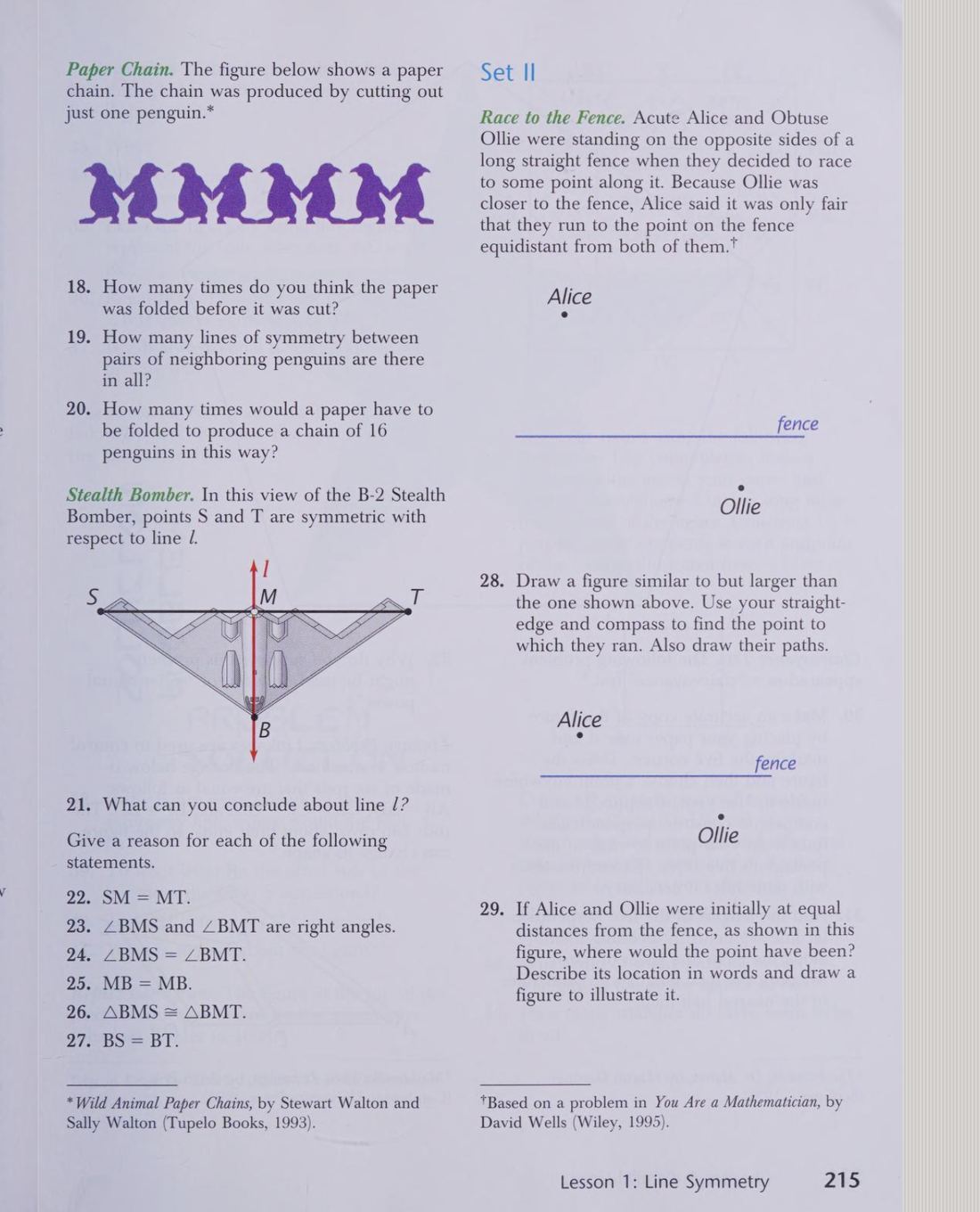
Questions 28 and 29: where do they race?
Alice and Ollie stand on opposite sides of a straight fence, Ollie nearer it. Construct the fence point equidistant from both. Then: where is the point if they start equally far from the fence?
- Question 28: every point equidistant from Alice and Ollie lies on the perpendicular bisector of the segment joining them (page 173's locus, now with Theorem 16 behind it).
- So construct segment AO, bisect it with the compass, and extend the perpendicular bisector until it crosses the fence. That crossing is the one fair finish point; draw both running paths to it and they measure equal.
- Question 29: if Alice and Ollie stand at equal distances on opposite sides, the midpoint of AO lands exactly on the fence, and the crossing point is that midpoint itself: the fair point is directly between them, where their segment punctures the fence.
- Check the edge case in your head: as Ollie steps closer to the fence, the bisector tilts and the fair point slides away down the fence line, which is why Ollie accepted the deal. Fairness is a locus, and the fence just samples it.
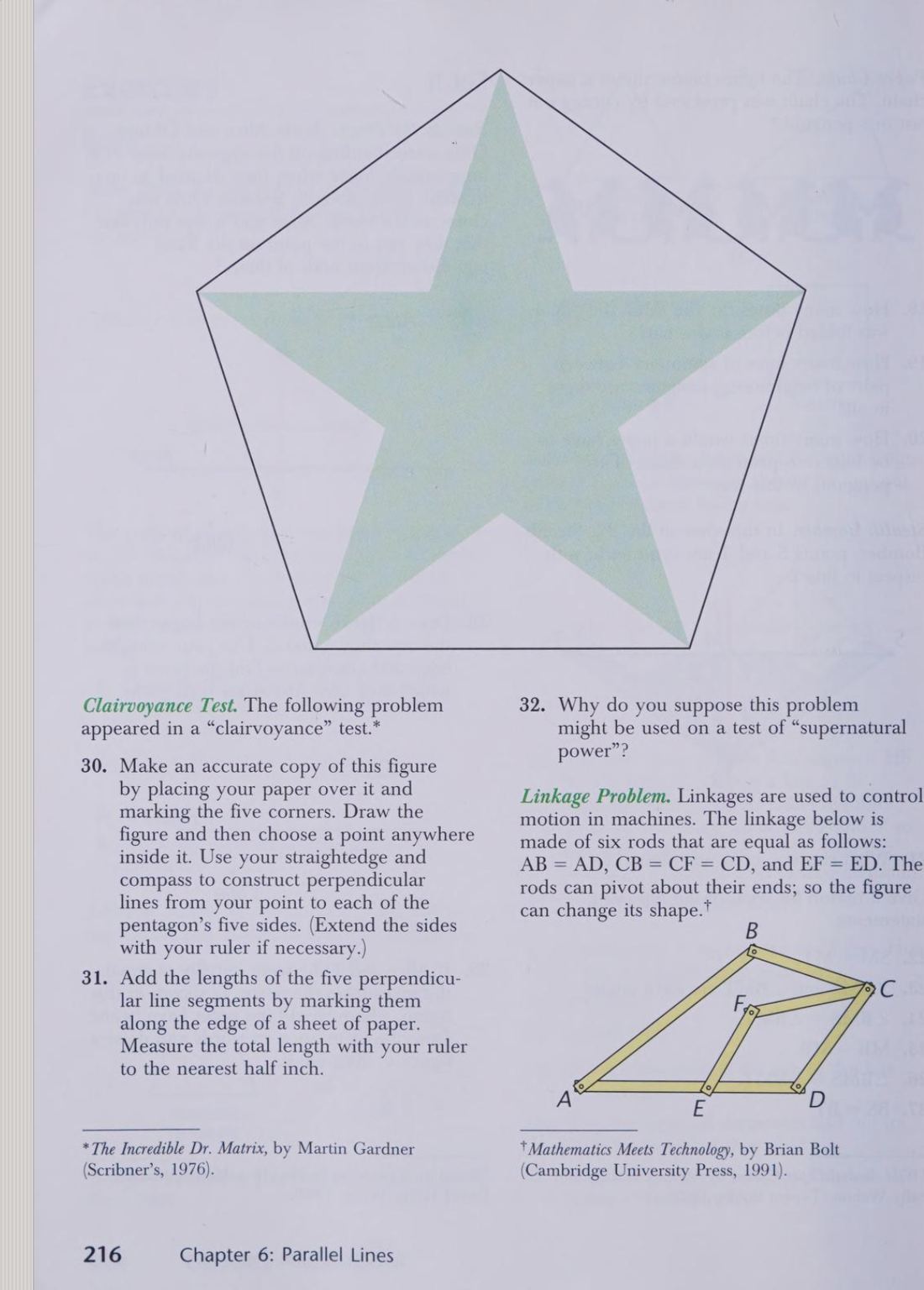
Questions 30 to 32: the clairvoyance test
Copy the regular pentagon, pick any interior point, construct the five perpendicular segments to the sides, and total their lengths. Why is this on a "supernatural power" test?
- Question 30: five runs of Construction 6, one per side (extend the sides first where your point sits far from them). Keep the arcs light and the feet labeled.
- Question 31: march the five lengths end to end along a paper edge and measure the total, to the nearest half inch.
- Question 32: the trick: every point inside gives the same total, so the tester "predicts" your secret answer. The reason, in area language: the five perpendiculars are the heights of five triangles from your point to the sides, the triangles tile the pentagon, and equal side lengths make the total height carry the whole area, point be where it may.
- Test the claim like a geometer: pick a second point, repeat, compare. Two matching totals from two secret points is more convincing than any horoscope, and better earned.
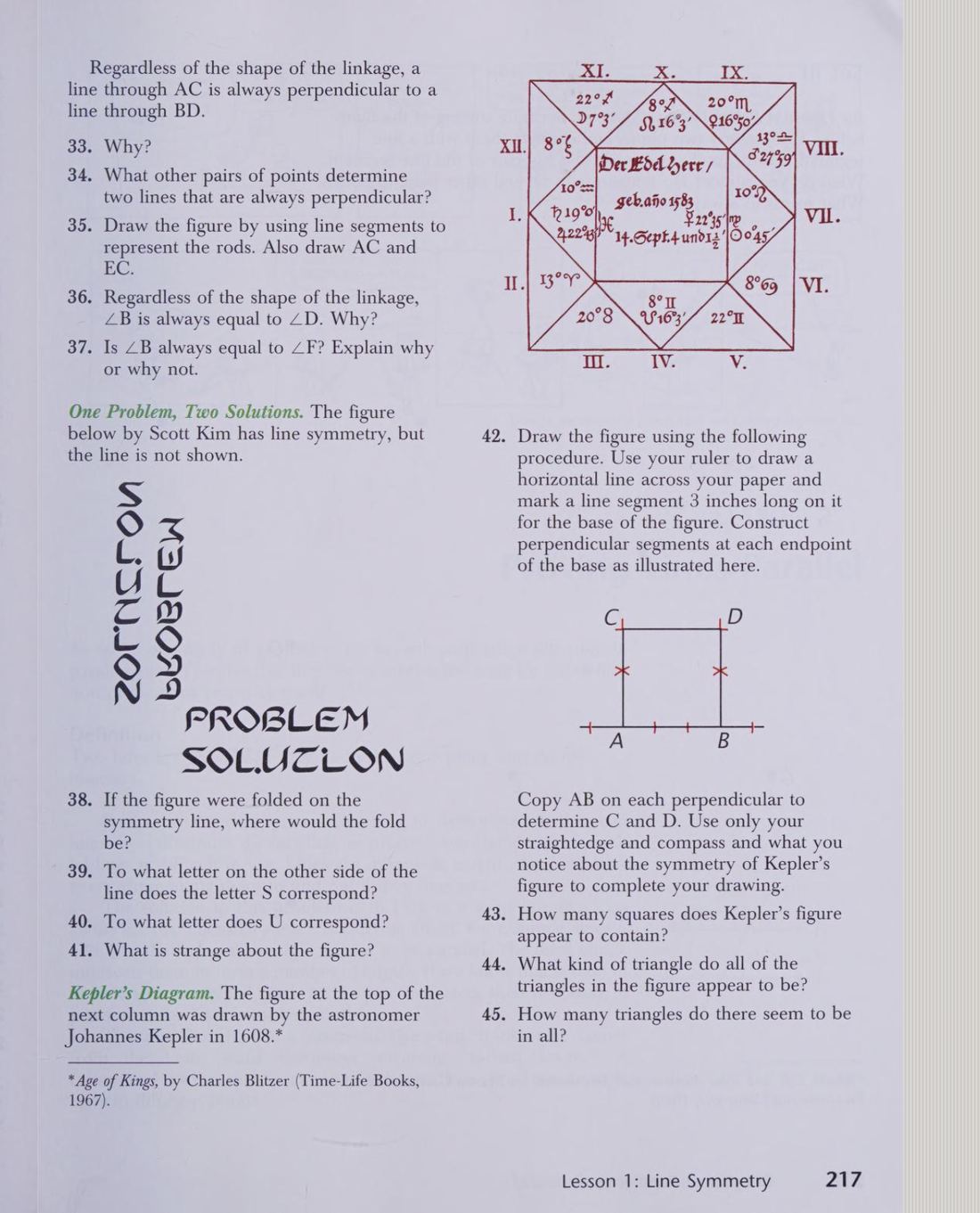
Questions 33 to 37: the six-rod linkage
AB = AD, CB = CF = CD, EF = ED, hinges throughout. Why is AC always perpendicular to BD, whatever the shape? What else stays perpendicular, and which angles stay equal?
- Question 33: A is equidistant from B and D (AB = AD), and C is equidistant from B and D (CB = CD). Two points equidistant from B and D determine the perpendicular bisector of BD: Theorem 16, at every hinge position. So line AC ⊥ line BD always.
- Question 34: run the same census on E and C: EF = ED and CF = CD make both equidistant from F and D, so line EC ⊥ line FD too. The machine carries two guaranteed right angles it never has to measure.
- Question 36: △ABC ≅ △ADC by SSS (AB = AD, CB = CD, AC shared), so ∠B = ∠D at every setting.
- Question 37: ∠F has no such certificate: F's triangle △ECF matches △ECD (giving ∠F = ∠EDC), but ∠EDC is only part of the full ∠D, so ∠B = ∠F fails in general. Equal rods promise exactly what SSS can prove, and nothing more.
- The takeaway: Theorem 16 is a rigidity guarantee. Machines hold perpendicularity not by precision manufacture but by equidistance, which hinges cannot disturb.
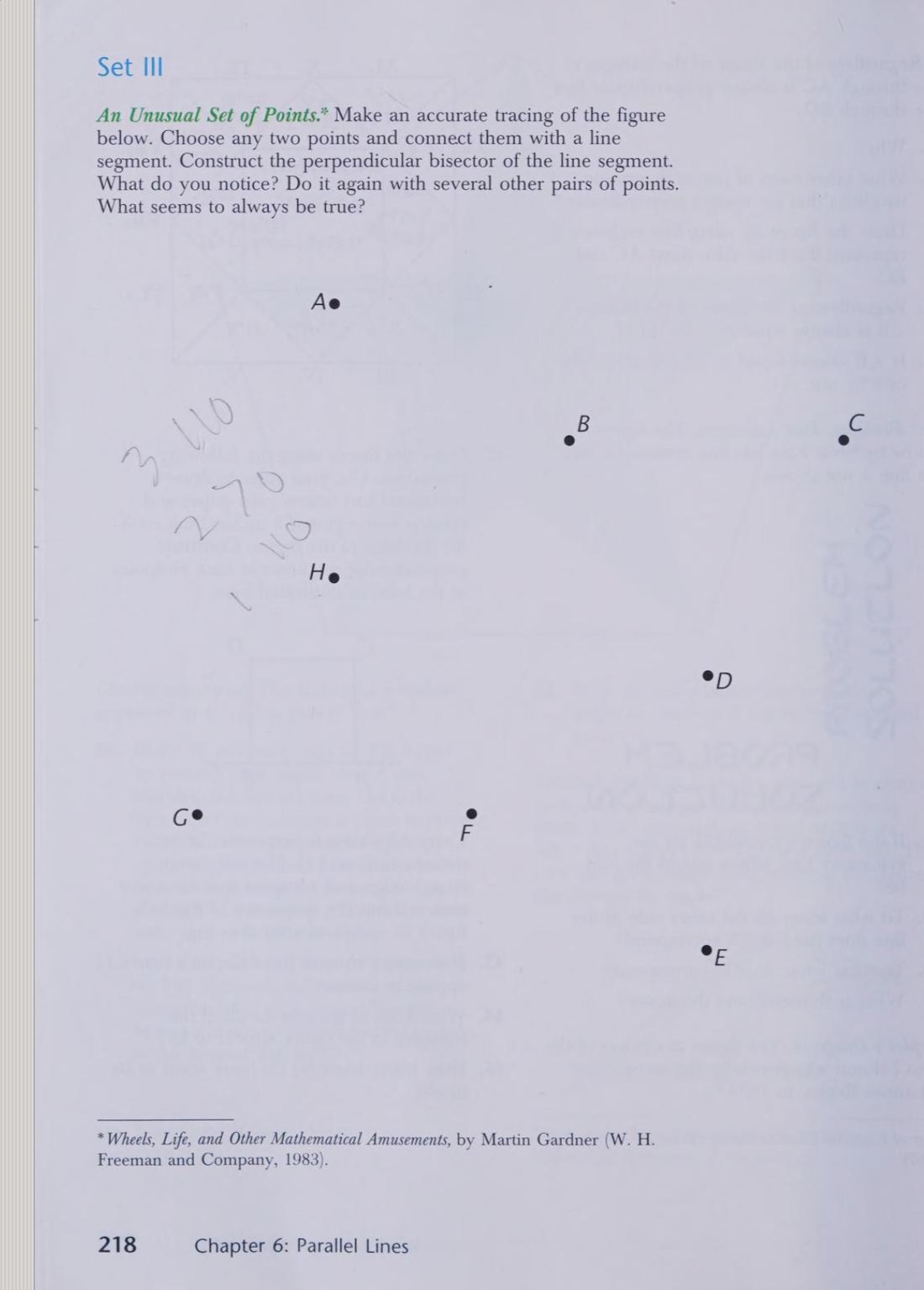
Set III: the unusual set of points
Trace the eight points. Bisect several pairs' segments. What always happens, and why?
- Trace carefully; the effect dies with sloppy tracing. Join any two points, construct the perpendicular bisector, and extend it generously across the page.
- Repeat for three or four more pairs, mixing near points with far ones. Every bisector crosses the others at a single common point. Mark it O.
- Why: each bisector is the set of points equidistant from its own pair (Theorem 16 and its converse working together). A point on two bisectors is equidistant from three of the dots; on all of them, equidistant from all eight.
- Test the conclusion with the compass: put the point on O, radius to A, and sweep. The circle threads every dot. The "unusual set" is a circle traveling incognito.
- Keep the method: given any circle without its center, two chords and their bisectors recover it. You will use exactly this in the circle chapters and any time a broken wheel needs its hub found.
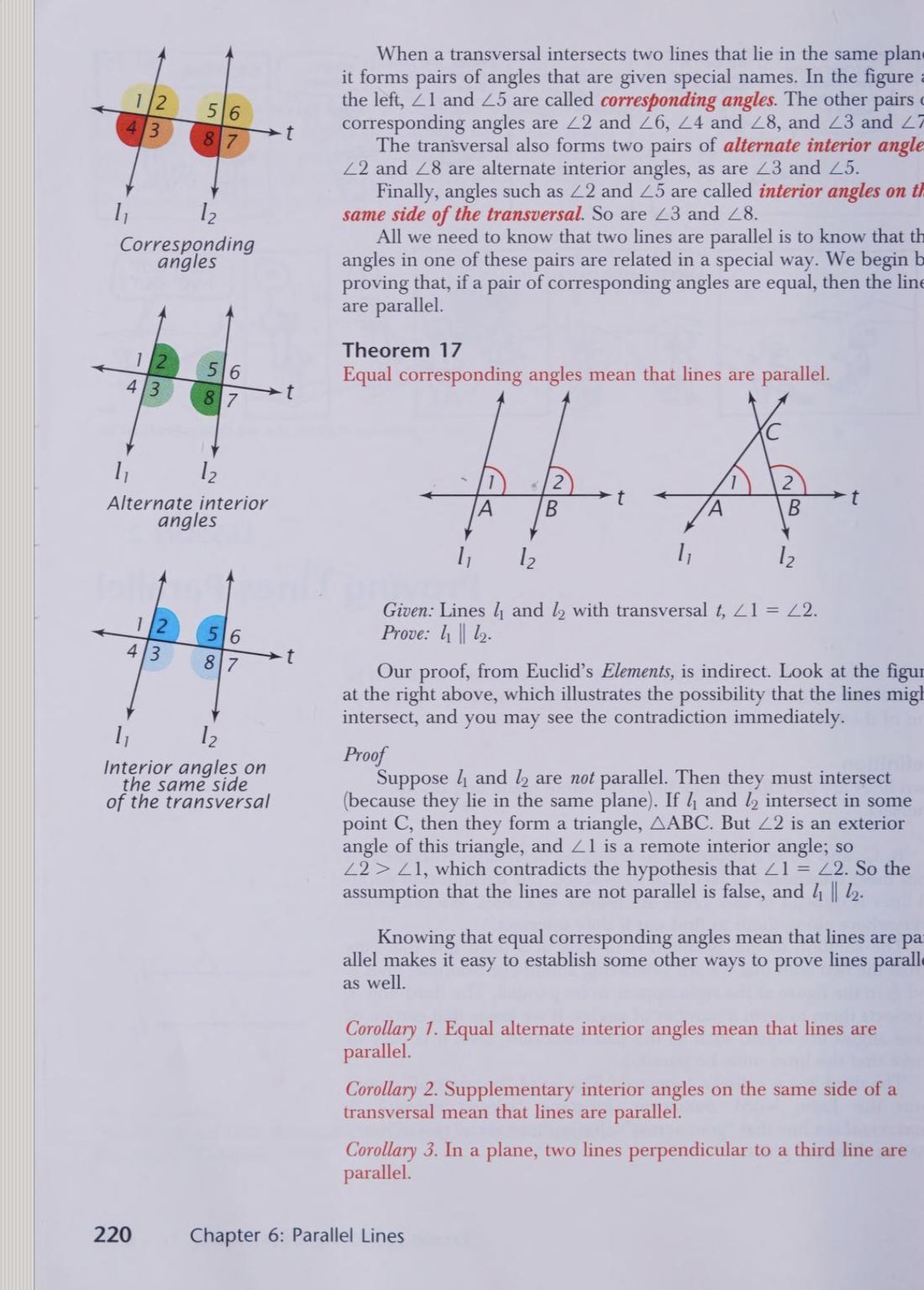
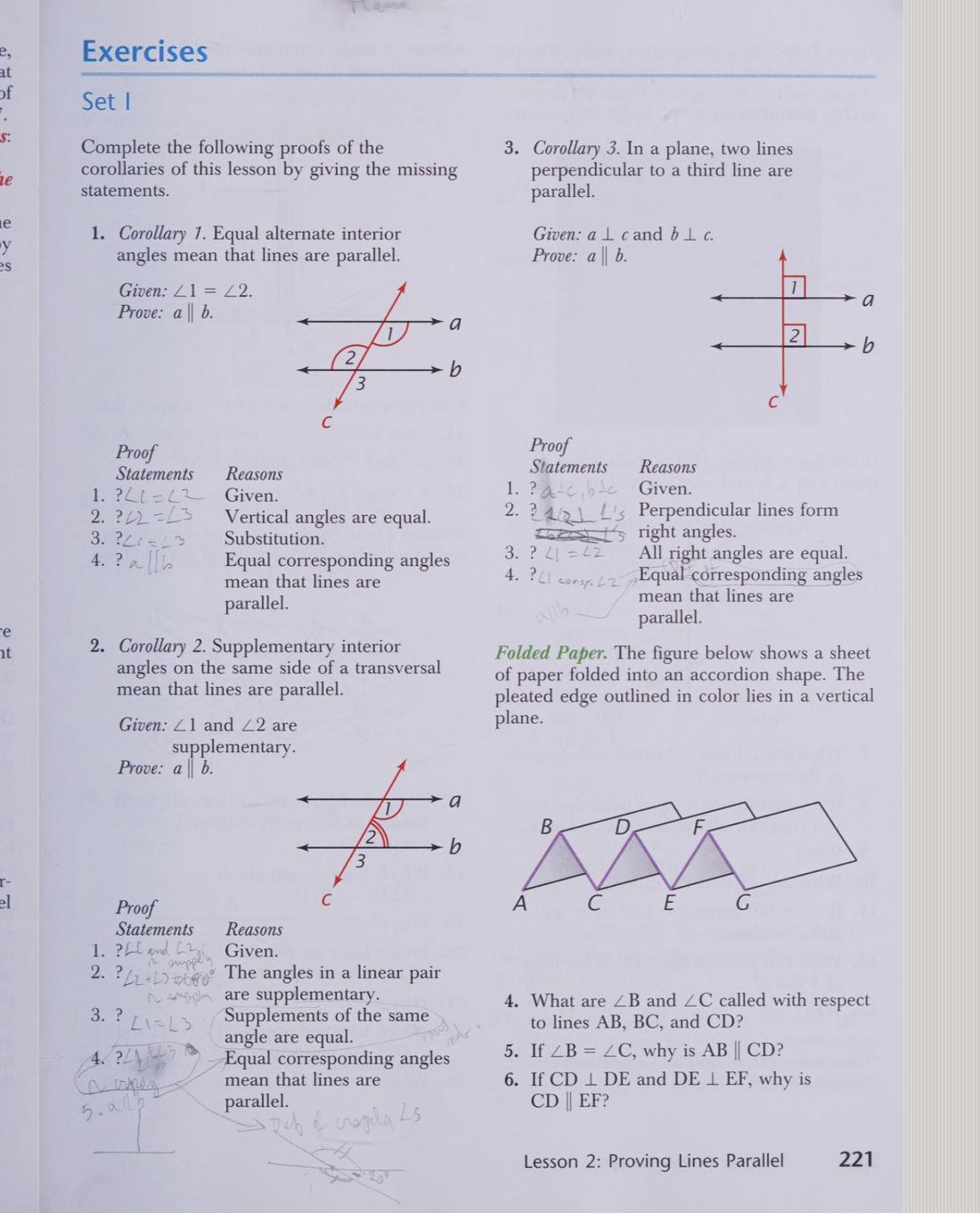
Questions 1 to 3: three proofs, one funnel
Fill in the missing statements for the three corollaries.
- Corollary 1 (equal alternate interior angles): statements run ∠1 = ∠2 (given); ∠2 = ∠3 (vertical angles); ∠1 = ∠3 (substitution); a ∥ b (equal corresponding angles). The vertical angle converts alternate into corresponding; that is the whole proof.
- Corollary 2 (supplementary same-side angles): ∠1 and ∠2 are supplementary (given); ∠2 and ∠3 are supplementary (linear pair); ∠1 = ∠3 (supplements of the same angle, Theorem 4 from page 109); a ∥ b (equal corresponding angles again).
- Corollary 3 (two perpendiculars): a ⊥ c and b ⊥ c (given); ∠1 and ∠2 are right angles (perpendicular lines form right angles); ∠1 = ∠2 (all right angles are equal); a ∥ b (corresponding angles once more).
- Now say what you noticed: three different hypotheses, three two-line conversions, one shared exit. When the book later says "lines are parallel because...", any of the four tickets may be punched, and they are all Theorem 17 underneath.
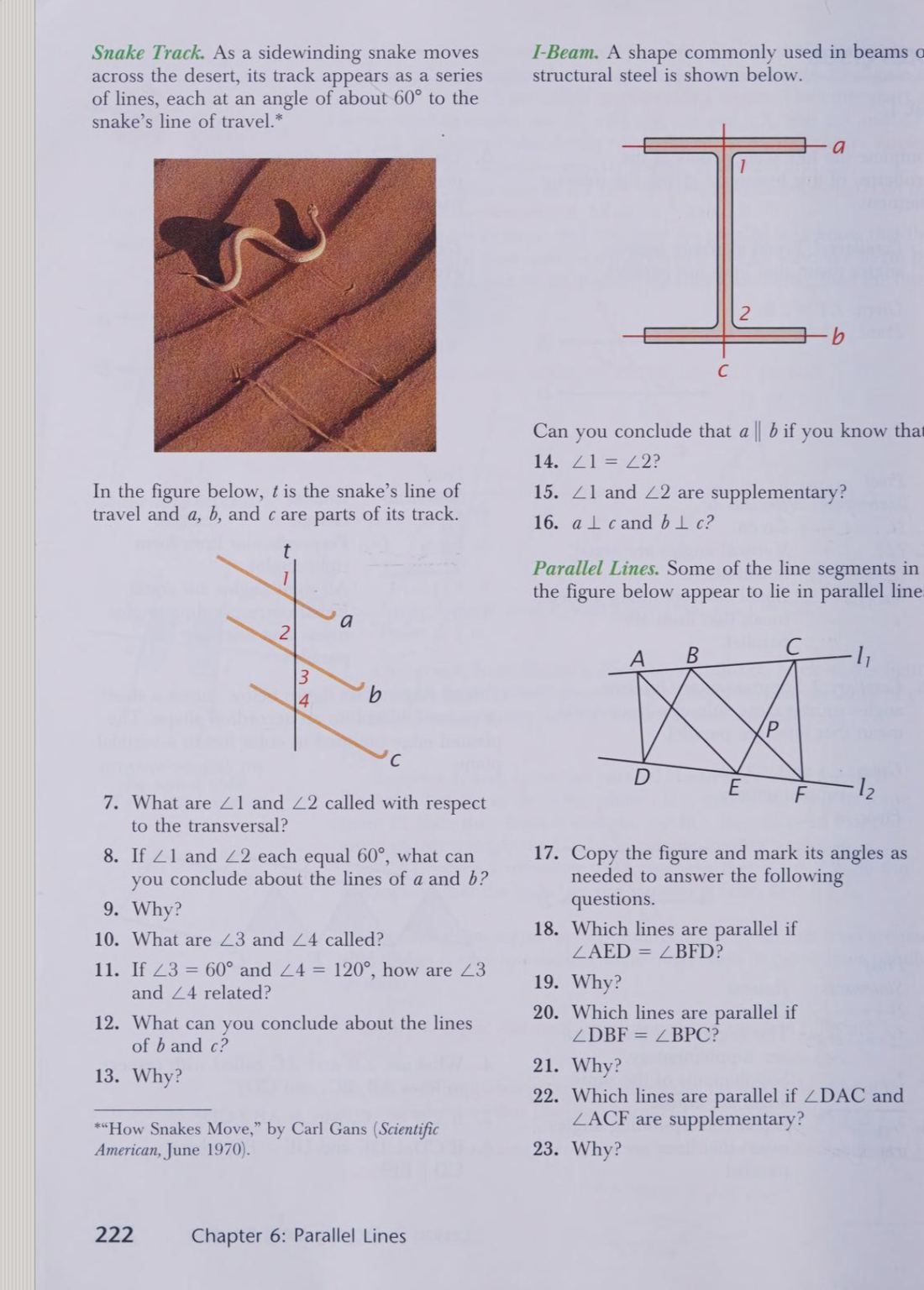
Questions 7 to 13: reading the snake's track
t is the snake's line of travel; a, b, c are track lines. ∠1 and ∠2 (at a and b) each measure 60°; ∠3 = 60° and ∠4 = 120° (at b and c). What follows?
- Questions 7 to 9: ∠1 and ∠2 sit at the same corner of their crossings with t: corresponding angles. Equal at 60° each, so a ∥ b by Theorem 17.
- Questions 10 and 11: ∠3 and ∠4 lie between b and c on the same side of t: interior angles on the same side, and 60 + 120 = 180 makes them supplementary.
- Questions 12 and 13: supplementary same-side interior angles mean b ∥ c, Corollary 2.
- Chain the results: a ∥ b and b ∥ c, and the sand shows it: the sidewinder lays parallel rulings across the desert because its body pushes off at a constant angle. The two corollaries just certified a snake's handwriting.
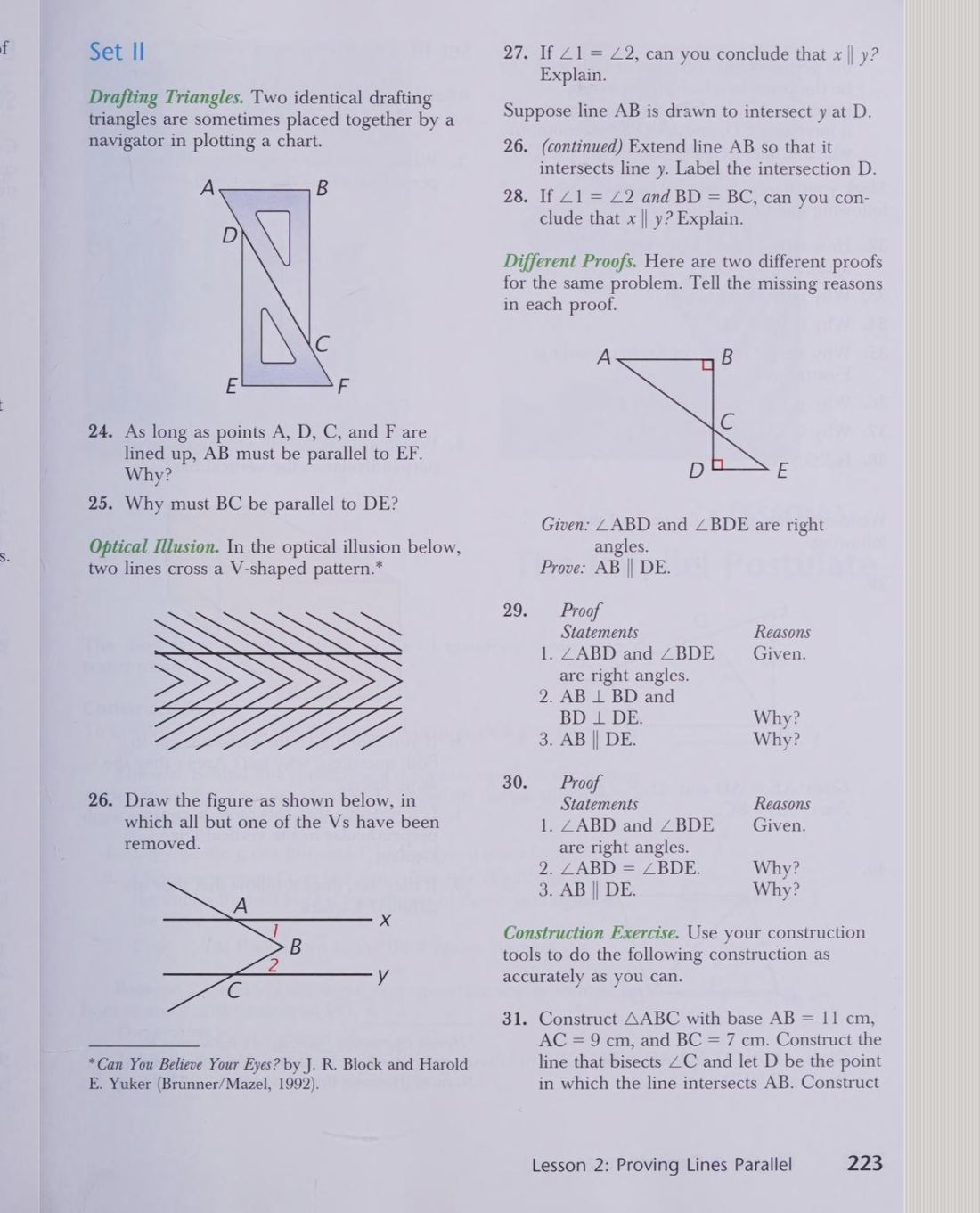
Questions 29 and 30: two roads to AB ∥ DE
Given: ∠ABD and ∠BDE are right angles. Prove AB ∥ DE two different ways, supplying the missing reasons.
- Proof 29, the perpendicular route: from the right angles, AB ⊥ BD and BD ⊥ DE (definition of perpendicular); then AB ∥ DE by Corollary 3, two lines perpendicular to a third line.
- Proof 30, the equal-angles route: ∠ABD = ∠BDE because all right angles are equal; and the two angles are alternate interior angles across transversal BD, so AB ∥ DE by Corollary 1.
- Same figure, same conclusion, different citations; both proofs are complete and correct.
- The meta-lesson is the one to keep: proofs are not unique, and the page 152 remark about step order goes deeper: even the route is a choice. Pick the citation your figure hands you most cheaply, and never apologize for a short proof.
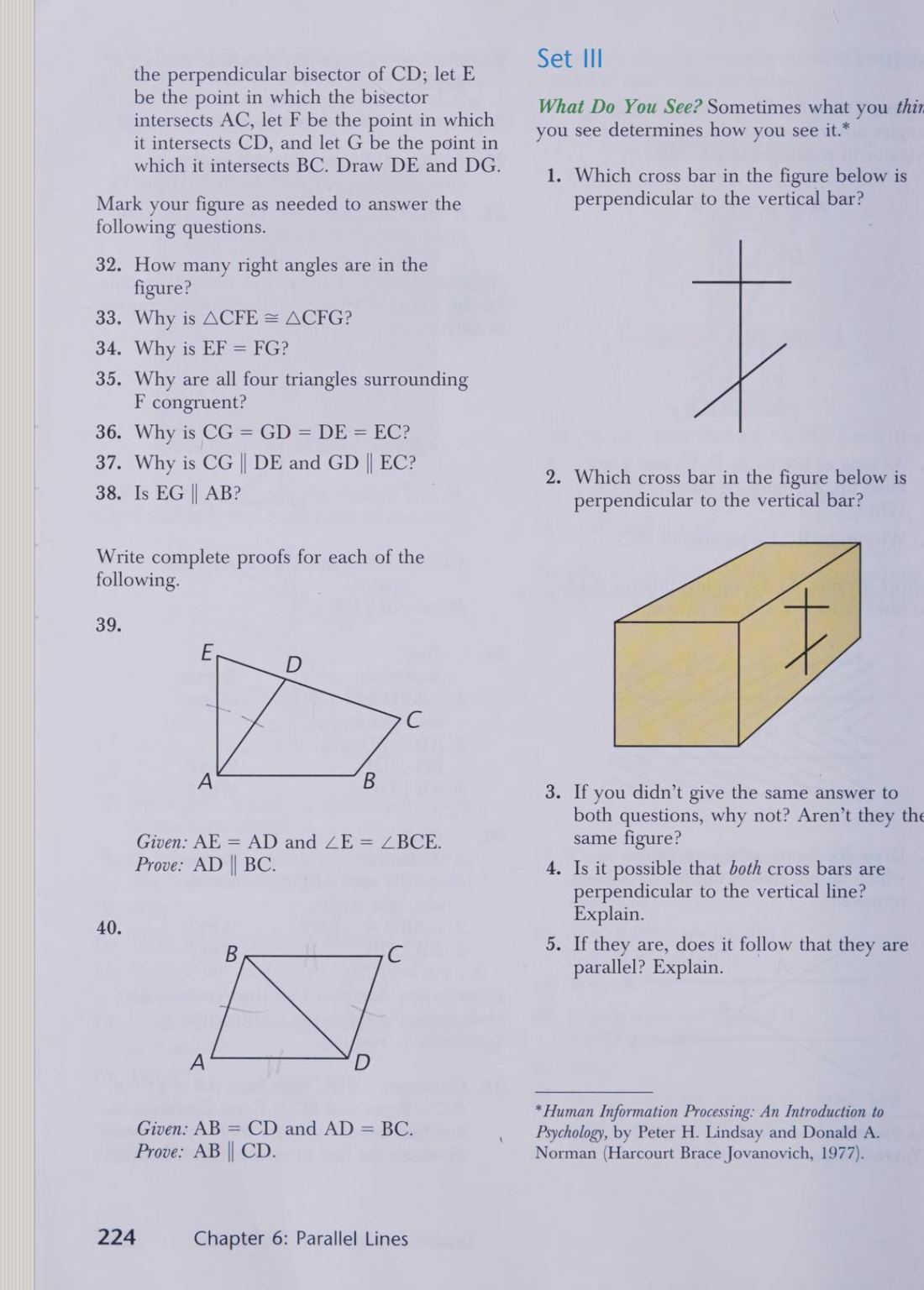
Questions 39 and 40: the last two proofs
39: given AE = AD and ∠E = ∠BCE, prove AD ∥ BC. 40: given AB = CD and AD = BC, prove AB ∥ CD.
- Proof 39: AE = AD makes △AED isosceles, so ∠E = ∠ADE (Theorem 9).
- ∠E = ∠BCE is given; substitute: ∠ADE = ∠BCE. E, D, and C are collinear, so those two are corresponding angles on transversal EC, and AD ∥ BC by Theorem 17.
- Proof 40: the figure's diagonal BD is the transversal. With AB = CD, AD = BC, and BD = BD, SSS gives △ABD ≅ △CDB.
- Corresponding parts: ∠ABD = ∠CDB, and they are alternate interior angles across transversal BD: AB ∥ CD by Corollary 1. (The same congruence also yields AD ∥ BC; a quadrilateral with both pairs of opposite sides equal has both pairs parallel, and chapter 7 will give that shape its name.)
- Score the session: symmetry built perpendiculars, and perpendiculars plus congruence now build parallels. The next session asks the question this one carefully avoided: through a point off a line, how many parallels are there?