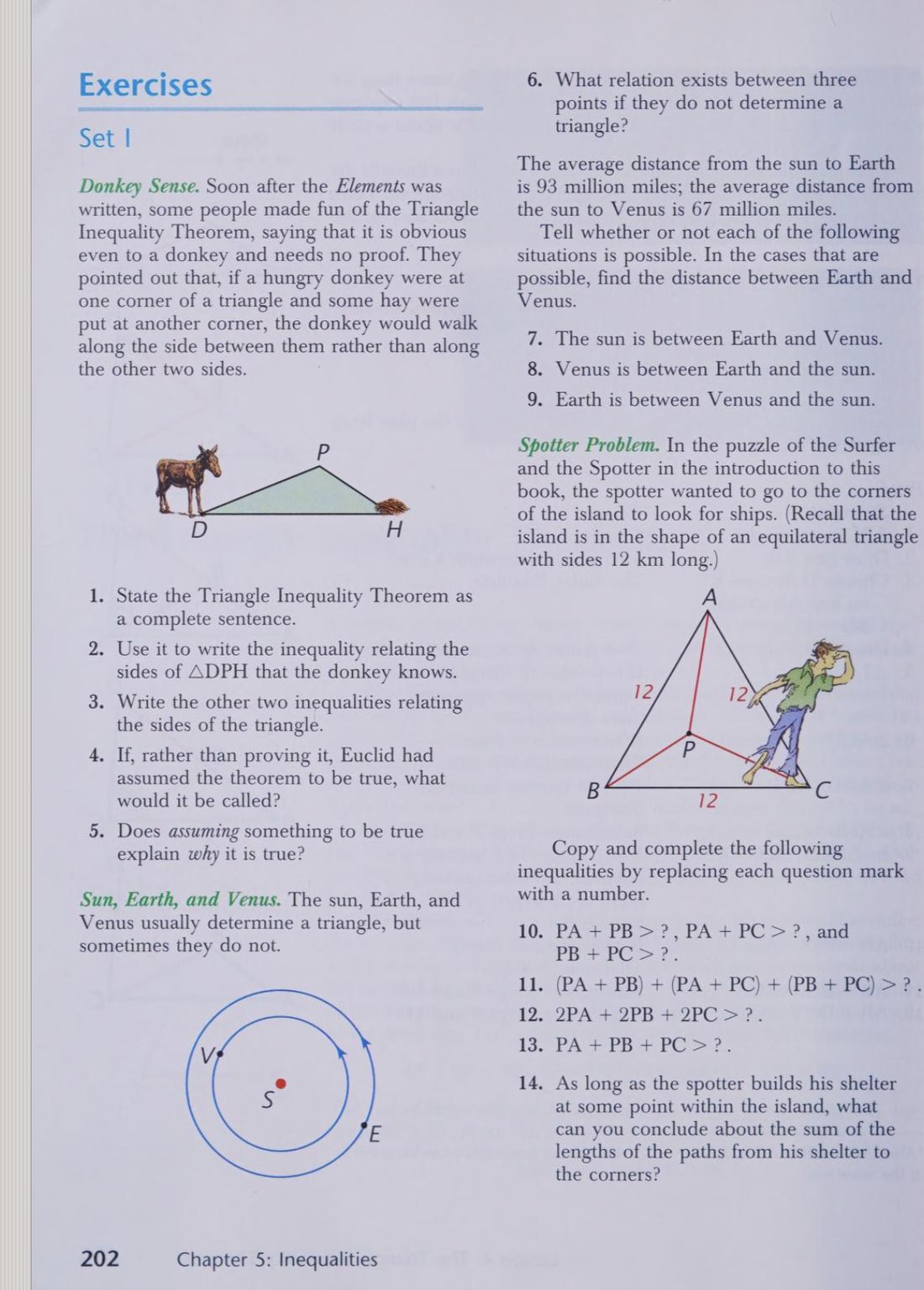
Questions 10 to 14: the spotter's three paths
P sits inside an equilateral island of side 12 km. Fill in the inequalities and conclude something about PA + PB + PC.
- Question 10: P with each pair of corners makes a triangle, and each triangle contains one 12-km island side: PA + PB > 12, PA + PC > 12, PB + PC > 12.
- Question 11: add all three inequalities (the Addition Theorem twice): (PA + PB) + (PA + PC) + (PB + PC) > 36.
- Question 12: collect: each distance appears twice, so 2PA + 2PB + 2PC > 36.
- Question 13: divide by 2 (division property, 2 > 0): PA + PB + PC > 18.
- Question 14, in words: wherever inside the island the spotter builds, walking to the three corners totals more than 18 km, half again the length of one coastline. A bound proved for every point at once, which no amount of pacing the island could measure.
Questions 21 to 23: pinning the third side
An isosceles triangle has sides 4 and 9: find the third. A scalene triangle has sides 5 and 7: what is known? A right triangle has sides 6 and 8: what could the third be?
- Question 21: isosceles means the third side repeats a given one: 4 or 9. Test 4: sides 4, 4, 9 fail the theorem (4 + 4 = 8 < 9). Test 9: sides 4, 9, 9 pass every sum. The third side must be 9; the theorem turned two candidates into one.
- Question 22: with 5 and 7, the theorem brackets the third side x: 7 − 5 < x < 7 + 5, so 2 < x < 12, and scalene strikes out x = 5 and x = 7. A range, not a value; that is all two sides can say.
- Question 23: "right triangle" adds the Pythagorean relation. If 6 and 8 are legs: third = √(36 + 64) = 10. If 8 is the hypotenuse: third = √(64 − 36) = √28 ≈ 5.3. Two honest answers, and both sit inside the inequality's 2-to-14 window, as they must.
- The pattern across all three: the Triangle Inequality gives the possible, extra hypotheses (isosceles, right) narrow it to the actual. Possibility first, then precision; that order is most of applied geometry.
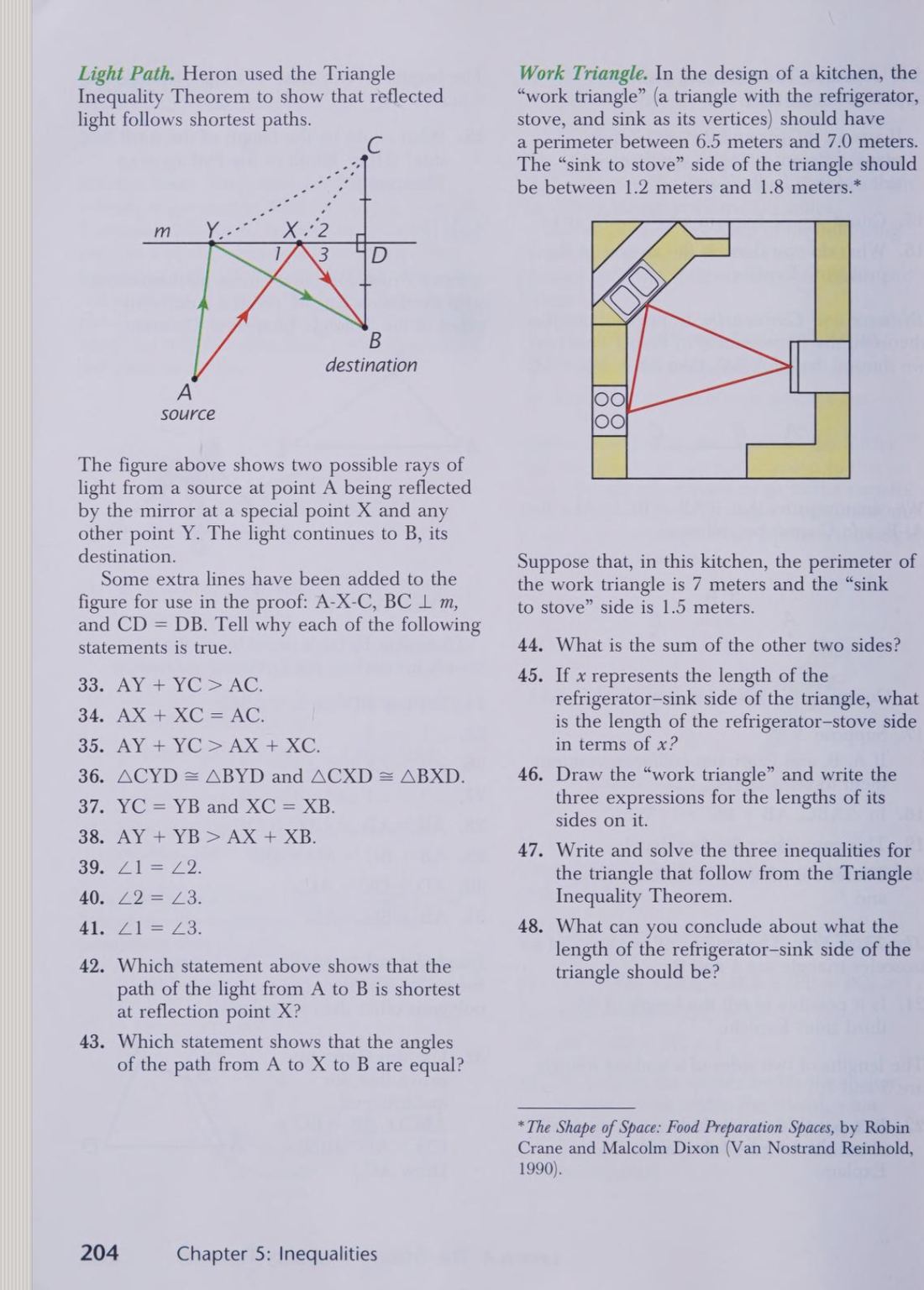
Questions 44 to 48: the kitchen triangle
Perimeter 7 m, sink-to-stove 1.5 m. Let x be refrigerator-to-sink. Bound x with the Triangle Inequality.
- Question 44: the other two sides sum to 7 − 1.5 = 5.5 m.
- Question 45: refrigerator-to-stove is then 5.5 − x, and question 46's triangle carries sides 1.5, x, 5.5 − x.
- Question 47, inequality one: x + 1.5 > 5.5 − x gives 2x > 4, so x > 2.
- Inequality two: (5.5 − x) + 1.5 > x, which is 7 − x > x, so 2x < 7 and x < 3.5. The third inequality, x + (5.5 − x) > 1.5, says 5.5 > 1.5: always true, information-free, like Venus's third inequality on page 200.
- Question 48: the refrigerator-to-sink run must satisfy 2 < x < 3.5 meters. A cabinet-maker could have guessed "around 2 or 3"; the theorem hands the exact window and the certainty that nothing outside it can close into a triangle.
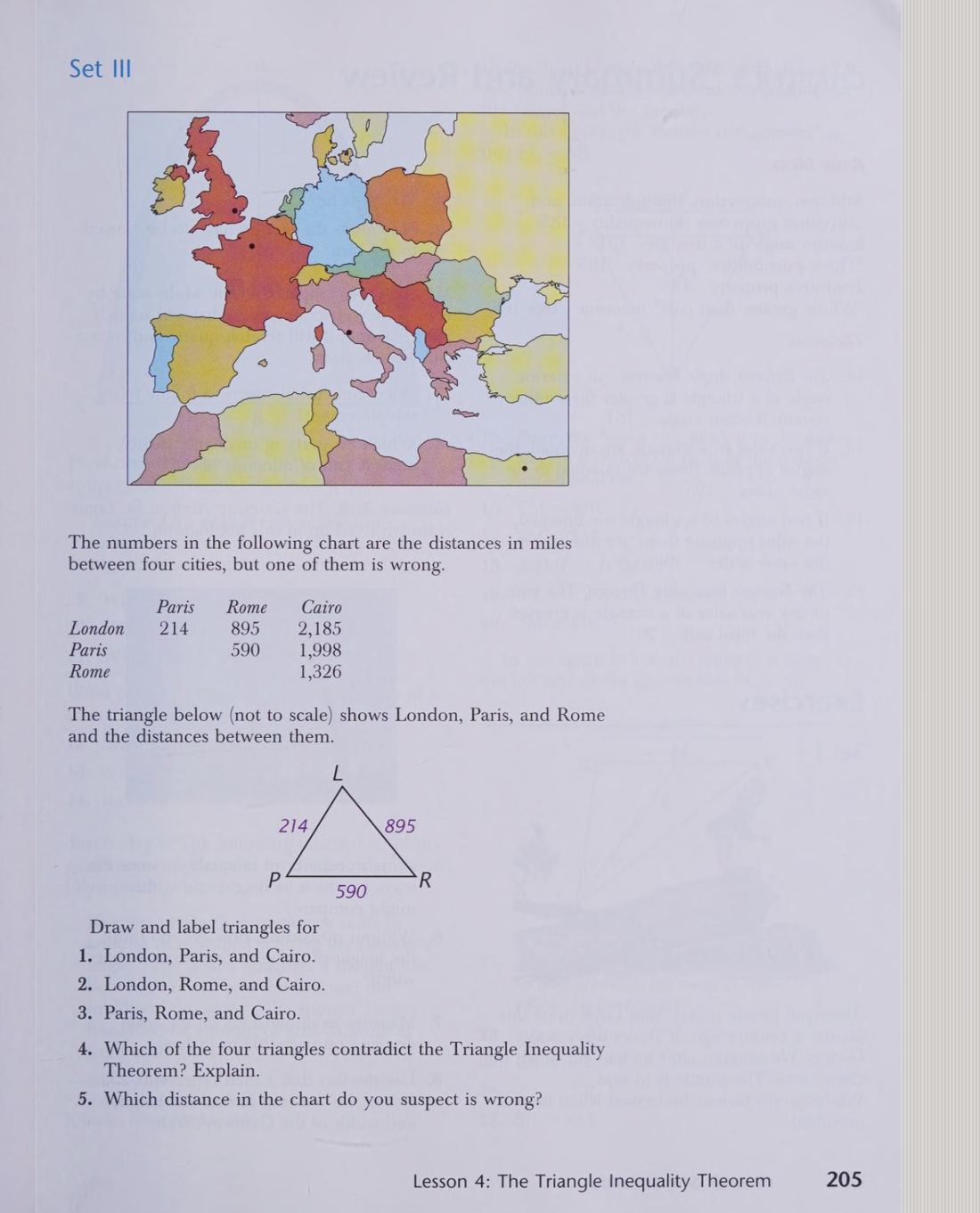
Set III: auditing the mileage chart
London-Paris 214, London-Rome 895, London-Cairo 2,185, Paris-Rome 590, Paris-Cairo 1,998, Rome-Cairo 1,326. One number is wrong. Which?
- Triangle London-Paris-Rome: does 214 + 590 > 895? The sum is 804: it fails. Something in this triangle lies.
- Triangle Paris-Rome-Cairo: does 590 + 1,326 > 1,998? The sum is 1,916: fails again.
- Triangle London-Paris-Cairo: 214 + 1,998 = 2,212 > 2,185: passes (barely; near-collinear cities run close). Triangle London-Rome-Cairo: 895 + 1,326 = 2,221 > 2,185: passes.
- Question 4's verdict: the two failing triangles share exactly one edge, Paris-Rome. The passing triangles avoid it. Question 5: the 590 is the liar.
- Check against the world: Paris to Rome is about 690 miles, and 690 repairs both failures (214 + 690 > 895 and 690 + 1,326 > 1,998). One theorem, four triangles, and the chart confesses which digit was mistyped. That is what "basic idea of all geometry" means in practice.
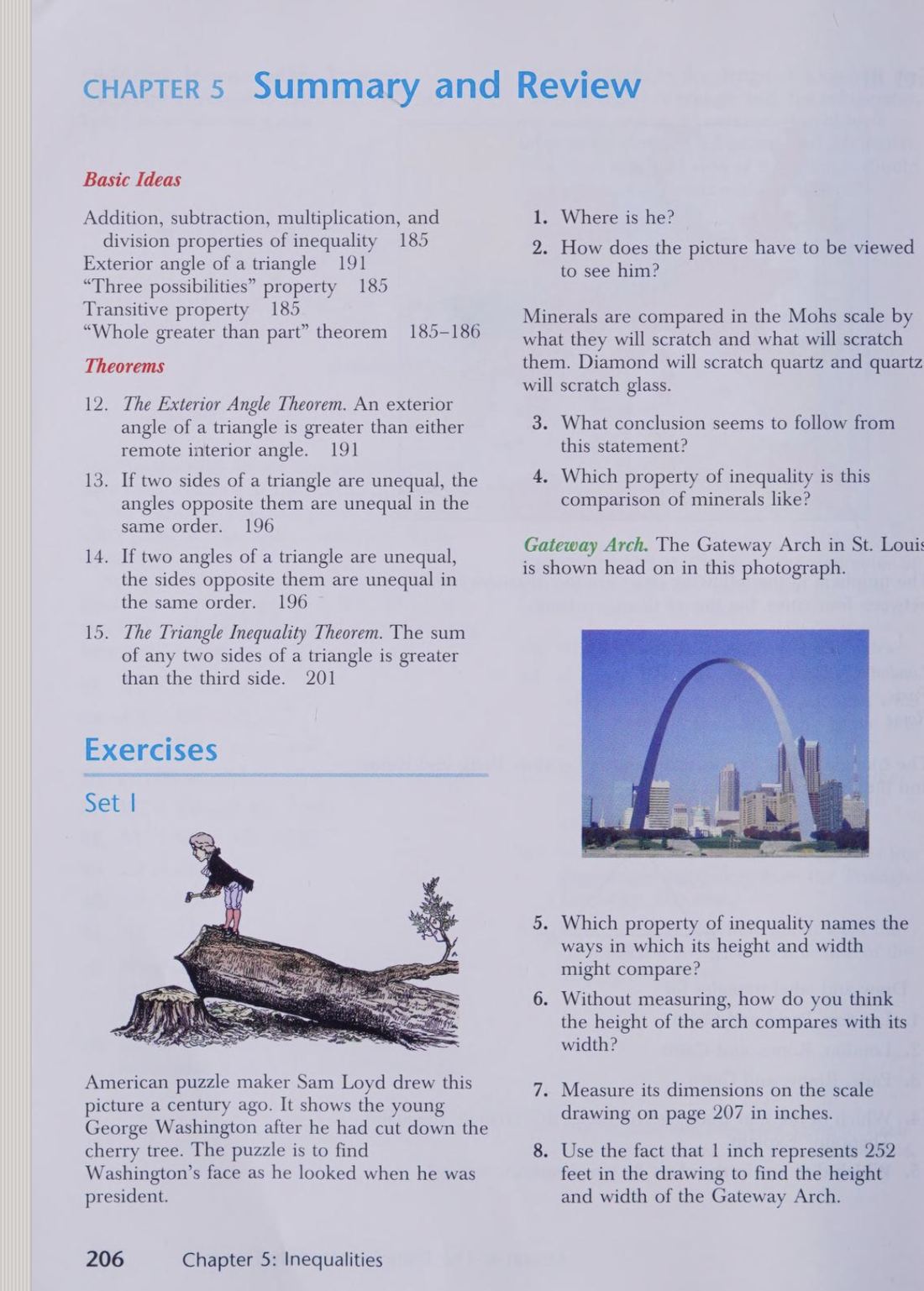
Questions 5 to 8: how tall is the Gateway Arch?
Compare the Arch's height and width by eye, then by ruler on the page 207 scale drawing (1 inch = 252 feet).
- Question 5: before any measuring, the honest frame is the Three Possibilities property: height > width, height = width, or height < width, exactly one.
- Question 6: commit to your eye's verdict. Nearly everyone reports taller than wide; vertical extents read larger (the top hat on page 186 made the same fool of us).
- Question 7: measure the drawing: both dimensions come out the same, about 2.5 inches, height and width alike.
- Question 8: convert: 2.5 × 252 = 630. The Gateway Arch is 630 feet tall and 630 feet wide, exactly, by Saarinen's design.
- The chapter in one landmark: the eye proposes an inequality, measurement returns an equality, and only the trichotomy made the question precise enough to settle. Keep distrusting tall things.
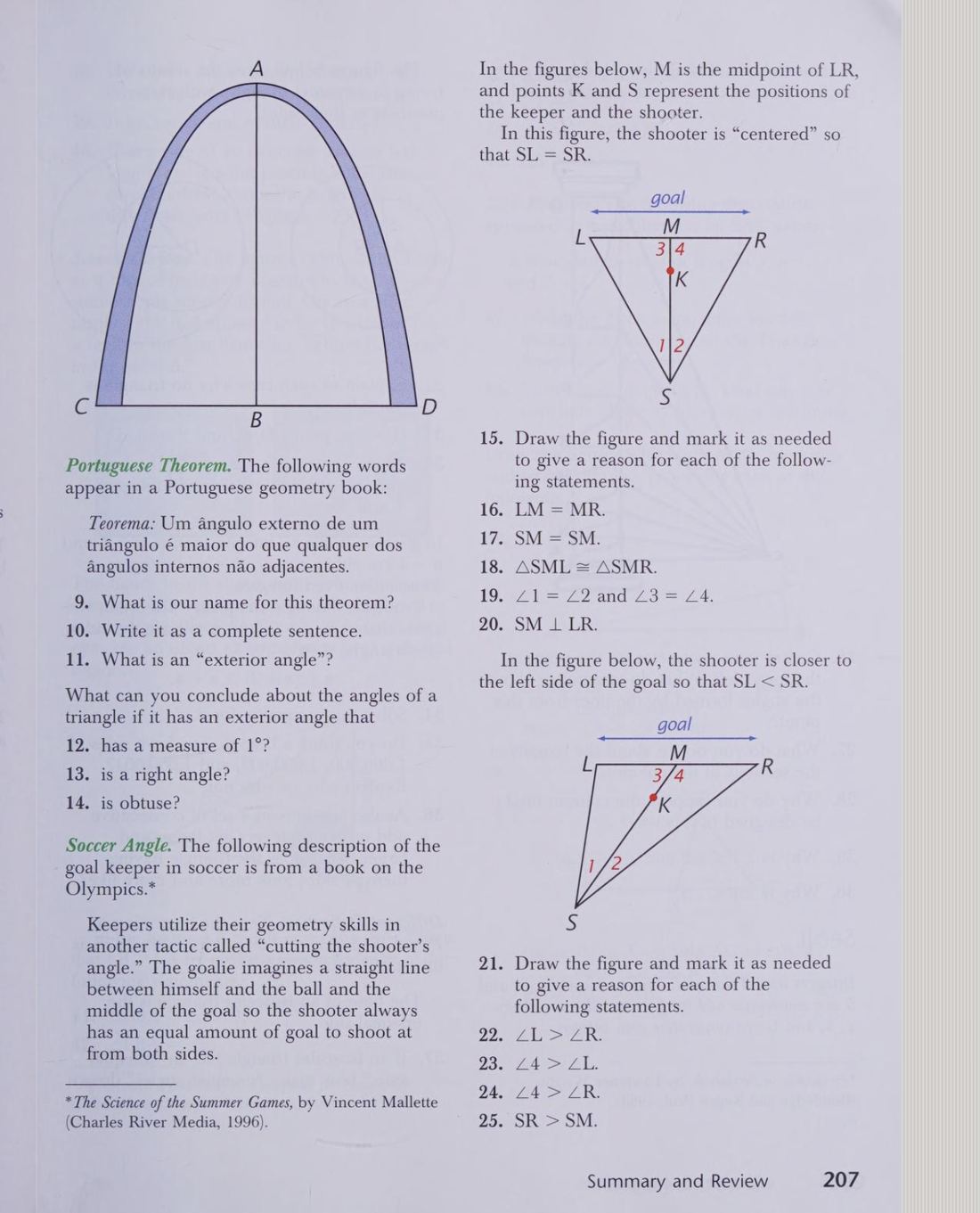
Questions 21 to 25: the off-center shooter
M is the goal line's midpoint, K the keeper on SM, and the shooter S stands nearer the left post: SL < SR. Justify each statement through SR > SM.
- Question 22: in △SLR, SL < SR, and Theorem 13 orders the opposite angles the same way: ∠R < ∠L, that is, ∠L > ∠R.
- Question 23: the keeper's line SM splits the big triangle in two, and ∠4 at M forms a linear pair with ∠3, making it an exterior angle of the left triangle SML. Theorem 12: ∠4 > ∠L.
- Question 24: chain with step 1 by the transitive property: ∠4 > ∠L > ∠R gives ∠4 > ∠R.
- Question 25: in △SMR the angles ∠4 and ∠R face sides SR and SM, so Theorem 14 converts: SR > SM.
- Read the soccer: SM, the keeper's line to the goal's middle, is shorter than the shooter's line to the far post, and the off-center shooter sees unequal slices of goal. The keeper's fix is to center on the ball rather than the goal, which is exactly what the quoted coaching manual teaches. Four theorems, one penalty kick.
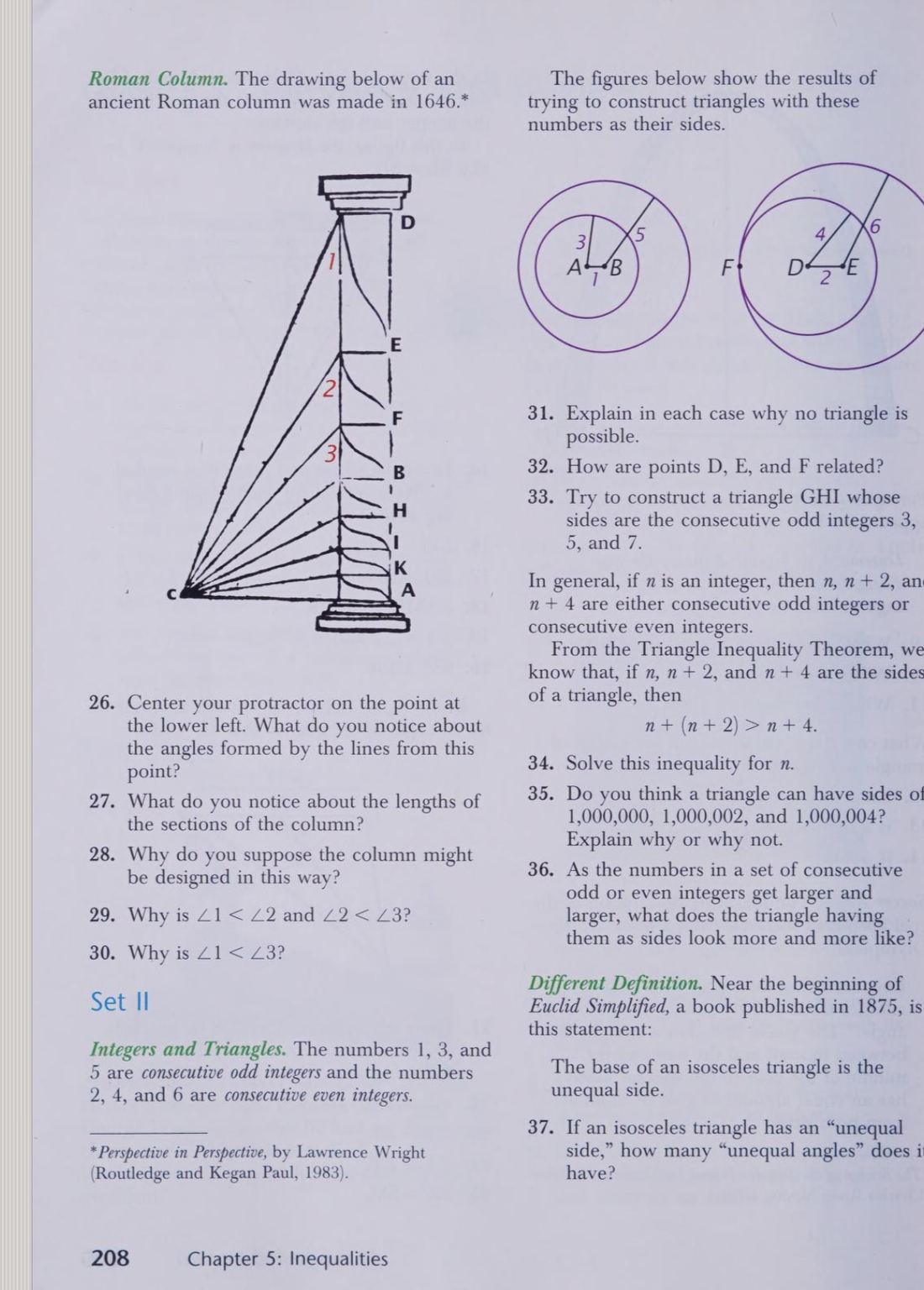
Questions 31 to 36: consecutive-integer triangles
Sides 1, 3, 5 and 2, 4, 6 fail to make triangles (the compass arcs show it). Why? Then solve n + (n + 2) > n + 4 and interpret.
- Question 31: 1 + 3 = 4 < 5, so the arcs of radii 1 and 3 never meet: the theorem fails outright. For 2, 4, 6: 2 + 4 = 6 exactly, and the arcs meet on the segment itself.
- Question 32: that equality is page 203's converse: D, E, F are collinear, a triangle flattened to a segment.
- Question 33: 3, 5, 7 builds honestly: 3 + 5 = 8 > 7.
- Questions 34 and 35: n + (n + 2) > n + 4 simplifies to n > 2, so every consecutive triple from 3, 5, 7 upward works, including 1,000,000, 1,000,002, 1,000,004: the sum clears the third side by a million minus two.
- Question 36: but watch the shape: the clearance (2n − 2) grows while the proportions flatten, and the giant triangle looks ever more like a straight segment. The theorem separates possible from impossible; it does not promise the possible looks like much. Both lessons matter.
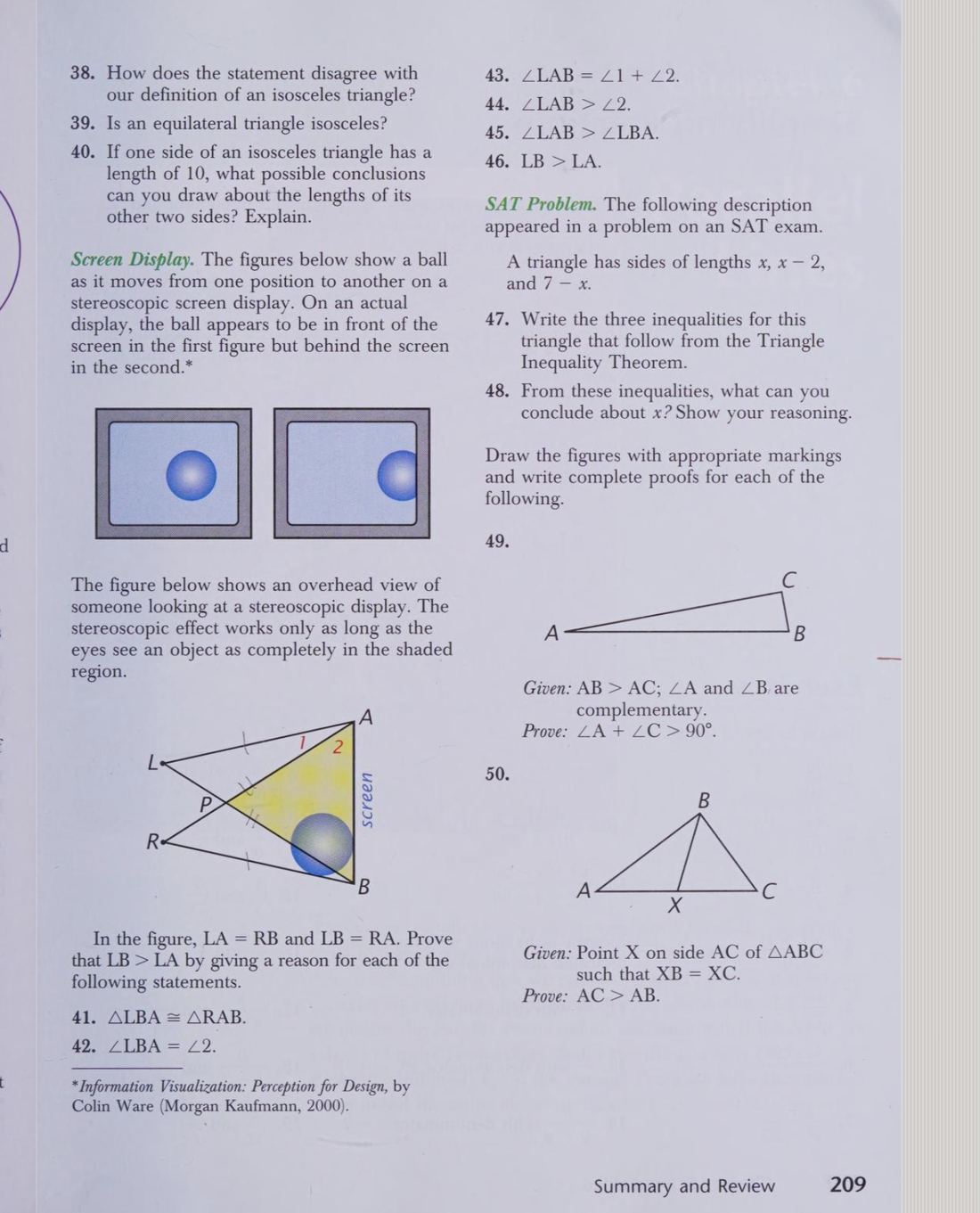
Questions 47 and 48: solving the SAT triangle
A triangle has sides x, x − 2, and 7 − x. Write the three Triangle Inequality statements and corner x.
- First inequality: x + (x − 2) > 7 − x gives 2x − 2 > 7 − x, so 3x > 9: x > 3.
- Second: x + (7 − x) > x − 2 collapses to 7 > x − 2: x < 9.
- Third: (x − 2) + (7 − x) > x collapses to 5 > x: x < 5.
- Question 48: intersect the three: x > 3 and x < 5 (the x < 9 is slack): 3 < x < 5. Quietly check side positivity too: x − 2 > 0 and 7 − x > 0 are both implied. Any x in the window (say 4: sides 4, 2, 3) builds a real triangle.
- Notice the anatomy repeating from the kitchen on page 204: one inequality bites from below, one from above, one is redundant. Two teeth and a spare is the theorem's usual grip on a one-variable triangle.
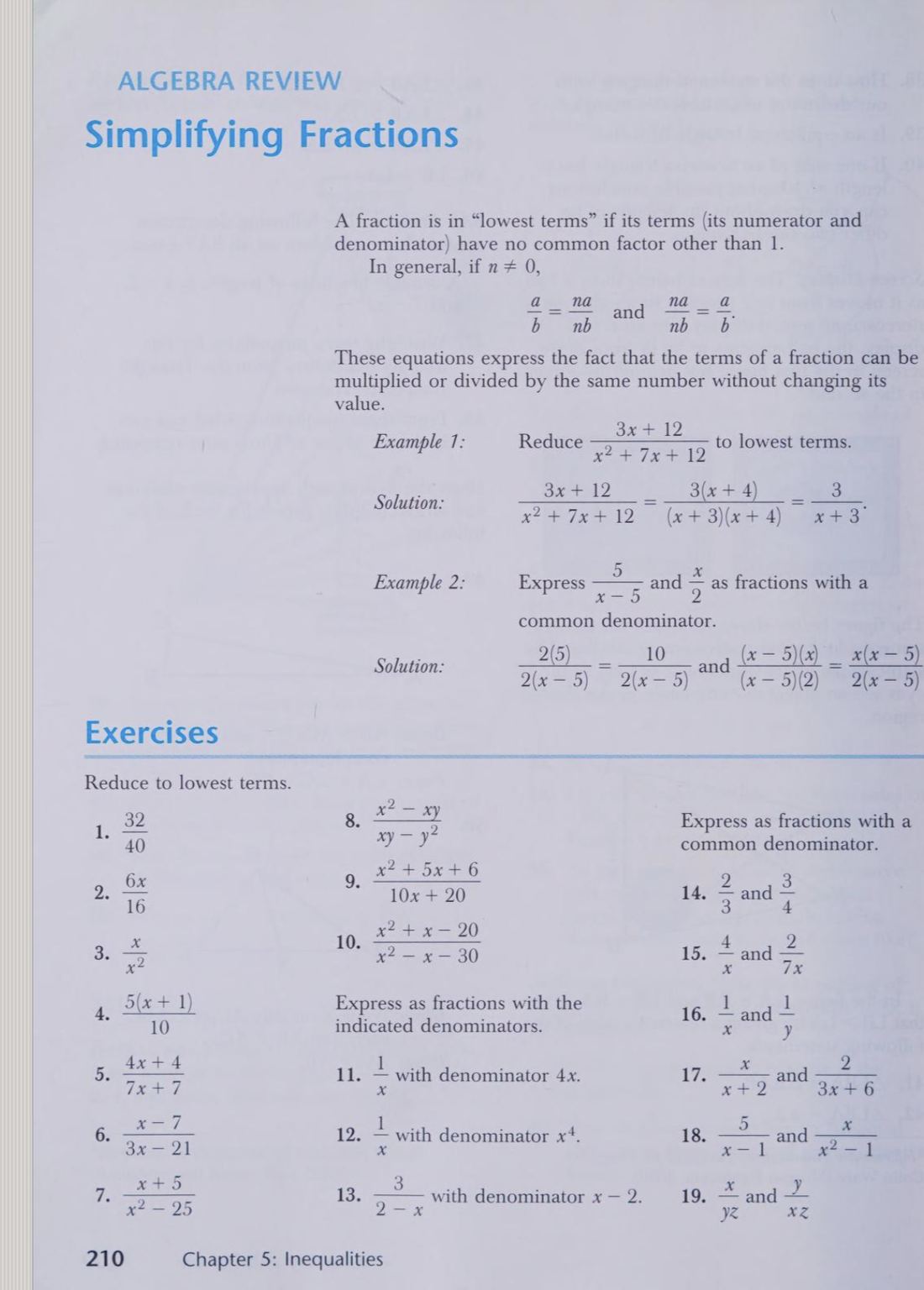
Questions 7 and 10: cancel factors, not terms
Reduce (x + 5)/(x² − 25) and (x² + x − 20)/(x² − x − 30) to lowest terms.
- Question 7: factor the bottom as a difference of squares: x² − 25 = (x + 5)(x − 5). The fraction is (x + 5)/((x + 5)(x − 5)).
- Cancel the shared factor (x + 5), legal because it is a factor of the entire top and bottom: the result is 1/(x − 5). Note the 1 that remains; a canceled numerator leaves 1, not 0.
- Question 10: factor both trinomials, page 182 style. Top: product −20, sum +1: (x + 5)(x − 4). Bottom: product −30, sum −1: (x − 6)(x + 5).
- Cancel the shared (x + 5): (x − 4)/(x − 6). Nothing else cancels; the x's in the remaining factors are terms, welded to their neighbors, and crossing them out is the classic crime this review exists to prevent.
- Audit with x = 1, the page 130 habit: question 10's original gives (1 + 1 − 20)/(1 − 1 − 30) = −18/−30 = 3/5, and (1 − 4)/(1 − 6) = −3/−5 = 3/5. Equal, and chapter 5 closes the way it opened: with a comparison you can trust.