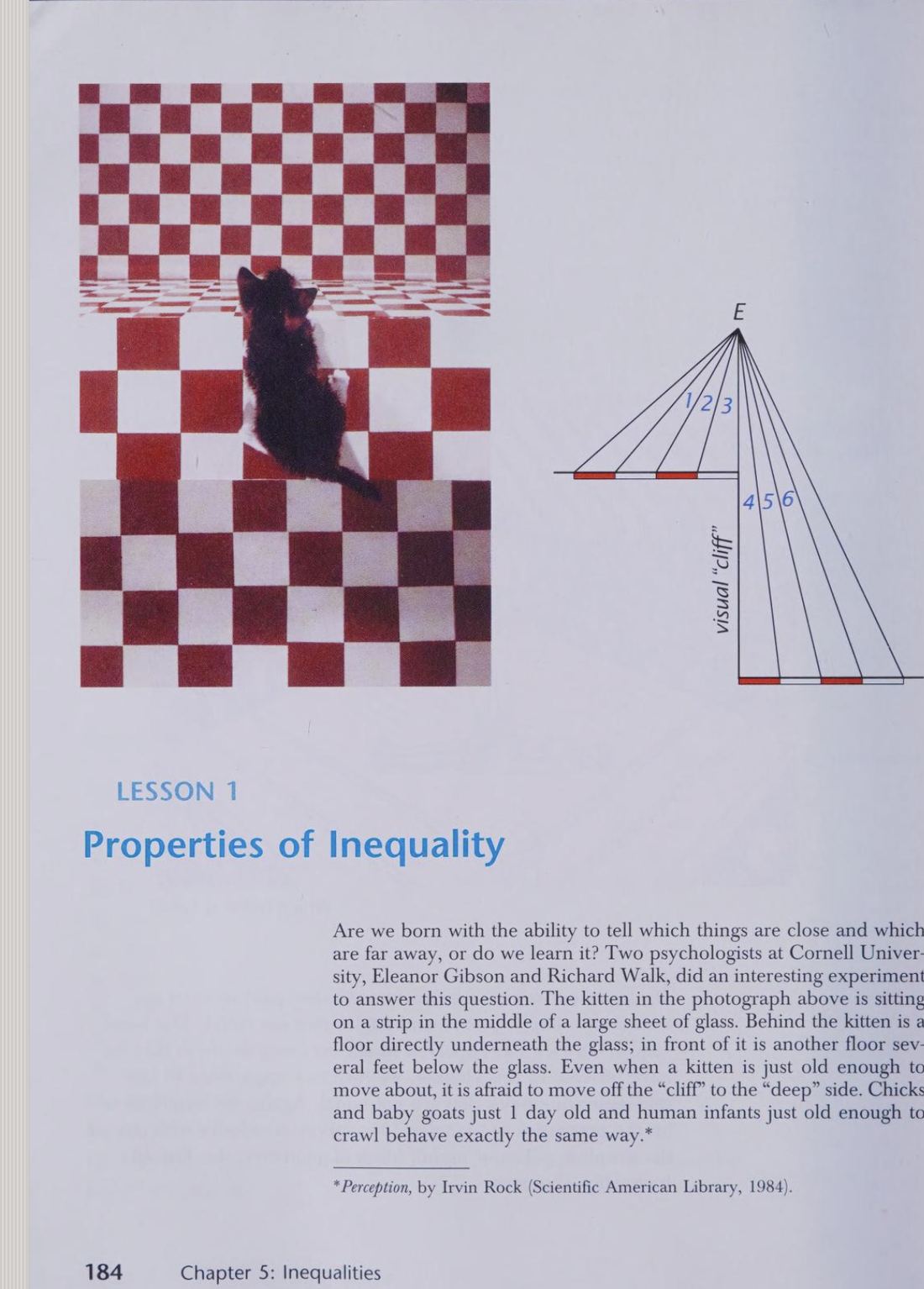
Questions 13 to 19: the deceiving triangles
Both triangles look equilateral and congruent. In △ABC, AB > AC and AC = BC. In △DEF, DF < EF and EF < DE. Classify each and compare the disputed sides.
- Question 13: AC = BC is two equal sides: △ABC is isosceles, whatever it looks like.
- Questions 14 and 15: AB > AC and AC = BC, so AB > BC by substitution. The "equilateral" triangle has a longest side.
- Question 16: DF < EF < DE is three different lengths: △DEF is scalene.
- Questions 17 and 18: DF < EF and EF < DE chain by the transitive property: DF < DE.
- Question 19: congruent triangles need equal corresponding sides; one triangle has two sides equal and the other has none, so no correspondence can work. Eyes said twins, properties said strangers, and this page is the chapter's thesis in miniature: inequality statements are checkable claims, not impressions.
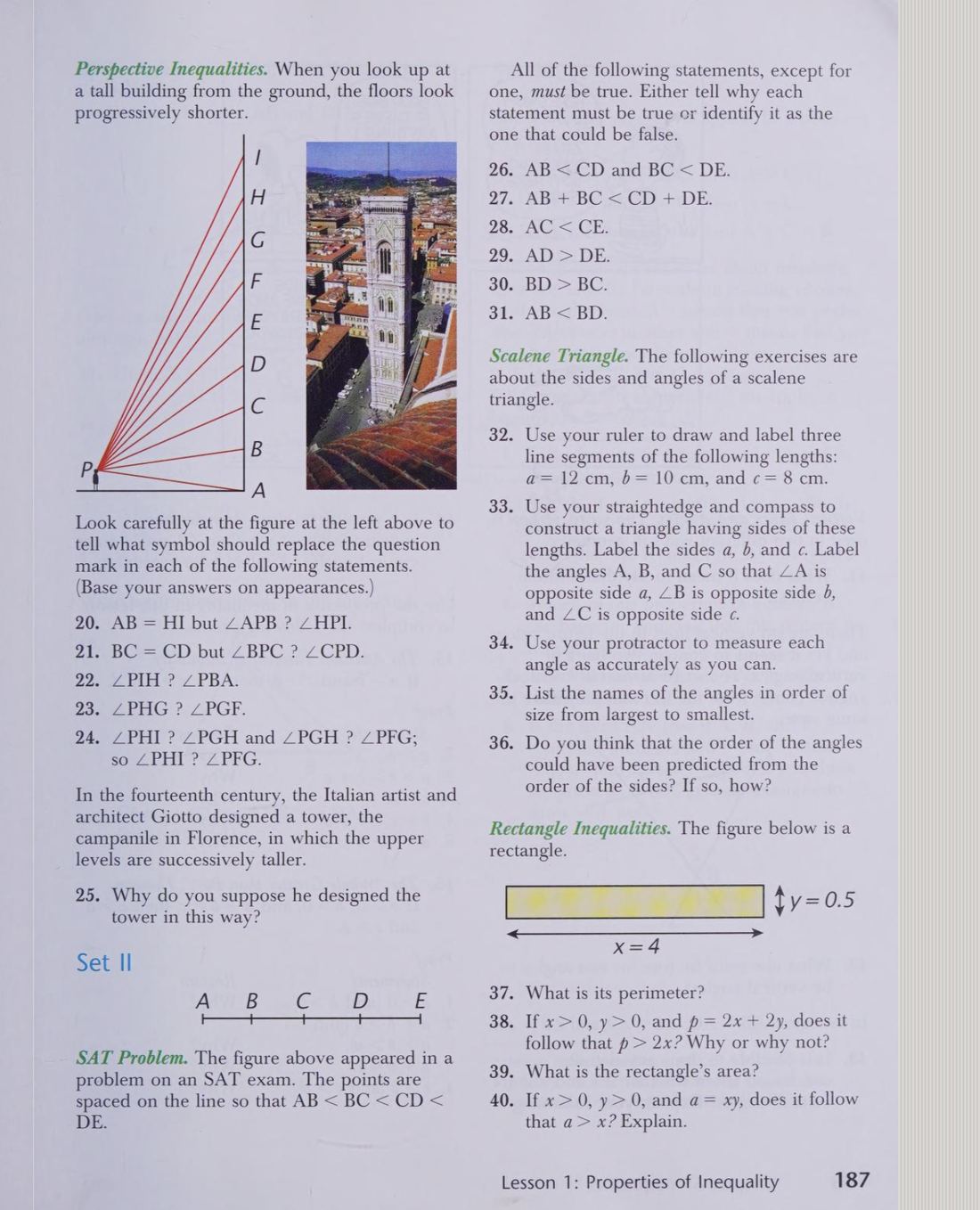
Questions 26 to 31: one statement can lie
Points in order with AB < BC < CD < DE. Five of the six statements must be true; find the one that could be false.
- Question 26: AB < CD chains through BC (transitive), and BC < DE likewise. Must be true.
- Question 27: add the two chains, AB + BC < CD + DE, the Addition Theorem of Inequality. Must be true.
- Question 28: AC = AB + BC and CE = CD + DE (Betweenness of Points), so 27 says exactly AC < CE. Must be true. Question 30: BD = BC + CD > BC, whole greater than part. Question 31: AB < BC < BD, transitive again. Both must be true.
- Question 29 claims AD > DE. Test with numbers honoring the givens: AB, BC, CD = 1, 2, 3 and DE = 100. Then AD = 6 and DE = 100: false. With DE = 7, AD = 6 < 7: false again; with DE = 4, AD = 6 > 4: true. It can go either way.
- So 29 is the one that could be false, and the method is the lesson: statements provable from the properties must hold; for the rest, hunt a counterexample. One number set settles what staring cannot.
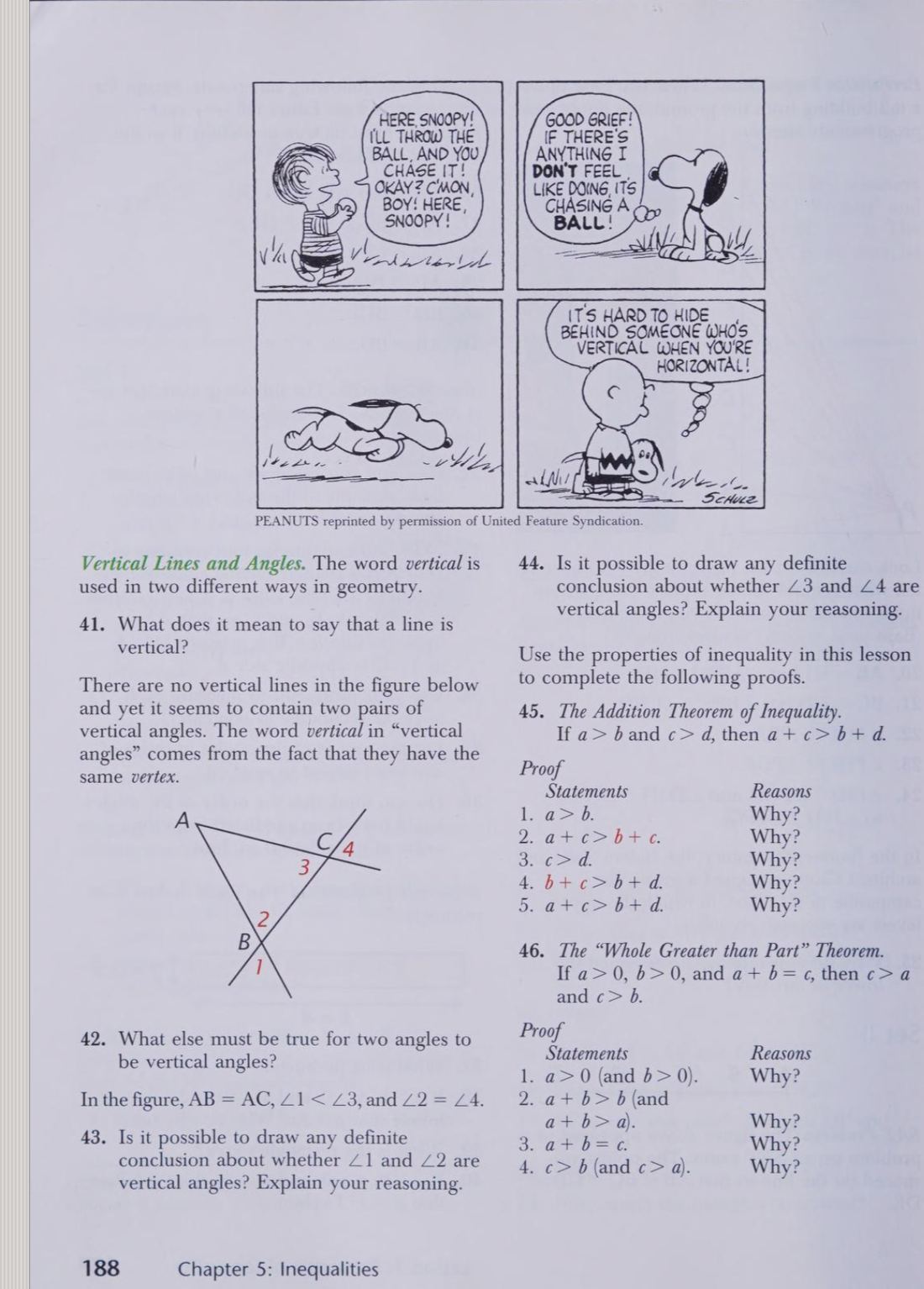
Question 45: proving the Addition Theorem
If a > b and c > d, then a + c > b + d. Supply the five reasons.
- Statement 1: a > b. Reason: given.
- Statement 2: a + c > b + c. Reason: the addition property of inequality, adding c to both sides of step 1.
- Statement 3: c > d. Reason: given (the second half).
- Statement 4: b + c > b + d. Reason: the addition property again, adding b to both sides of step 3.
- Statement 5: a + c > b + d. Reason: transitive, splicing steps 2 and 4 through their shared middle b + c. Two additions and one splice; the theorem is the transitive property wearing work gloves. Now run question 46 the same way: a + b > b needs only that a > 0 plus addition, and c > b follows by substitution.
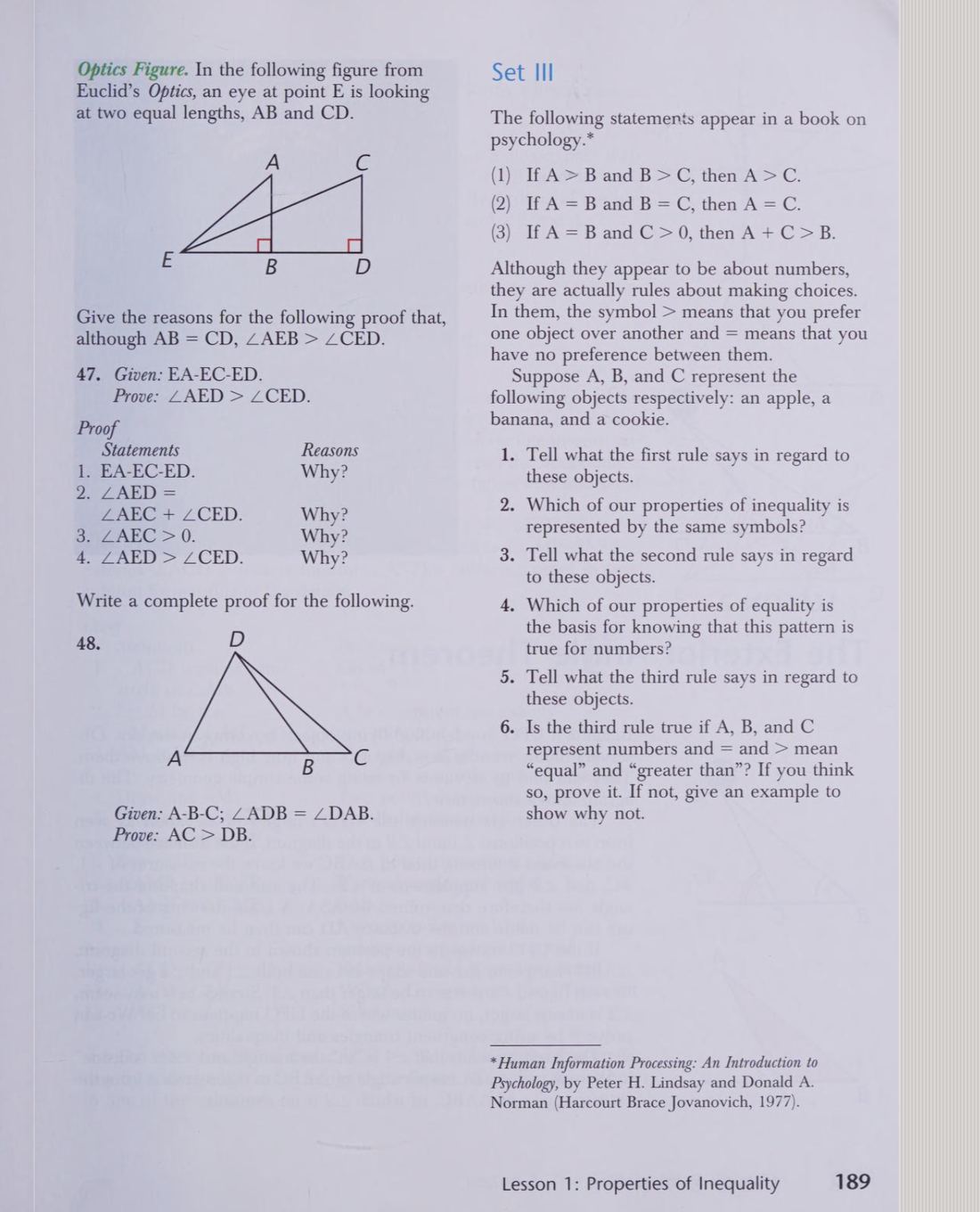
Question 48: AC beats DB
Given A-B-C and ∠ADB = ∠DAB, prove AC > DB.
- Mark the figure: D above segment AC, triangle ABD with equal angles at A and D.
- ∠ADB = ∠DAB is given, and in △ABD those angles sit opposite sides AB and DB. Theorem 10 (equal angles, equal opposite sides): AB = DB.
- A-B-C is given, so AC = AB + BC by the Betweenness of Points Theorem.
- BC is a positive length, so AC > AB by the whole greater than part theorem.
- Substitute step 2 into step 4: AC > DB. Five statements, and look at the guest list: a chapter 4 isosceles theorem, a chapter 3 betweenness theorem, and this lesson's inequality engine, all in one five-line proof. The chapters are done being separate subjects.
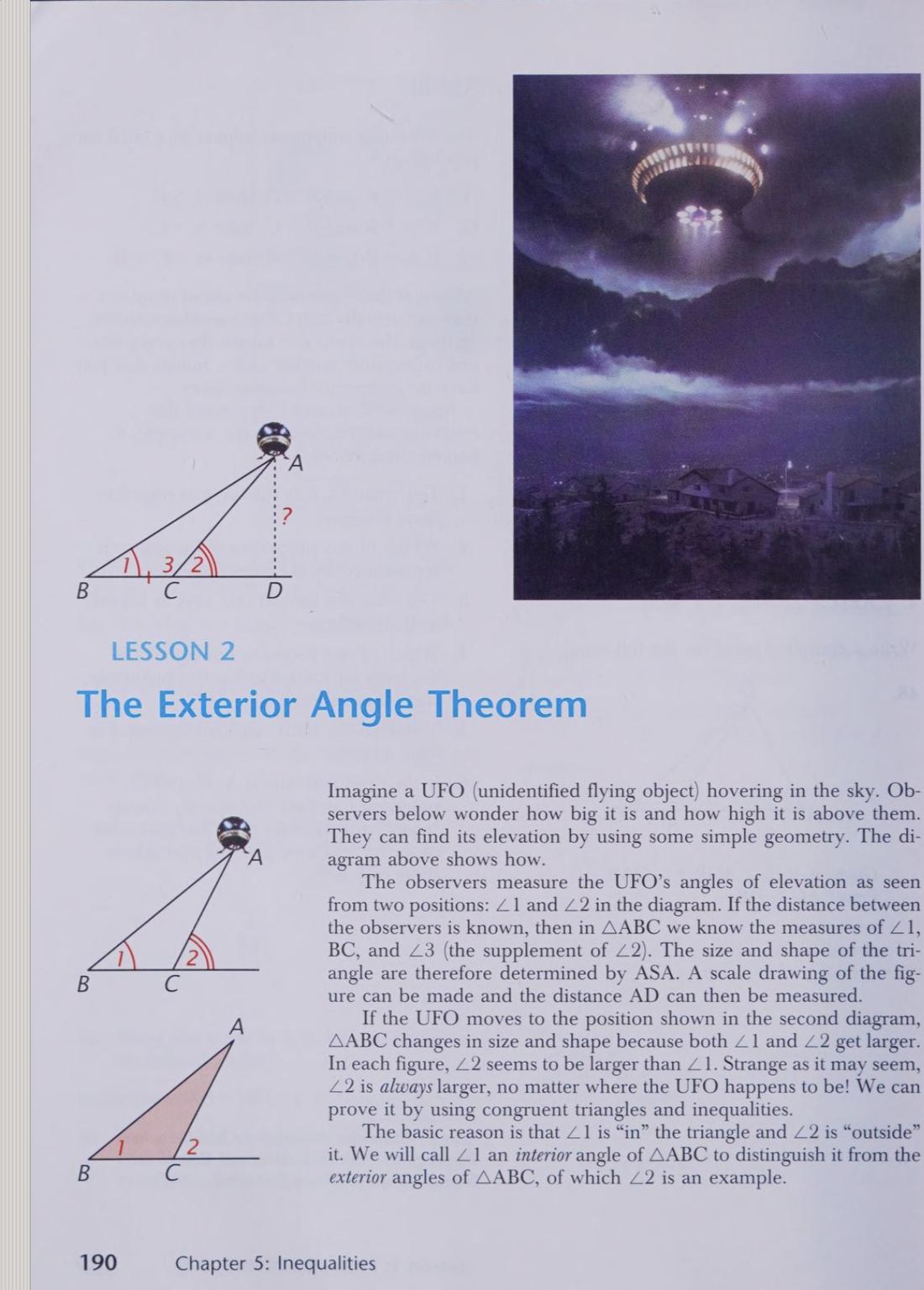
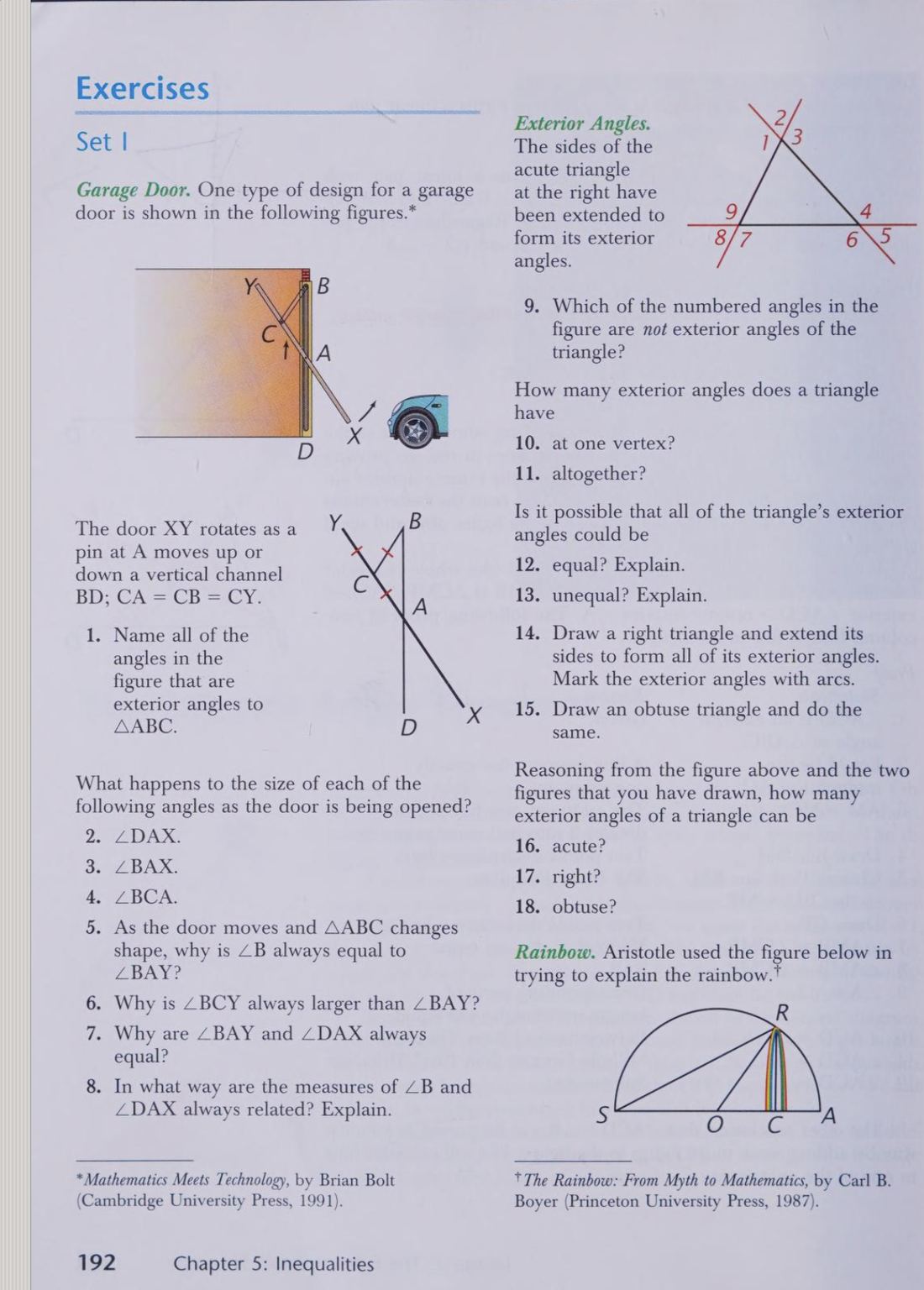
Questions 9 to 18: an exterior-angle census
Extend all three sides of a triangle both ways. Which angles are exterior, how many are there, and how many can be acute, right, or obtuse?
- Question 9: at each vertex the extensions make four angles: the interior one, two exterior ones (the linear-pair partners), and the interior's vertical angle, which is exterior to nothing. The three vertical copies are the non-exterior numbered angles.
- Questions 10 and 11: two exterior angles per vertex, six altogether, and the two at any vertex are vertical angles, hence equal.
- Question 12: all six equal happens exactly for the equilateral triangle: every interior 60, every exterior 120. Question 13: all six unequal is impossible (the two at each vertex always match), but three different pairs happen in any scalene triangle.
- Questions 14 to 18, from your right and obtuse sketches: an exterior angle is acute only where the interior is obtuse, so at most 2 acute (obtuse triangle); right exteriors come only from the right angle: at most 2; and obtuse exteriors number 6 in an acute triangle, 4 in the others.
- The bookkeeping matters because the theorem is about to be quoted constantly: knowing which angles even qualify as exterior keeps every later citation honest.
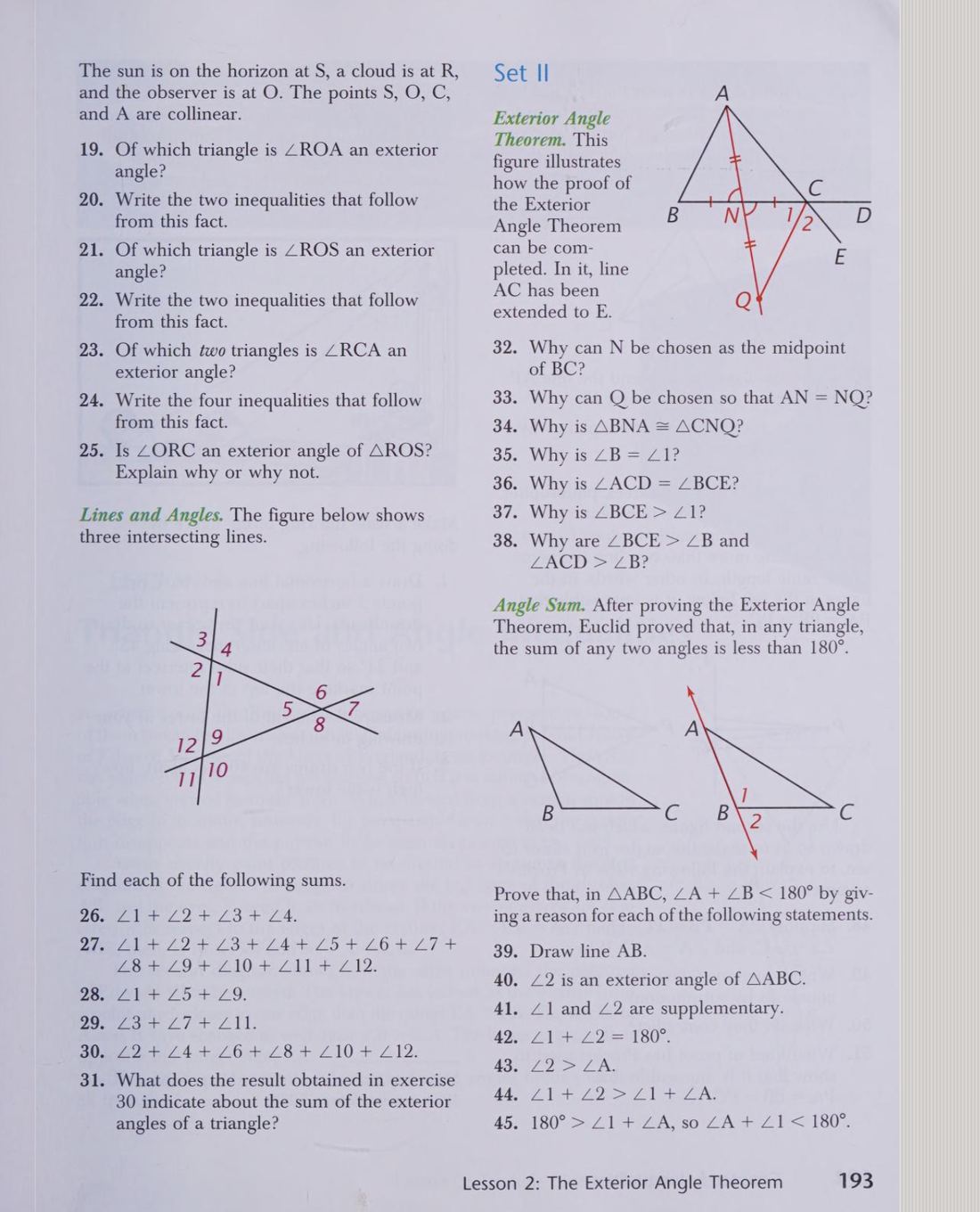
Questions 39 to 45: two angles always fall short of 180
Prove that in △ABC, ∠A + ∠B < 180°, giving a reason per statement.
- Question 39: draw line AB. Reason: two points determine a line; the extension creates the exterior angle the proof needs.
- Questions 40 to 42: ∠2 (beside ∠1 at B) is an exterior angle of the triangle by definition; it forms a linear pair with ∠1, so ∠1 + ∠2 = 180° by Theorem 5 and the definition of supplementary.
- Question 43: ∠2 > ∠A: the Exterior Angle Theorem, ∠A being remote interior.
- Question 44: add ∠1 to both sides of that inequality: ∠1 + ∠2 > ∠1 + ∠A, the addition property.
- Question 45: substitute 180 for ∠1 + ∠2: 180 > ∠1 + ∠A, which is ∠A + ∠B < 180. One theorem, one linear pair, one substitution, and every triangle in the world just promised to keep two of its angles under a straight angle, no parallel postulate required.
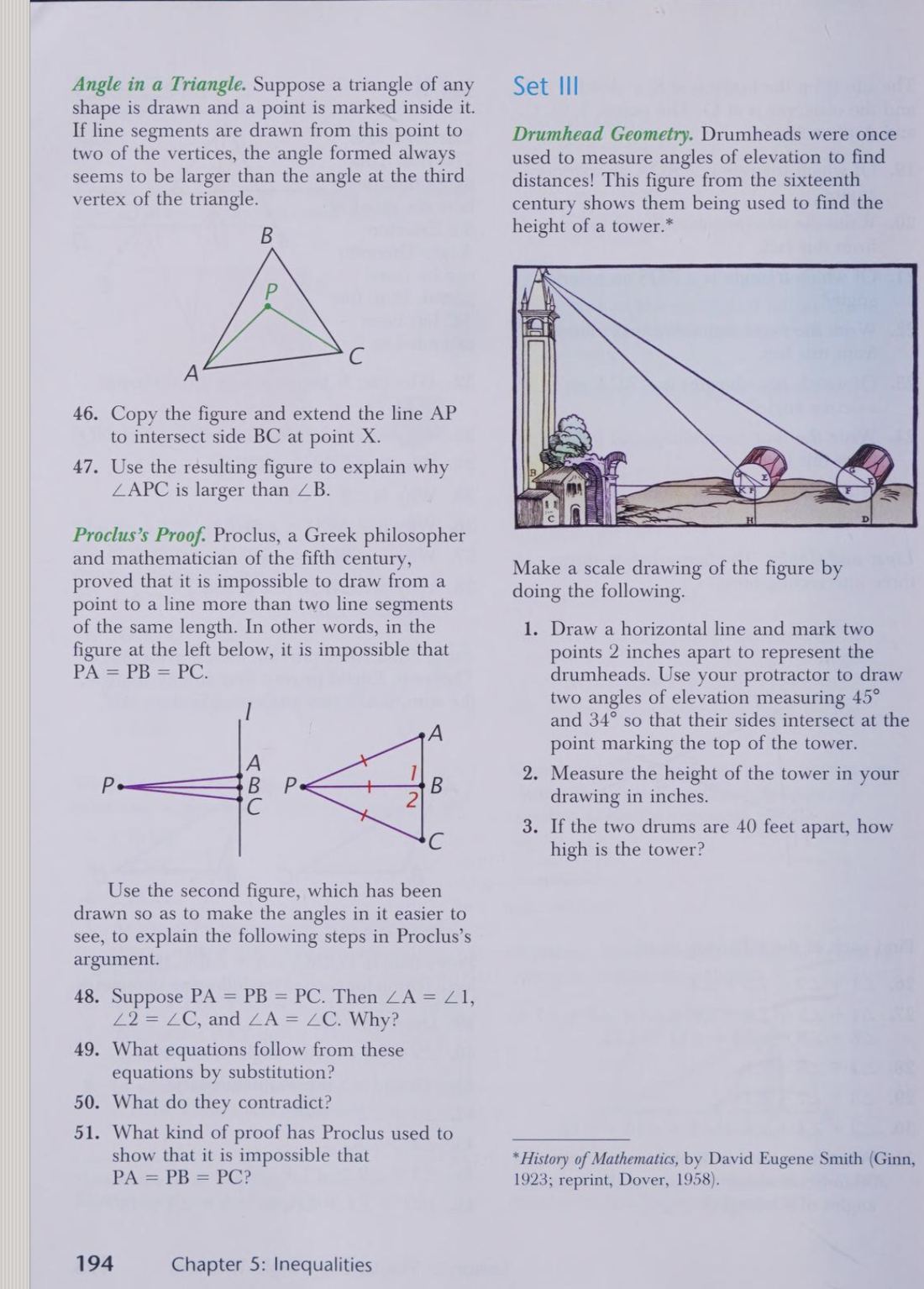
Questions 48 to 51: Proclus's impossible segments
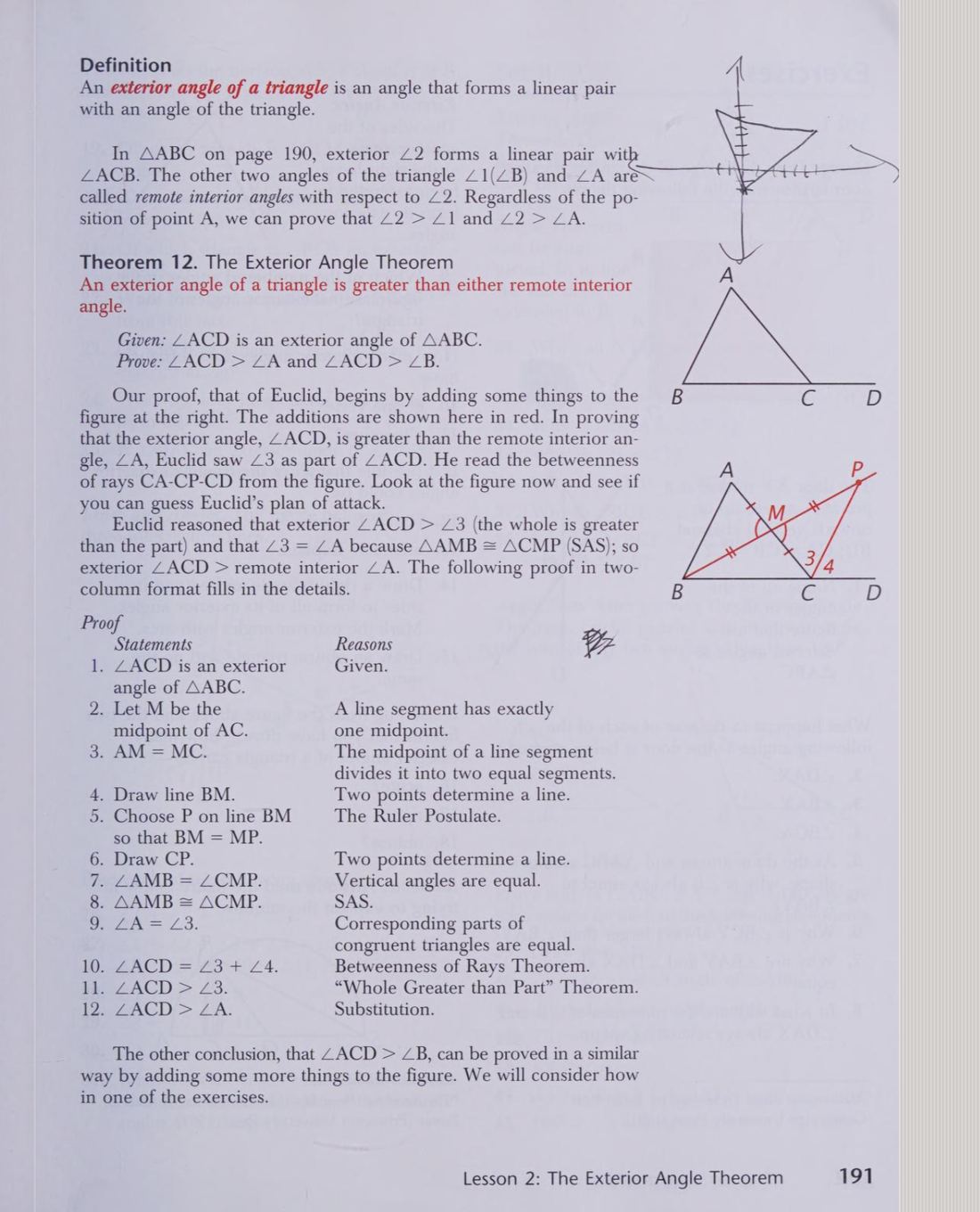
Show it is impossible that PA = PB = PC for three points A, B, C on a line, using the second figure's angles.
- Question 48: suppose PA = PB = PC. Each equal pair makes an isosceles triangle, so base angles match: ∠A = ∠1 (in △PAB), ∠2 = ∠C (in △PBC), and ∠A = ∠C (in the big △PAC). Reason: if two sides of a triangle are equal, the angles opposite them are equal.
- Question 49: substitute through the chain: ∠1 = ∠A = ∠C = ∠2, so ∠1 = ∠2, and combining, ∠1 = ∠C.
- Question 50: but ∠1 is an exterior angle of △PBC (linear pair with ∠2 at B), so the Exterior Angle Theorem demands ∠1 > ∠C. Equality and strict inequality cannot share ∠1 and ∠C: contradiction.
- Question 51: the assumption dies, so the three equal segments are impossible: an indirect proof, the page 56 skeleton with Theorem 12 as the collision.
- Read the theorem's shadow: from a point off a line, each distance to the line is taken at most twice (once per side of the perpendicular). That fact will quietly run the circle chapters: a circle meets a line at most twice.
Questions 4 to 13: proving Theorem 14 indirectly
Given △ABC with ∠A > ∠B, prove BC > AC by ruling out the alternatives.
- Suppose BC is not longer than AC. Question 4: then BC = AC or BC < AC. Question 5's reason: the Three Possibilities property; there is no fourth option.
- Questions 6 to 8: if BC = AC, the triangle is isosceles and Theorem 9 forces ∠A = ∠B, contradicting the given ∠A > ∠B.
- Questions 9 to 11: if BC < AC, Theorem 13 forces ∠A < ∠B (angles follow sides, same order), contradicting the given again.
- Question 12: both alternatives die, so BC > AC.
- Question 13: an indirect proof, and a special breed worth naming: the converse proved by eliminating cases with the original theorem. Whenever a theorem and the three-possibilities trichotomy both hold, the converse comes almost free; file the trick, because the book reuses it.
Questions 29 to 35: the folding proof
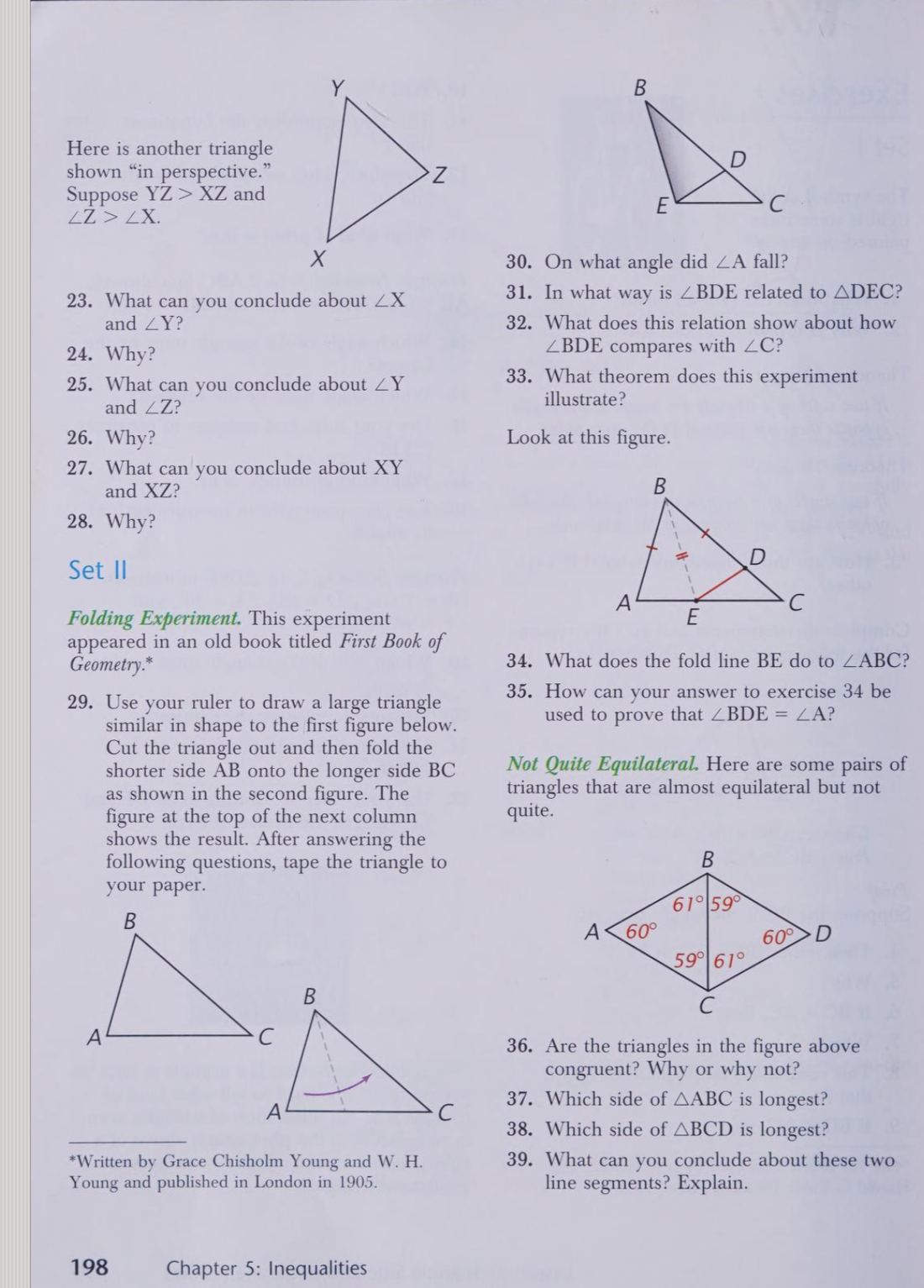
Cut out a triangle with BC longer than BA. Fold side BA onto BC; A lands at D, the crease is BE. What does the fold prove?
- Question 30: the fold carries ∠A exactly onto ∠BDE: paper congruence, the page 99 sense of "equal."
- Question 31: ∠BDE forms a linear pair with ∠EDC, so it is an exterior angle of △DEC.
- Question 32: the Exterior Angle Theorem then says ∠BDE > ∠C, and since the fold made ∠BDE = ∠A, you are holding ∠A > ∠C in your hands.
- Question 33: that is Theorem 13: the angle opposite the longer side (BC) beats the angle opposite the shorter (BA), and the fold worked only because BA fit inside BC.
- Questions 34 and 35, the formal echo: the crease BE bisects ∠ABC, so △ABE ≅ △DBE by SAS, which is the deductive reason ∠BDE = ∠A. The 1905 authors knew exactly what they were doing: the fold is Euclid's page 196 construction, performed by your thumbs.
Questions 45 to 49: BD beats DC
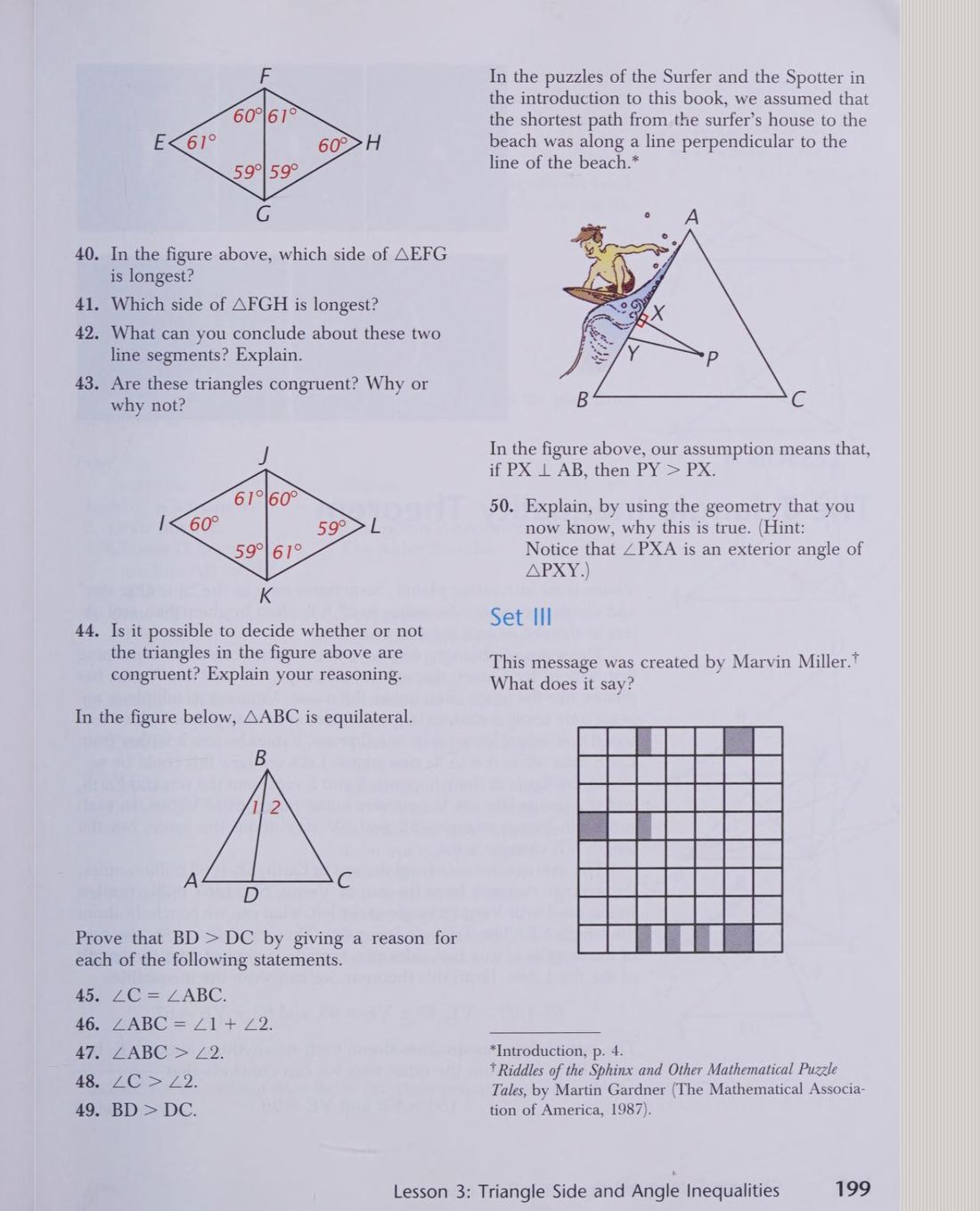
△ABC is equilateral, and D lies on AC between A and C, with BD drawn splitting ∠B into ∠1 and ∠2. Prove BD > DC by giving each reason.
- Question 45: ∠C = ∠ABC because an equilateral triangle is equiangular (the page 159 corollary), all angles 60.
- Question 46: BD splits the 60 at B: ∠ABC = ∠1 + ∠2, the Betweenness of Rays Theorem.
- Question 47: ∠ABC > ∠2, whole greater than part.
- Question 48: substitute step 45's equality: ∠C > ∠2.
- Question 49: in △BDC, the sides opposite ∠C and ∠2 are BD and DC, so Theorem 14 delivers BD > DC. Five reasons, four different theorems, and one more entry in the pattern this session keeps hitting: split an angle, order the parts, convert to sides. Keep the rhythm; the Triangle Inequality on the next page is this proof scaled up.