Questions 5 to 8: name that construction
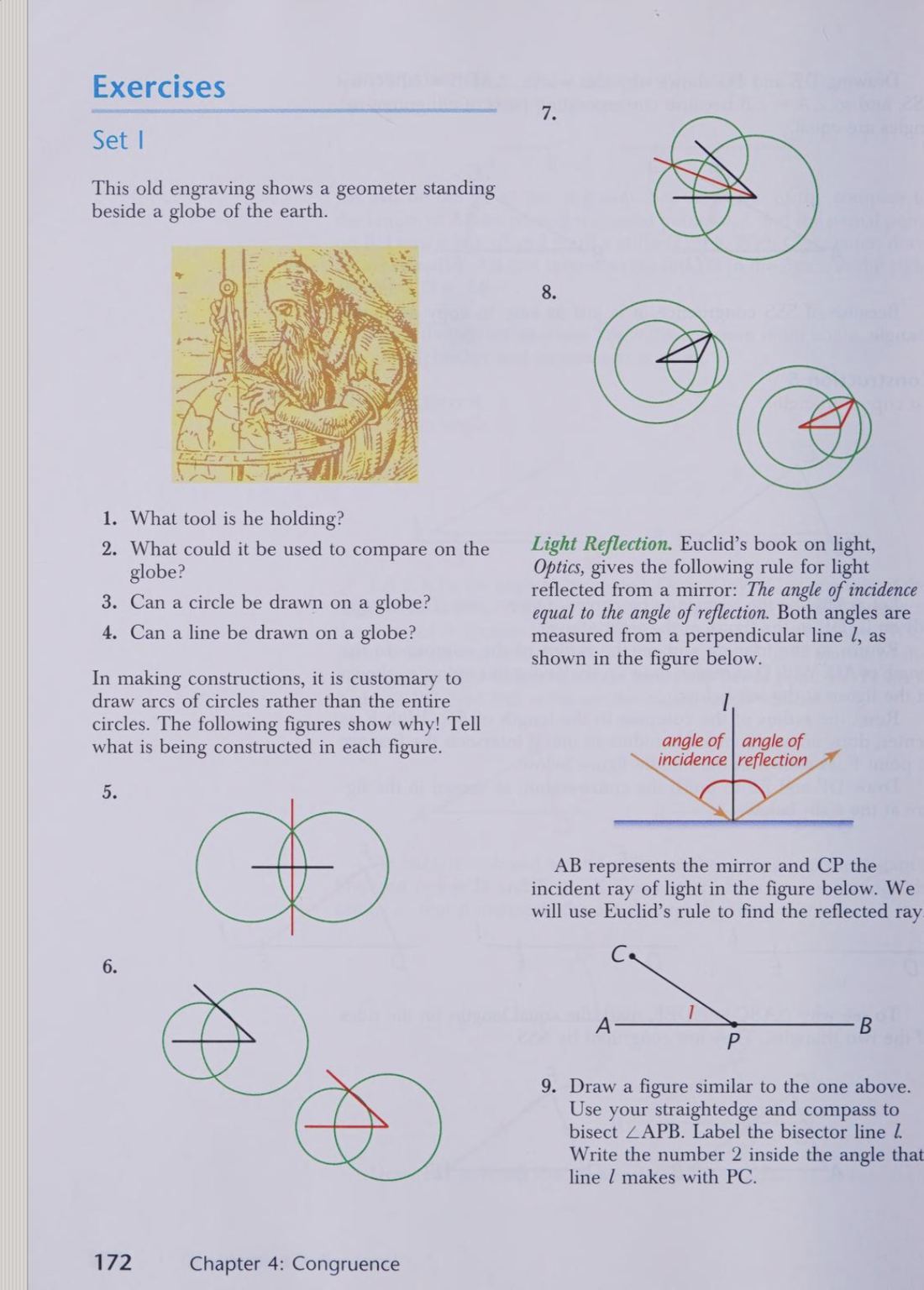
Each figure shows full circles where a normal construction would show only arcs. Identify what is being built.
- Figure 5: two same-radius circles centered on a segment's endpoints, crossing twice; the line through the crossings is drawn. That is Construction 1, bisecting a line segment, and the clutter shows why we normally keep only the two little crossing arcs.
- Figure 6: a circle centered at an angle's vertex catching both sides, then equal circles on those catches meeting inside: Construction 2, bisecting an angle.
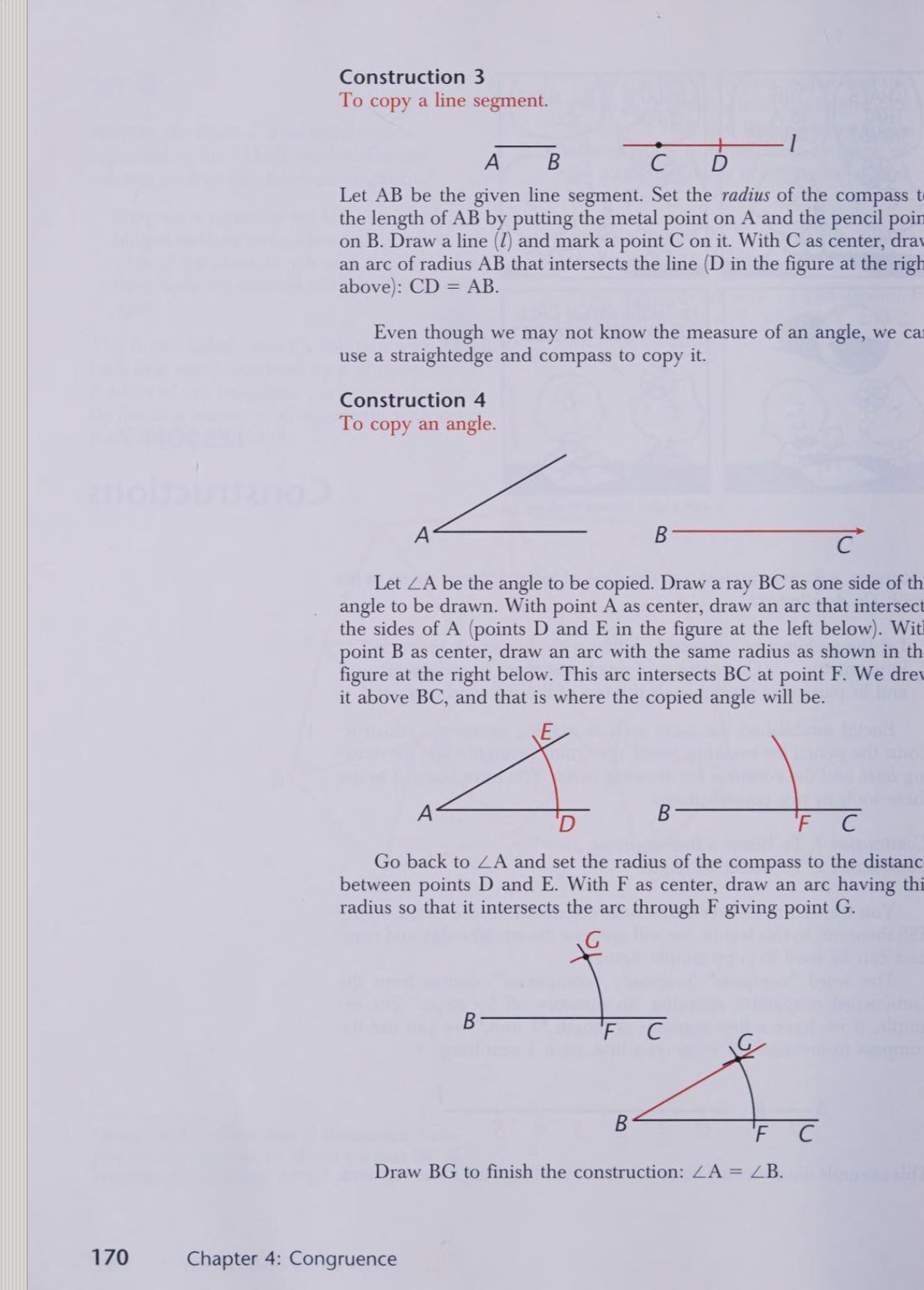
- Figure 7: an arc across an angle, the same radius swung on a bare ray, and a second distance carried over: Construction 4, copying an angle.
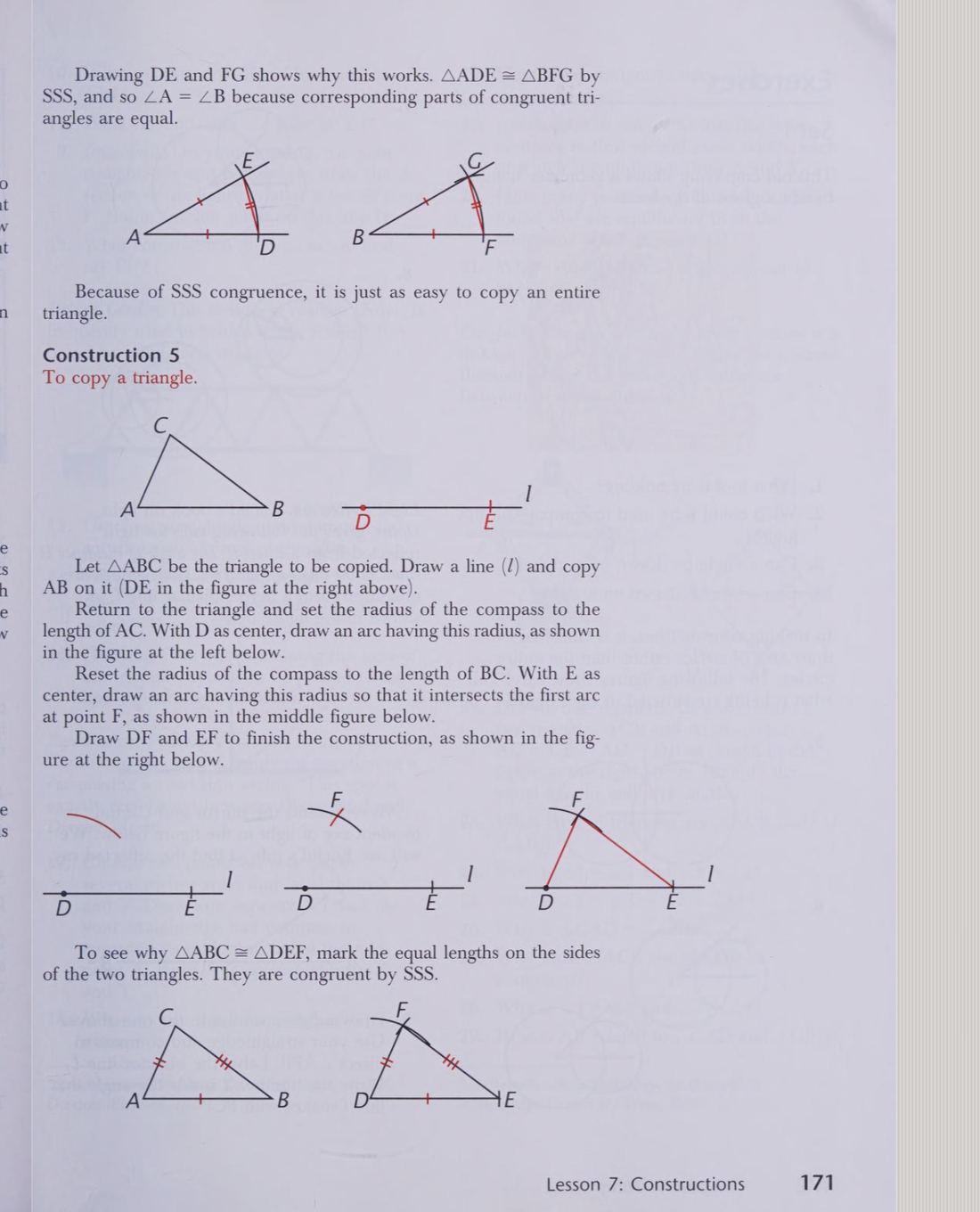
- Figure 8: a segment copied, then two circles of the other two side-lengths crossing above it: Construction 5, copying a triangle.
- Self-check: every identification came from asking one question per circle: which two points does this radius declare equidistant? Constructions are just equality claims drawn in ink, which is why SSS could audit them all.
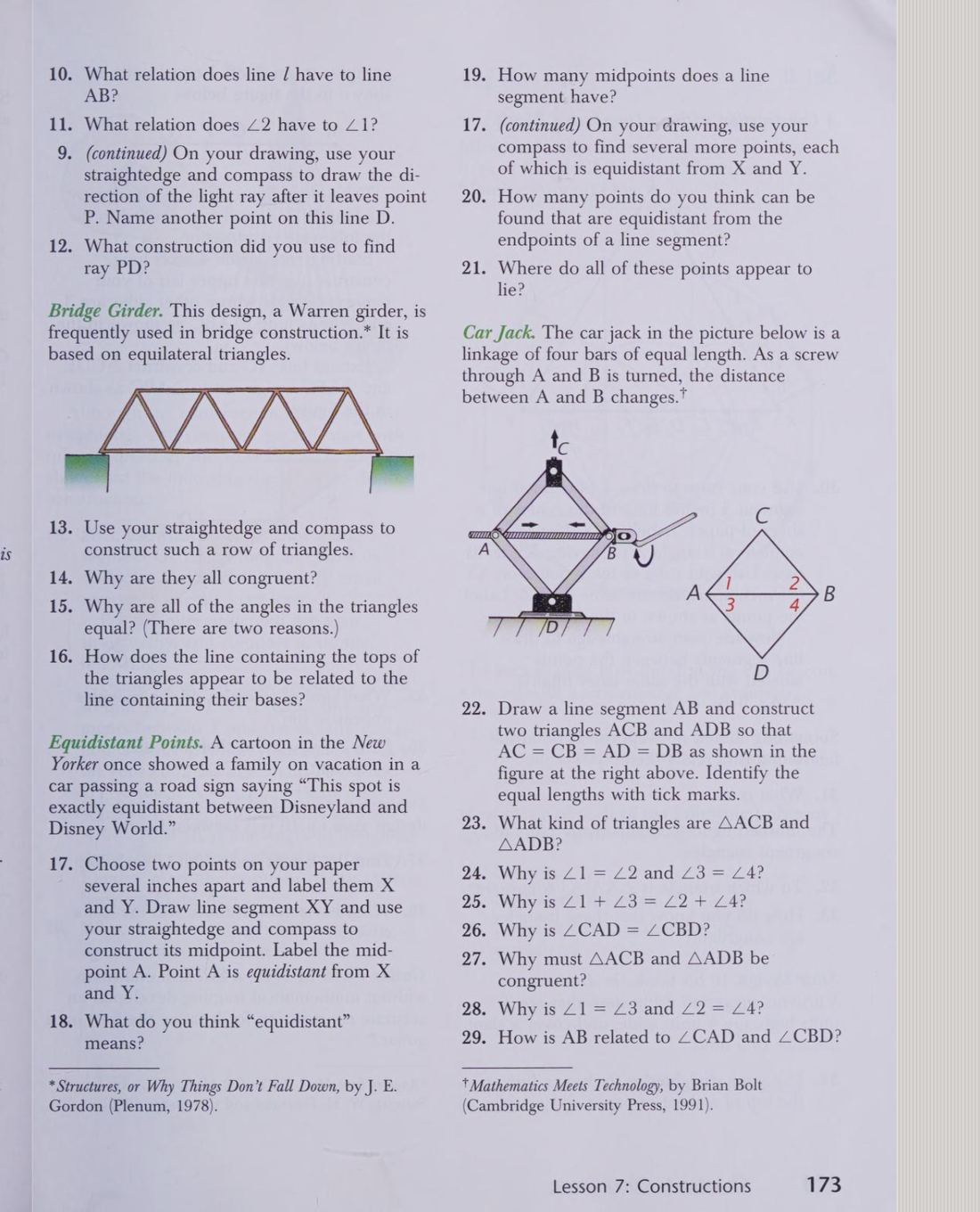
Questions 17 to 21: the equidistant hunt
Construct the midpoint A of segment XY. Then find more points equidistant from X and Y. How many are there, and where do they all lie?
- Question 18 first, in your own words: equidistant from X and Y means the same distance from each, XP = YP. The midpoint qualifies (question 19 reminds you it is the only one on the segment itself, by the corollary to the Ruler Postulate).
- Question 17 continued: set the compass to any radius bigger than half XY, swing an arc from X and one from Y with the same radius; their crossing is equidistant by construction. Change the radius and do it again, above and below the segment.
- Question 20: every radius gives new crossings, and radii come in endless supply: infinitely many equidistant points.
- Question 21: lay a straightedge along your crossings: all of them, plus the midpoint, sit on one line, and it crosses XY squarely: the perpendicular bisector. (Your bisection construction has been sampling this line since page 25.)
- Hold the idea in locus form: the set of all points equidistant from two points is a line. Chapter 5 will prove it both ways and spend it heavily; today it explains why Disneyland-to-Disney-World signs can only be honest along one line of America.
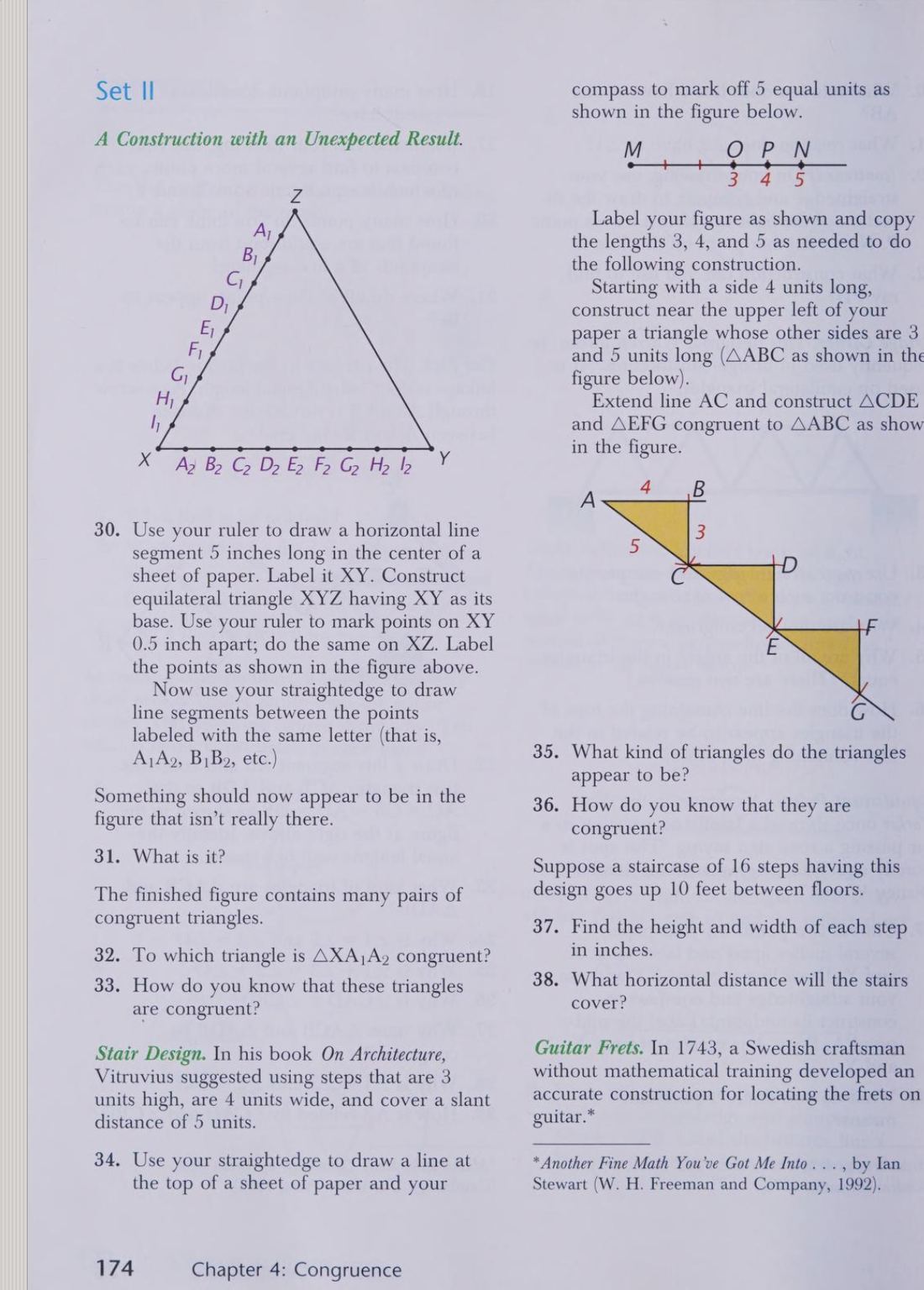
Questions 34 to 38: the Vitruvian staircase
Steps rise 3 units, run 4 units, slant 5. Construct three congruent 3-4-5 triangles stepping down a line, then scale a 16-step staircase climbing 10 feet.
- Questions 34 to 36: mark 5 equal compass-units on a line, then copy lengths 3, 4, and 5 into stacked triangles by Construction 5. They are congruent by SSS (question 36), and they look like right triangles (question 35); the converse of the Pythagorean Theorem, still unproved in this book, is what your eye is reporting.
- Question 37: sixteen steps climb 10 feet, so each rise is 120 inches / 16 = 7.5 inches.
- The 3-4-5 shape scales the run with the rise: run = (4/3) × 7.5 = 10 inches per step. (Check the slant: (5/3) × 7.5 = 12.5, and 7.5² + 10² = 156.25 = 12.5².)
- Question 38: sixteen runs of 10 inches cover 160 inches horizontally: 13 feet 4 inches of floor.
- Notice what Vitruvius knew: 3-4-5 was the builder's right angle two thousand years before your protractor, and stairs built to it still meet modern comfort codes almost exactly. Geometry ages well.
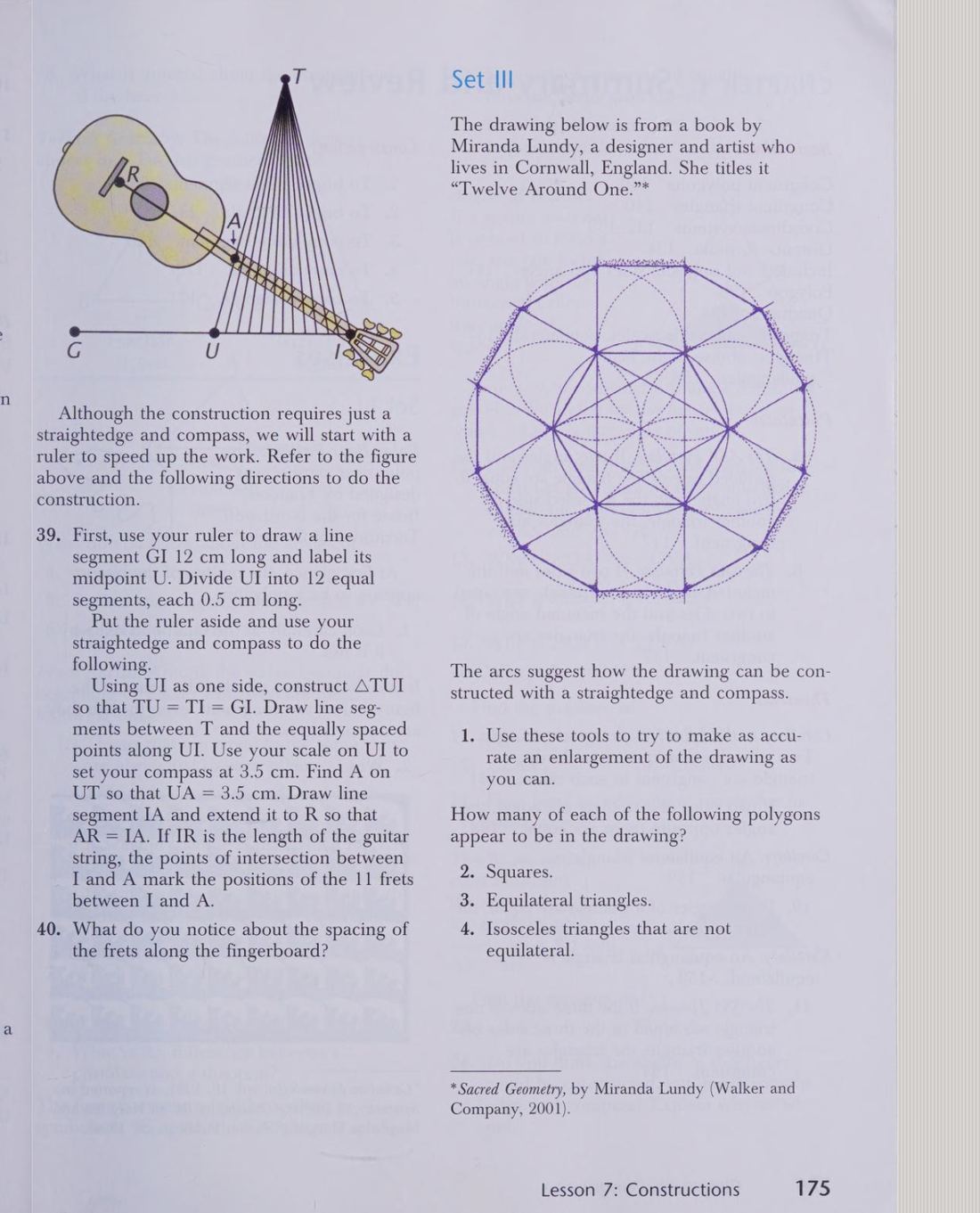
Set III: building Twelve Around One
Reproduce the drawing with straightedge and compass, then count its squares, equilateral triangles, and non-equilateral isosceles triangles.
- Start with the central circle. Keeping the same radius, step the compass around it: six marks (the page 28 hexagon move).
- Bisect the six central angles (Construction 2) to split six points into twelve: a regular 12-point ring, and the reason the title says twelve around one.
- With the same radius, draw the twelve outer circles centered on the ring points; their crossings weave the pattern's petals. Then connect ring points with the straightedge: every 12th, every 3rd, every 4th point, following the printed drawing's chords.
- Count by symmetry, not by scanning: pick one wedge (one twelfth of the figure), count each shape type whose "lead corner" lies in it, and multiply by 12; then check for larger shapes (squares from every-third-point chords, big triangles from every-fourth) that repeat fewer than 12 times because they close early. Your counts, done this way, will survive rechecking.
- The drawing's lesson is the chapter's: three tools, one radius, and every square and triangle in it flows from equal distances. "Sacred geometry" is mostly SSS with good taste.
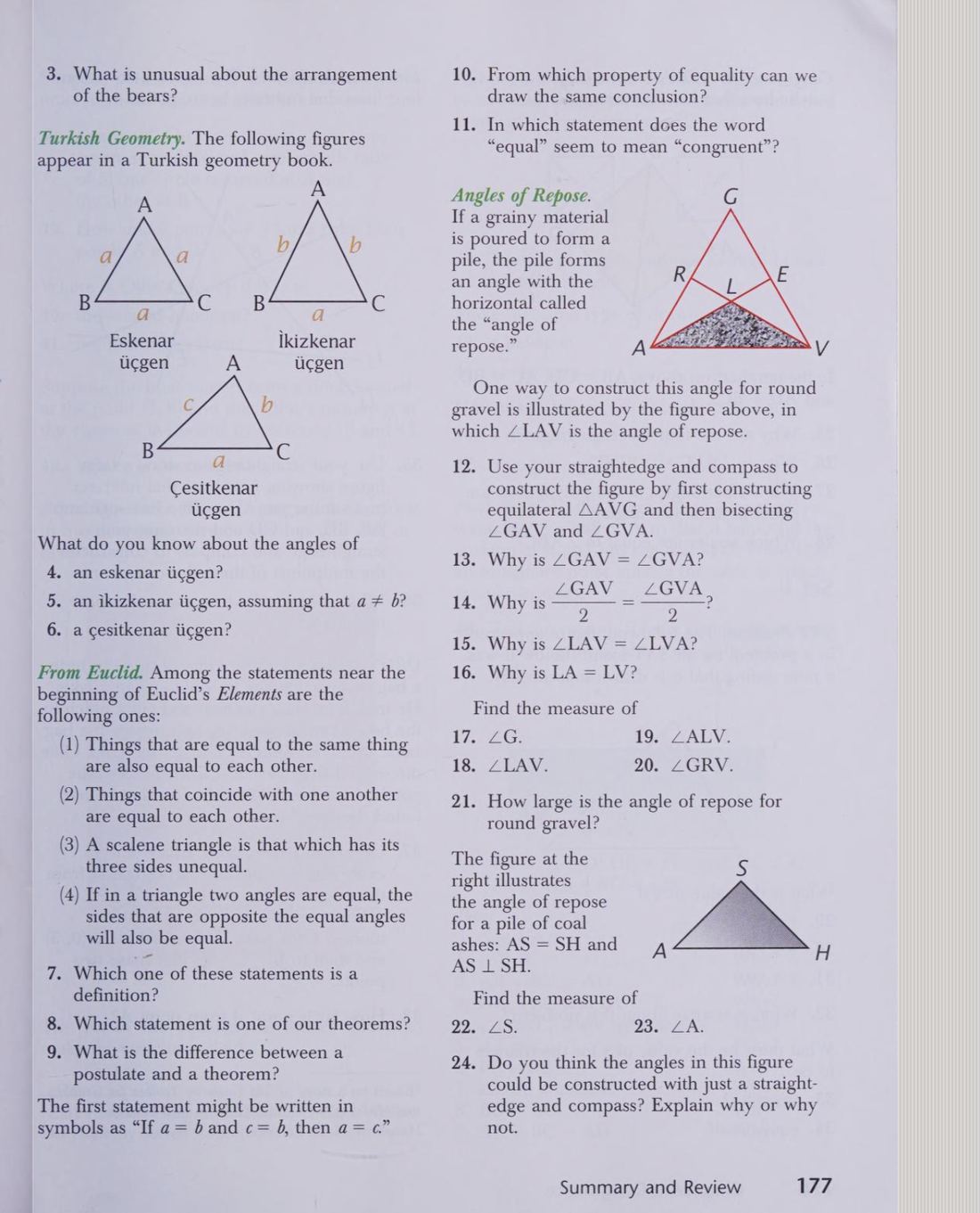
Questions 12 to 21: the angle of repose
Construct equilateral △AVG, bisect ∠GAV and ∠GVA, and let the bisectors meet at L. Justify the equalities and find every angle, ending with gravel's angle of repose.
- Question 13: ∠GAV = ∠GVA because an equilateral triangle is equiangular (the corollary), each 60° (question 17's ∠G too).
- Question 14: halves of equals are equal, division property: each half-angle is 30°.
- Questions 15 and 16: ∠LAV = ∠LVA = 30°, so △LAV is isosceles by Theorem 10: LA = LV.
- Questions 18 to 20: ∠LAV = 30°; ∠ALV = 180 − 30 − 30 = 120°; and at R, where V's bisector meets side AG: in △ARV the angles 60 and 30 leave ∠ARV = 90, so ∠GRV = 90° by linear pair.
- Question 21: the repose angle ∠LAV is 30°: round gravel piles at thirty degrees, and the construction that says so used one equilateral triangle and two bisections. Compare the ash pile overleaf: steeper stuff, 45°, right isosceles.
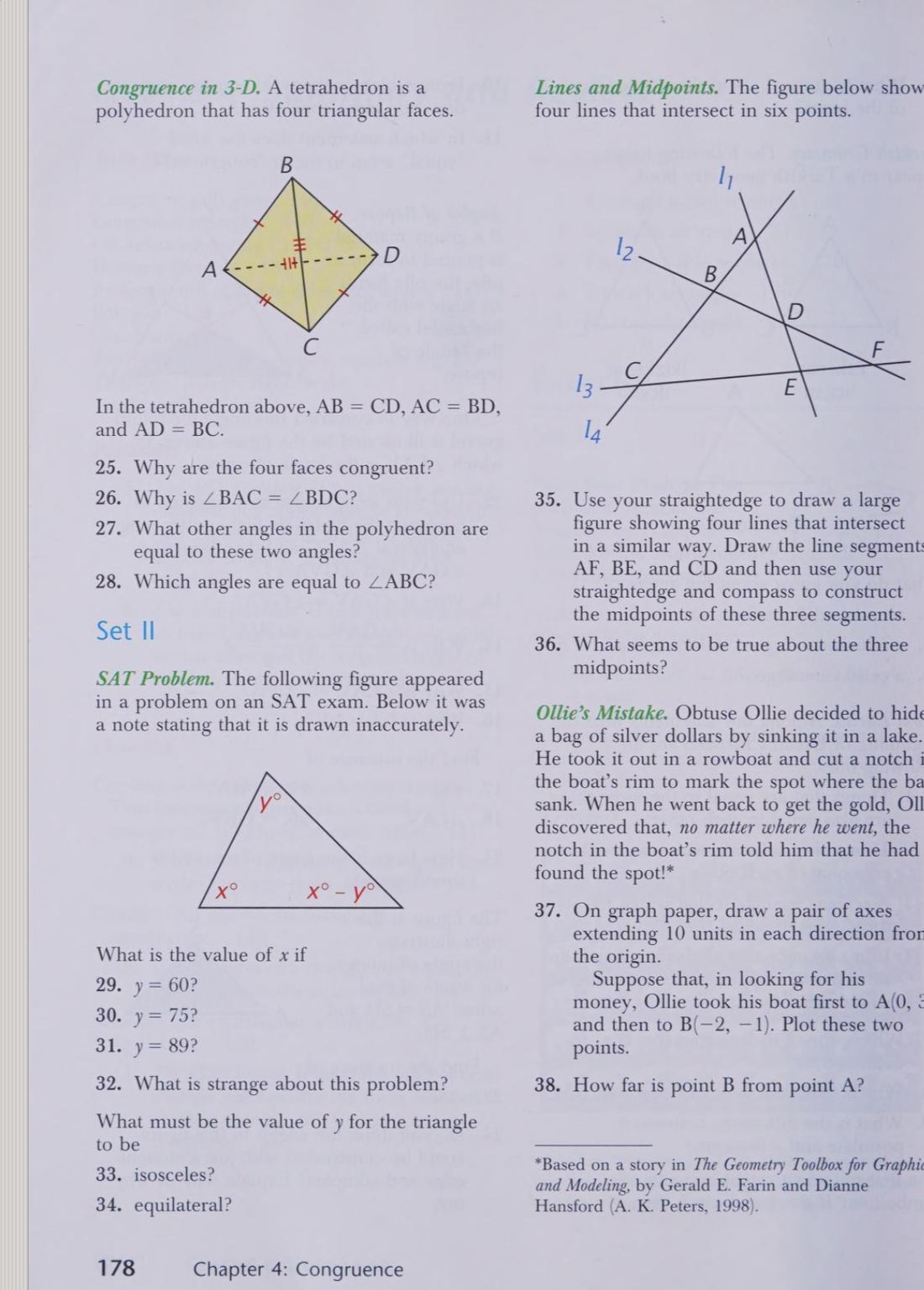
Questions 29 to 34: the self-solving SAT triangle
A triangle's angles are marked y at the top, x at one base corner, and x − y at the other (drawn inaccurately, the exam warned). Find x when y is 60, 75, 89. What is strange? When is the triangle isosceles, and can it be equilateral?
- Angle sum: x + y + (x − y) = 180. The y cancels entirely: 2x = 180, so x = 90.
- Questions 29 to 31: for y = 60, 75, 89, the answer never moves: x = 90 every time.
- Question 32: that is the strangeness: the problem hands you a dial (y) that turns nothing. The triangle is right-angled at x for every legal y, and the SAT was testing whether you would compute three times or think once.
- Question 33: isosceles needs two equal angles. With x = 90, the options are y = x − y, giving y = 45 (a 90-45-45 triangle); matching anything to 90 would demand a second right angle, impossible by the angle sum.
- Question 34: equilateral needs all angles 60, but x is welded to 90: no y works. One equation, and the whole problem family audited; algebra is a fine geometer.
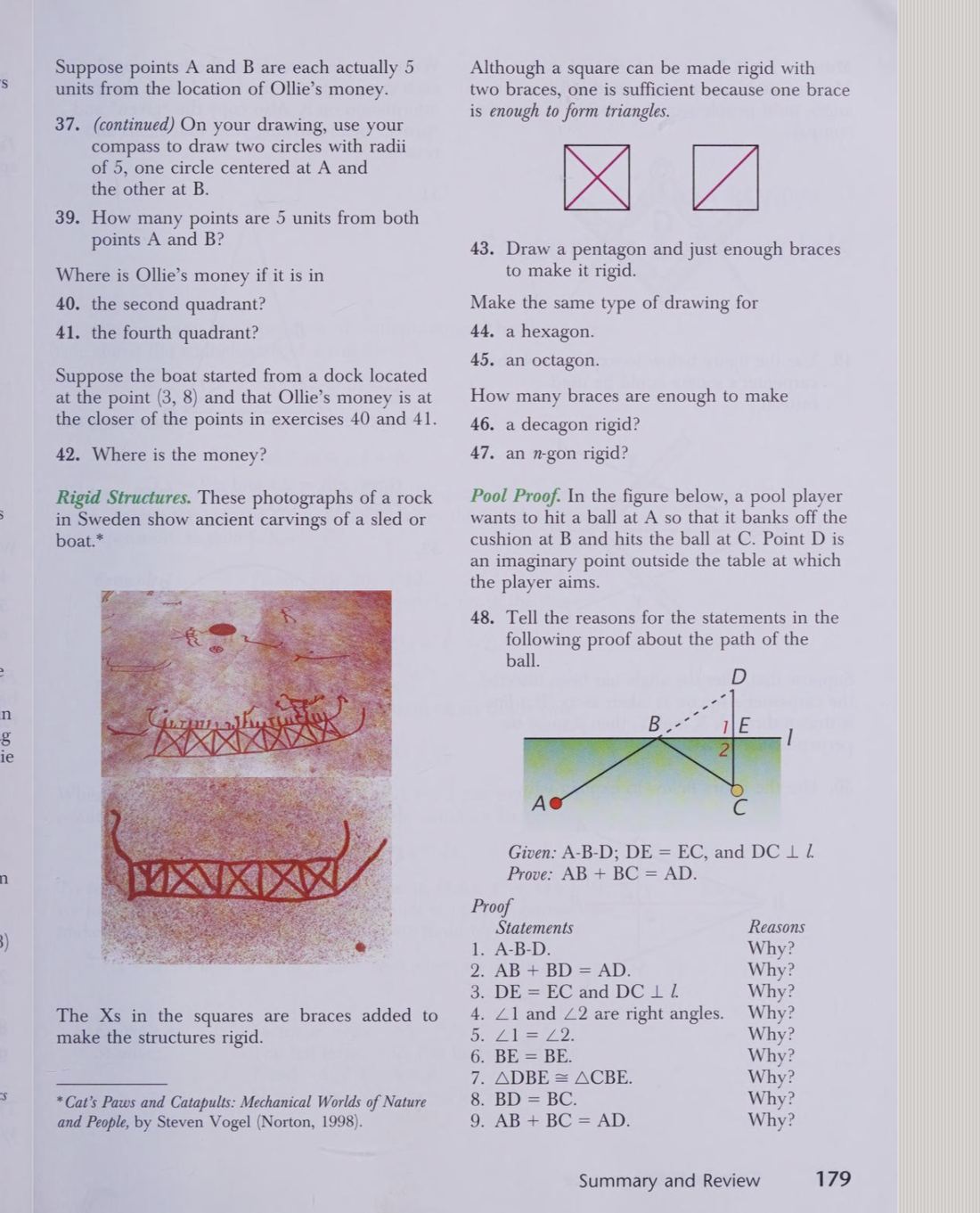
Questions 39 to 42: raising Ollie's silver
A(0, 3) and B(−2, −1) are each 5 units from the money. Circles of radius 5 around both: how many candidate points, where are they, and which is closer to the dock at (3, 8)?
- Question 39: two circles of equal radius whose centers sit √20 ≈ 4.5 apart (less than 5 + 5) cross in exactly two points; your compass drawing shows both.
- Read them from the graph paper: one crossing in the second quadrant at (−5, 3), one in the fourth at (3, −1). (Check either with the distance formula: from A, √((3−0)² + (−1−3)²) = √(9+16) = 5. Honest.)
- Questions 40 and 41 are those two readings. This is why the notch alone told Ollie nothing: one distance constrains you to a whole circle of spots, and even two distances leave a pair.
- Question 42: dock (3, 8) to (−5, 3): √(64 + 25) = √89 ≈ 9.4. Dock to (3, −1): √(0 + 81) = 9. The fourth-quadrant point is closer: the money sits at (3, −1).
- Name what you just used: circles as equidistance loci (page 173's idea), intersected to pin a point. Surveyors call it trilateration, and your phone's GPS does exactly this with three spheres and a clock.
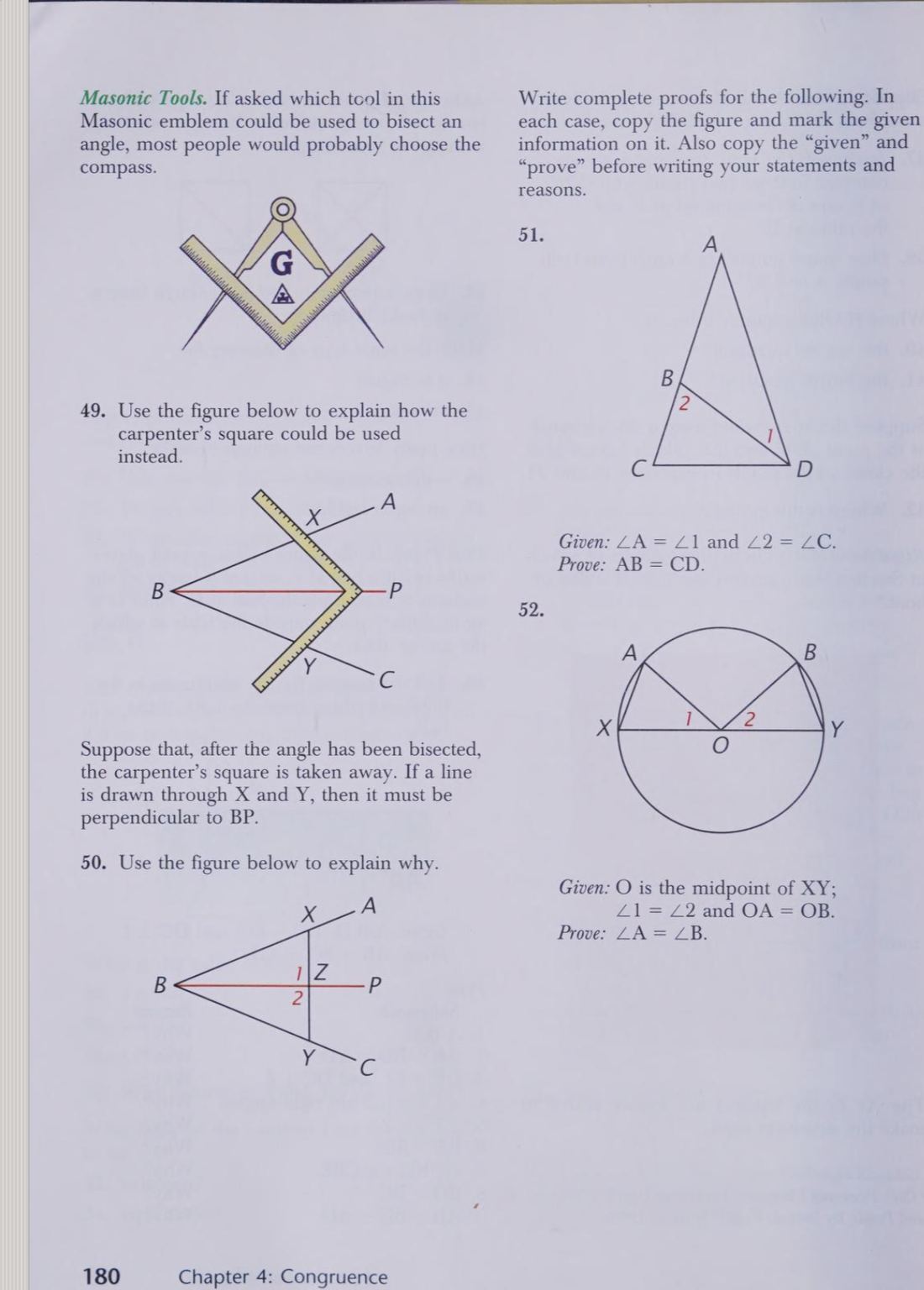
Questions 49 and 50: bisecting with a carpenter's square
The square's two arms cross the angle's sides at X and Y with BX = BY (equal markings), and its corner sits at P. Why does BP bisect ∠ABC, and why is XY ⊥ BP afterward?
- Question 49: the square's arms are marked so BX = BY, and the corner P sits at equal arm-lengths: XP = YP. With BP shared, △BXP ≅ △BYP by SSS.
- Corresponding parts: ∠XBP = ∠YBP, and equal halves is the definition of bisecting: BP bisects ∠ABC. (The compass construction on page 25 made the same two isosceles pairs with arcs; the steel square just manufactures them rigidly.)
- Question 50: now drop the square and draw XY, crossing BP at Z. In △XBZ and △YBZ: BX = BY, ∠XBZ = ∠YBZ (just proved), BZ shared: SAS.
- So ∠XZB = ∠YZB, corresponding parts: an equal linear pair. Theorem 8 (page 118) finishes: sides of an equal linear pair are perpendicular, so XY ⊥ BP.
- Count the machinery in this little factory item: SSS, SAS, corresponding parts, the bisection definition, and a chapter 3 theorem, all inside one Masonic emblem. The chapter closes where it aimed: tools explained, not just used.
Questions 13 and 14: one sign, two worlds
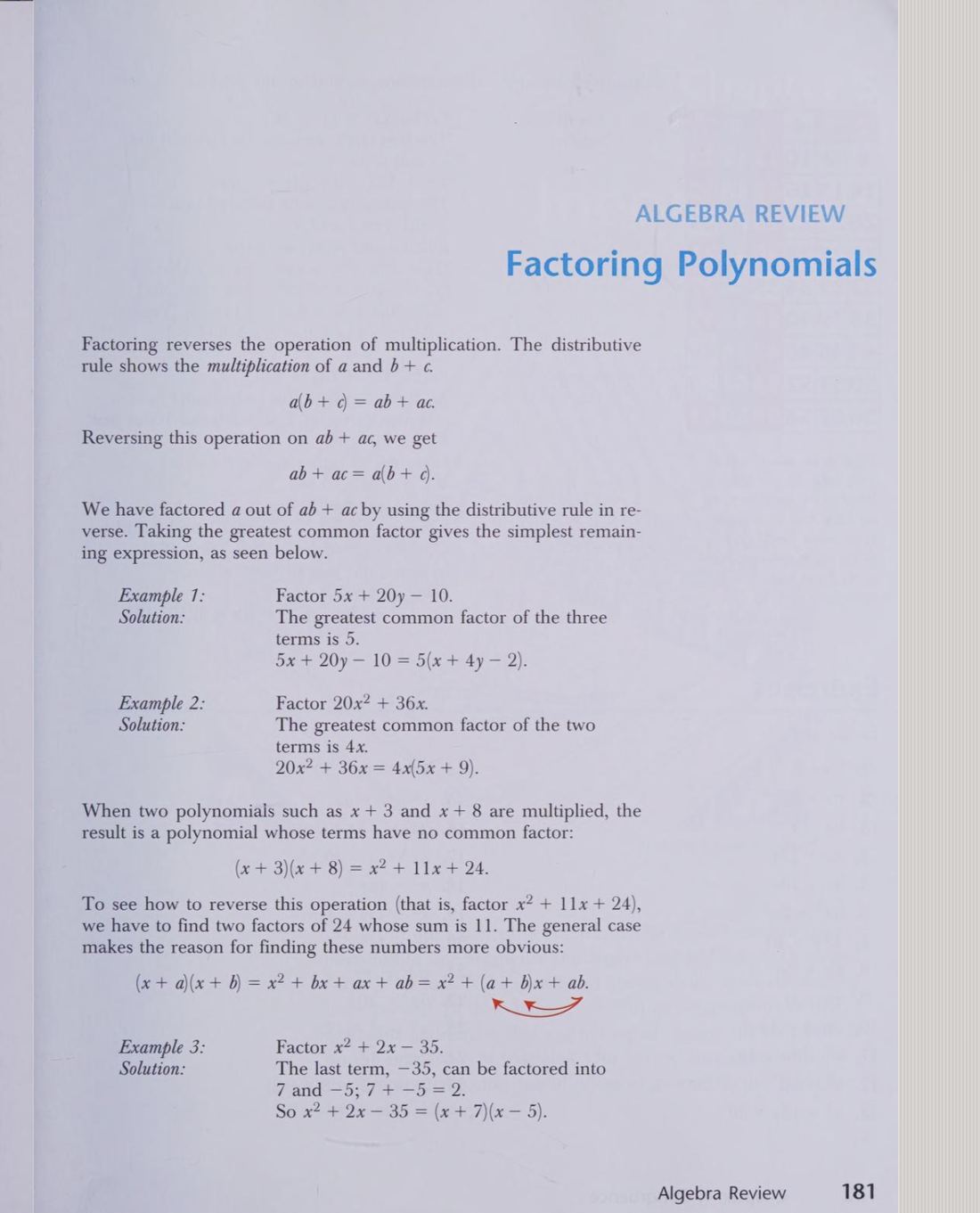
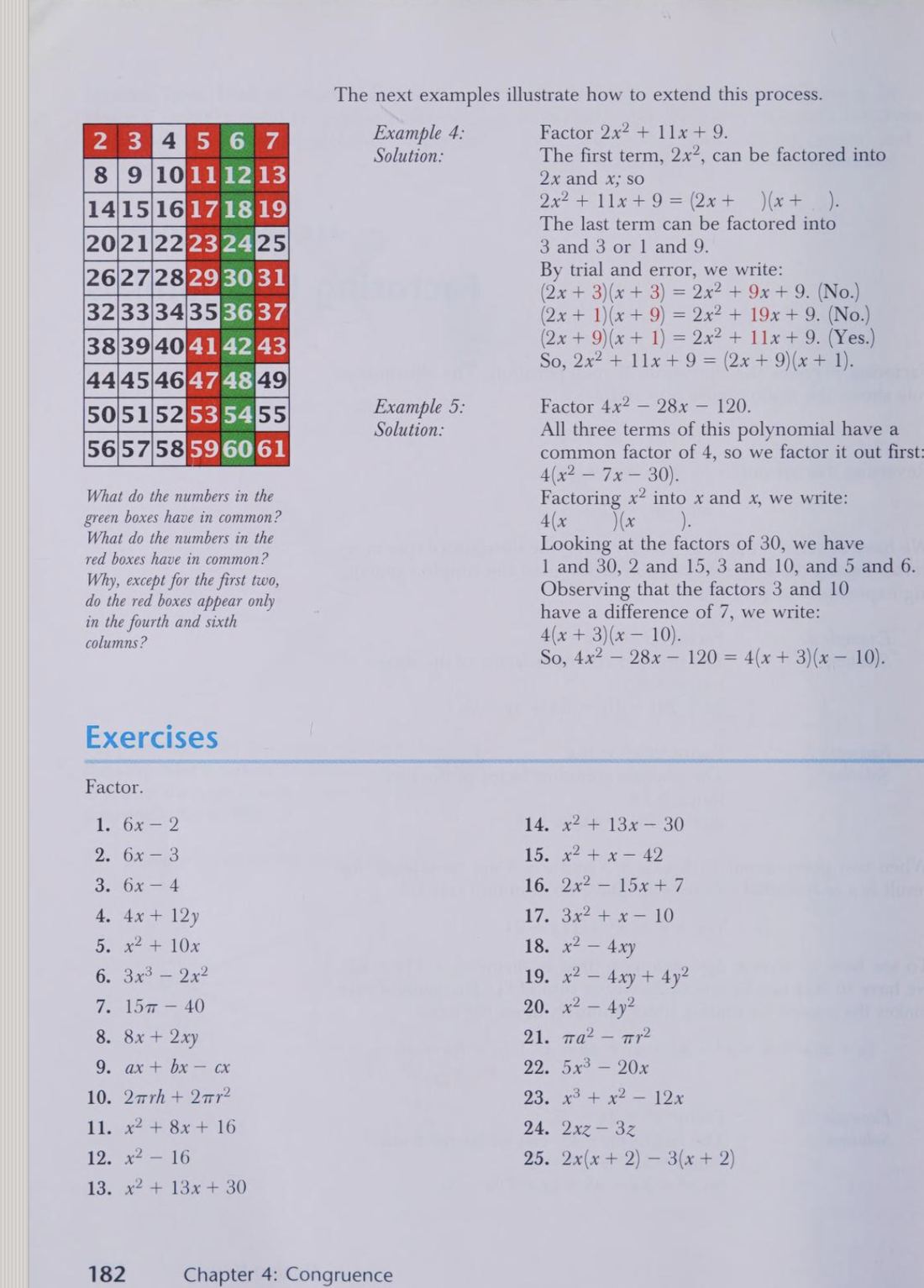
Factor x² + 13x + 30, and then x² + 13x − 30.
- Question 13: need two numbers with product +30 and sum +13. Both must be positive. Walk the factor pairs of 30: 1 and 30, 2 and 15, 3 and 10, 5 and 6. Sum 13 is 3 and 10: (x + 3)(x + 10).
- Question 14: product −30 means opposite signs, and sum +13 means the positive one is bigger. Same pairs, new job: difference of 13 is 15 and 2: (x + 15)(x − 2).
- Check each by the page 130 substitution habit: at x = 1, question 13's original gives 44 and (4)(11) = 44; question 14's gives −16 and (16)(−1) = −16. Both honest.
- Say the sign rule once, aloud: plus product, same signs, add to the middle; minus product, opposite signs, subtract to the middle. That sentence is the whole trinomial game.
- Then spend it: question 16 (2x² − 15x + 7) needs the trial-and-error of Example 4, and lands at (2x − 1)(x − 7). Verify with x = 1: original −6, factors (1)(−6). The review closes chapter 4 the way the chapter closed every proof: checked.