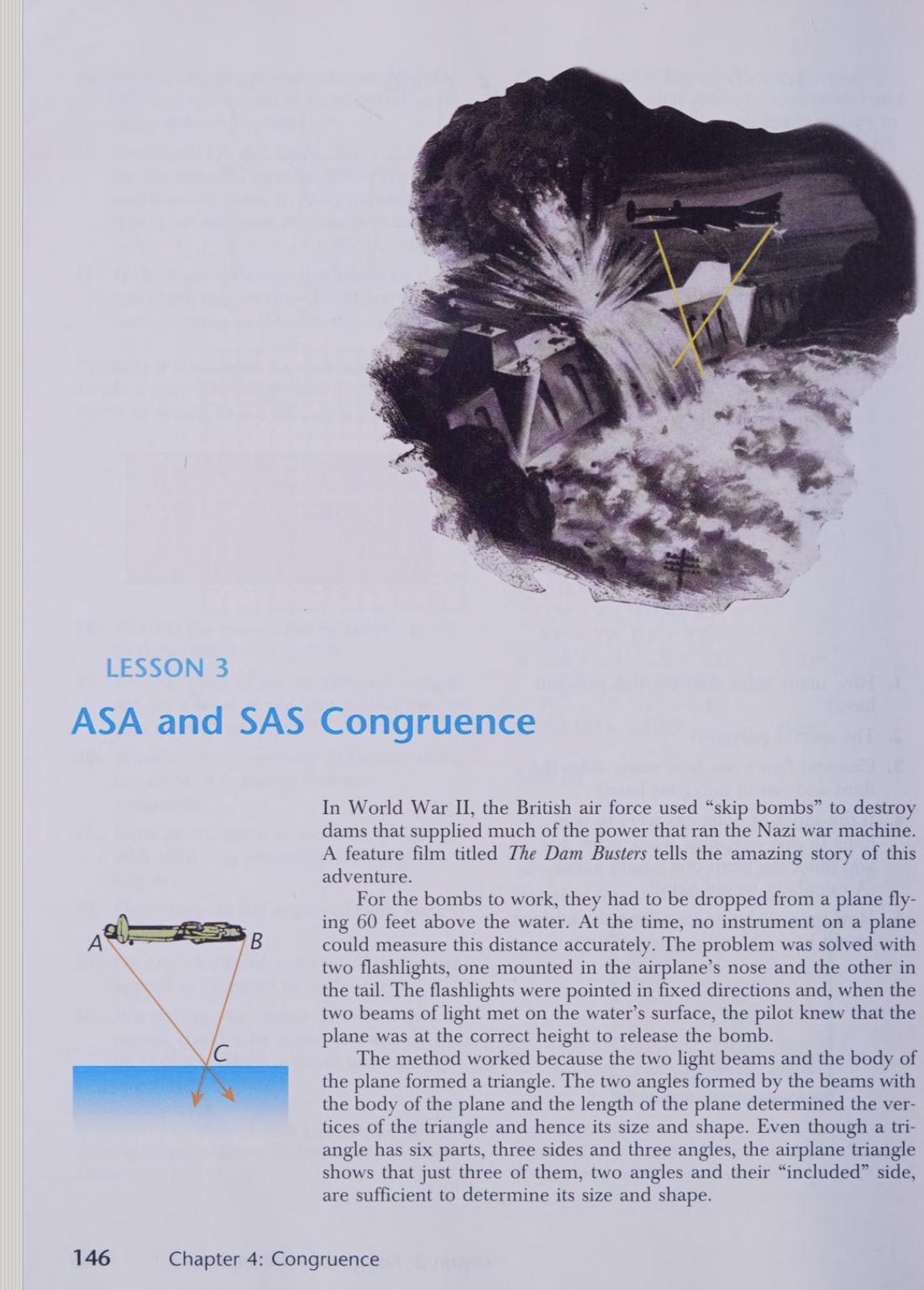
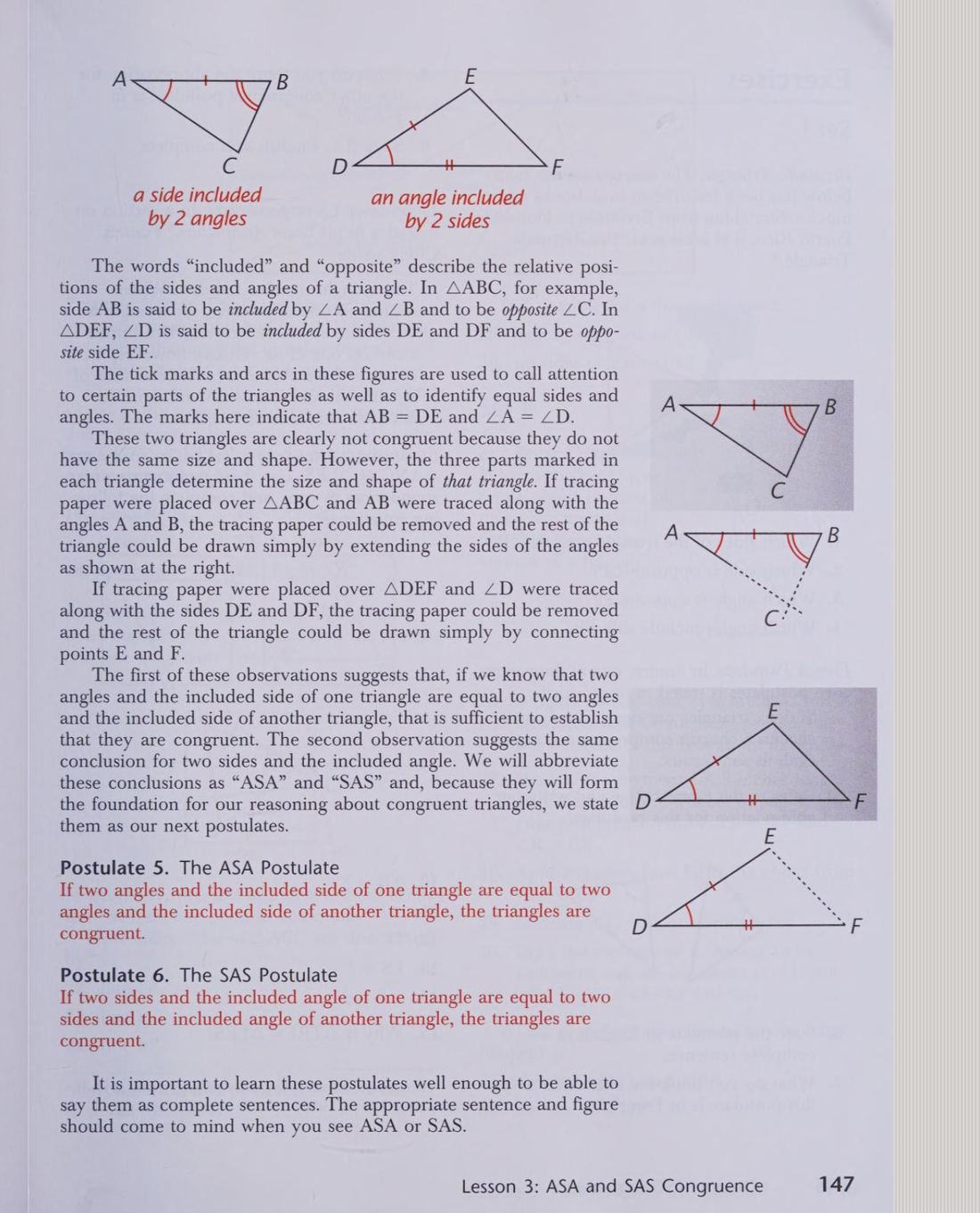
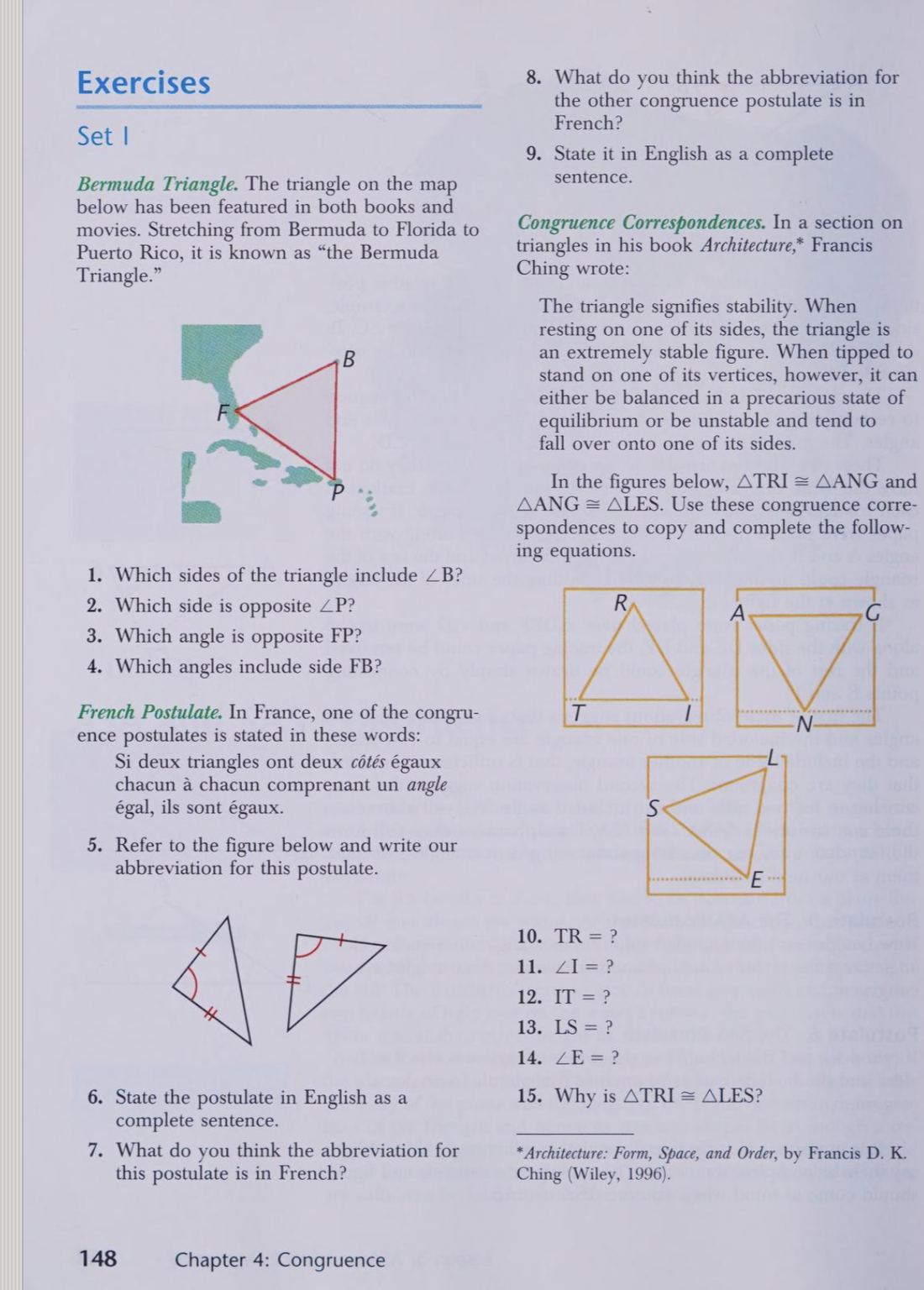
Questions 5 to 9: the French postulate
"Si deux triangles ont deux côtés égaux chacun à chacun comprenant un angle égal, ils sont égaux." Which of our postulates is this, and what are the French abbreviations likely to be?
- Mine the cognates: côtés is "sides" (two of them), angle is angle, comprenant is "including," égaux is "equal." Two sides including an equal angle.
- Question 5: sides, included angle, sides: this is SAS, and the marked figure beside it confirms the two ticks and the arc between them.
- Question 6, in English, as a full sentence: if two sides and the included angle of one triangle are equal to two sides and the included angle of another triangle, the triangles are congruent.
- Questions 7 and 8: French abbreviates with its own initials: SAS becomes CAC (côté-angle-côté), and ASA becomes ACA (angle-côté-angle).
- Question 9: state ACA in English: if two angles and the included side of one triangle are equal to two angles and the included side of another, the triangles are congruent. Different alphabet, same geometry; Euclid travels better than vocabulary does.
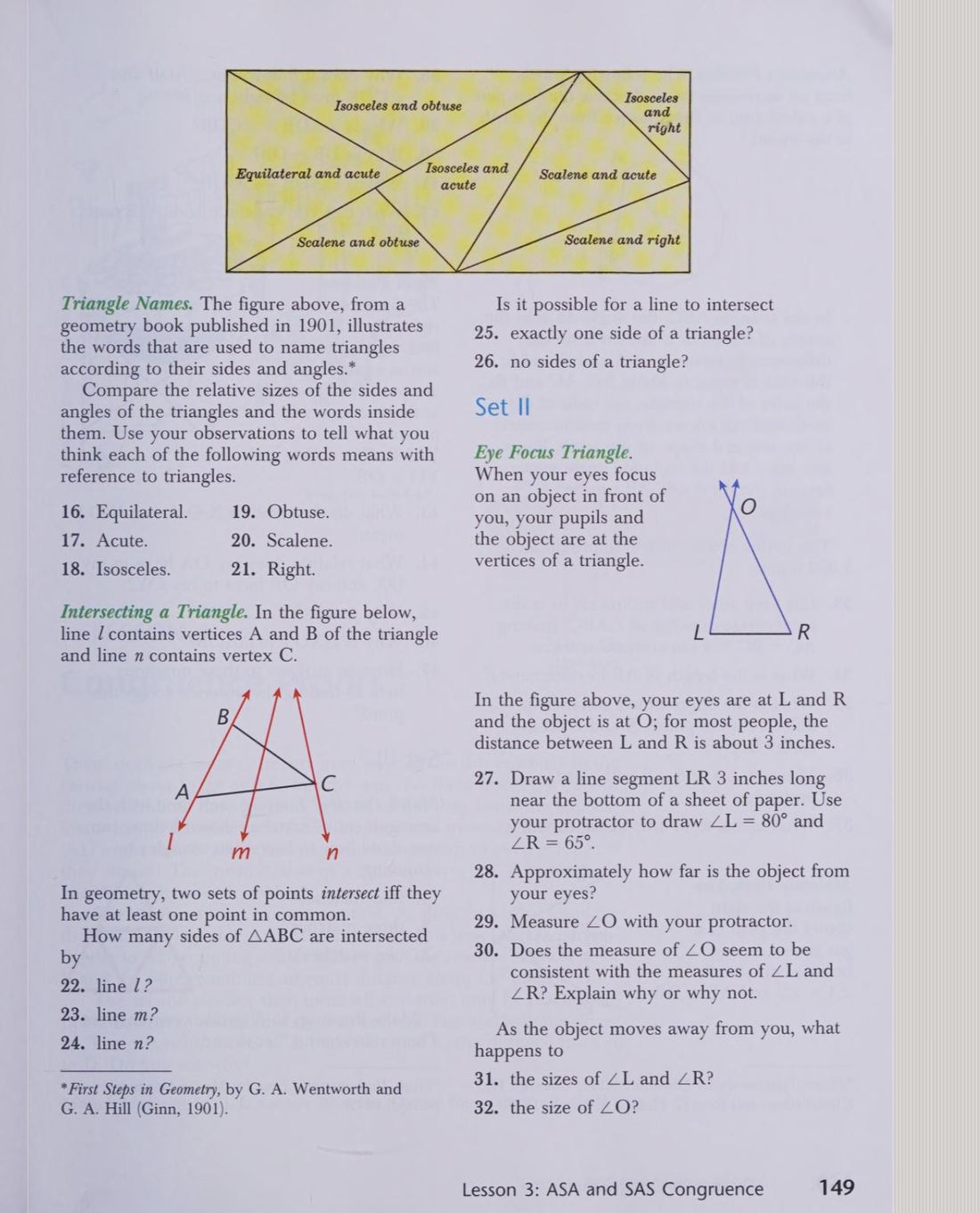
Questions 27 to 32: the eye-focus triangle
Draw LR 3 inches long, ∠L = 80° and ∠R = 65°, and extend the sides until they meet at O. How far is O, what is ∠O, and what happens as the object recedes?
- Question 27: the drawing is ASA in action: one included side (3 inches), two angles, and the triangle closes itself at O with no further choices. That inevitability is the postulate.
- Question 28: measure with your ruler: O lands roughly 4 inches from each eye (your drawing may say 3.9 or 4.2; the point is that it says one thing).
- Questions 29 and 30: the protractor reads ∠O ≈ 35°, and the angle sum explains why it had to: 180 − 80 − 65 = 35. Measurement and theorem agreeing is your accuracy check.
- Questions 31 and 32: push O away in your head: the sighting angles at L and R open toward 90°, and ∠O shrinks toward 0. Your brain reads that shrinking angle as distance, which is depth perception in one sentence.
- Now reread the Dam Busters page: same triangle, flashlights for eyes, and the 60 feet is your 4 inches. One postulate, two instruments, one of them yours.
Questions 43 to 47: measuring the pond
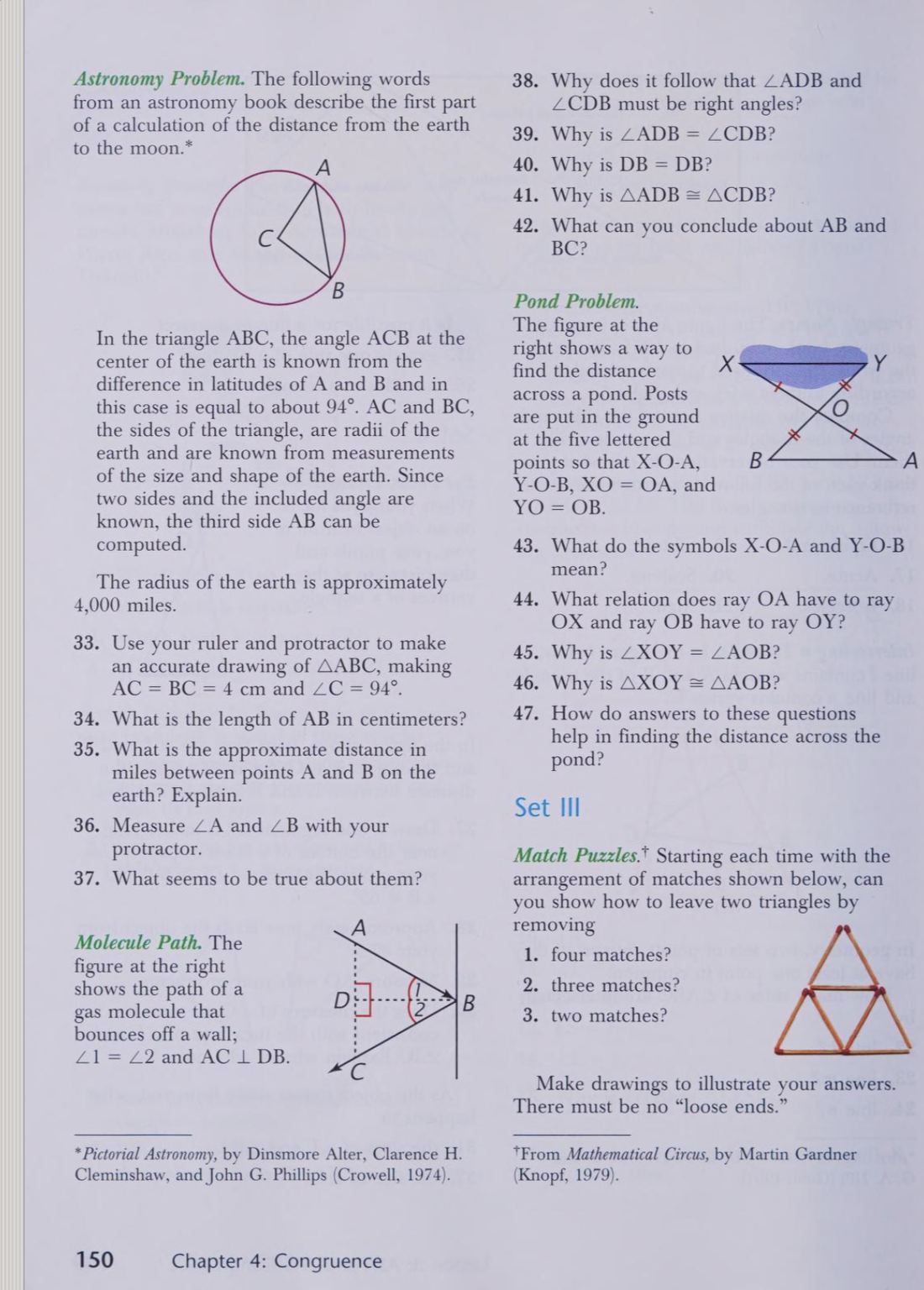
Posts at X, O, A, Y, B satisfy X-O-A, Y-O-B, XO = OA, YO = OB. Why is △XOY ≅ △AOB, and how does that measure the pond?
- Question 43: the symbols say O is between X and A, and between Y and B: the two stake lines pass straight through O.
- Question 44: betweenness makes ray OA and ray OX opposite rays, likewise OB and OY.
- Question 45: two pairs of opposite rays make ∠XOY and ∠AOB vertical angles, equal by Theorem 6 (page 112 still earning).
- Question 46: XO = OA and YO = OB are given, and the equal vertical angle sits included between them: SAS, so △XOY ≅ △AOB.
- Question 47: corresponding parts are equal, so XY (across the water) equals AB (on dry land), and you measure AB with your feet. Every stake is reachable; the unreachable distance comes out anyway. That is what congruence is for, and the Romans knew it.
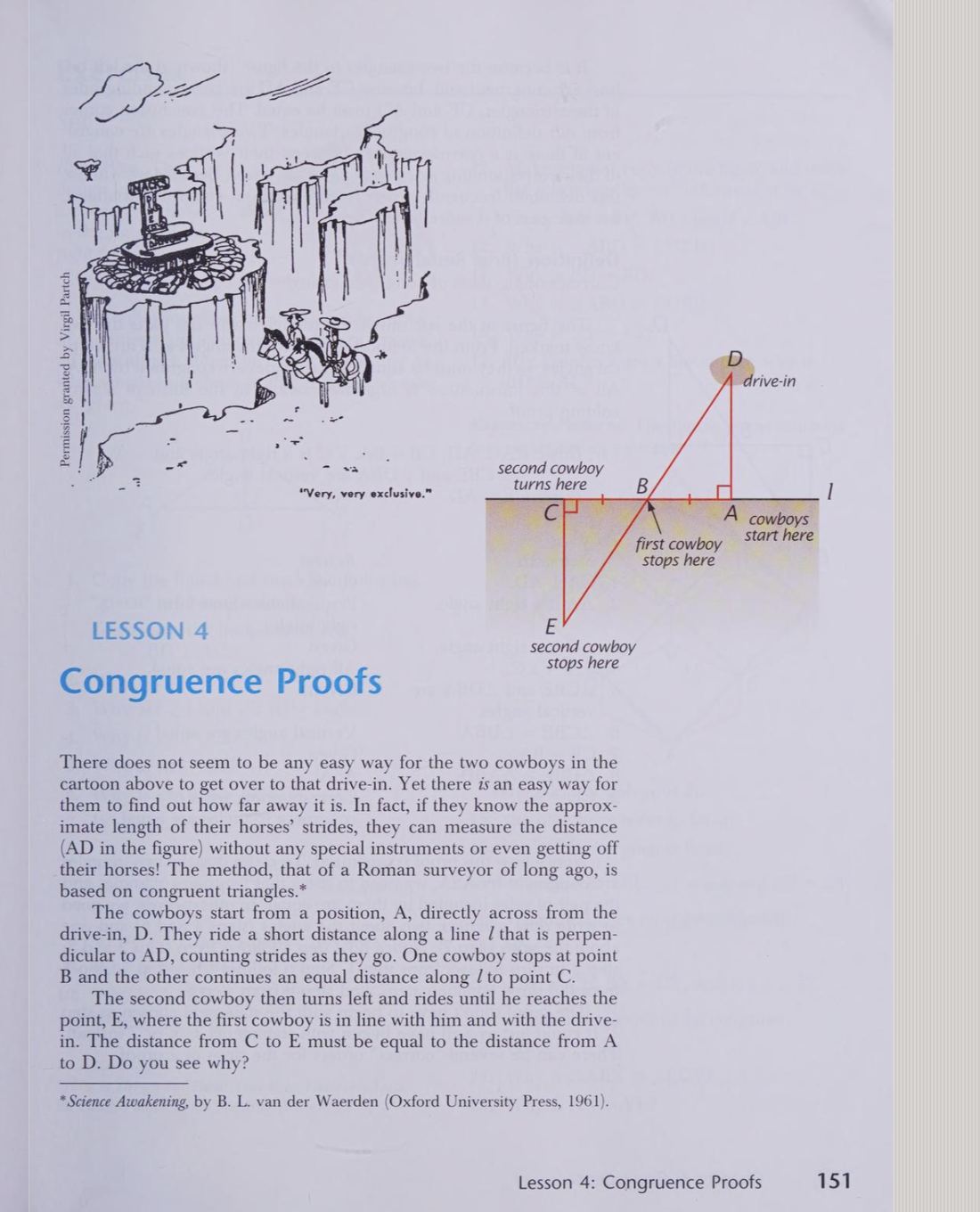
Questions 1 to 7: the first roof proof
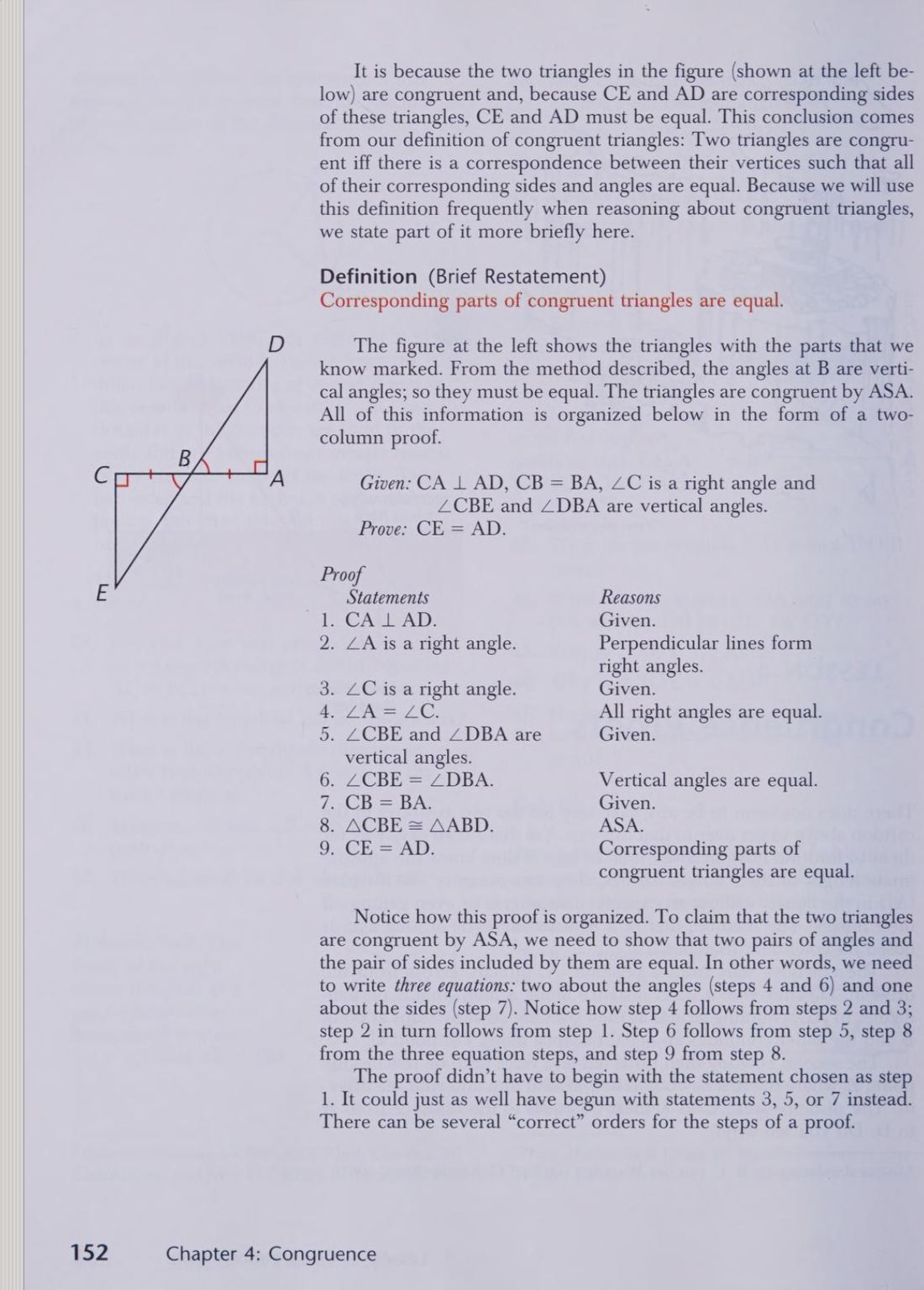
Given: D is the midpoint of AC, and BD ⊥ AC. Prove the rafter angles equal: ∠BAD = ∠BCD.
- Questions 1 and 2: mark the figure first, as ordered; marked figures are half the proof. D a midpoint gives AD = DC by the definition of midpoint.
- Question 3: BD ⊥ AC makes ∠1 and ∠2 right angles (perpendicular lines form right angles).
- Question 4: all right angles are equal (page 118's corollary), so ∠1 = ∠2.
- Question 5: BD = BD, the reflexive property: the shared post belongs to both triangles, and citing it is how a proof says so.
- Questions 6 and 7: two sides (AD = DC, BD = BD) and the included right angles equal: SAS gives △ABD ≅ △CBD, and corresponding parts make ∠BAD = ∠BCD. Now reread questions 8 to 17 and watch the same truss yield to ASA and then SAS from different givens; that flexibility is the lesson.
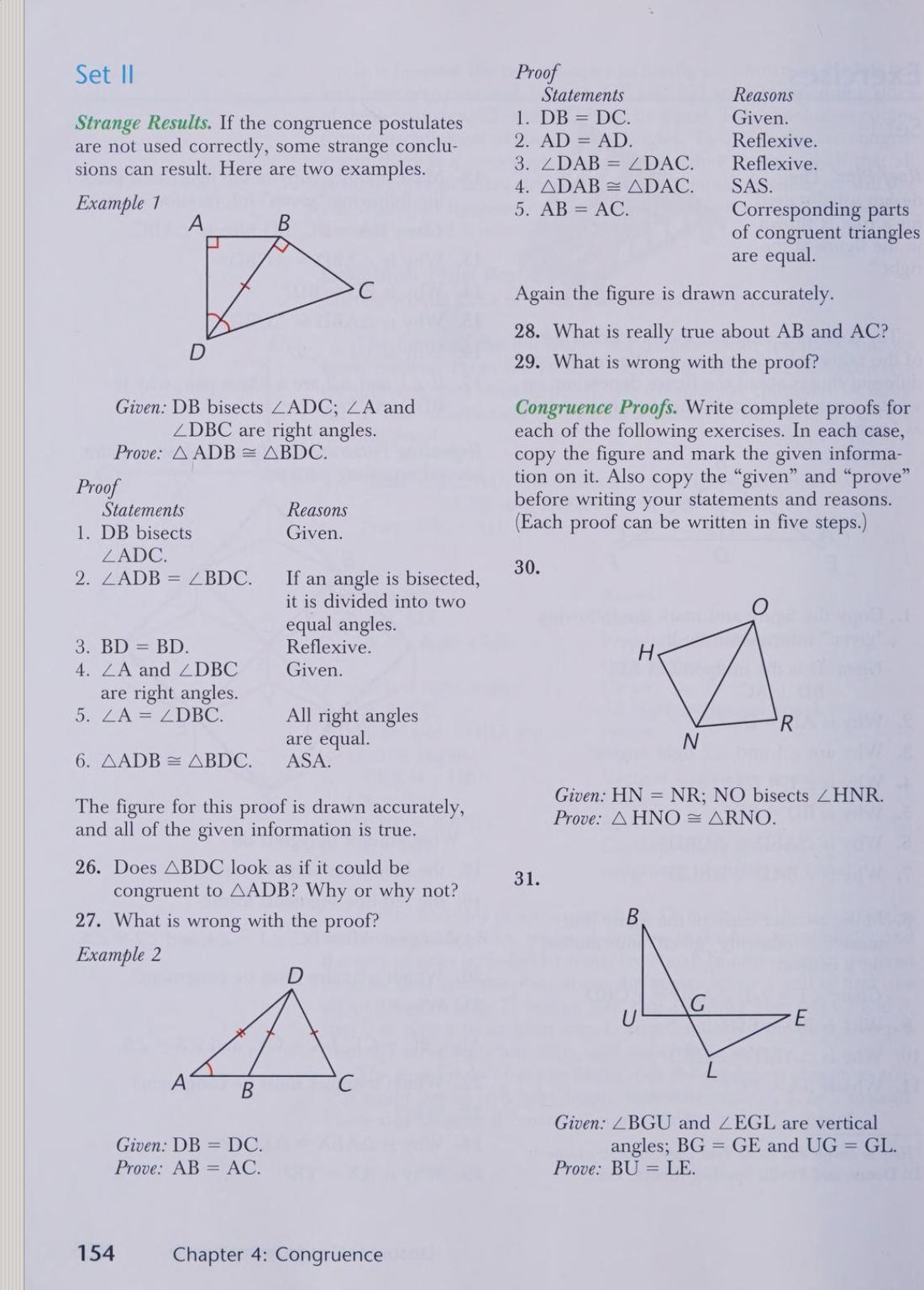
Questions 26 to 29: the two forgeries
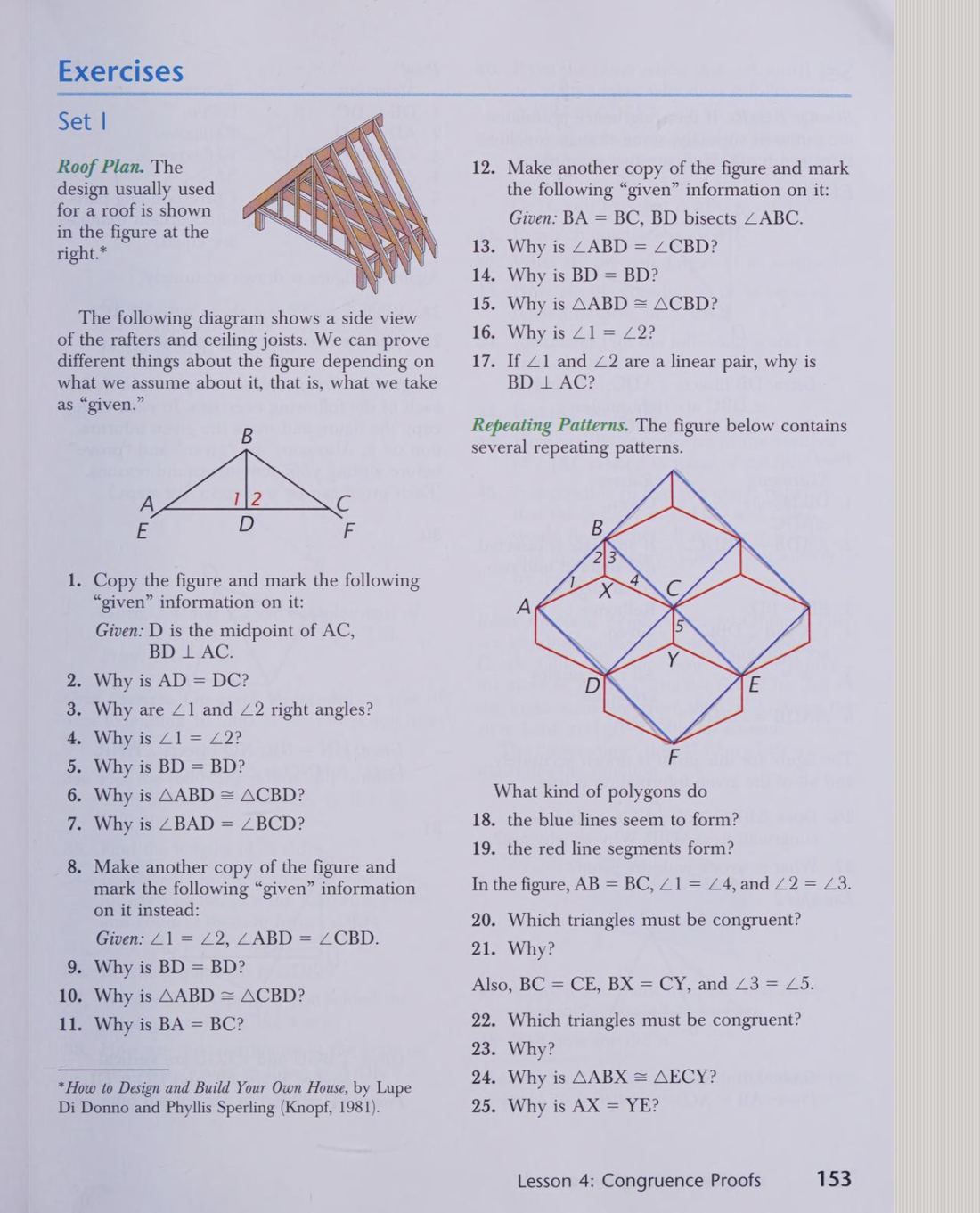
Example 1 "proves" △ADB ≅ △BDC by ASA; example 2 "proves" AB = AC by SAS. Both figures are accurate. Find each proof's lie.
- Question 26: look at the figure: △BDC is visibly longer and thinner than △ADB; no tracing fits. So some step must be false, before you even hunt it.
- Question 27: the ASA step needs the equal side included between the two equal angles. In △ADB the side BD is included by ∠ADB and ∠DBA, but the proof used ∠A, and BD is opposite ∠A, not included. Right rule, wrong side: ASA never applied.
- Question 28: in example 2's accurate figure, AB is plainly longer than AC; the conclusion is false.
- Question 29: step 3 claims ∠DAB = ∠DAC "by reflexive." But those are two different angles; reflexive only says a thing equals itself. The equal-looking citation smuggles in an equality nobody granted, and SAS collapses with it.
- The moral, twice over: a proof's citations must fit the figure's actual anatomy: included means included, reflexive means the same part. Checking that fit is what page 51 called auditing the logic, and forgeries are the drill.
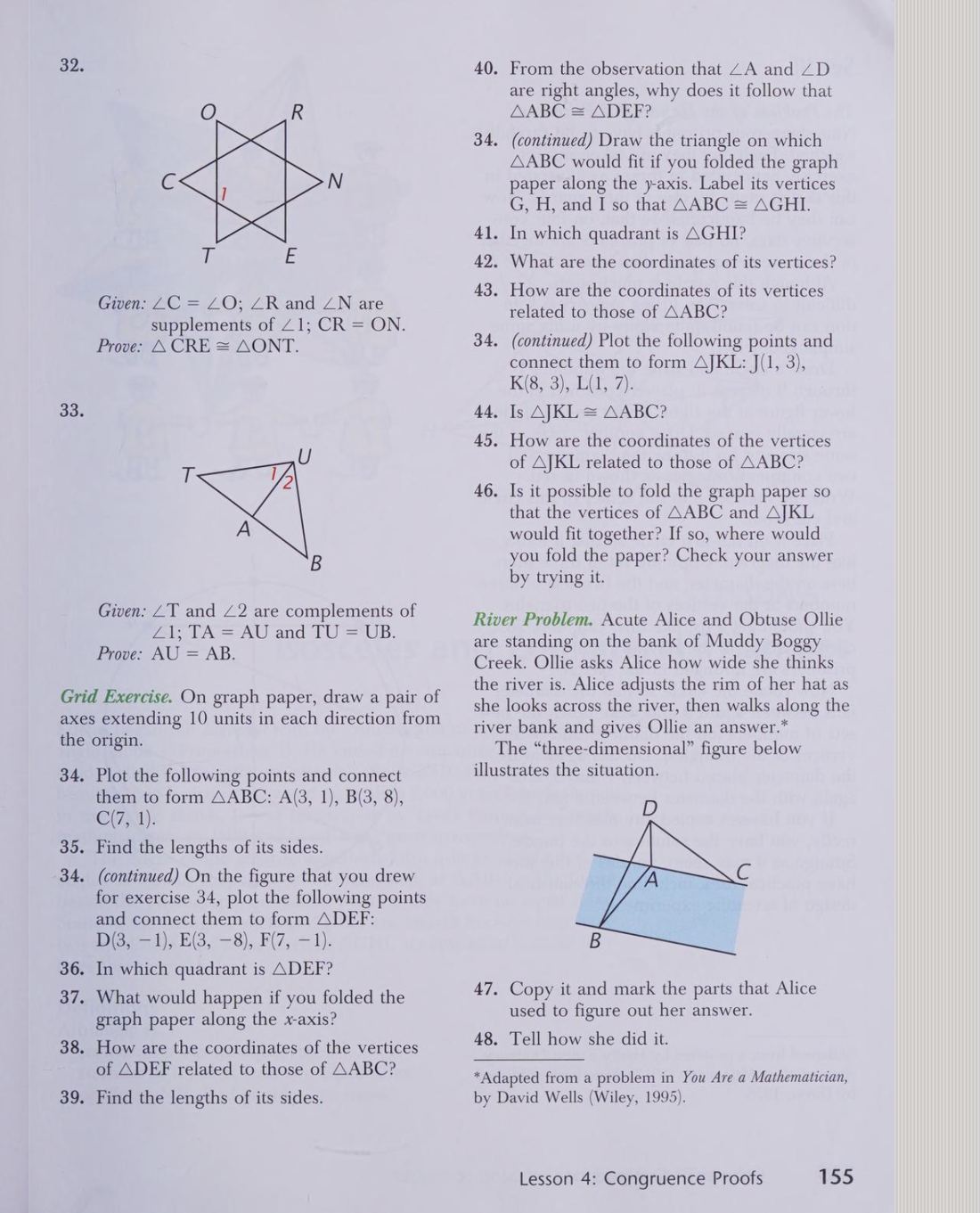
Questions 34 to 46: folding the graph paper
△ABC has A(3, 1), B(3, 8), C(7, 1). △DEF has D(3, −1), E(3, −8), F(7, −1); △JKL has J(1, 3), K(8, 3), L(1, 7). Relate them all to △ABC.
- Questions 35 and 39: legs by subtraction: AB = 7, AC = 4, and the distance formula gives BC = √(16 + 49) = √65. DEF repeats the same three numbers.
- Questions 36 to 38: DEF lives in quadrant IV, each vertex the ABC vertex with its y negated. Folding along the x-axis drops one triangle exactly onto the other: a reflection.
- Question 40: right angles at A and at D, equal legs around them: SAS certifies △ABC ≅ △DEF with no tracing paper, only coordinates.
- Questions 41 to 43: the y-axis fold lands ABC in quadrant II at G(−3, 1), H(−3, 8), I(−7, 1): x negated this time.
- Questions 44 to 46: JKL swaps each vertex's coordinates (x, y) to (y, x), which is the fold along the diagonal line through the origin, the line where x = y. Try it: the crease runs corner to corner through (1,1), (2,2), and the vertices meet. Three folds, three reflections, one congruent triangle each: the plane is full of free congruences, and coordinates name them.
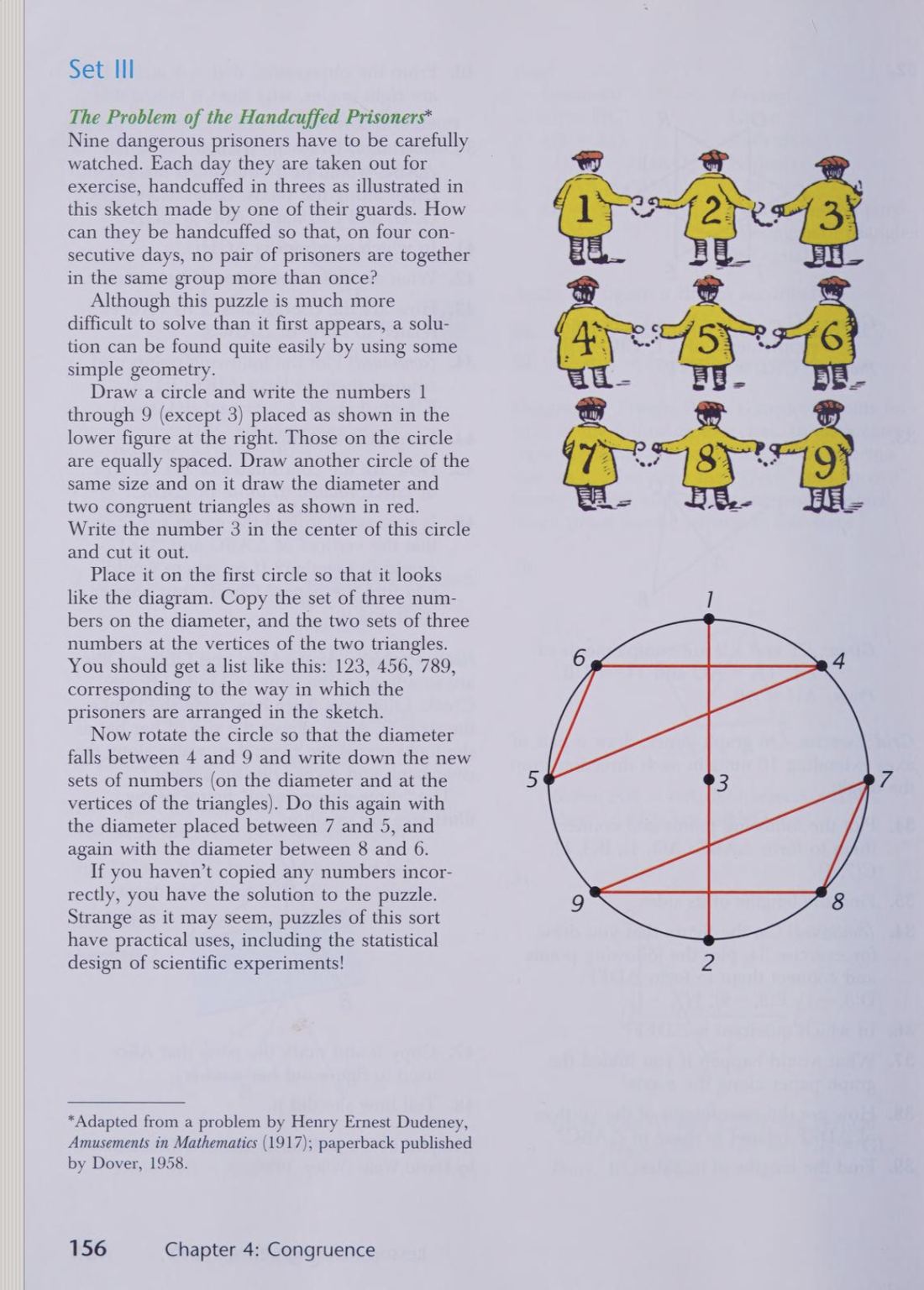
Set III: running the prisoner wheel
Numbers 1, 2, 4, 5, 6, 7, 8, 9 around the circle, 3 at the center of the cut-out disc bearing a diameter and two congruent triangles. Rotate and read four days of groupings.
- Day one, disc as drawn: the diameter reads 1-3-2, one triangle picks up 4-5-6, the other 7-8-9. List: 123, 456, 789, matching the guard's sketch.
- Rotate until the diameter spans 4 and 9 (with 3 riding the center always): read the new diameter trio and the two new triangle trios, writing them down before turning again.
- Repeat with the diameter between 7 and 5, then between 8 and 6. Four readings, four days.
- Audit like a geometer: pick any pair (say 2 and 6) and scan your four days; they should share a group exactly once. The congruent triangles enforce this: rotation never changes their spacing, so each turn meets each number pattern once.
- The last sentence of the page deserves its exclamation point: this wheel is a baby Latin-square design, and field biologists rotate treatments across plots with exactly this trick. Dudeney built lab equipment and called it a puzzle.