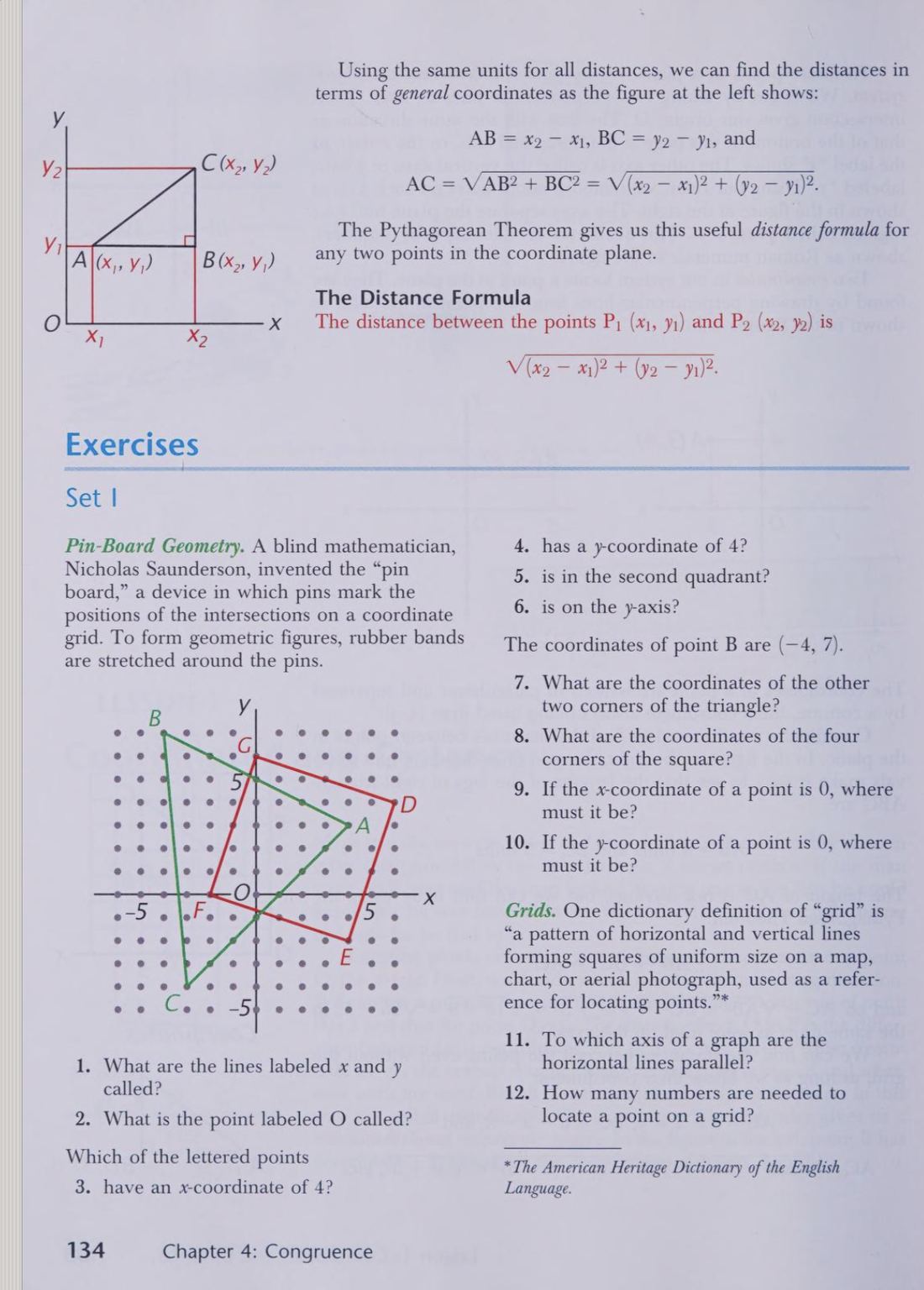
Questions 7 and 8: reading the pin board
Point B of the green triangle sits at (−4, 7). Find the coordinates of the triangle's other two corners, and of the red square's four corners.
- Anchor yourself: from B, count 4 left of the y-axis and 7 up. Every other point is read the same way, x first, sign from the quadrant.
- Question 7: trace the green band to its other corners: F just left of the origin at (−2, −1), and C down in the third quadrant at (−3, −5). (Read your own board carefully; the counting, not my numbers, is the skill.)
- Question 8: the red square's corners read G(0, 5), D(6, 3), E(4, −3), and the fourth near (−2, −1). Notice it is a tilted square: no side runs parallel to an axis, yet the coordinates pin it exactly.
- Self-check with the new formula: opposite corners of a square must be equally far from the other pair. One distance-formula computation on your read-off corners will confirm or catch a miscount, which is precisely what the formula is for.
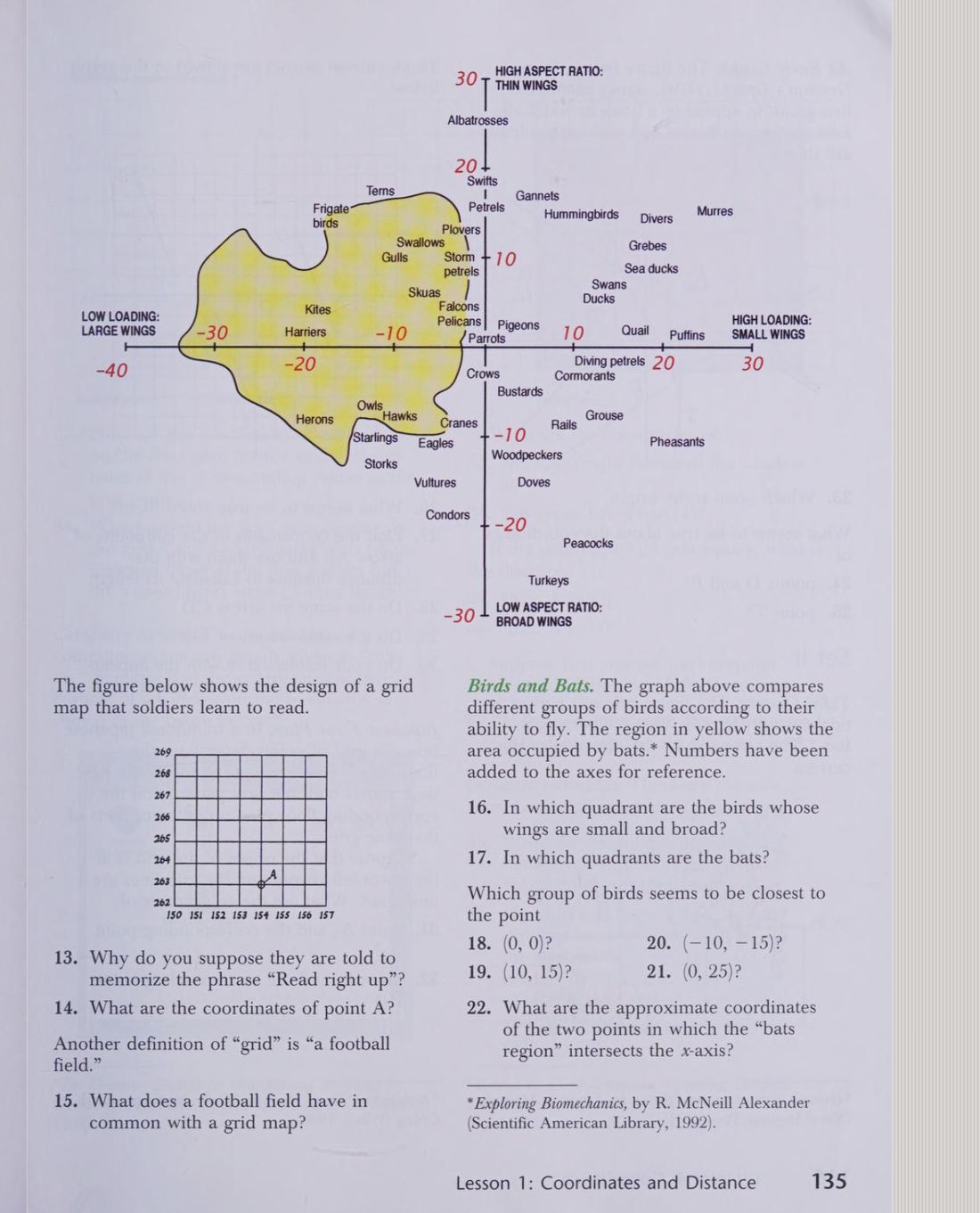
Questions 16 to 22: reading the bird chart
Which quadrant holds small broad wings? Where are the bats? Which bird groups sit nearest (0, 0), (10, 15), (−10, −15), (0, 25), and where does the bat region cross the x-axis?
- Question 16: small wings means positive x (high loading), broad wings means negative y (low aspect ratio): quadrant IV, where the chart parks pheasants, peacocks, and turkeys.
- Question 17: the yellow bat blob spans quadrants II and III and pokes past the y-axis into I: three quadrants, never IV.
- Questions 18 to 21: nearest (0, 0) are the pigeons and parrots crowd; near (10, 15) the divers and grebes; near (−10, −15) the owls and hawks; straight up at (0, 25) the swifts.
- Question 22: the bat region cuts the x-axis at roughly (−25, 0) and (−3, 0); read your own chart to the nearest 5, since "approximate" is in the question.
- Notice what you just did: turned zoology into geometry and back four times. Any two measured quantities make a plane, and that idea, not any bird, is the exercise.
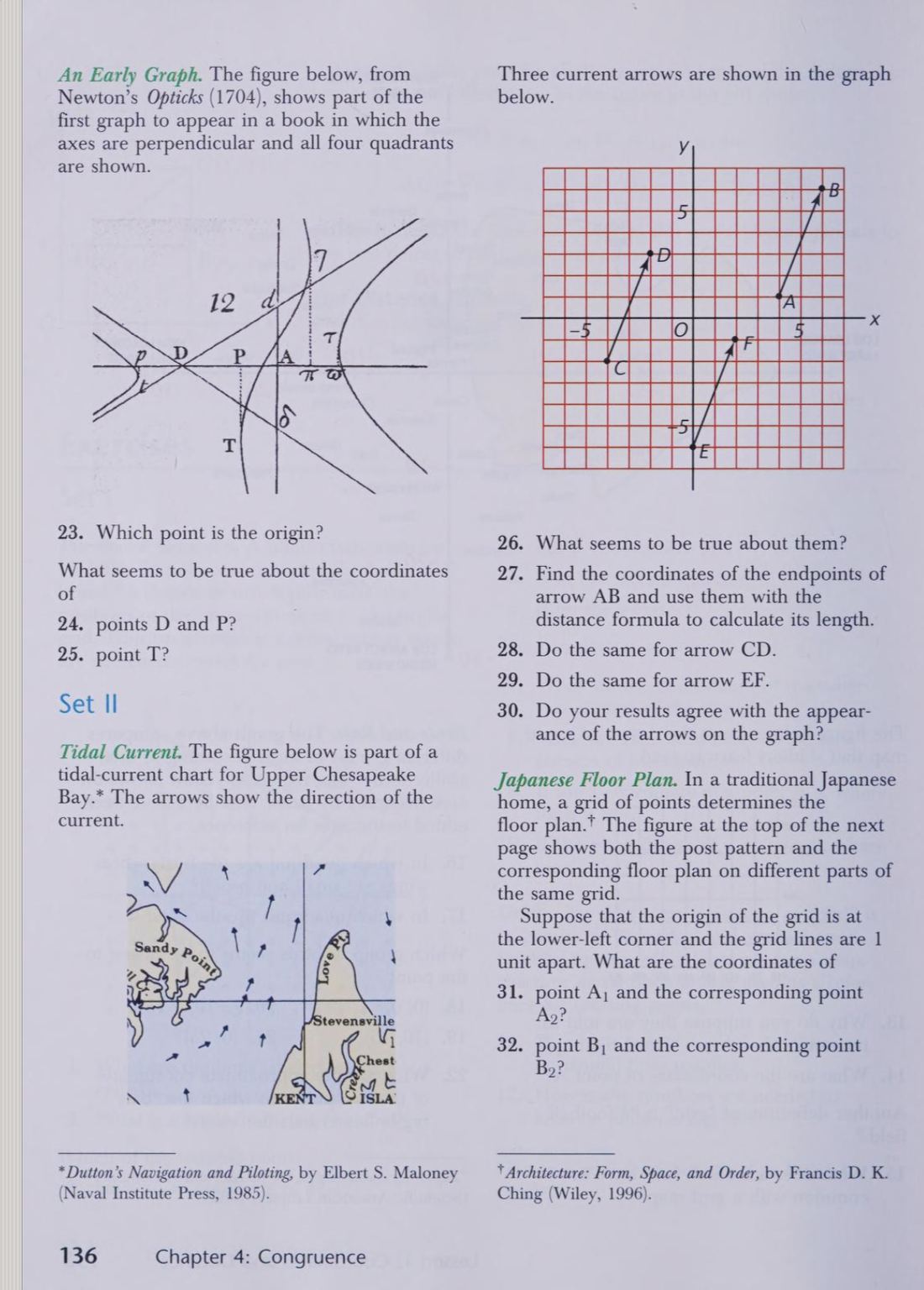
Questions 26 to 30: three current arrows
Read the endpoints of arrows AB, CD, and EF from the grid and compute each length with the distance formula. Do the results match their look?
- Read endpoints first, compute second (mixing the two steps is where errors live). From the grid: A(4, 1) to B(6, 6); C(−4, −1) to D(−2, 4); E(2, −6) to F(4, −1). Check each against your own figure.
- AB: √((6 − 4)² + (6 − 1)²) = √(4 + 25) = √29.
- CD: √((−2 − (−4))² + (4 − (−1))²) = √(4 + 25) = √29. Mind the signs: subtracting a negative is where question 28 earns its keep.
- EF: √((4 − 2)² + (−1 − (−6))²) = √29 again. All three arrows are exactly √29 ≈ 5.4 units.
- Question 26 and 30 close the loop: the arrows are parallel and equally long, drawn in different places. Same displacement, different position; hold that idea gently, because "same size and shape, different place" is this chapter's entire subject.
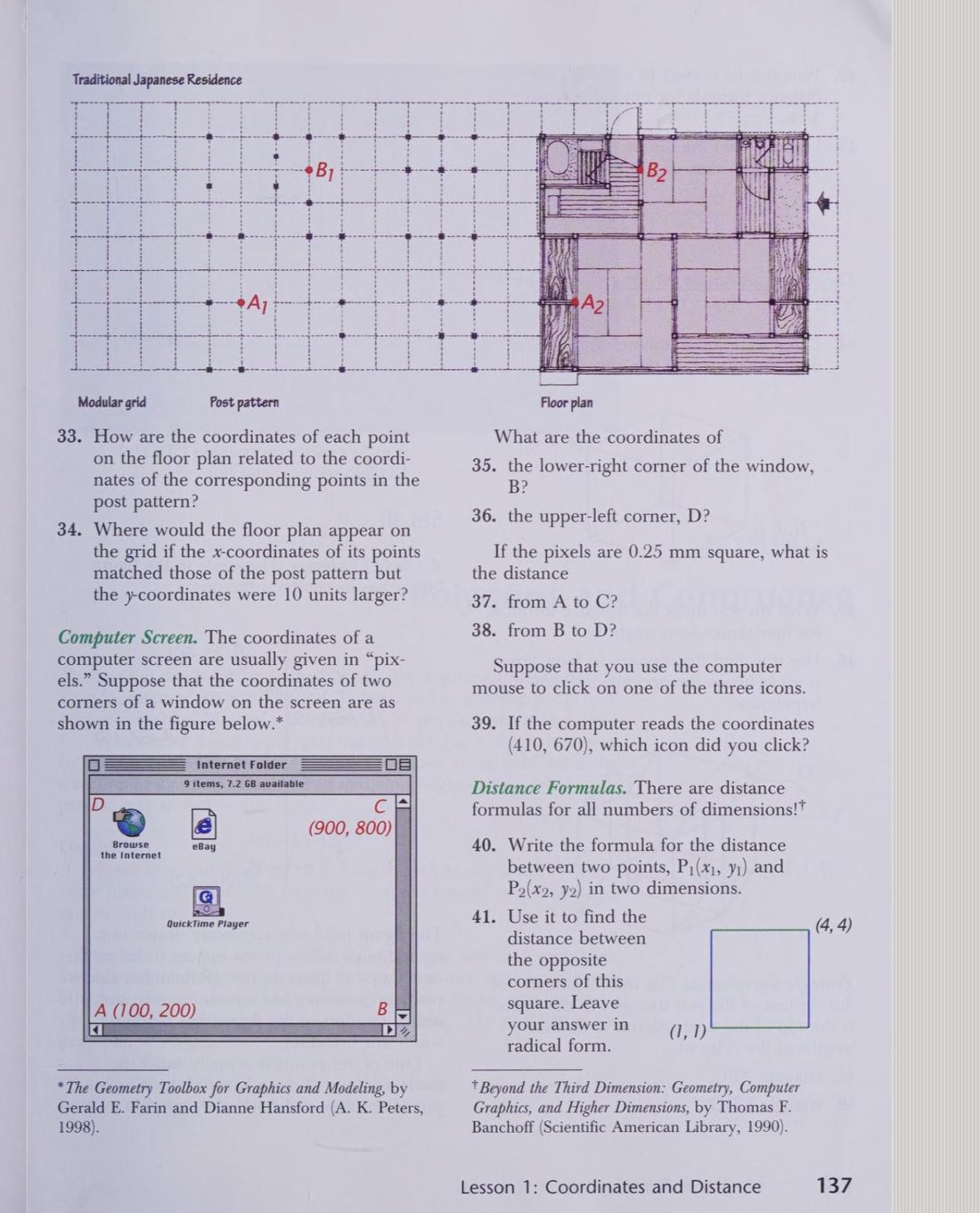
Questions 35 to 38: the window's diagonal
A window's corners A(100, 200) and C(900, 800) are given. Find B and D, then the pixel distance A to C and B to D, and convert at 0.25 mm per pixel.
- Questions 35 and 36: a screen window's sides run with the axes, so B shares C's x and A's y: B(900, 200); D shares A's x and C's y: D(100, 800).
- Question 37: AC = √((900 − 100)² + (800 − 200)²) = √(800² + 600²) = √(640,000 + 360,000) = √1,000,000 = 1,000 pixels.
- Spot the family: 800 and 600 are 4 and 3 scaled by 200, so the diagonal had to be 5 × 200. The 3-4-5 triangle from the Greek stamp keeps paying rent.
- Question 38: BD runs (900, 200) to (100, 800): √((−800)² + 600²) = 1,000 pixels too. A rectangle's diagonals match, now proved by arithmetic rather than looks.
- Convert: 1,000 pixels × 0.25 mm = 250 mm, a 25-centimeter diagonal. Question 39's click at (410, 670) lands on the QuickTime icon, and you resolved it exactly the way the machine does.
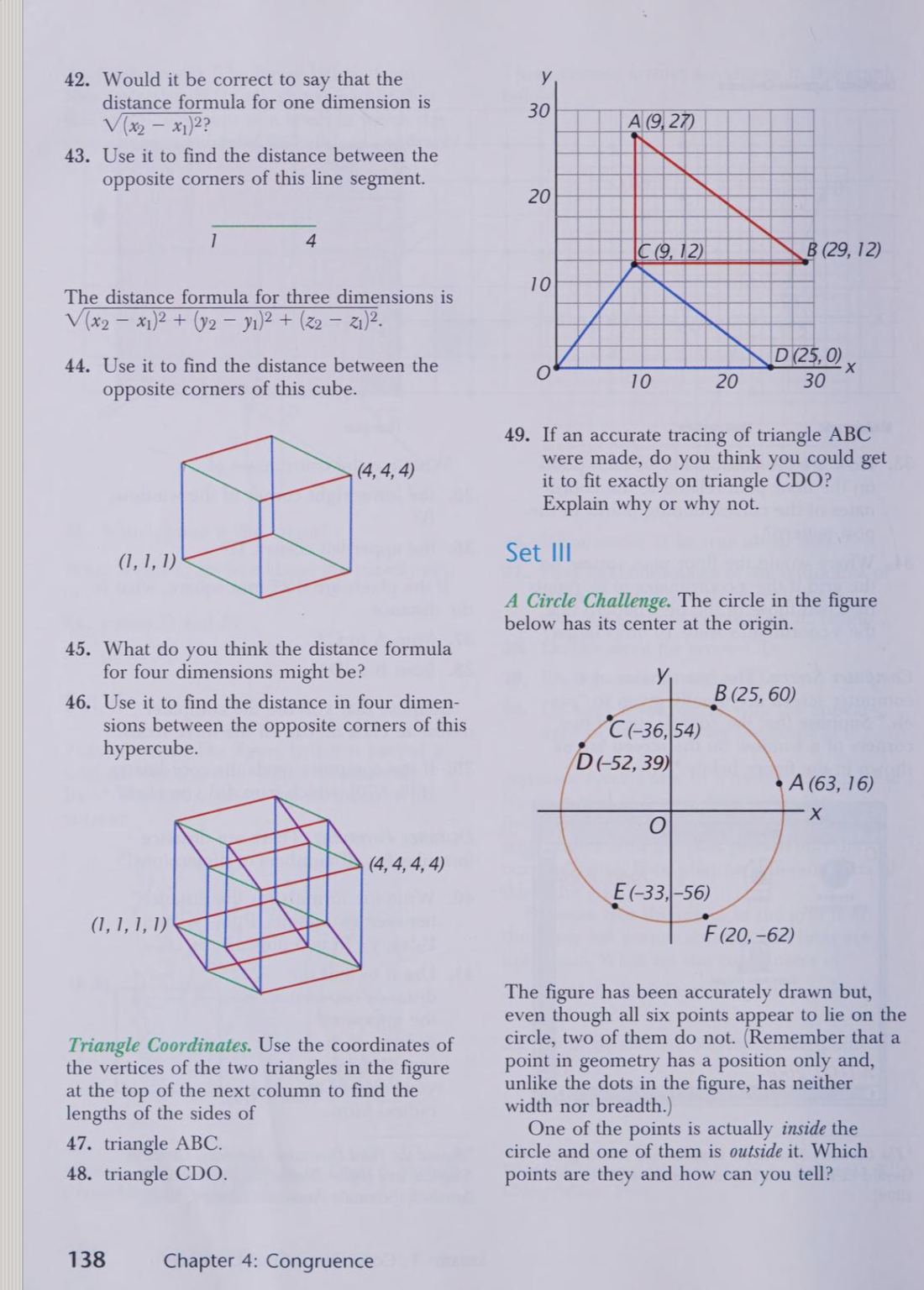
Set III: six points, one circle, two liars
A circle is centered at the origin. Points A(63, 16), B(25, 60), C(−36, 54), D(−52, 39), E(−33, −56), F(20, −62) all appear to lie on it, but one is inside and one outside. Which, and how can you tell?
- The definition from page 24 is the tool: on the circle means exactly one radius from the center. With the center at O, each point's distance is √(x² + y²), so compare x² + y² and skip the square roots entirely.
- A: 63² + 16² = 3969 + 256 = 4225. B: 625 + 3600 = 4225. So the radius squared is 4225 (radius 65), and A and B are honest.
- D: 2704 + 1521 = 4225. E: 1089 + 3136 = 4225. Also honest.
- C: 1296 + 2916 = 4212, just under 4225: C is inside the circle. F: 400 + 3844 = 4244, just over: F is outside.
- The gaps are 13 and 19 parts in 4225, far too small for any eye or printer, which is the book's point in the parentheses: drawn dots have width, geometric points do not, and only computation can referee. Five distance formulas just outperformed a perfectly accurate drawing.
Questions 3 to 5: the dot-to-dot polygon
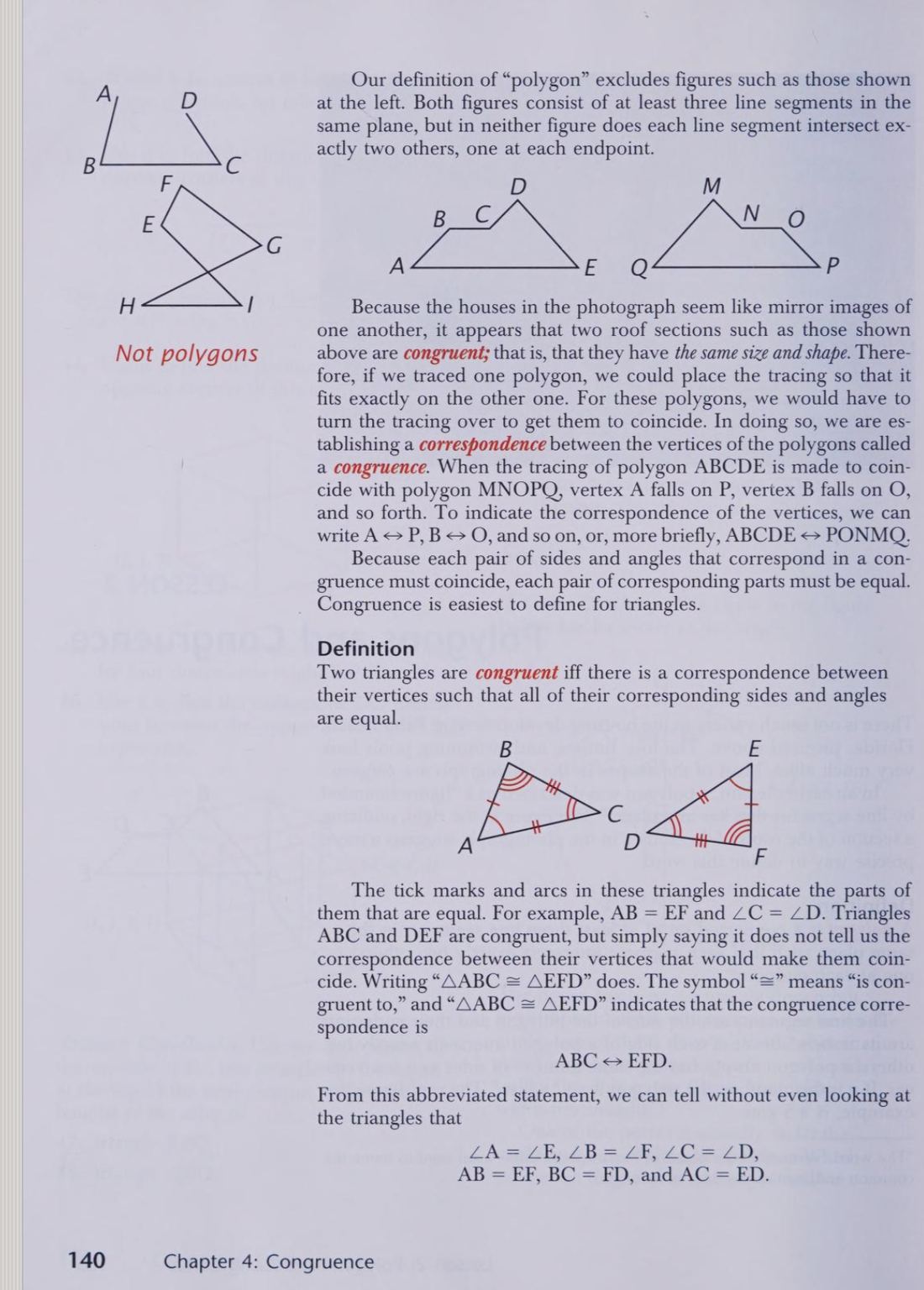
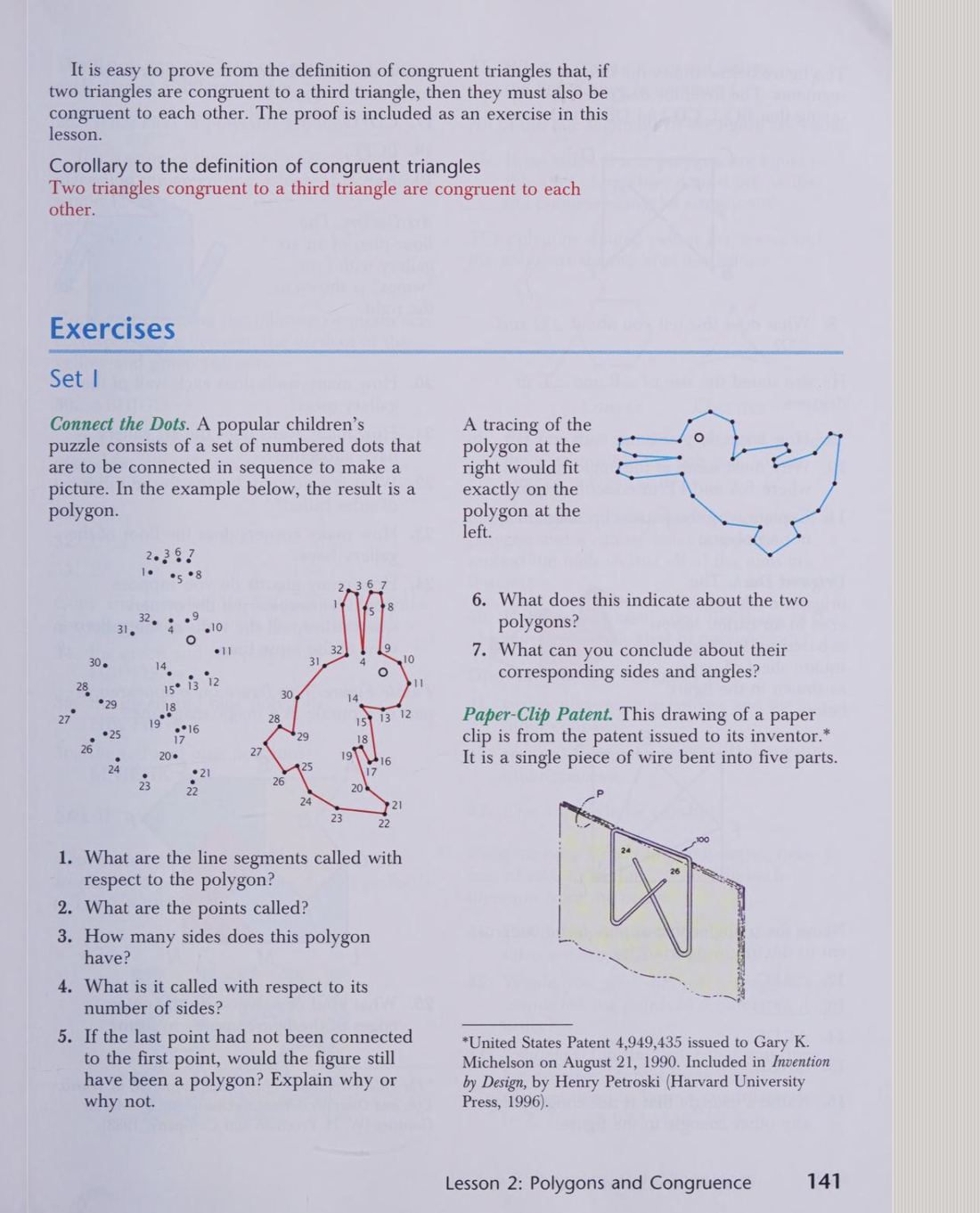
The finished puzzle is a polygon. How many sides does it have, what is it called, and would it still be a polygon if the last dot were not joined back to the first?
- Question 3: the dots number 1 through 31, and closing the figure joins 31 back to 1, so there are exactly 31 segments: 31 sides. No recount needed, and that shortcut is the definition talking: sides equal vertices.
- Question 4: page 139's naming rule makes it a 31-gon. Not every polygon has a Greek name, and the n-gon convention exists for exactly this reason.
- Question 5: leave the last segment out and vertex 1 and vertex 31 each touch only one segment. The definition demands every segment meet exactly two others, one at each endpoint, so the open chain is not a polygon.
- Say the failure precisely, citing the clause, the way page 140's non-polygons are dismissed. Definitions with teeth are what let the rest of this chapter say "polygon" and mean something checkable.
Questions 12 to 16: congruent triangles in the duck
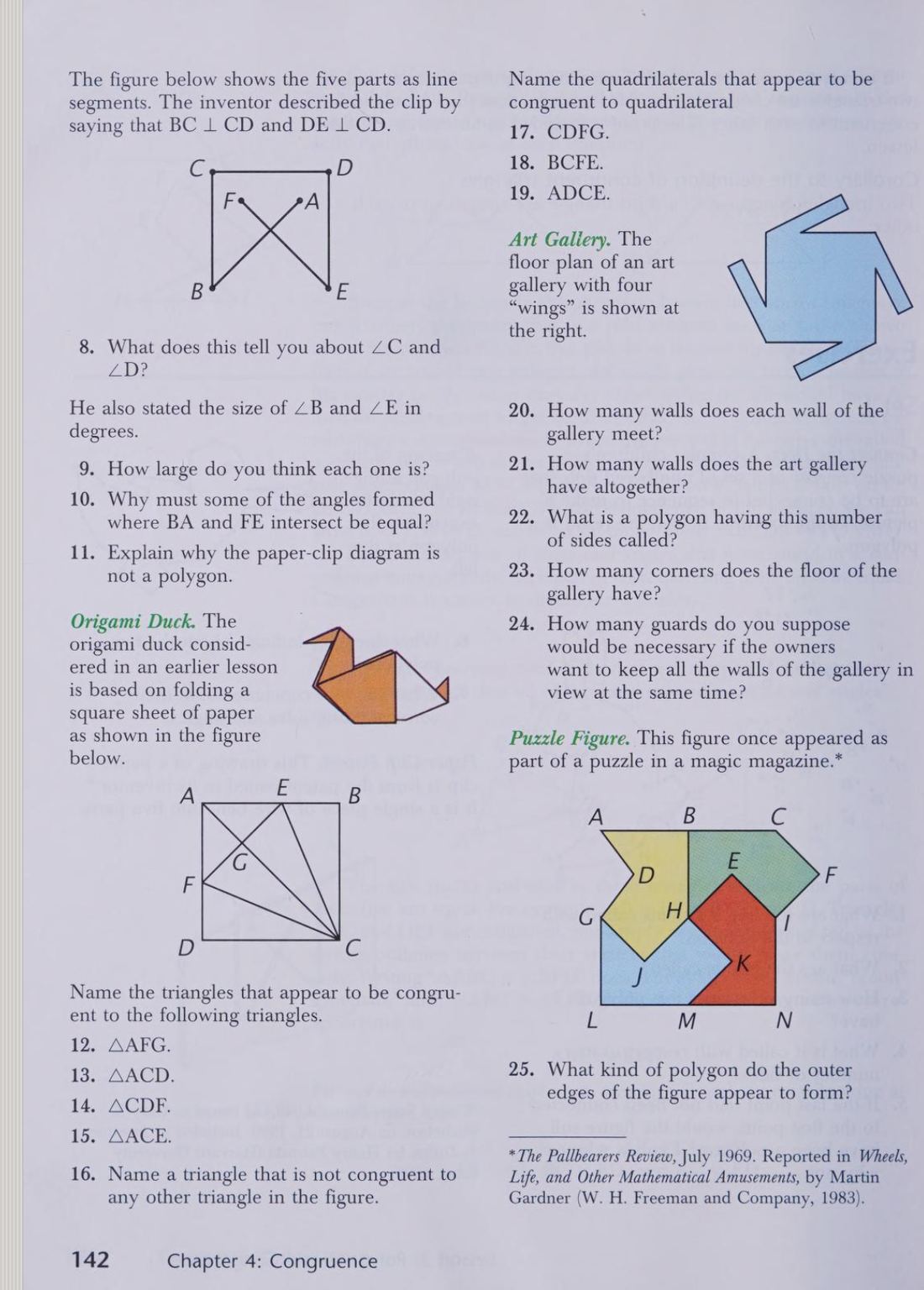
In the folded square (diagonal AC, creases from the folds, E the midpoint region on AB), name the triangles that appear congruent to △AFG, △ACD, △CDF, △ACE, and one triangle congruent to nothing else.
- Use the folds, not your eye: every fold in page 101's construction laid one region exactly onto another, and regions that coincided are congruent by definition.
- Question 12: the fold along AC carried △AFG onto △AEG... read your figure's letters: the small triangle above the diagonal pairs with its mirror below. Match your lettering by the fold that swaps B and D.
- Questions 13 to 15 follow the same rule: △ACD pairs with △ACB (the big halves of the square); △CDF with △CBE; △ACE with △ACF.
- Question 16: hunt for a triangle no fold ever moved onto another; the odd-sized one (the book intends △GCE or its cousin in your lettering) has no partner.
- Check any claimed pair by the tracing test: could you cut one out and lay it on the other? For fold-partners the paper already did it, which is why origami is a congruence machine.
Questions 39 to 43: convex or concave
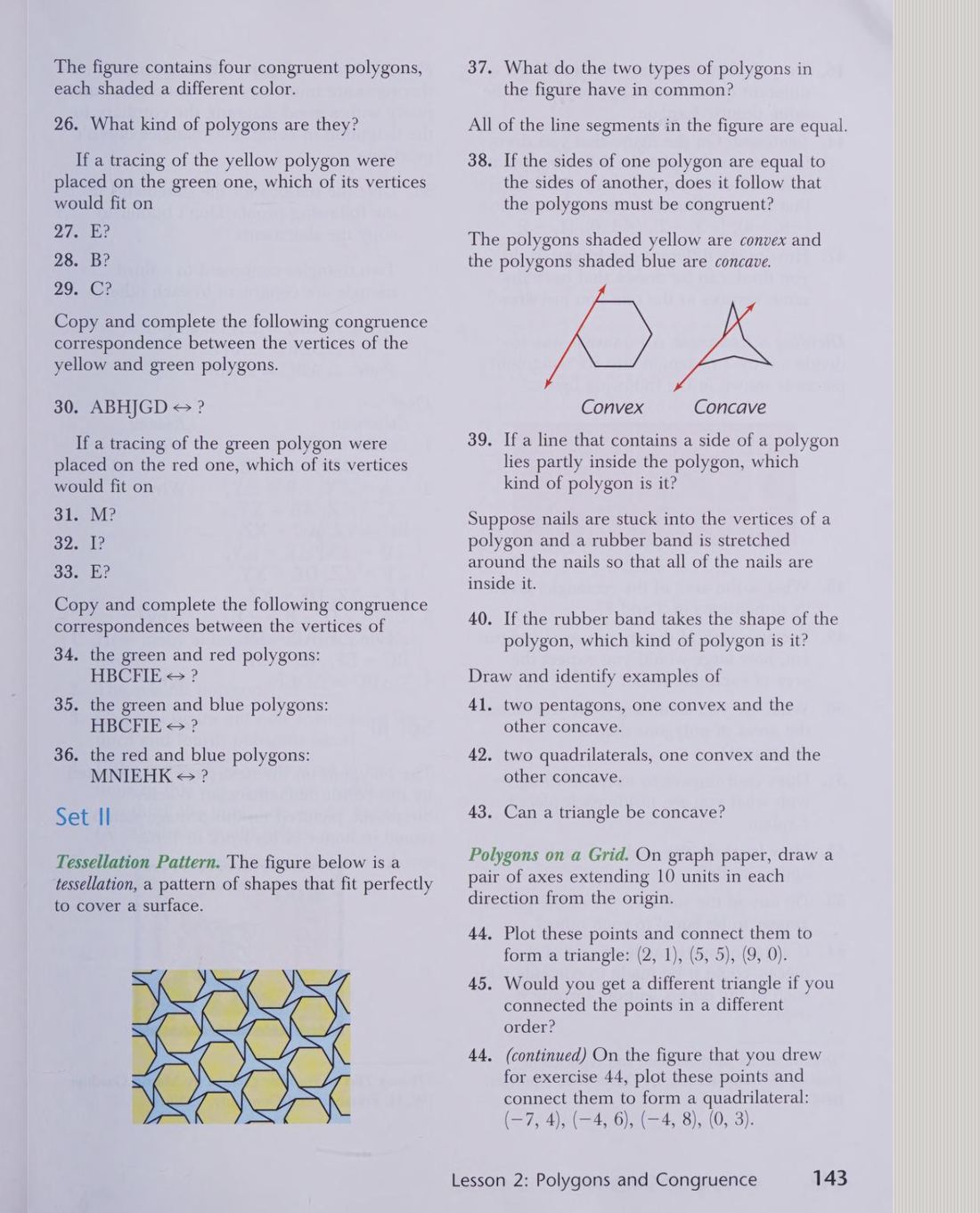
State the line test and the rubber-band test, then settle question 43: can a triangle be concave?
- Question 39: extend each side into a full line. If some side's line passes through the polygon's interior, the polygon is concave; if every side's line keeps the whole polygon on one side, it is convex. A dent is exactly a side whose line cuts back in.
- Question 40: nails at the vertices, rubber band around all of them. The band takes the polygon's own shape only when the polygon is convex; around a concave one, the band bridges the dent.
- Draw the four examples (41 and 42) with the tests in mind: to make a concave pentagon or quadrilateral, push one vertex inward until a side's line slices the interior.
- Question 43: try the same trick on a triangle. Three vertices leave nothing to push between; each side's line is fenced off by the opposite vertex alone, and the band always fits. A triangle cannot be concave, which is one more reason triangles are the chapter's chosen atoms.
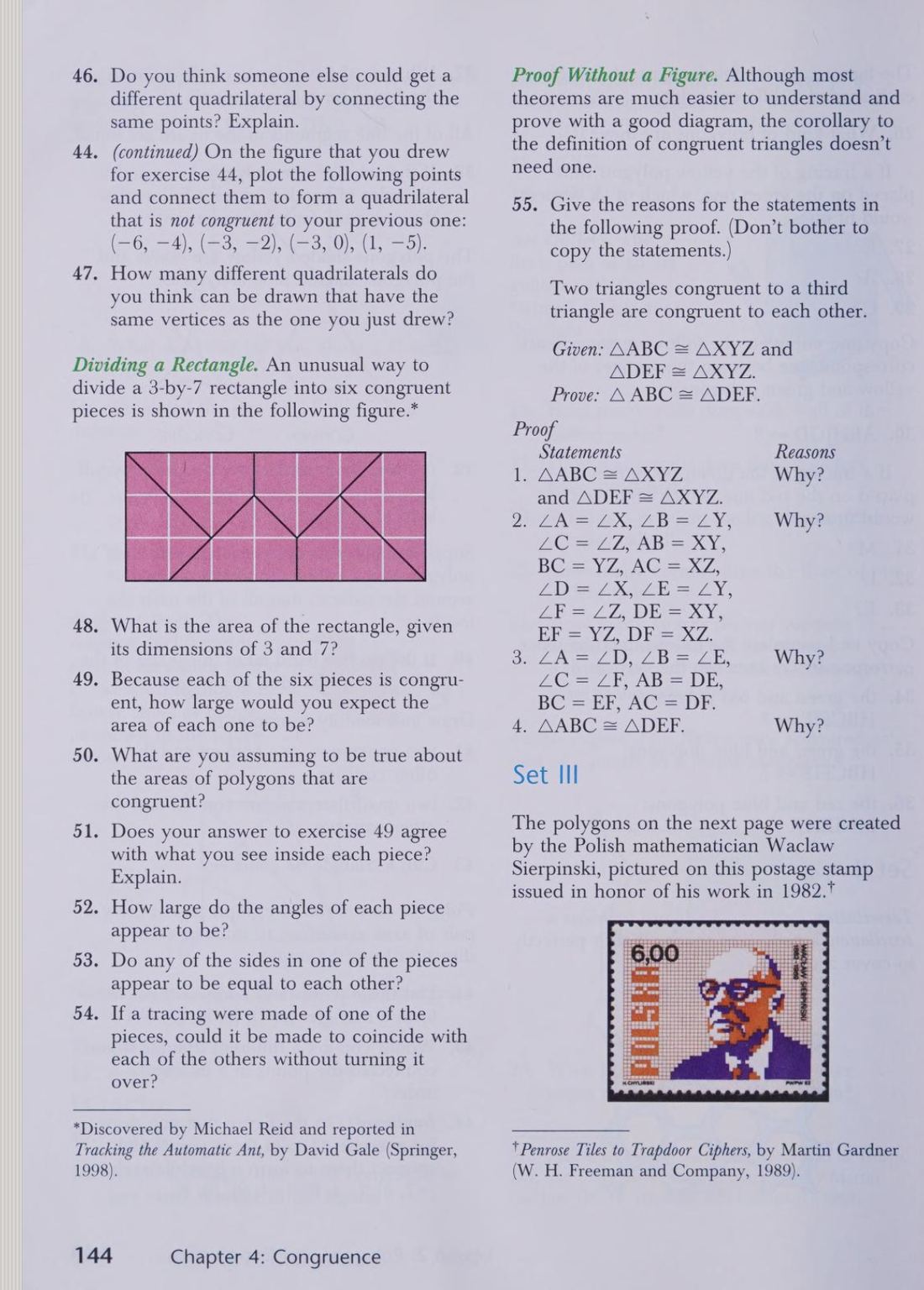
Question 55: two triangles congruent to a third
Given △ABC ≅ △XYZ and △DEF ≅ △XYZ, prove △ABC ≅ △DEF. Supply the four reasons.
- Statement 1 is the hypothesis: Given.
- Statement 2 unpacks both congruences into their twelve equalities (six parts each). Reason: the definition of congruent triangles, which is exactly the license to trade the symbol ≅ for a list of equal parts.
- Statement 3 splices the lists: ∠A = ∠X and ∠D = ∠X force ∠A = ∠D, and likewise five more times. Reason: substitution (two things equal to the same thing), page 79's property earning its keep.
- Statement 4 repacks: six matching equalities under the correspondence ABC ↔ DEF is precisely what △ABC ≅ △DEF means. Reason: the definition of congruent triangles again, now run in reverse.
- Definition open, algebra, definition shut: that rhythm is most of congruence proofs, and the corollary now joins your equipment list, no figure ever drawn.
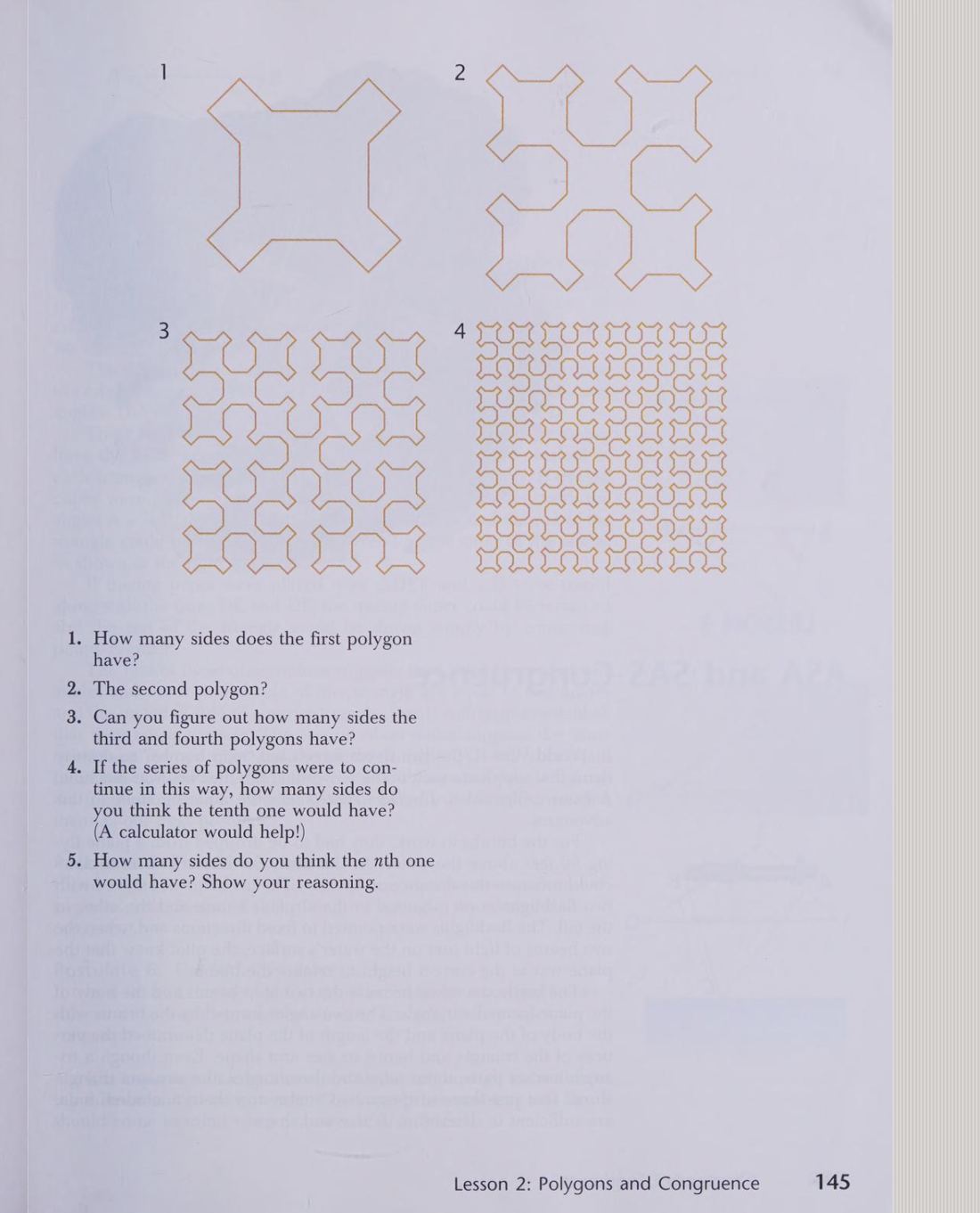
Set III: counting Sierpinski's sides
The first polygon has some number of sides; each later polygon replaces every piece with four smaller ones. How many sides do the third, fourth, tenth, and nth have?
- Questions 1 and 2: count the first figure honestly: 12 sides. Count the second by groups, not one by one: each of the 12 became 4, so 48.
- Question 3: the rule, once seen, does the counting: third generation 48 × 4 = 192, fourth 192 × 4 = 768. Verify a corner of the printed third figure against the rule; countable chaos is still countable.
- Question 4: the tenth continues the quadrupling nine times from 12: 12 × 4⁹ = 12 × 262,144 = 3,145,728 sides.
- Question 5: the nth polygon has 12 × 4ⁿ⁻¹ sides. Show the reasoning as the pattern, stated once: start at 12, multiply by 4 per generation, n − 1 generations after the first.
- Contrast with page 34's circle regions, where the obvious pattern lied. Here the rule is not a guess: the construction itself replaces each side with four, so the multiplication is built in, not observed. Knowing why a pattern holds is what makes it safe to ride to three million.