Questions 13 to 17: what division by zero would mean
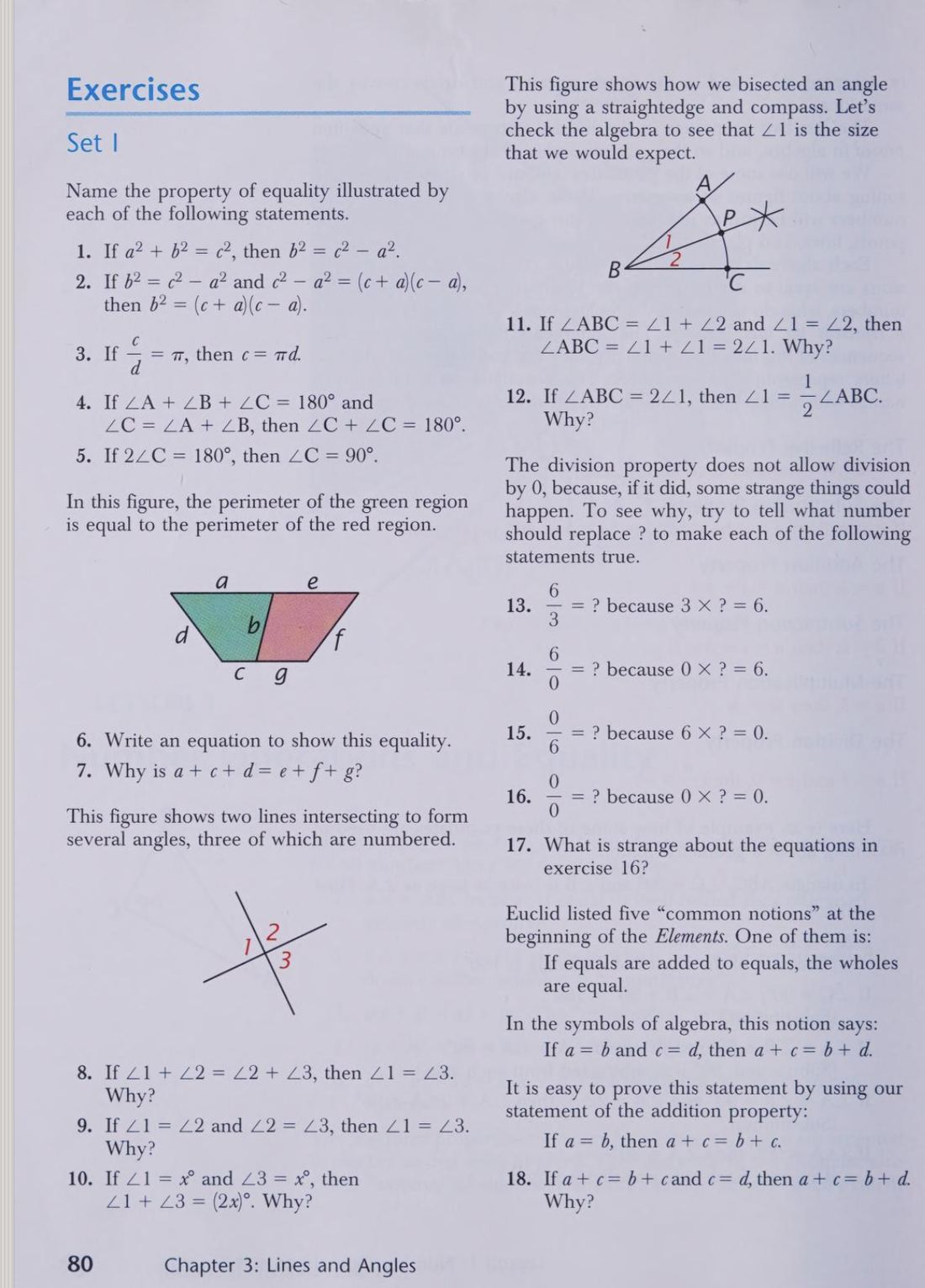
Fill in each ?: 6/3 = ? because 3 × ? = 6. 6/0 = ? because 0 × ? = 6. 0/6 = ? because 6 × ? = 0. 0/0 = ? because 0 × ? = 0. What is strange about the last one?
- Question 13 sets the pattern: every division is secretly a multiplication question. 6/3 = 2 because 3 × 2 = 6.
- Question 14: 6/0 asks for a number with 0 × ? = 6. Zero times anything is 0, never 6, so no number works at all.
- Question 15: 0/6 asks for 6 × ? = 0, and ? = 0 works fine. Dividing zero is legal; dividing by zero is not.
- Question 16: 0/0 asks for 0 × ? = 0, and now every number works: 0, 7, a million. Question 17's strangeness is the opposite disease: not no answer, but all of them.
- Now reread the division property on page 79 and notice the clause "and c ≠ 0" was carrying all of this. One fraction has no value, the other has every value, and either would let you prove 2 × 2 = 5, which is literally what happens on page 83.
Questions 23 and 24: the triangle and the crescents
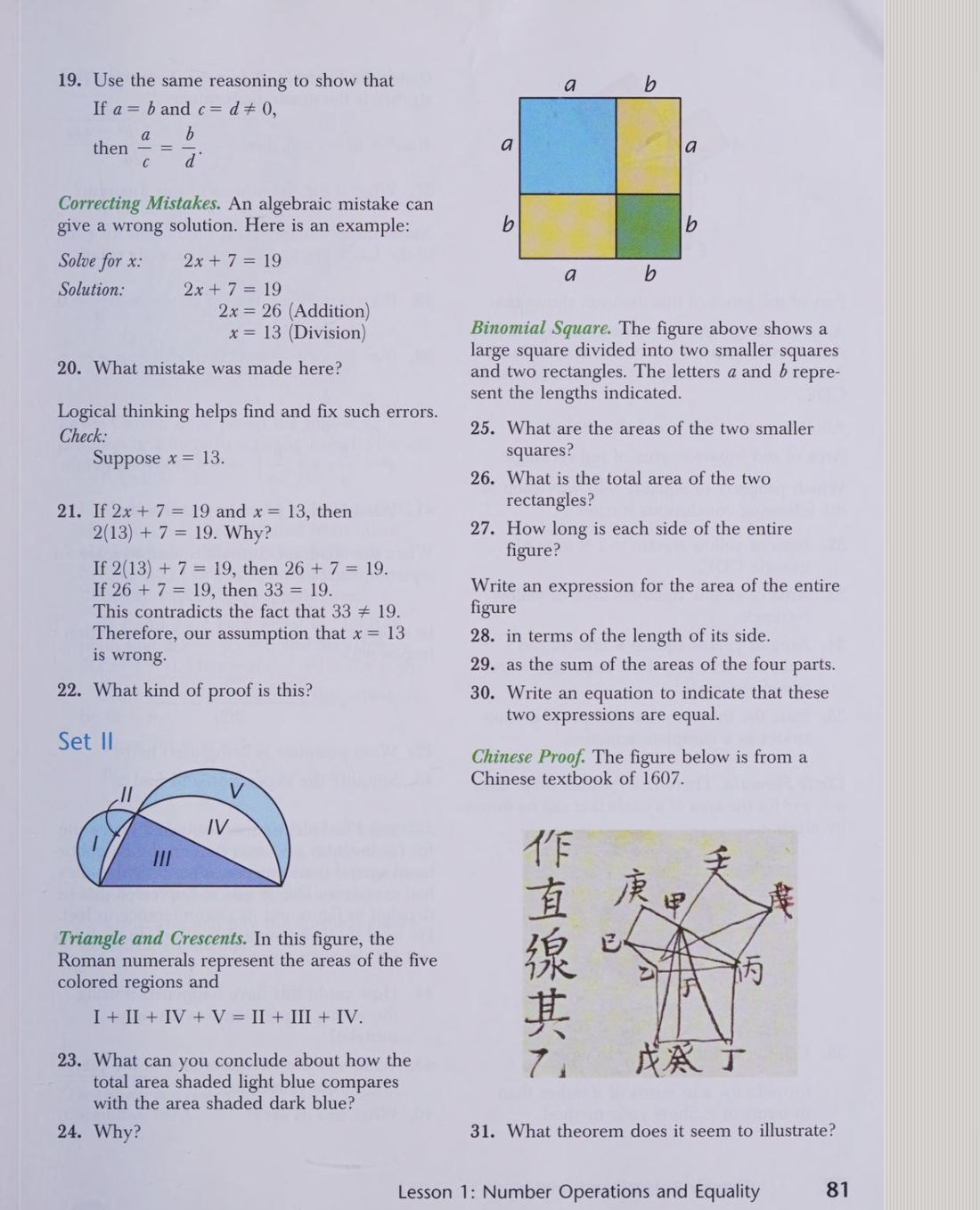
The five regions satisfy I + II + IV + V = II + III + IV. The light blue regions are I and V (the crescents); the dark blue is III (the triangle). How do their areas compare, and why?
- Write what is given: I + II + IV + V = II + III + IV. The left side is the two half-circles on the triangle's legs; the right side is the half-circle on its hypotenuse. (That equality is the Pythagorean Theorem wearing half-circles instead of squares.)
- Subtract II from both sides: I + IV + V = III + IV. Reason: the subtraction property.
- Subtract IV from both sides: I + V = III. Same reason again.
- Read the result in words for question 23: the two crescents together have exactly the area of the triangle. No curve was ever measured; two subtractions did everything, which is question 24's answer.
- This result has a name worth knowing, the lunes of Hippocrates, proved about 440 B.C., the first curved region in history whose exact area was found. You just reproved it with the subtraction property.
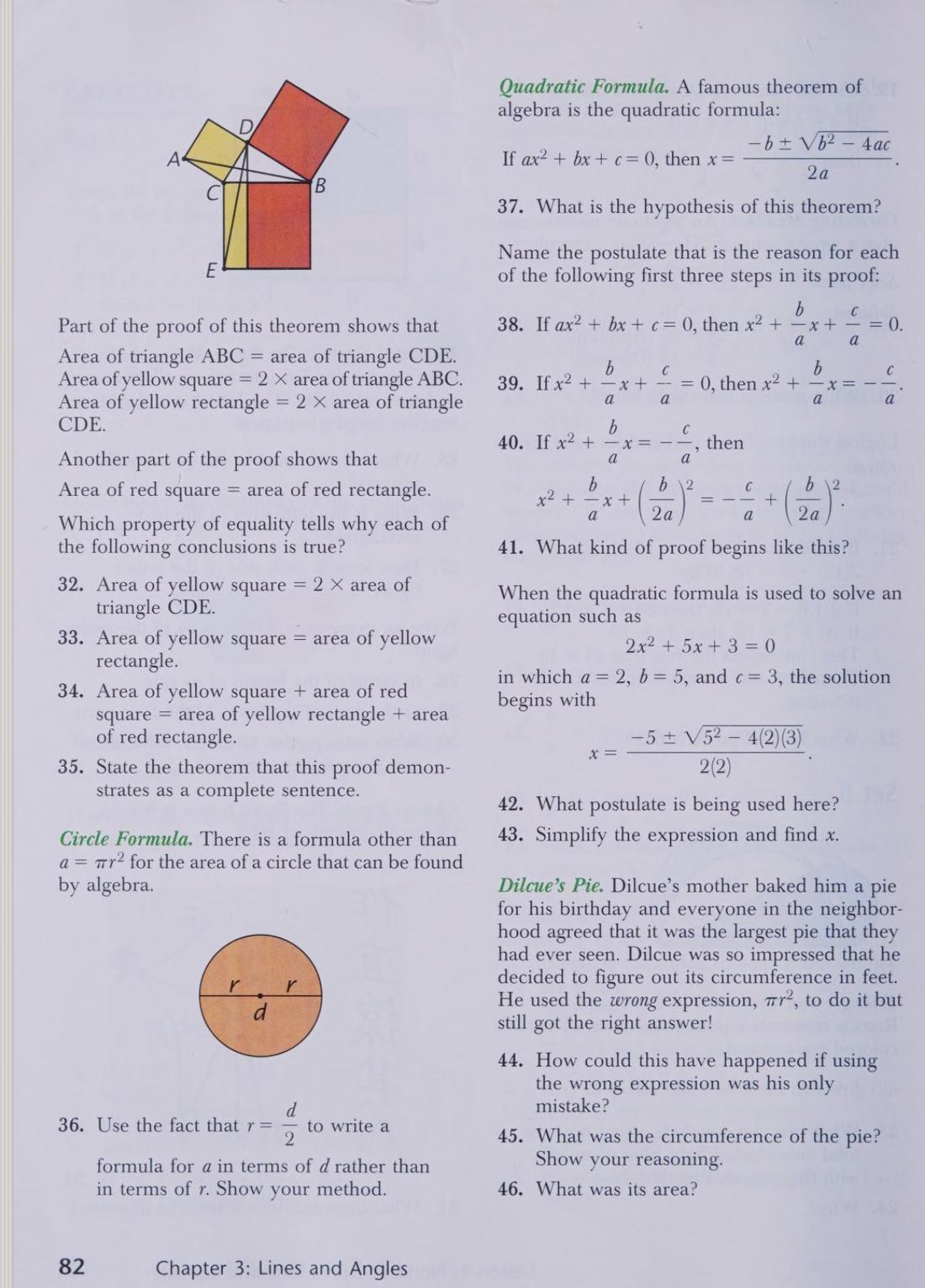
Questions 44 to 46: Dilcue's pie
Dilcue computed the circumference of a giant pie using the wrong expression, πr², and still got the right answer. How? What was the circumference, and what was the area?
- Set the wrong expression equal to the right one. The right expression for circumference is 2πr, so his luck requires πr² = 2πr.
- Divide both sides by πr (legal, since r is not 0): r = 2. The pie had a radius of exactly 2 feet, which answers question 44: only that one radius forgives the mistake.
- Question 45: circumference = 2πr = 4π ≈ 12.6 feet.
- Question 46: area = πr² = 4π square feet, the same number with different units, which is the whole joke: at r = 2 the two formulas coincide numerically.
- Self-check with page 21's lesson: feet and square feet measure different things, so "the same answer" is a coincidence of numbers, not of quantities. Dilcue was lucky once; the units would have caught him.
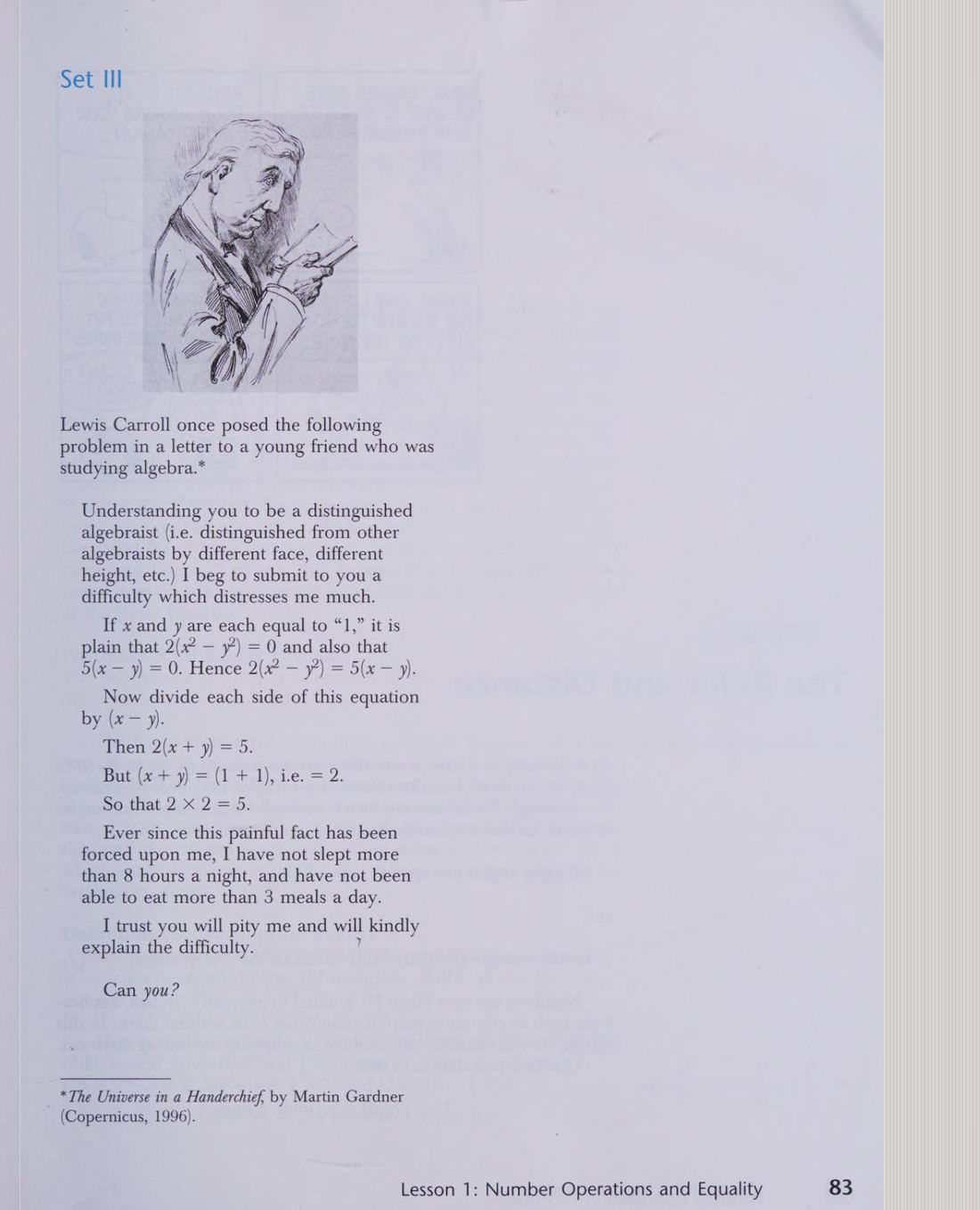
Set III: rescuing Lewis Carroll
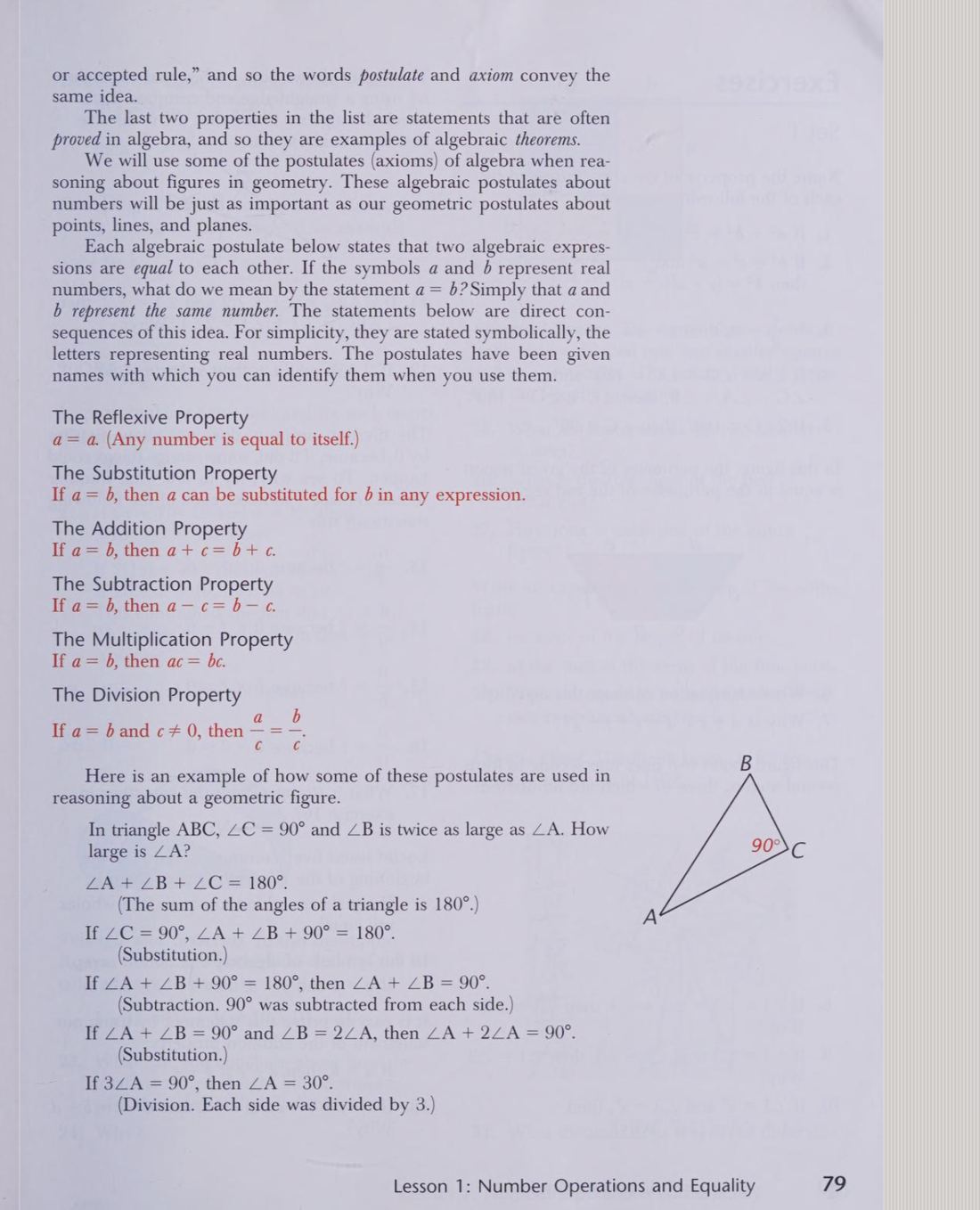
With x = y = 1: 2(x² − y²) = 0 and 5(x − y) = 0, so 2(x² − y²) = 5(x − y). Divide both sides by (x − y) to get 2(x + y) = 5, so 4 = 5. Where is the crime?
- Audit the opening: with x = y = 1, both products really are 0, and 0 = 0, so setting them equal is the substitution property used correctly. So far, sound.
- The factoring is page 78's property 5: x² − y² = (x + y)(x − y). Also sound.
- Now the division. The division property (page 79) says: if a = b and c ≠ 0, then a/c = b/c. Here c is (x − y) = 1 − 1 = 0. The property's hypothesis fails, so the step has no justification.
- Everything after the illegal step is garbage dressed in good algebra: 2(x + y) = 5 was never established, so 4 = 5 never follows.
- Answer Carroll the way page 52 answered Aristotle: the logic of each later step is fine, but a chain is no stronger than its weakest link, and this chain's third link divides by zero. That is why the division property carries its c ≠ 0 clause like a loaded warning.
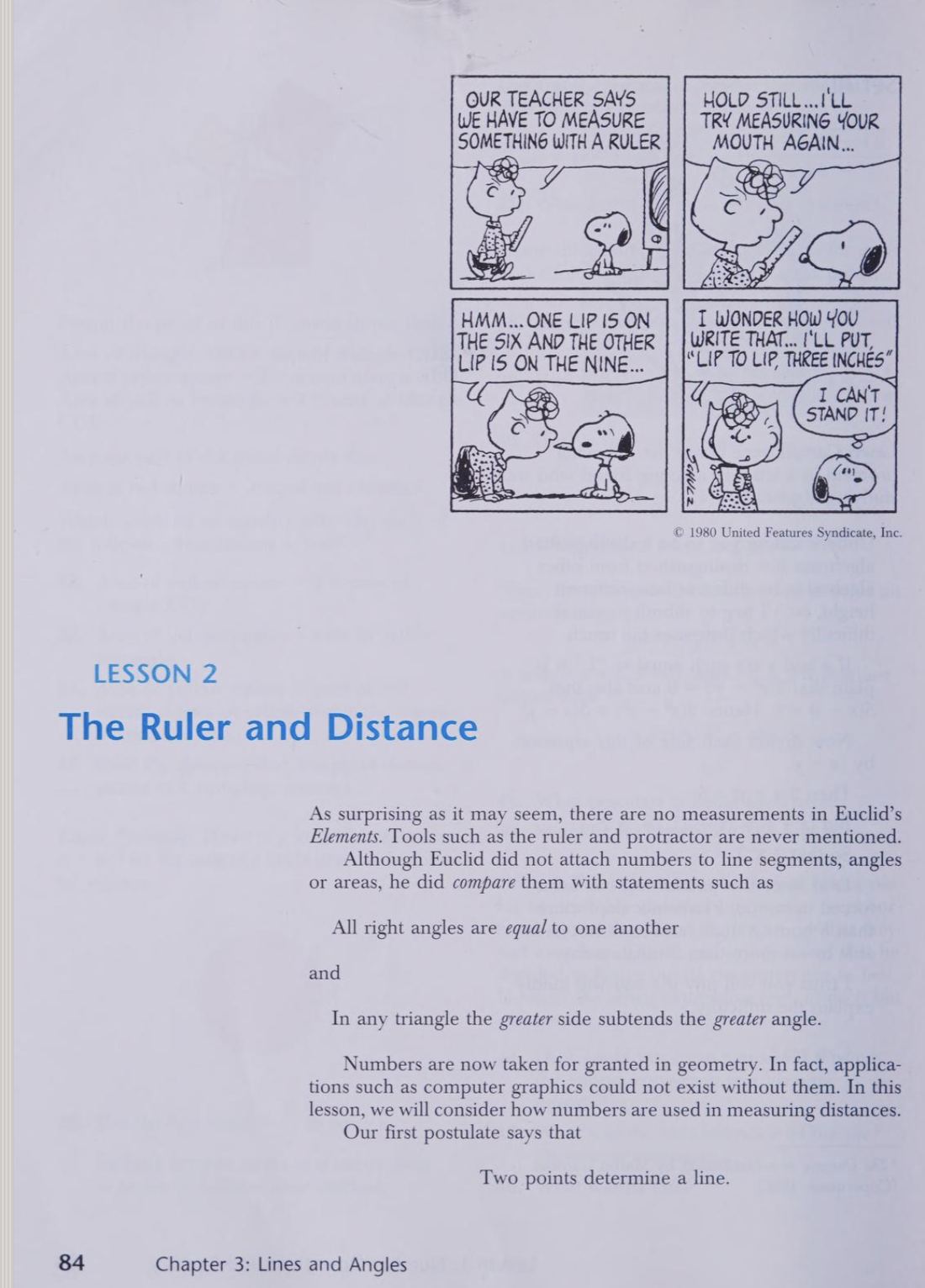
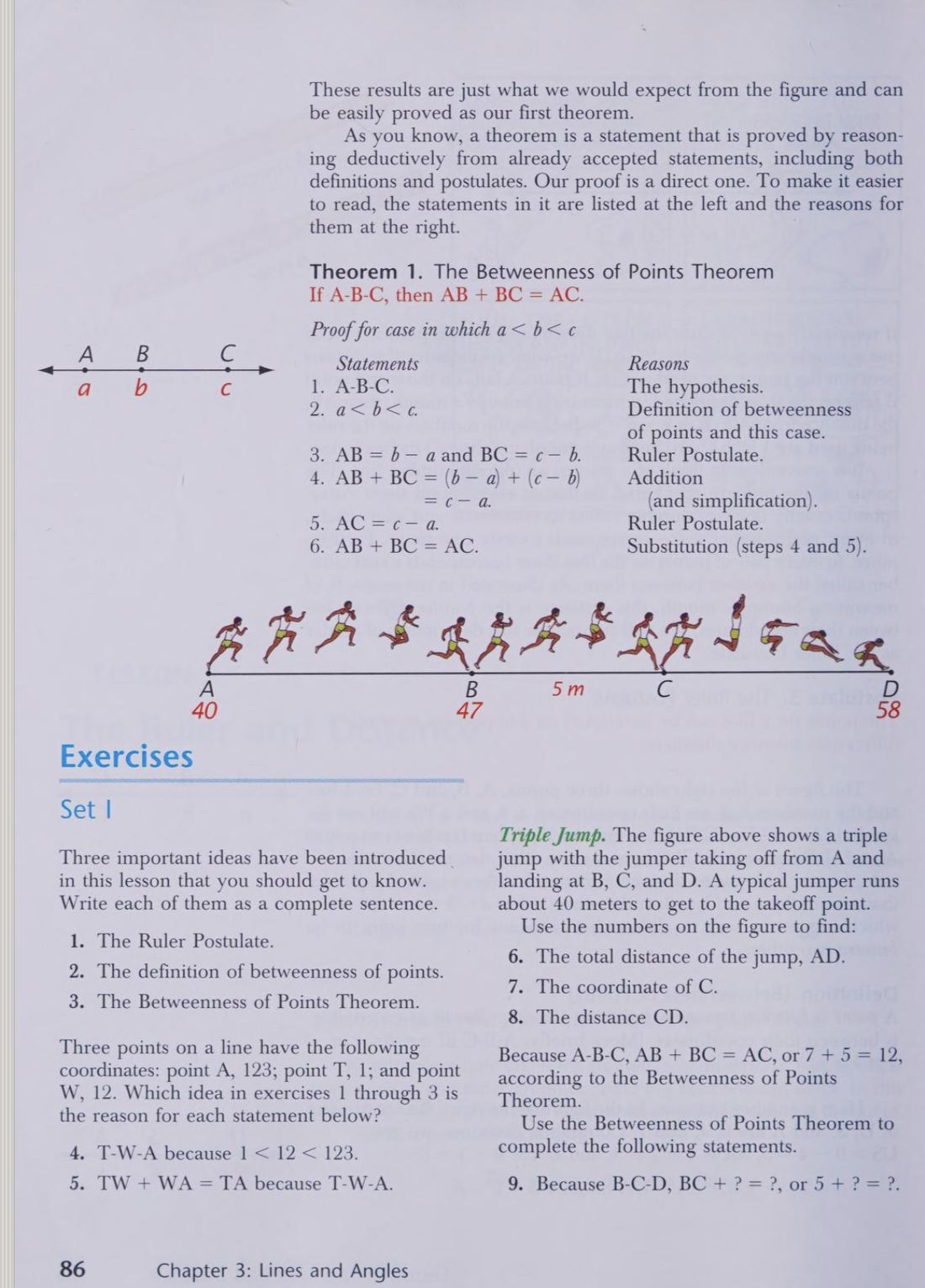
Questions 6 to 8: the triple jump
The jumper takes off at A (coordinate 40) and lands at B (47), C, and D (58). The hop from B to C is 5 meters. Find AD, the coordinate of C, and CD.
- Question 6: AD is a distance, so subtract coordinates: 58 − 40 = 18 meters for the whole triple jump.
- Question 7: C sits 5 meters past B, so its coordinate is 47 + 5 = 52.
- Question 8: CD = 58 − 52 = 6 meters.
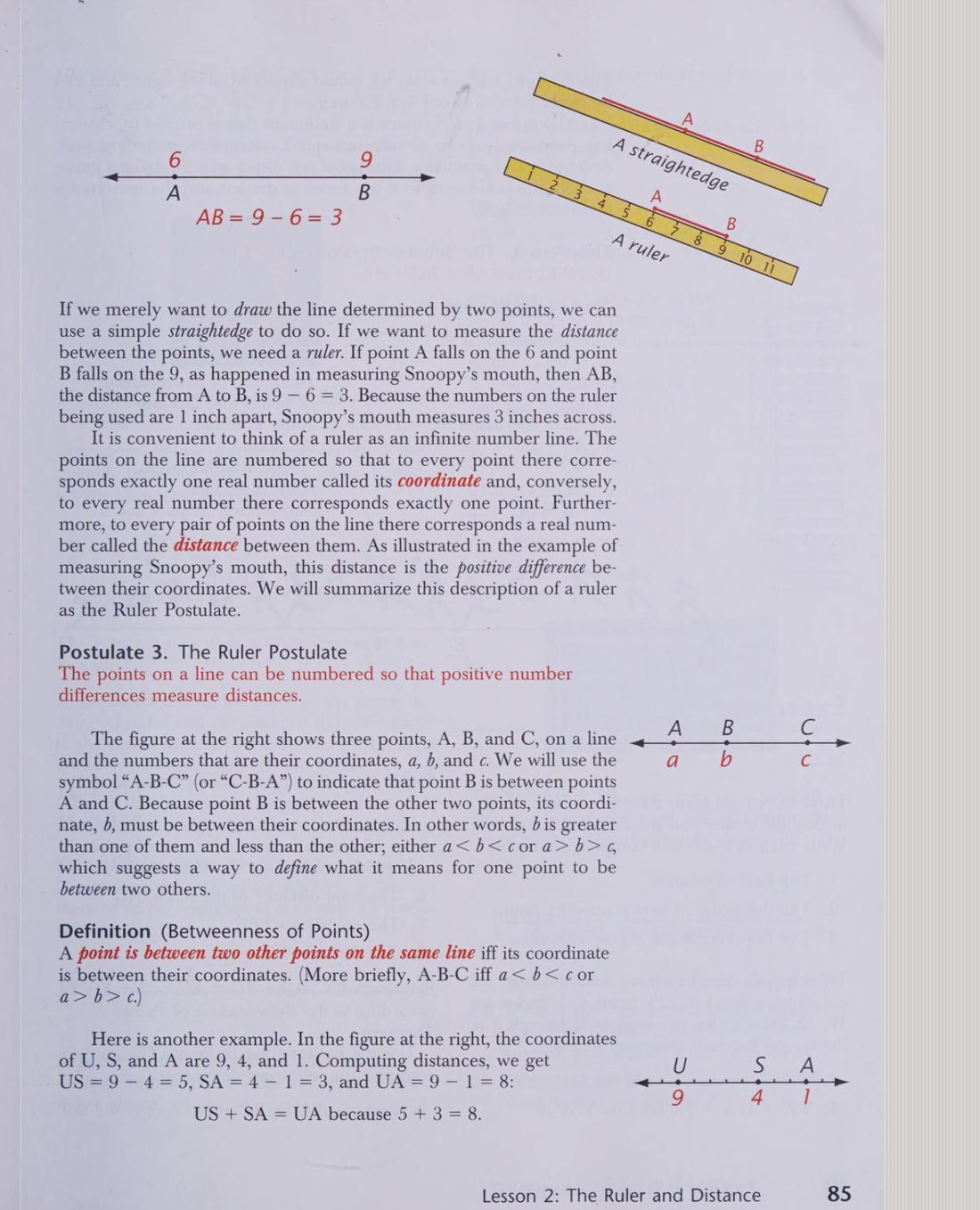
- Now audit with the new theorem: A-B-C-D in order, so the three phases should sum to the whole. Hop 47 − 40 = 7, step 5, jump 6, and 7 + 5 + 6 = 18 = AD. The Betweenness of Points Theorem is the reason that check is guaranteed to work, which is exactly what questions 9 to 11 have you write out.
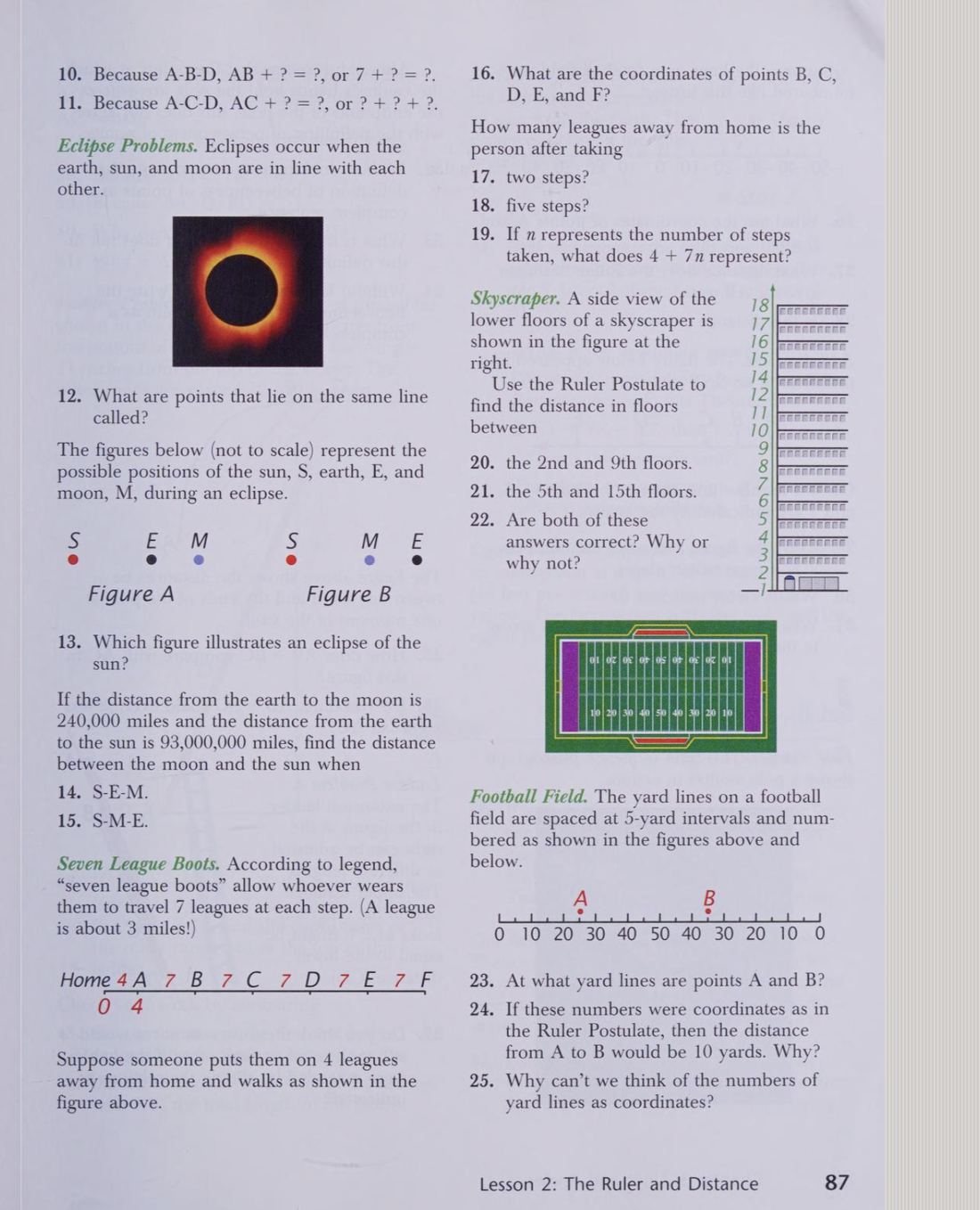
Questions 20 to 22: the skyscraper's missing floor
Using floor numbers as coordinates, find the distance in floors from the 2nd to the 9th floor, and from the 5th to the 15th. Are both answers correct?
- Question 20: 9 − 2 = 7 floors. Count the drawn floors in the figure to confirm: correct.
- Question 21: 15 − 5 = 10 floors, says the subtraction.
- Question 22: now look at the figure's numbers: ... 11, 12, 14, 15. There is no 13th floor; the builders skipped the unlucky number. Climbing from 5 to 15 you pass 9 actual floors, not 10.
- Say the failure in the postulate's own words: the Ruler Postulate demands points numbered so that differences measure distances. The floor numbers skip a value, so they are labels, not coordinates, and differences across the gap lie by one.
- Keep the two failure modes straight: the football field reuses numbers, the skyscraper skips one. Real rulers may do neither, which is exactly what the postulate asserts and why it had to be a postulate at all.
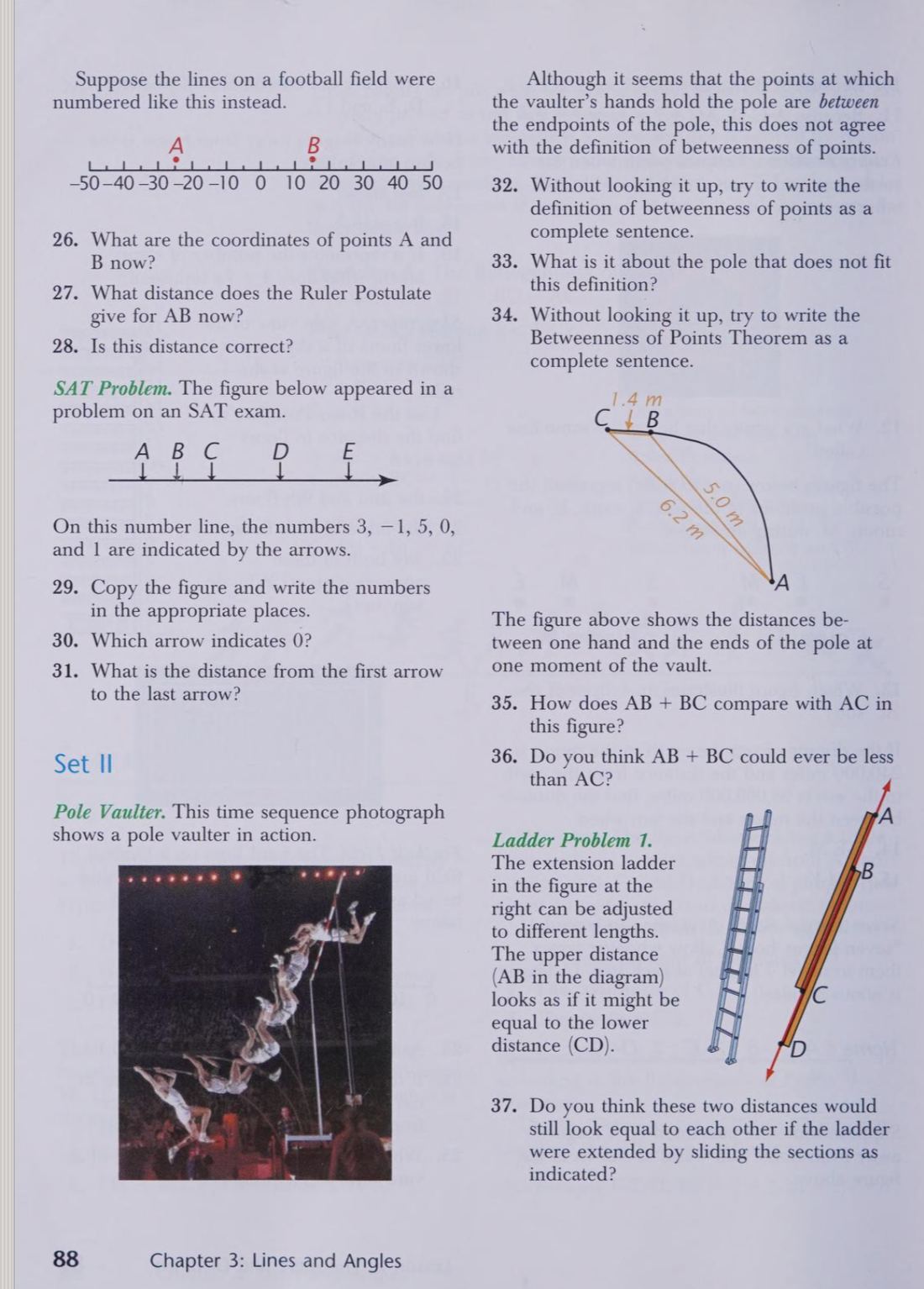
Questions 35 and 36: the bent pole
On the bent pole, AB = 1.4 m, BC = 5.0 m, and AC = 6.2 m. How does AB + BC compare with AC? Could AB + BC ever be less than AC?
- Add: AB + BC = 1.4 + 5.0 = 6.4, and AC is 6.2. The sum is larger.
- Why no contradiction with Theorem 1? The theorem's hypothesis is A-B-C, betweenness, and betweenness lives on a line. B sits on the curve of a bent pole, so the theorem is silent here. A theorem never owes you anything when its hypothesis fails.
- Question 36: imagine straightening the pole. The detour through B shrinks until, on the straight line, 1.4 + 5.0 would land exactly on 6.4 = AC. Bending can only lengthen the trip through B, never shorten it, so AB + BC < AC cannot happen.
- You have just met, informally, the triangle inequality: the straight path is never beaten. The book will formalize it later; for now it is your sanity check on every distance figure.
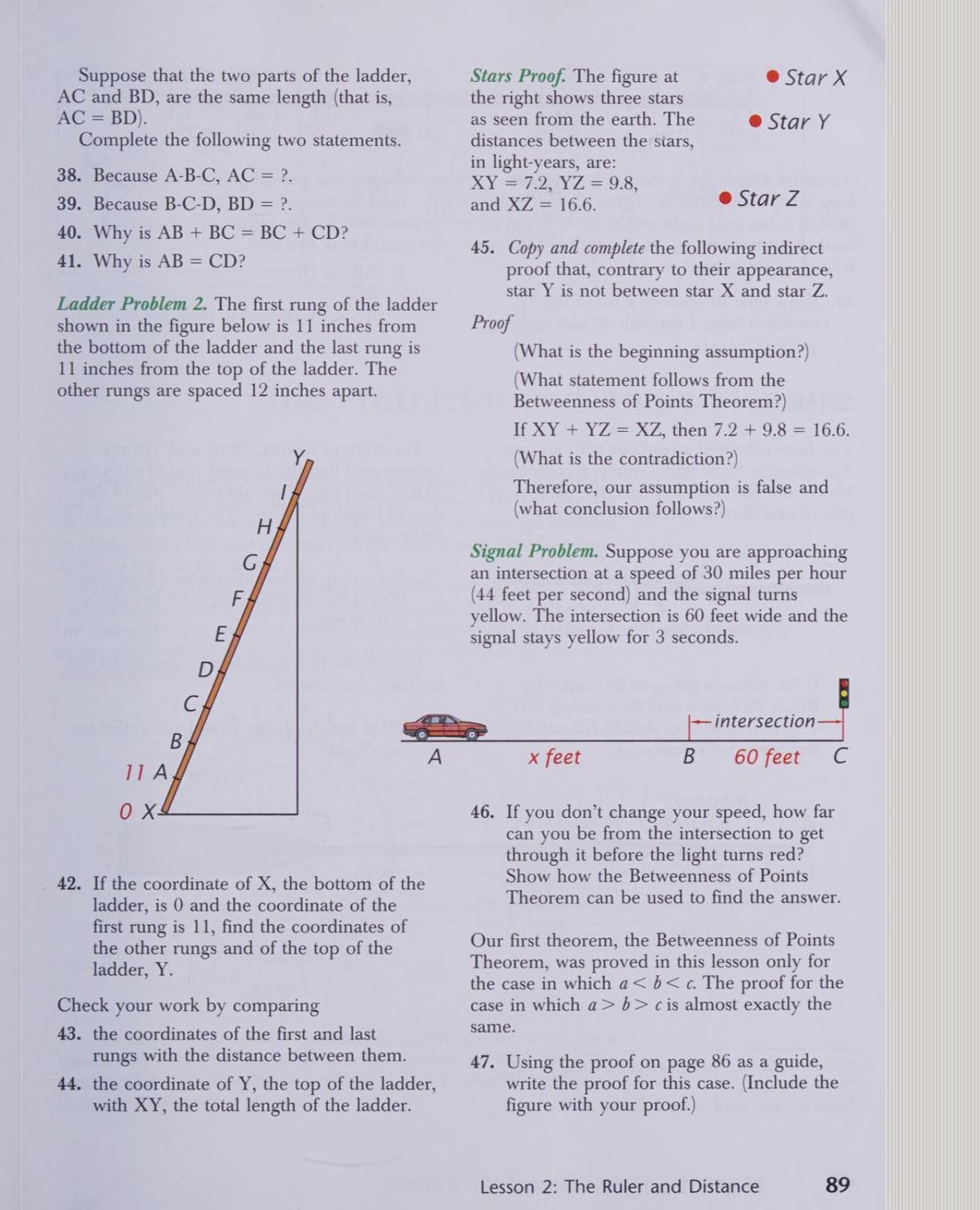
Question 45: the stars that only look lined up
XY = 7.2, YZ = 9.8, XZ = 16.6 light-years. Complete the indirect proof that star Y is not between star X and star Z.
- Beginning assumption, the opposite of the claim: suppose Y is between X and Z, that is, X-Y-Z.
- Next line, from the Betweenness of Points Theorem: if X-Y-Z, then XY + YZ = XZ.
- Substitute the measured distances: 7.2 + 9.8 = 16.6.
- The contradiction: 7.2 + 9.8 = 17.0, and 17.0 ≠ 16.6.
- Therefore the assumption is false: star Y is not between the other two, no matter how the night sky looks from here. Compare Orion's belt on page 16, where "apparent" did the same work by eye; now a theorem and 0.4 light-years settle it deductively.
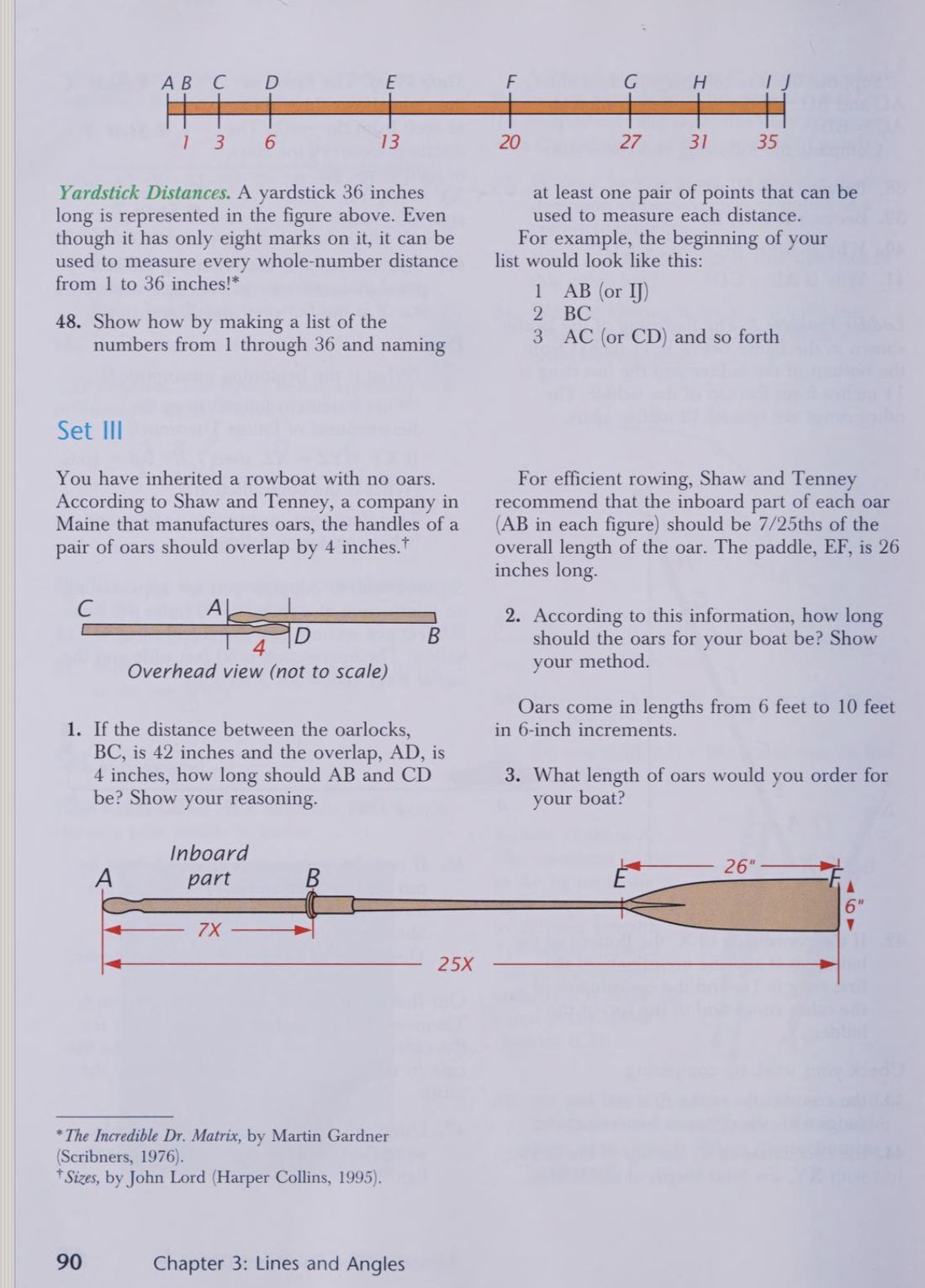
Set III: sizing the oars
Oarlocks are 42 inches apart (BC), and the handles should overlap 4 inches (AD). How long are AB and CD? If the inboard part AB must be 7/25 of the oar's length, how long is the oar, and what length do you order (6 to 10 feet, in 6-inch steps)?
- Question 1: look at the overhead figure's order: C, A, D, B. Each inboard section spans from an oarlock past the middle overlap. The span CB = 42 covers CD and AB, but the overlap AD lies inside both, so AB + CD = 42 + 4 = 46. The two oars match, so AB = CD = 23 inches.
- Question 2: the company's rule says AB is 7/25 of the whole oar. With the oar drawn as 25X and the inboard part as 7X: 7X = 23, so X = 23/7 ≈ 3.29 inches.
- The oar is 25X ≈ 25 × 3.29 ≈ 82.1 inches, about 6 feet 10 inches.
- Question 3: order from the catalog's 6-inch steps: 7 feet (84 inches) is the nearest length, and slightly long beats slightly short in an oar. Betweenness, subtraction, and one proportion turned a rowboat problem into arithmetic; that is the whole lesson in one purchase.