Questions 1 and 2: finding north
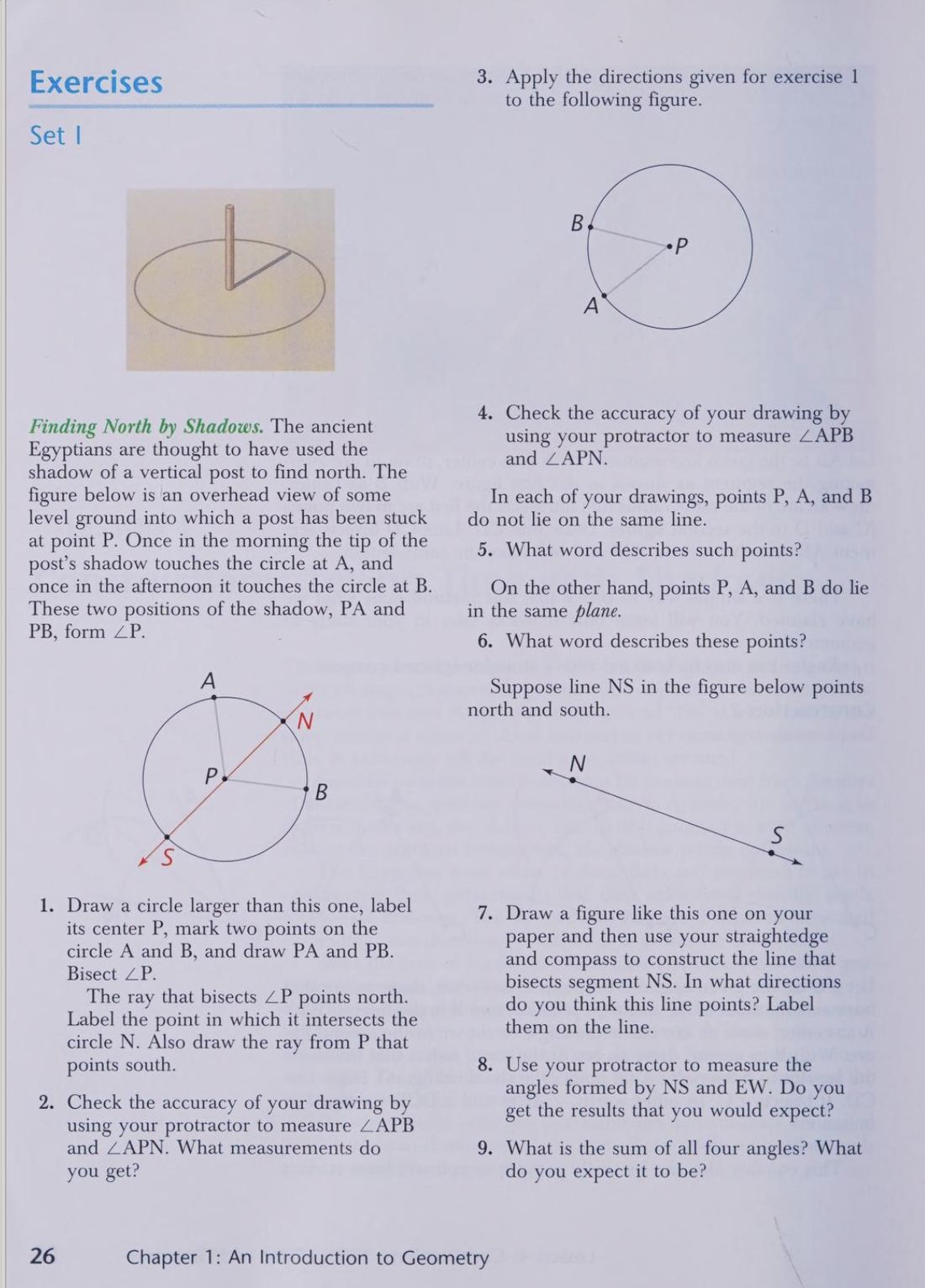
Draw a circle with center P, mark shadow points A and B on it, draw PA and PB, and bisect ∠P. The bisecting ray points north. What should the protractor say?
- Draw the circle big; small figures hide errors (page 12's lesson). Place A and B anywhere on it, not symmetric-looking, and draw the two shadow rays.
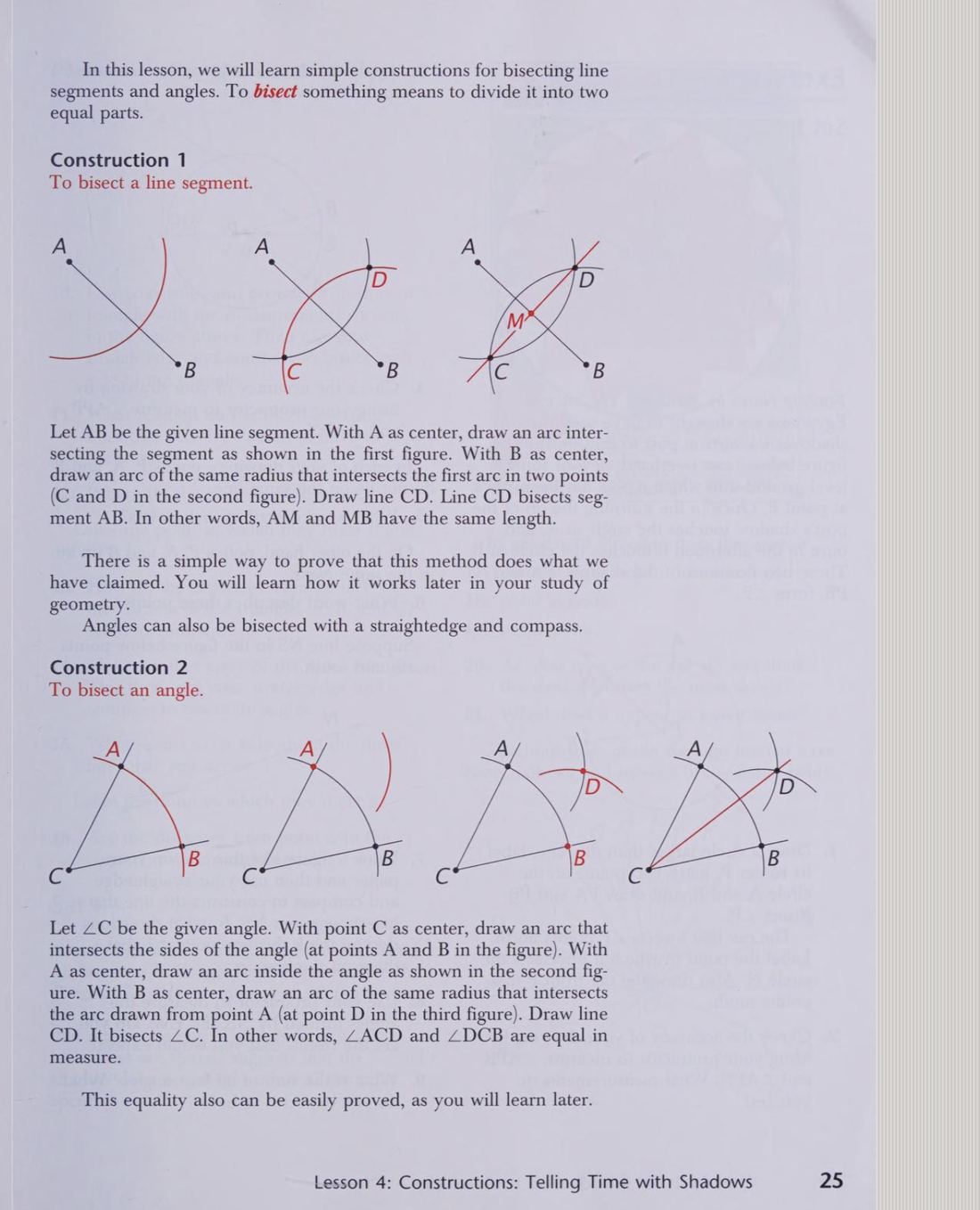
- Run Construction 2 from page 25: arc from P through both sides, equal arcs from the two crossing points, ray through their intersection. Label the ray's circle-crossing N and extend it backward through P for south.
- Question 2's check: measure ∠APB, then ∠APN. Whatever ∠APB reads (say 74°), ∠APN should read half of it (37°). Your own numbers will differ; the halving is what must not.
- If the halves disagree by more than a degree, the usual culprit is a changed compass radius mid-construction. Reset and redo; a construction is only as honest as the radius you kept.
Questions 10 to 13: the three side-bisectors
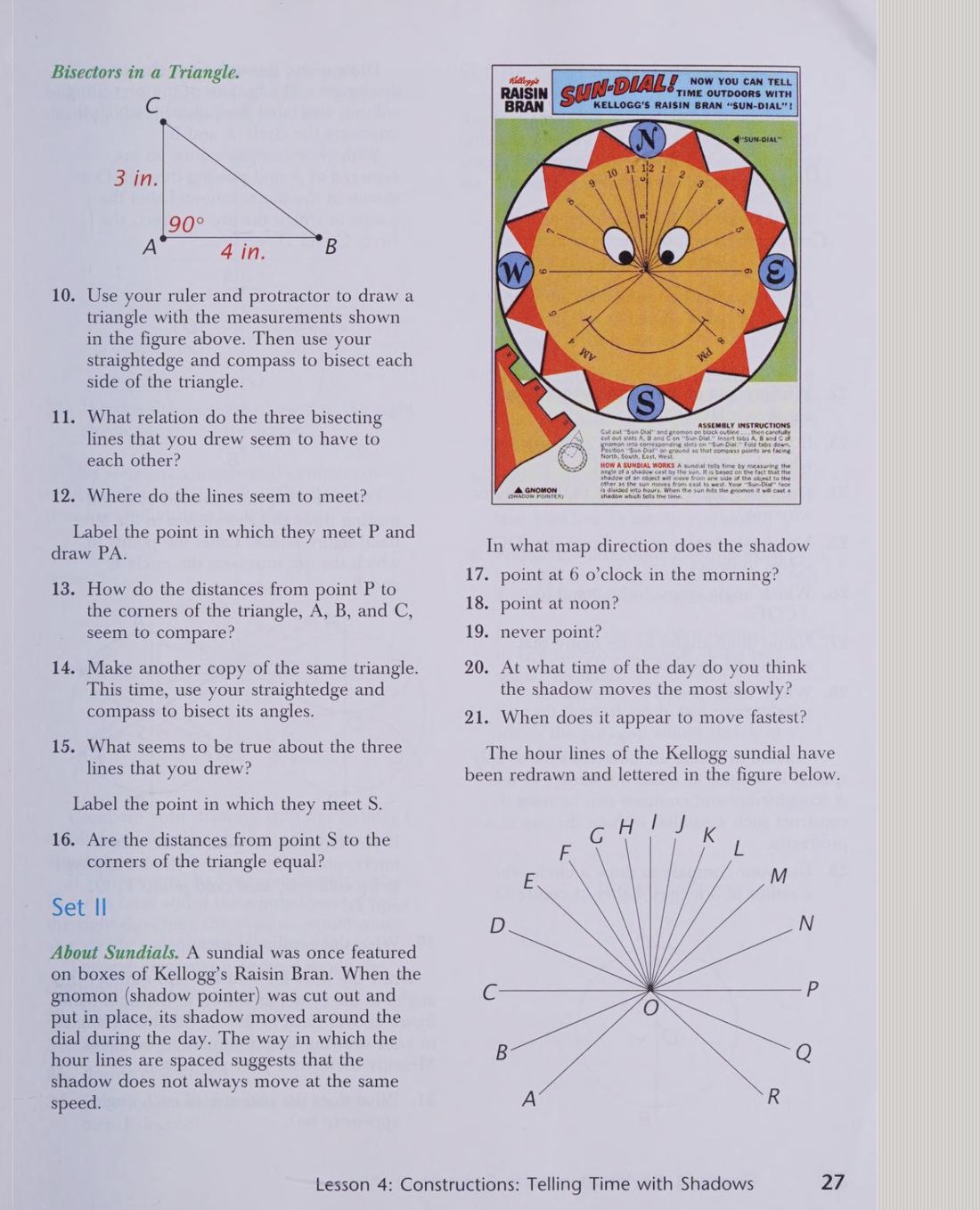
Draw the triangle (right angle at A, legs 3 and 4 inches), bisect each side with straightedge and compass, and study the three bisecting lines.
- Draw the triangle with ruler and protractor first; the construction rules only govern the bisecting.
- Run Construction 1 on each side separately, arcs from both endpoints, full crossing line each time. Keep the arcs; erasing evidence makes errors invisible.
- Question 11: the three lines are concurrent, one common point. That is the surprise; two lines must cross somewhere, but the third has no obvious obligation to join them.
- Questions 12 and 13: label the meeting point P and measure PA, PB, PC. All three match. On this triangle P lands at the midpoint of the long side; file that oddity away, because it is a right triangle's private signature.
- Self-check by circle: put the compass point on P with radius PA and sweep. The circle should thread all three corners. One point, equidistant from three corners, is a circle's center wearing a disguise, and that is why the concurrence had to happen.
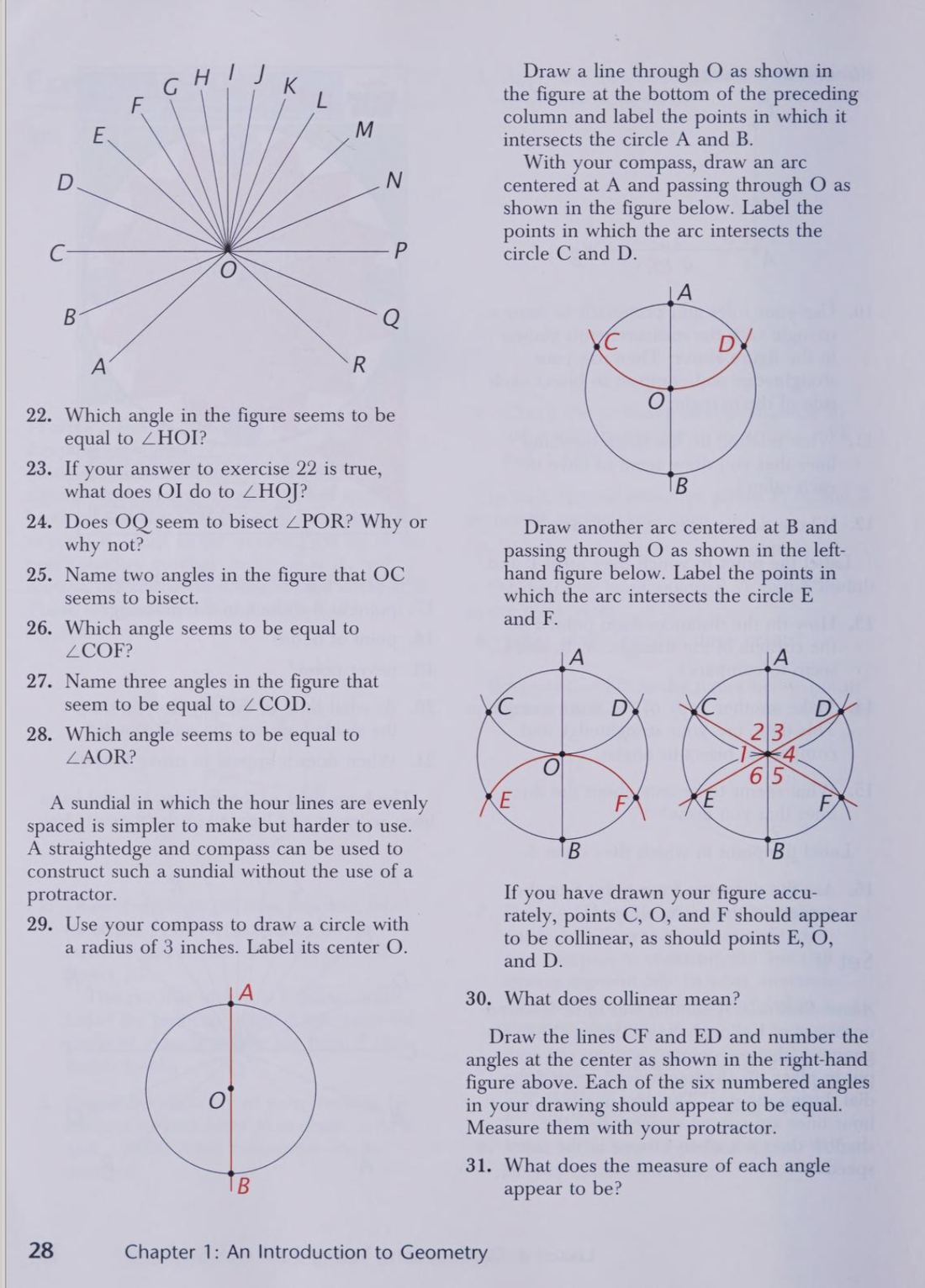
Questions 29 to 31: six equal angles from one radius
Draw a 3-inch circle centered at O, a line through O meeting it at A and B, then arcs centered at A and at B, each passing through O. Why do the crossings cut the circle into six equal parts?
- Draw the circle and keep the compass locked at 3 inches for the entire construction; the whole trick lives in that discipline.
- Arc centered at A through O: it crosses the circle at C and D. Every point of that arc sits 3 inches from A, so C and D are 3 inches from A and 3 inches from O.
- Arc centered at B through O gives E and F the same way. Now look at what you own: six points on the circle (A, C, E, B, F, D in order... check your own lettering against the book's), each neighboring pair 3 inches apart, on a circle of radius 3.
- Question 30's word: C, O, F collinear, and E, O, D collinear; the lines CF and ED plus AB make three lines through O.
- Question 31: each of the six central angles measures 60°, since six equal slices share 360. Your protractor is the check, not the method; the compass never needed it. That independence from measurement is what "construction" means.
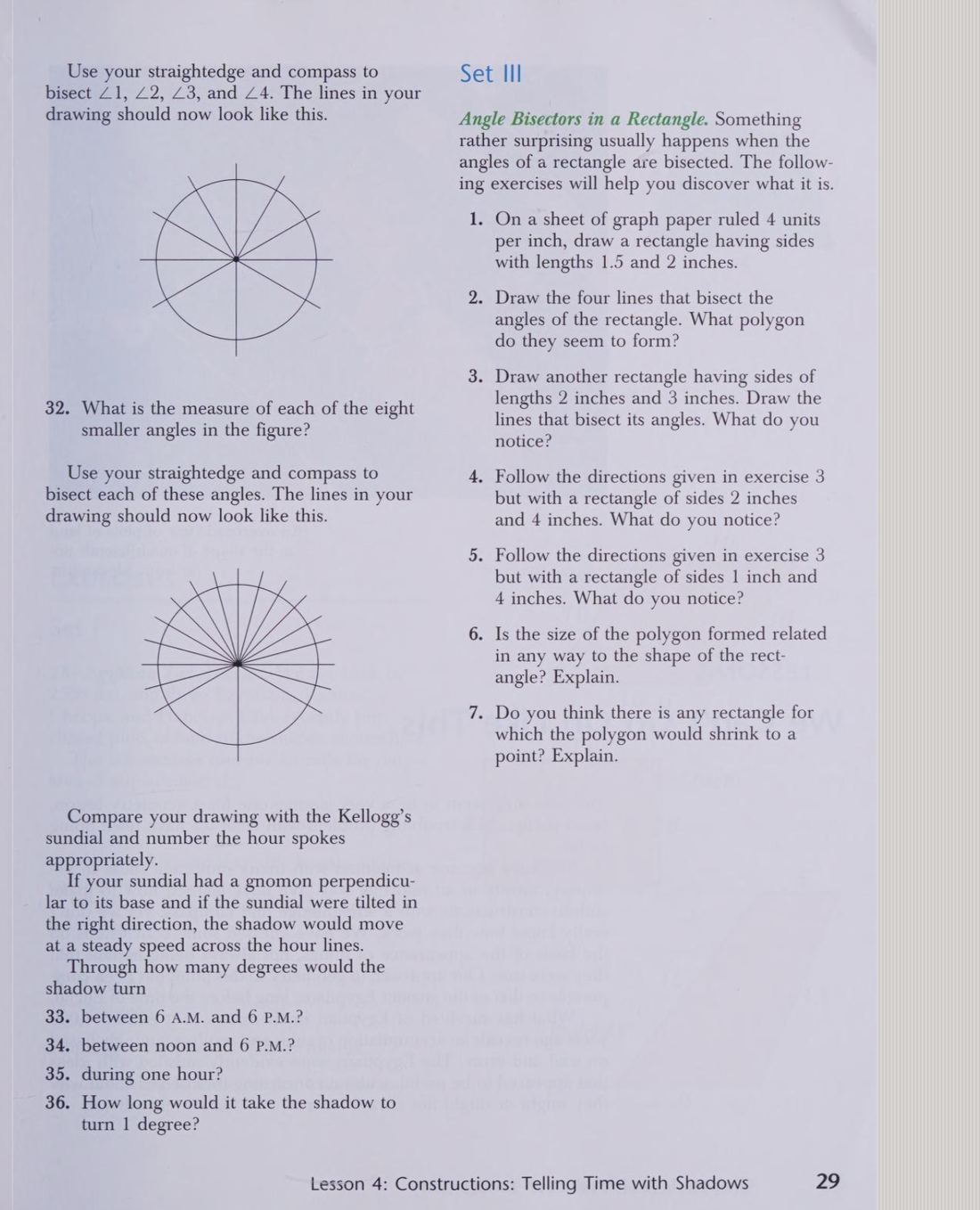
Set III: bisecting a rectangle's angles
Bisect all four angles of rectangles measuring 1.5 by 2, 2 by 3, 2 by 4, and 1 by 4 inches. What polygon do the bisectors form, and can it ever shrink to a point?
- Each bisector leaves a 90° corner at 45°, so every bisector runs diagonally at 45° to the sides. That single fact drives everything you are about to see.
- Questions 2 to 5: in every rectangle the four bisectors enclose a small square, tilted 45°. Different rectangles, same shape, only the size changes.
- Question 6: compare sizes against the rectangles. The square grows with the gap between length and width; the 1 by 4 gives a big square, the 2 by 3 a small one... check your drawings: the pattern is that the square's diagonal equals the difference of the rectangle's sides.
- Question 7: shrink the difference to zero. A rectangle with equal sides is a square, its bisectors are its two diagonals, and they meet in a single point. So yes: the polygon collapses to a point exactly when the rectangle is a square.
- Self-check the claim with one more drawing, a 2 by 2 square. Four bisectors, one crossing. A discovery you can force to happen on demand is the best kind to trust.
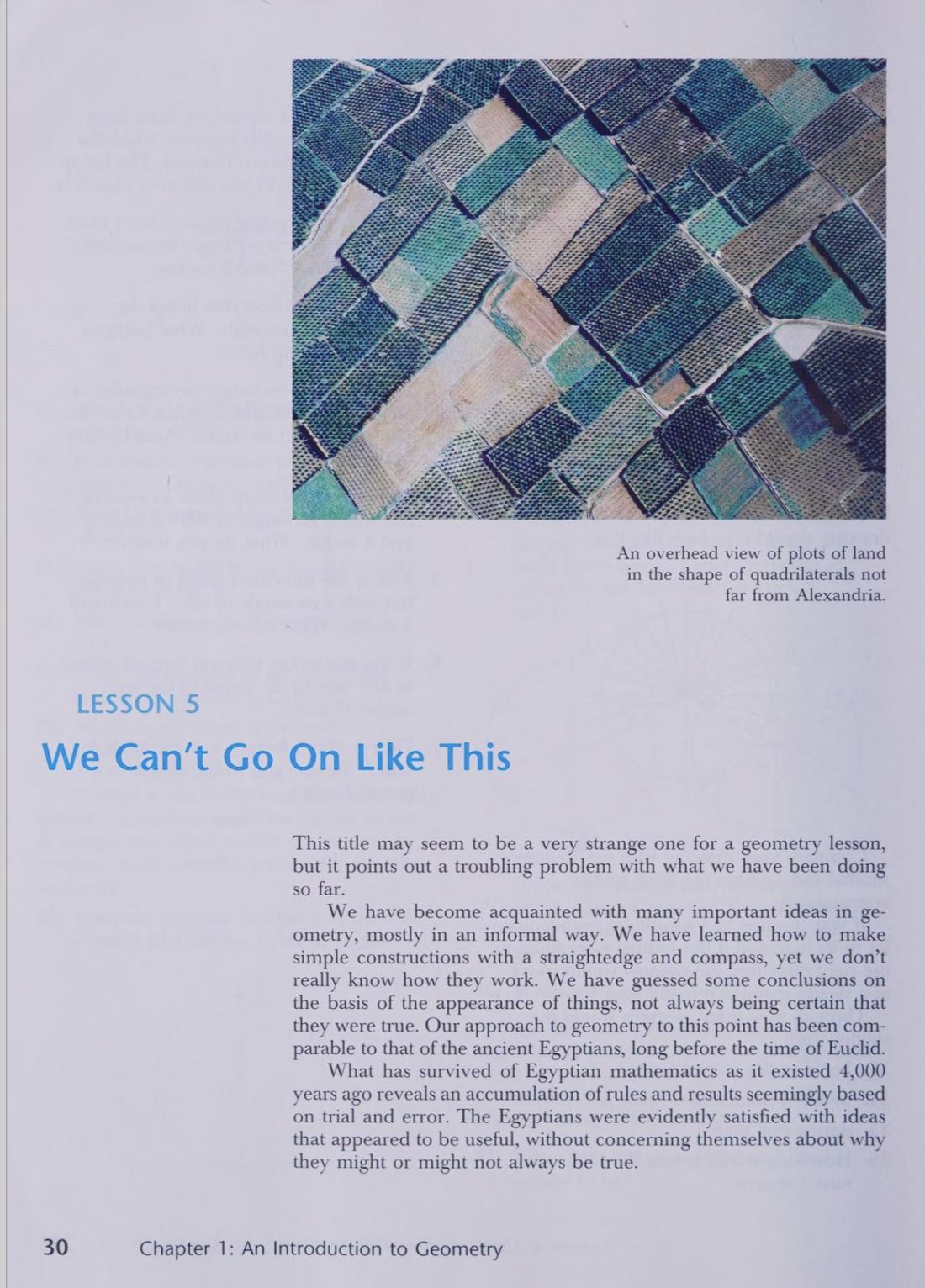
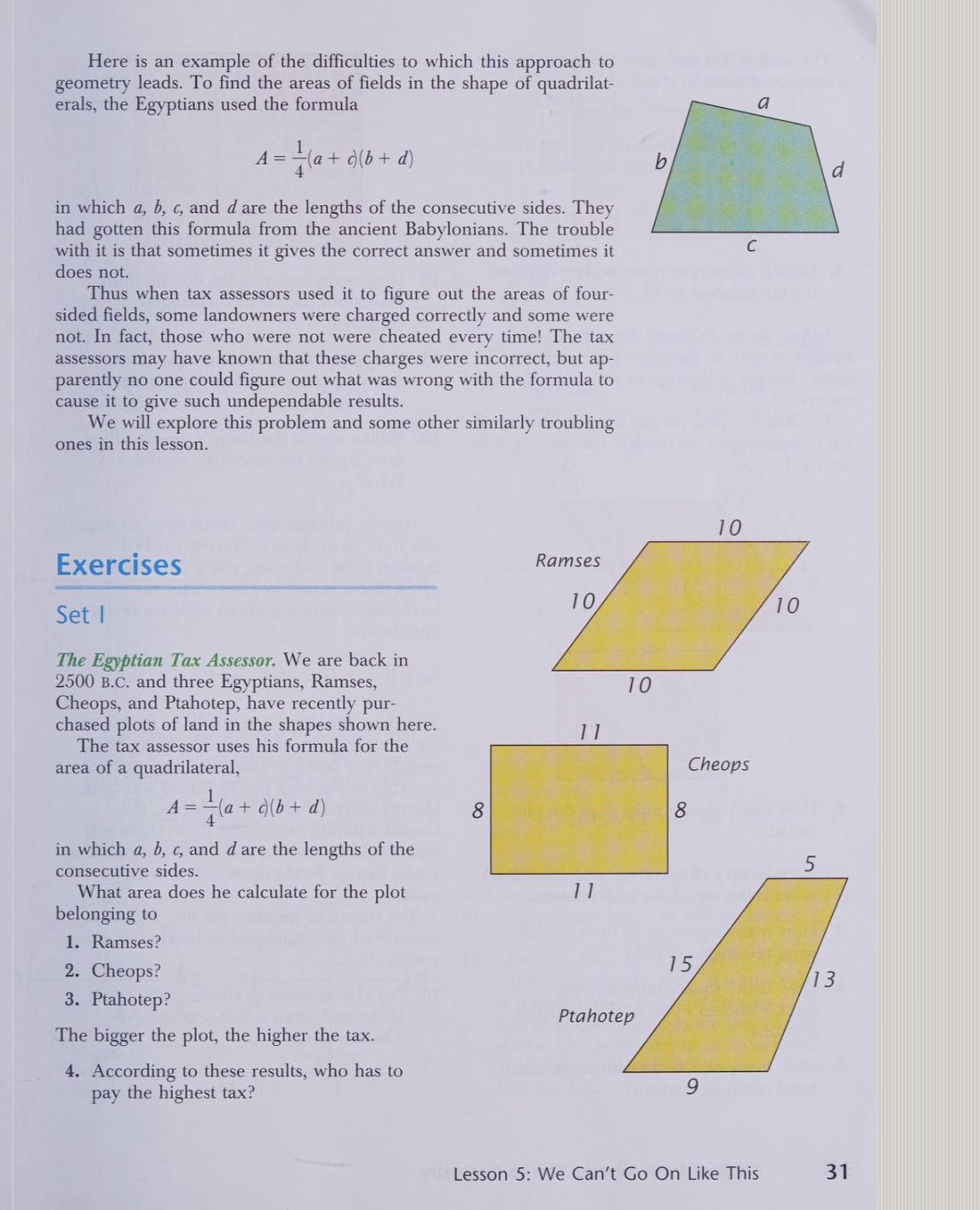
Questions 1 to 4: the assessor's arithmetic
Apply A = (a + c)(b + d)/4 to Ramses' plot (sides 10, 10, 10, 10), Cheops's (11, 8, 11, 8), and Ptahotep's (15, 13, 9, 5). Who pays the most tax?
- Ramses: (10 + 10)(10 + 10)/4 = (20)(20)/4 = 100 square units.
- Cheops: opposite sides pair as 11 with 11 and 8 with 8: (22)(16)/4 = 88.
- Ptahotep: consecutive sides 15, 13, 9, 5 pair opposites 15 with 9 and 13 with 5: (24)(18)/4 = 108.
- Question 4: Ptahotep is assessed highest at 108, Ramses next at 100, Cheops at 88.
- Now look at the figures before page 32 makes you count: Ramses' slanted parallelogram is clearly thinner than a 10-by-10 square, yet it was billed as one. Hold that suspicion; the squares are about to testify.
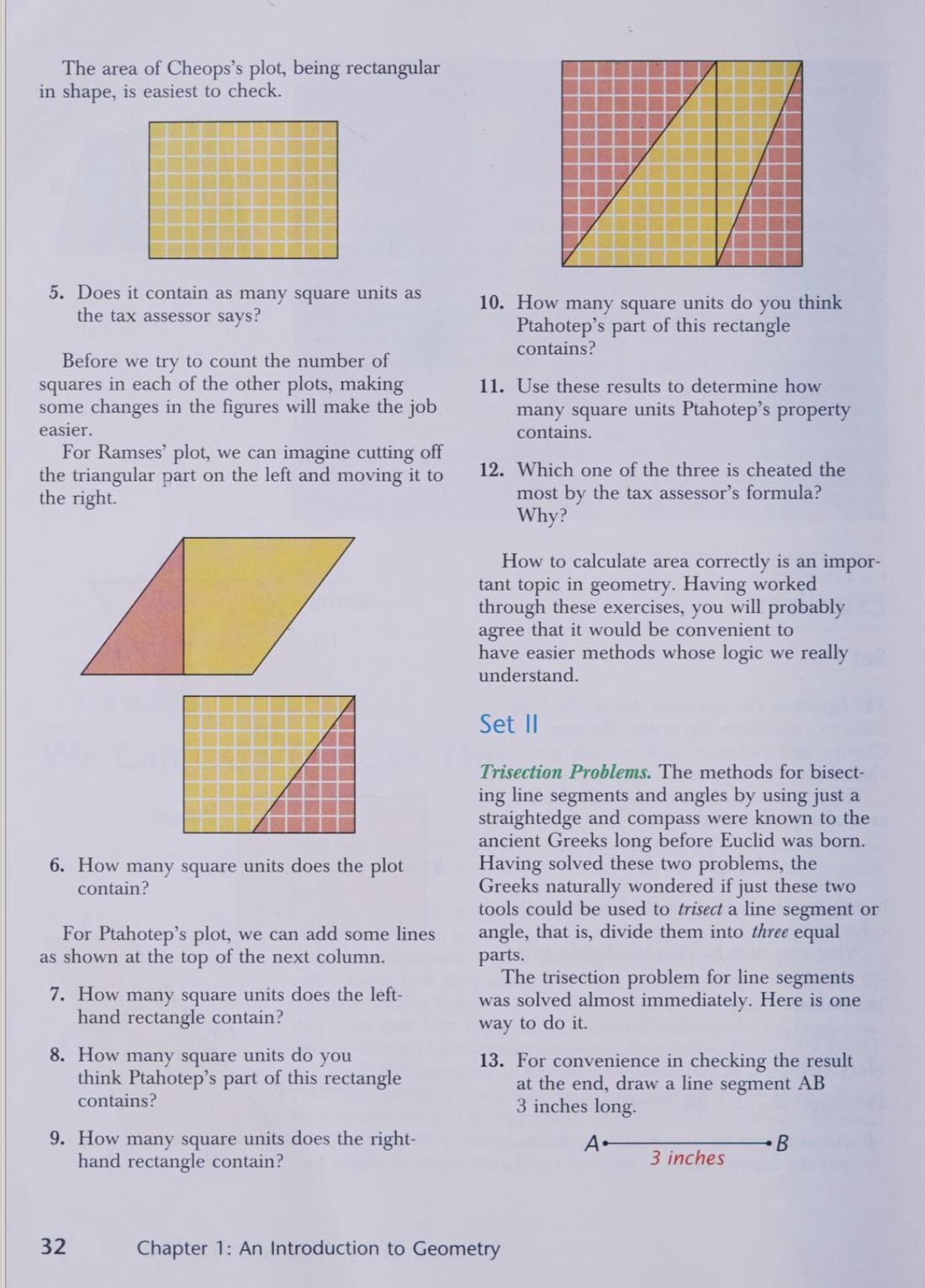
Questions 5 and 6: auditing by rearrangement
Check the assessor: does Cheops's 11 by 8 rectangle really hold 88 squares? And how many squares does Ramses' slanted plot actually contain?
- Question 5: count Cheops's grid, 11 columns of 8: 88. The formula told the truth, because for a rectangle "average of opposite sides" is just the sides themselves.
- Question 6: do not count Ramses' plot slantwise. Cut the triangle off its left end and slide it onto the right, exactly as the book's figure shows.
- The moved triangle changes nothing about area (cutting and rearranging never does; that was the Dudeney lesson on page 23), and the plot becomes a 10-by-8 rectangle: 80 square units.
- So Ramses was billed 100 for 80, a 25 percent overcharge, and the slant was the entire error: the formula treats a leaning side's full length as if it stood upright.
- Carry the method into 7 to 12: box Ptahotep's plot in rectangles, halve where a diagonal cuts one, and compare his true total against 108. The audit's verdict on question 12: the more a plot leans, the worse the formula lies.
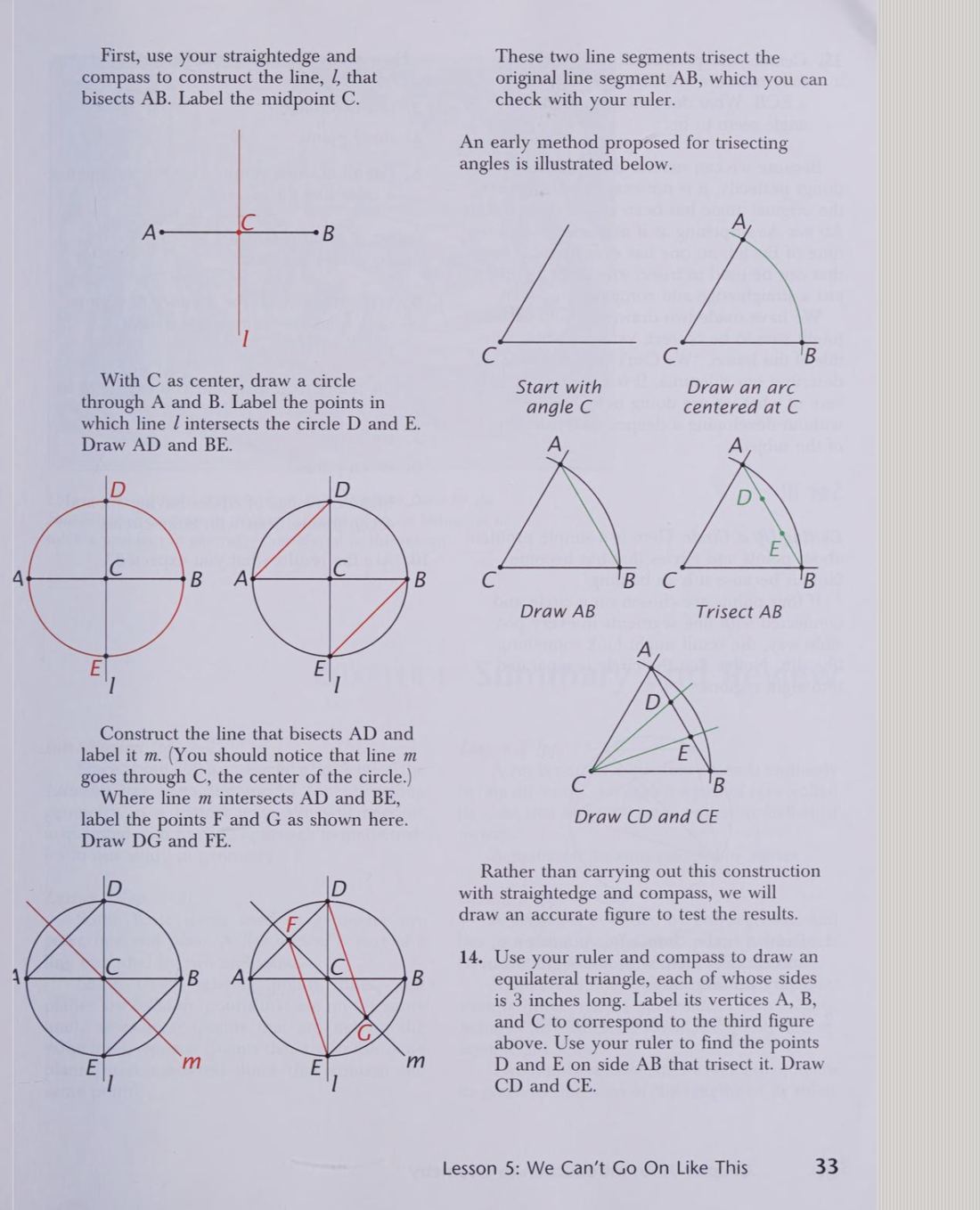
Question 13: trisecting a segment honestly
Draw AB 3 inches long and trisect it with straightedge and compass, following the book's construction. Why does the ruler check land on 1-inch marks?
- Bisect AB (Construction 1); call the midpoint C. One bisection, nothing new.
- Compass on C, radius CA: draw the full circle through A and B. The bisecting line from step 1 crosses it at D and E. Draw AD and BE.
- Bisect AD, and notice the bisecting line m passes through C, the circle's center. (Every bisector of a chord does; the book plants this quietly and proves it in the circle chapter.) Mark F on AD and G on BE where m crosses them.
- Draw DG and FE. Where they cut AB is the trisection: your ruler should read 1 inch and 2 inches. If it misses by more than a hair, the usual sin is a drifted compass radius in step 2.
- Count what was used: two bisections, one circle, straight lines. Three equal parts from tools that only know how to halve; that is why the Greeks were confident angles would fall the same way. Hold that confidence up against tomorrow's page.
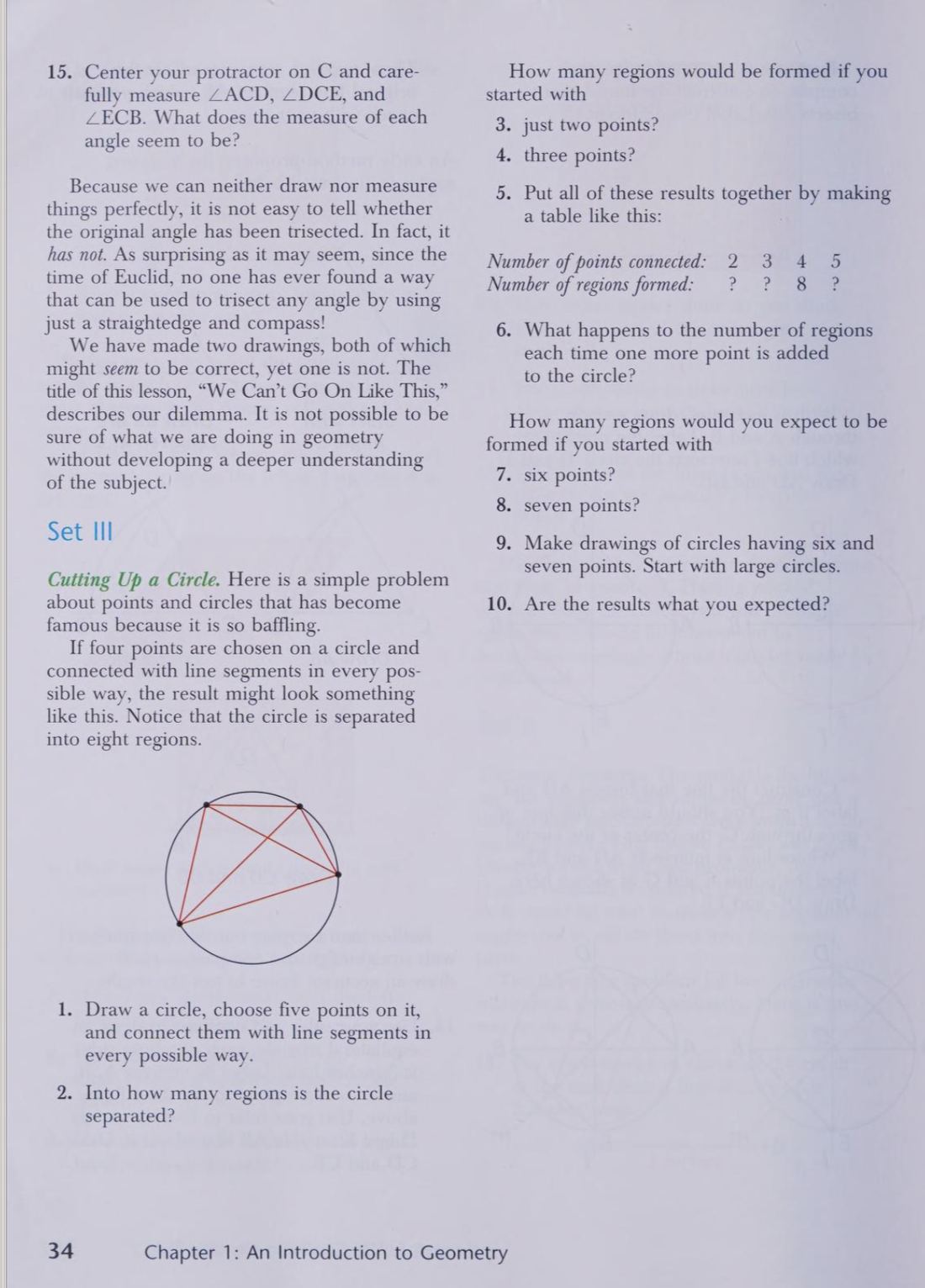
Set III: cutting up the circle
Points on a circle, all pairs joined: 2 points give 2 regions, 3 give 4, 4 give 8. Build the table, predict six and seven points, then draw and count.
- Question 5's table so far: 2 points, 2 regions; 3 points, 4; 4 points, 8; and your five-point drawing (question 2) gives 16. Question 6: each new point has doubled the count.
- Questions 7 and 8: the pattern predicts 32 for six points and 64 for seven. Write the predictions down; committing is what makes the check honest (the page 16 star-guessing discipline).
- Question 9: draw the six-point circle large, space the points unevenly so no three chords meet at one interior point, and count regions by shading as you go.
- The count is 31. Not 32. The doubling was a coincidence that ran out of room, and seven points give 57, nowhere near 64.
- Question 10's moral is the lesson's: five confirmations are not a proof. A pattern can hold five times for reasons that quit on the sixth, and only deduction, not accumulation, closes the case. This little circle is famous among mathematicians precisely because it teaches that so painfully.
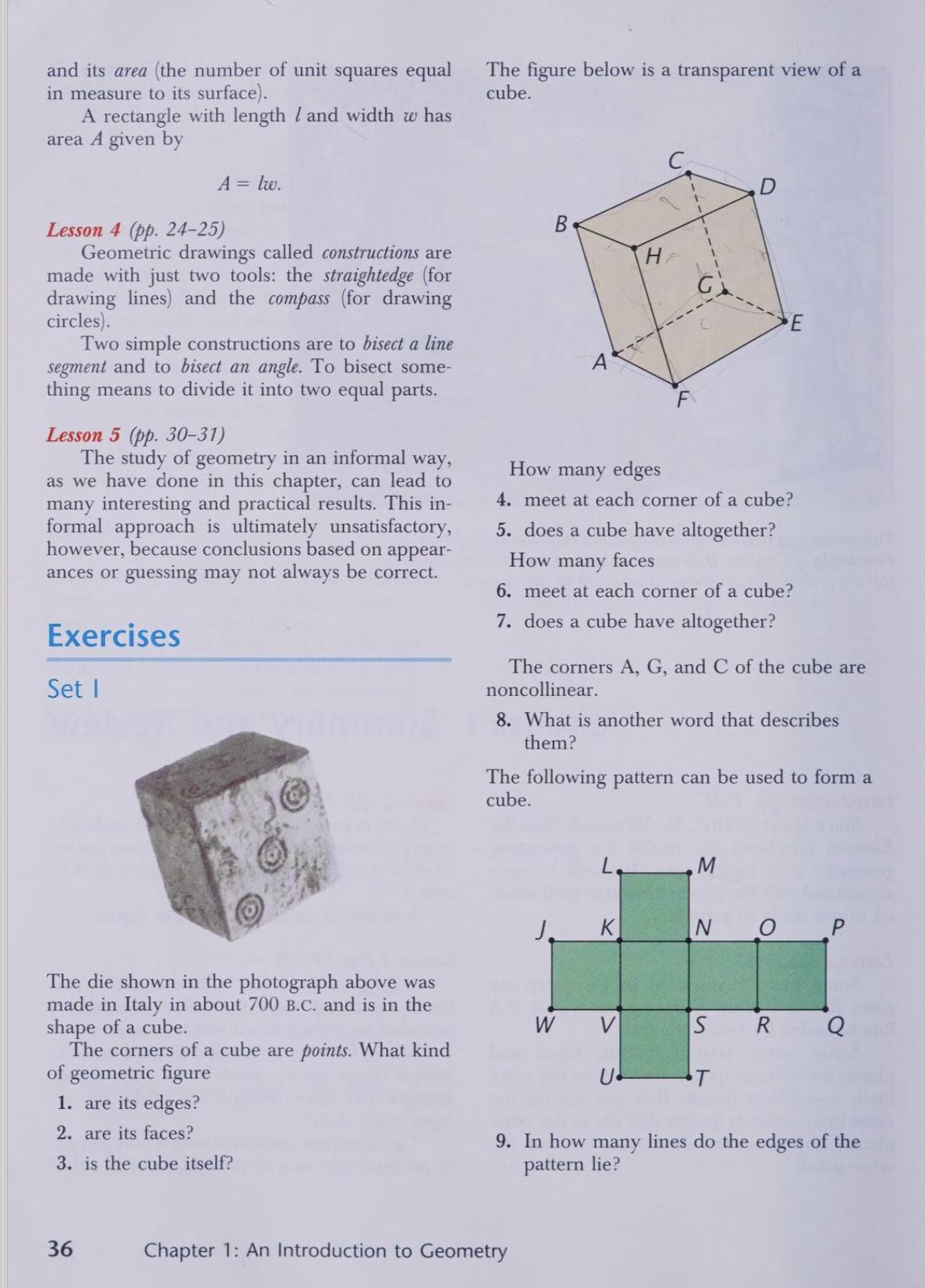
Questions 4 to 7: counting a cube
How many edges meet at each corner, and how many edges altogether? How many faces meet at each corner, and how many faces altogether?
- Corners first, since the counts hang on them: a cube has 8 corners (four on top, four on bottom).
- Question 4: stand at any corner of the die: one edge runs away in each of three directions. Three edges per corner.
- Question 5: multiply and repair the double-count: 8 corners × 3 edges = 24, but every edge was counted from both its ends, so 24/2 = 12 edges. (Recount the picture to believe it: 4 top, 4 bottom, 4 vertical.)
- Questions 6 and 7: three faces meet at each corner; and counting faces by corners, 8 × 3 = 24 with each face claimed by its 4 corners: 24/4 = 6 faces.
- The count-then-divide trick is the takeaway; it counted the pyramid's edges on page 22 and will count diagonals and handshakes for chapters. And notice 8 corners − 12 edges + 6 faces = 2; keep that curiosity in a drawer.
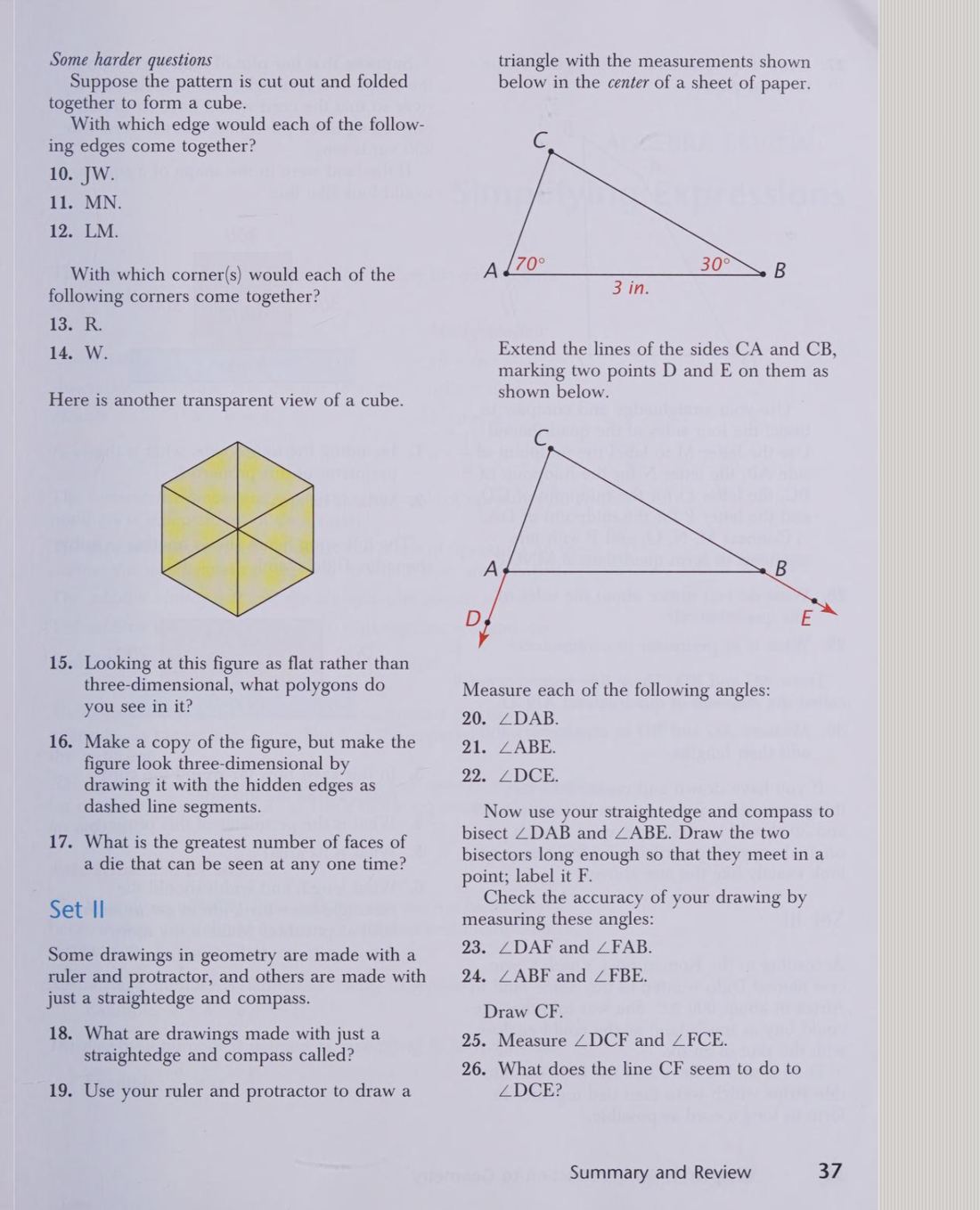
Questions 19 to 26: the outside bisectors
Draw the 70-30 triangle with a 3-inch base, extend CA and CB past A and B to D and E, bisect ∠DAB and ∠ABE, and let the bisectors meet at F. What do the measurements say, and what does CF do?
- Questions 20 to 22 first, by protractor: ∠DAB = 110° (it sits beside the 70 on line DC), ∠ABE = 150° (beside the 30), and ∠DCE = ∠ACB = 80° since 180 − 70 − 30 = 80. Three different chapter-3 facts in one warm-up, done here purely by measuring.
- Bisect the two outside angles by construction: the halves should measure 55 and 55 at A (question 23), 75 and 75 at B (question 24).
- Extend both bisectors until they cross; label it F. It lands outside the triangle, below the base; make paper room.
- Draw CF and measure ∠DCF and ∠FCE (question 25). Both read 40°: CF bisects ∠DCE, question 26's answer.
- Three bisectors, built from three unrelated-looking angles, concurrent again. You have now seen concurrence happen four times (pages 12, 27 twice, and here) and can prove none of them; that imbalance is the itch the rest of the book scratches. (The point F even has a name in the trade: an excenter.)
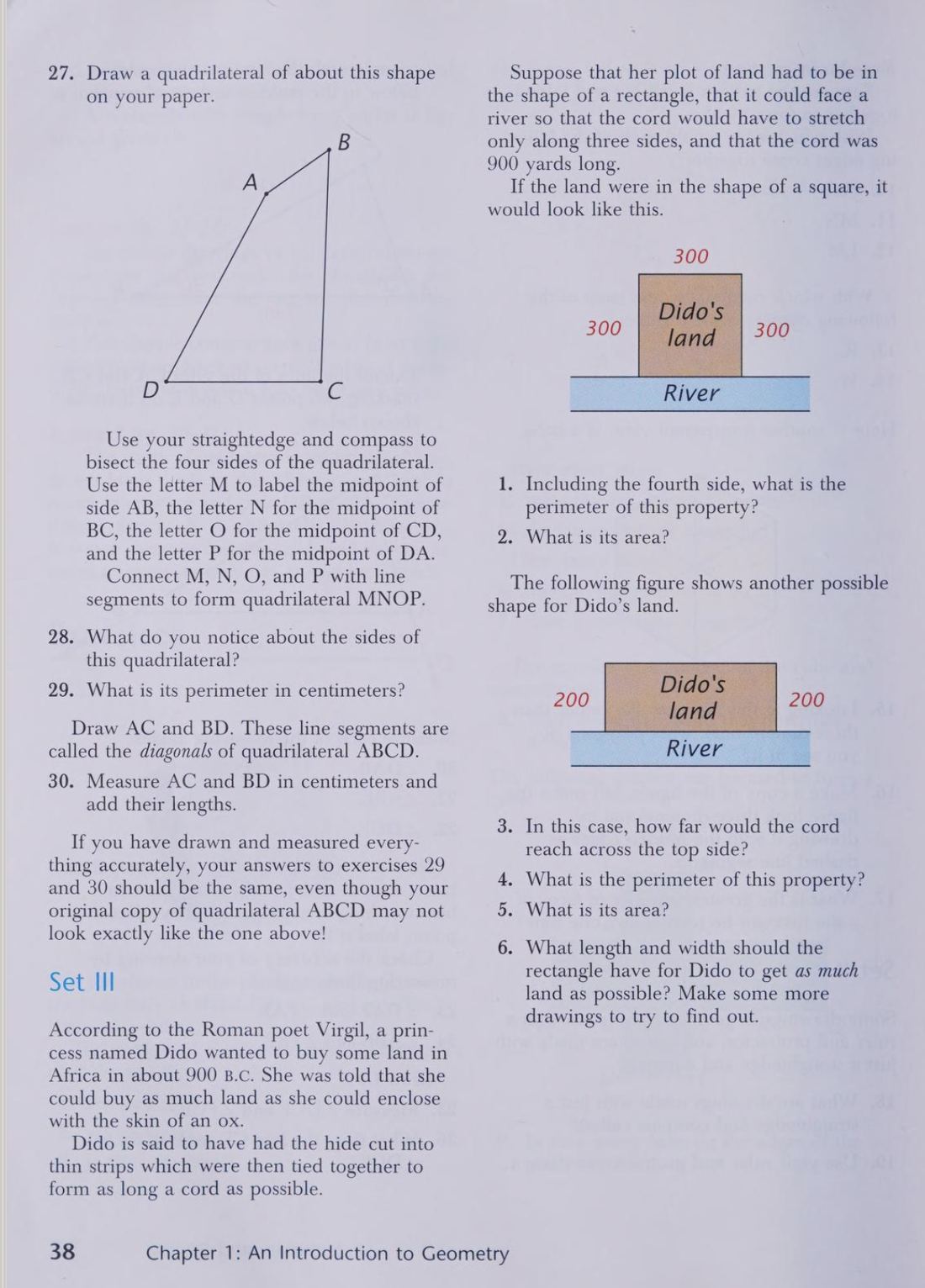
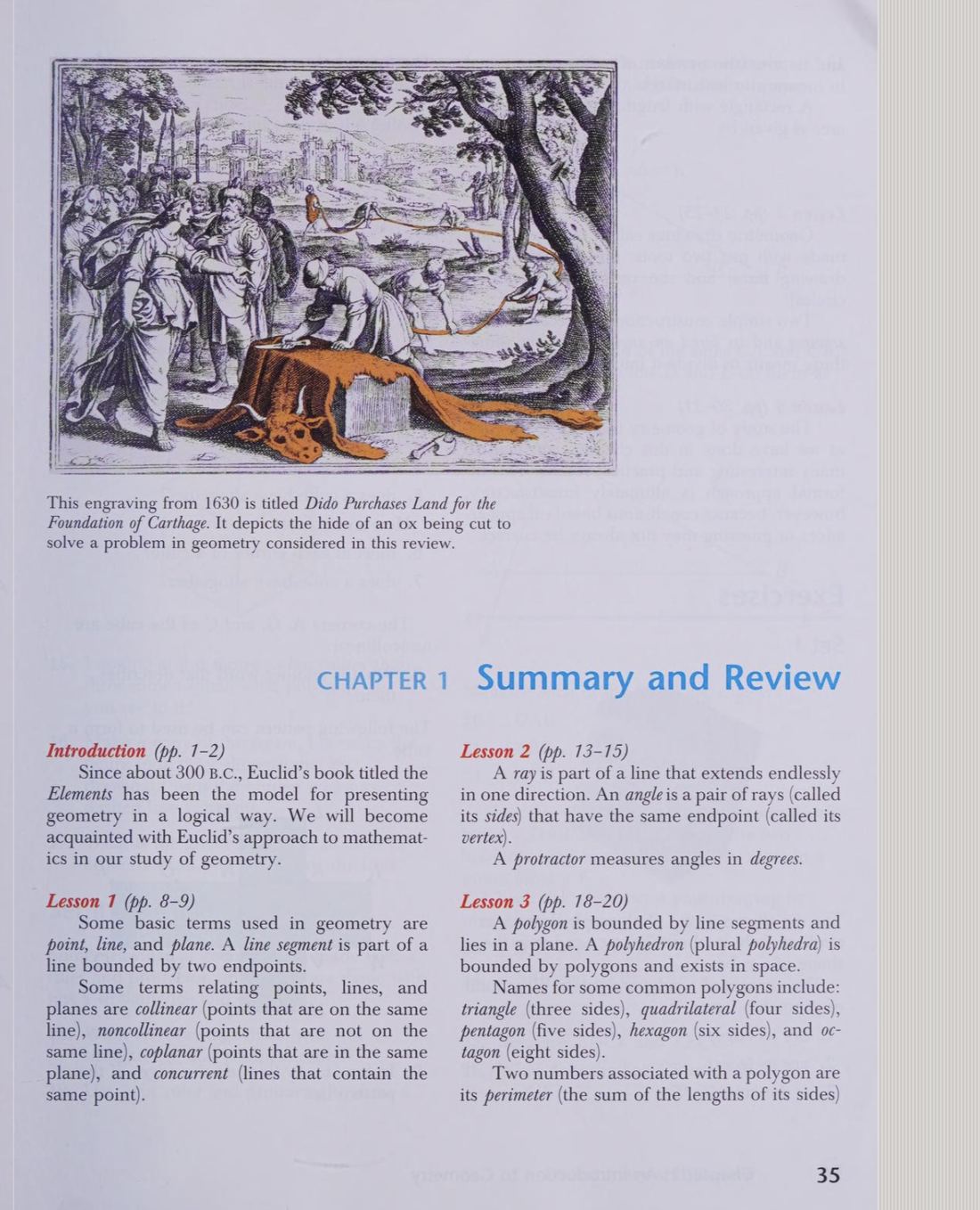
Set III: Dido's land
A 900-yard cord fences three sides of a rectangle; the river is the fourth side. Compare the square layout with a 200-yard version, then hunt the best shape.
- Questions 1 and 2, the square: three sides of 300 use the cord exactly. Perimeter counting the river bank: 4 × 300 = 1,200 yards. Area: 300 × 300 = 90,000 square yards.
- Questions 3 to 5, the squat version: sides of 200 leave 900 − 400 = 500 for the top. Perimeter 200 + 500 + 200 + 500 = 1,400. Area: 500 × 200 = 100,000. More land from the same cord, and a bigger perimeter courtesy of the free river side; page 21's lesson that area and perimeter answer different questions, now with money on it.
- Question 6: try more shapes. Depth 150 gives 600 × 150 = 90,000; depth 250 gives 400 × 250 = 100,000; depth 225 gives 450 × 225 = 101,250.
- The pattern peaks at depth 225: the best rectangle is twice as wide as it is deep, splitting the cord as 225 + 450 + 225. Every trial to either side comes in lower; test 210 and 240 to feel the hump.
- Why width equals twice depth: the river donates a side, so the cord buys two depths but only one width, and the optimum spends equally on each direction: 450 on depth (225 twice) and 450 on width. Virgil says Dido got Carthage out of it; the geometry says she earned it.
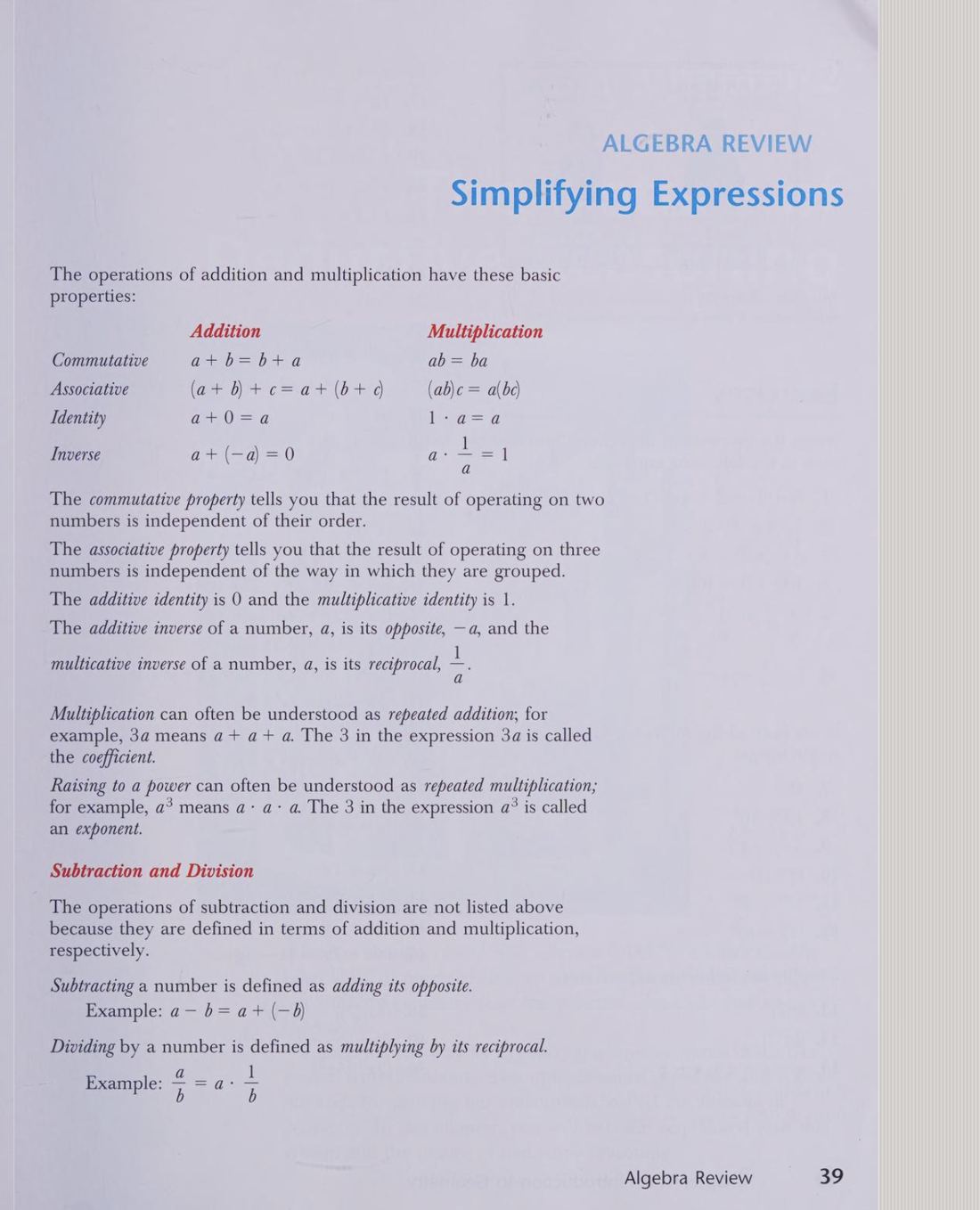
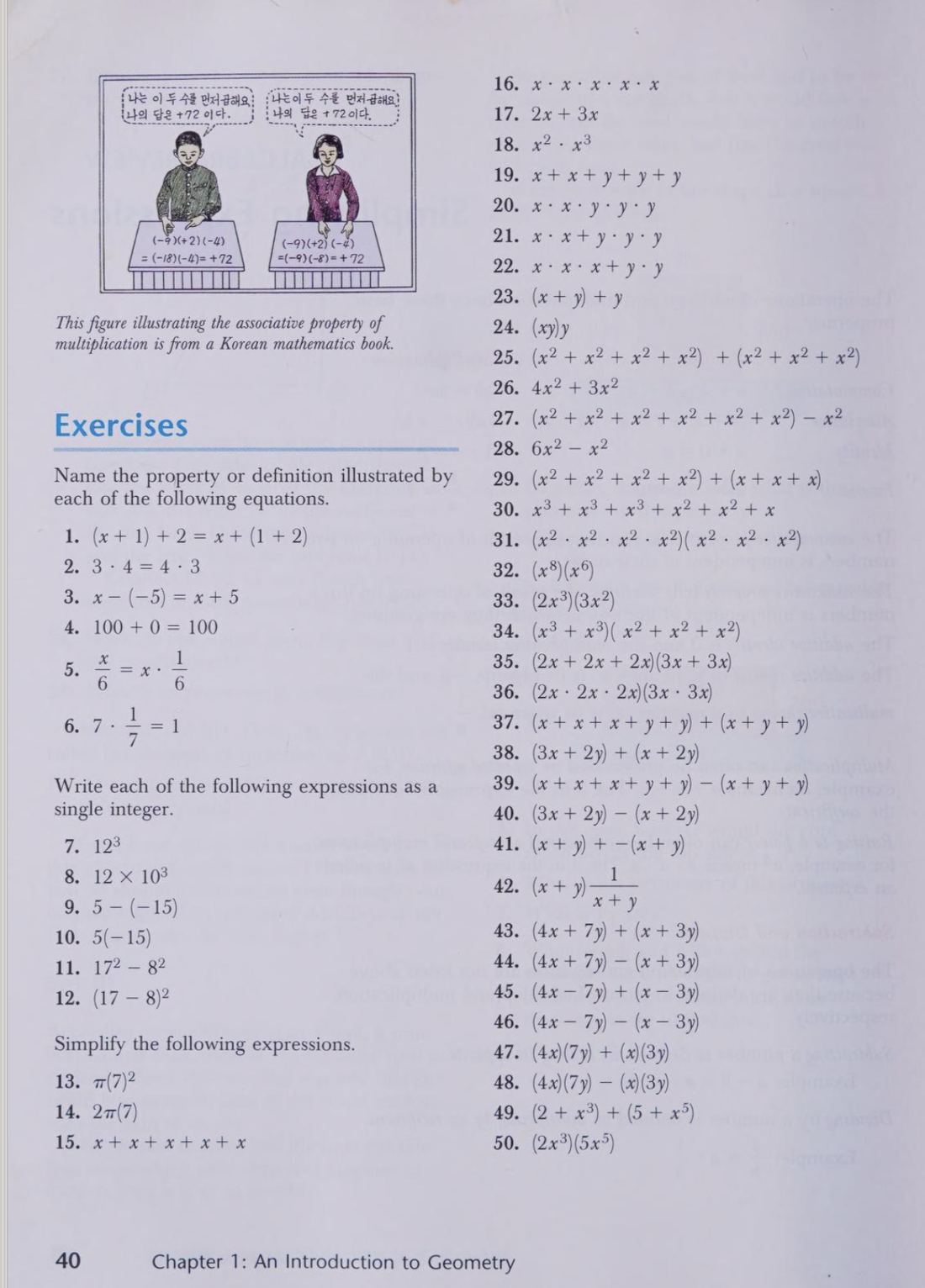
Questions 35 and 36: sums versus products
Simplify (2x + 2x + 2x)(3x + 3x) and then (2x · 2x · 2x)(3x · 3x).
- Question 35: collapse each parenthesis by addition first. 2x + 2x + 2x = 6x (repeated addition builds a coefficient), and 3x + 3x = 6x.
- Multiply: (6x)(6x) = 36x². Coefficients multiply, exponents add: 1 + 1 = 2.
- Question 36: now the parentheses hold products. 2x · 2x · 2x = 8x³ (repeated multiplication builds an exponent), and 3x · 3x = 9x².
- Multiply: (8x³)(9x²) = 72x⁵.
- Same ink, wildly different answers: 36x² against 72x⁵. The plus signs fed coefficients, the dots fed exponents, and the check is to substitute x = 1 into your original and your answer (question 35: 6 × 6 = 36 ✓). That one-number check is the same audit you ran on page 130, and it closes chapter 1's story: even simplifying, you verify.